
 4 hours ago
6
4 hours ago
6
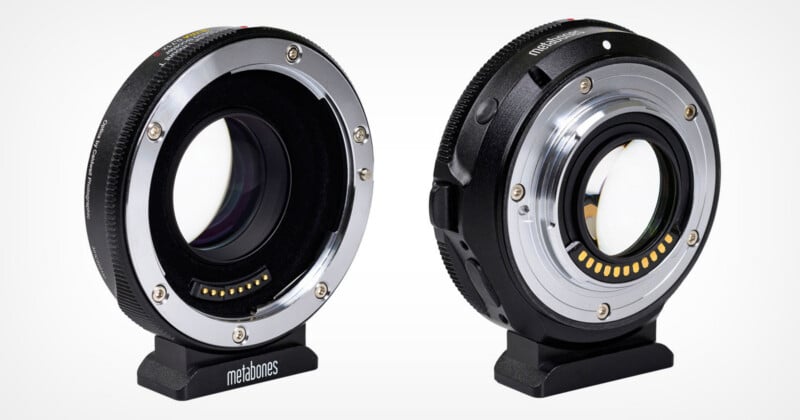
Adapter company Metabones has unveiled TruePDAF Technology, which it promises improves phase-detect autofocus and in-body image stabilization performance such that an adapted lens is “often practically indistinguishable” from a native lens. That is the dream of lens adapters.
When Metabones released its Speed Booster Mark II and Smart Adapter Mark II products for Micro Four Thirds, performance was initially unchanged. However, TruePDAF Technology promises to change that. The four Metabones Mark II products all enable users to adapt EF-mount lenses to Micro Four Thirds cameras. While this is a fairly limited scope of products, EF lenses are undoubtedly very popular among filmmakers.
At its core, this is like a firmware update. TruePDAF Technology leverages the improved hardware in the Mark II adapters for Micro Four Thirds and works alongside lens profile data for more than 100 lenses.
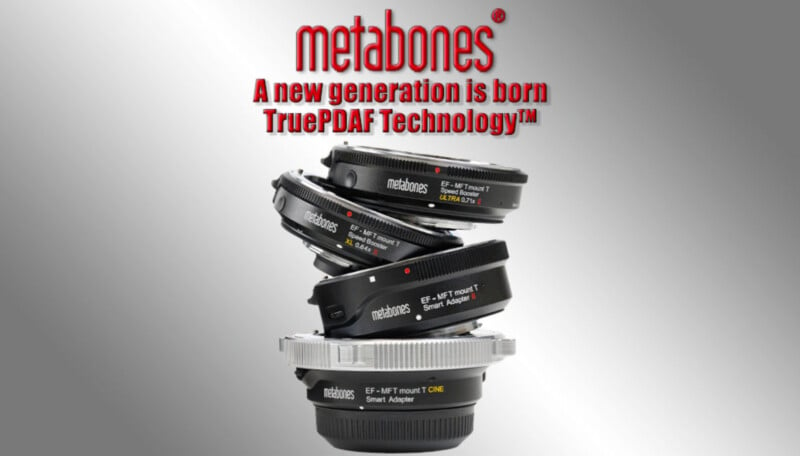
If the customer is using a supported lens, the Speed Booster or Smart Adapter’s LED glows pink rather than white, indicating enhanced support. In these cases, additional lens metadata is delivered to the connected camera, which Metabones says is the same metadata native lenses share with cameras. With the extra information, Metabones promises improved phase-detect autofocus performance, especially in challenging situations like low lighting, when shooting low-contrast subjects, when autofocus points are near the edges of the frame, and when the lens is operating near its minimum focusing distance.
Metabones adds that stabilization effectiveness is also better, especially at macro focusing distances.
If a lens isn’t supported, performance is unchanged and the same as Mark I. Metabones notes that optimal autofocus performance requires the Panasonic GH7 or Panasonic G9 II. “Other cameras will not be able to attain a near-native level of performance,” the Canadian company notes.
However, in an update to a new YouTube video, Metabones notes that the Olympus E-M1 and OM-1 series cameras still have improved performance with compatible lenses. The results are “not as consistent” as with the Panasonic GH7 and G9 II, but there are still evident autofocus gains.
There are a lot of caveats here, but the list of supported EF lenses is extensive. It includes APS-C and full-frame primes and zooms, ranging from entry-level to L Series professional-grade glass. It also includes third-party EF lenses from Samyang, Sigma, and Tamron.
The Metabones EF-MFT Mark II adapters start at $399 and are available now.
Image credits: Metabones
PetaPixel articles may include affiliate links; if you buy something through such a link, PetaPixel may earn a commission.
Love PetaPixel? Go Premium.
PetaPixel is the world’s largest independent photography publication and we’re only able to continue our work with your help. Become a PetaPixel Member now and support our mission to bring you regular, high-quality reviews, features, news, and more.
- Remove banner ads
- Gain access to full-resolution RAW and JPEG Sample Galleries
- Get 5% off orders from KEH.com
- Get a $15 coupon to spend at Moment
- Get 10% off lighting equipment from FJ Westcott
- Get 10% off film development, scanning, and printing from Blue Moon Camera and Machine





 English (US) ·