
 3 weeks ago
59
3 weeks ago
59

A Mozilla engineer has shared survey data and calculations suggesting that up to 15% of Firefox crashes are due to a bit flip. For the purposes of this report, a bit flip occurs when a memory cell (RAM, cache, etc) updates its value from 0 to 1, or vice-versa, following some unintentional external input. The most common triggers for bit flips are thought to be electrical issues and instability, thermal effects, underlying manufacturing defects and aging, crosstalk, and even memory cells being flipped by an ionizing cosmic ray.
No one seems to have a hard figure for the biggest bit flip contributor. However, systems sent to space will use specialized components hardened to resist interference from cosmic radiation, extremes of temperature, etc, and to include aggressive error checking.
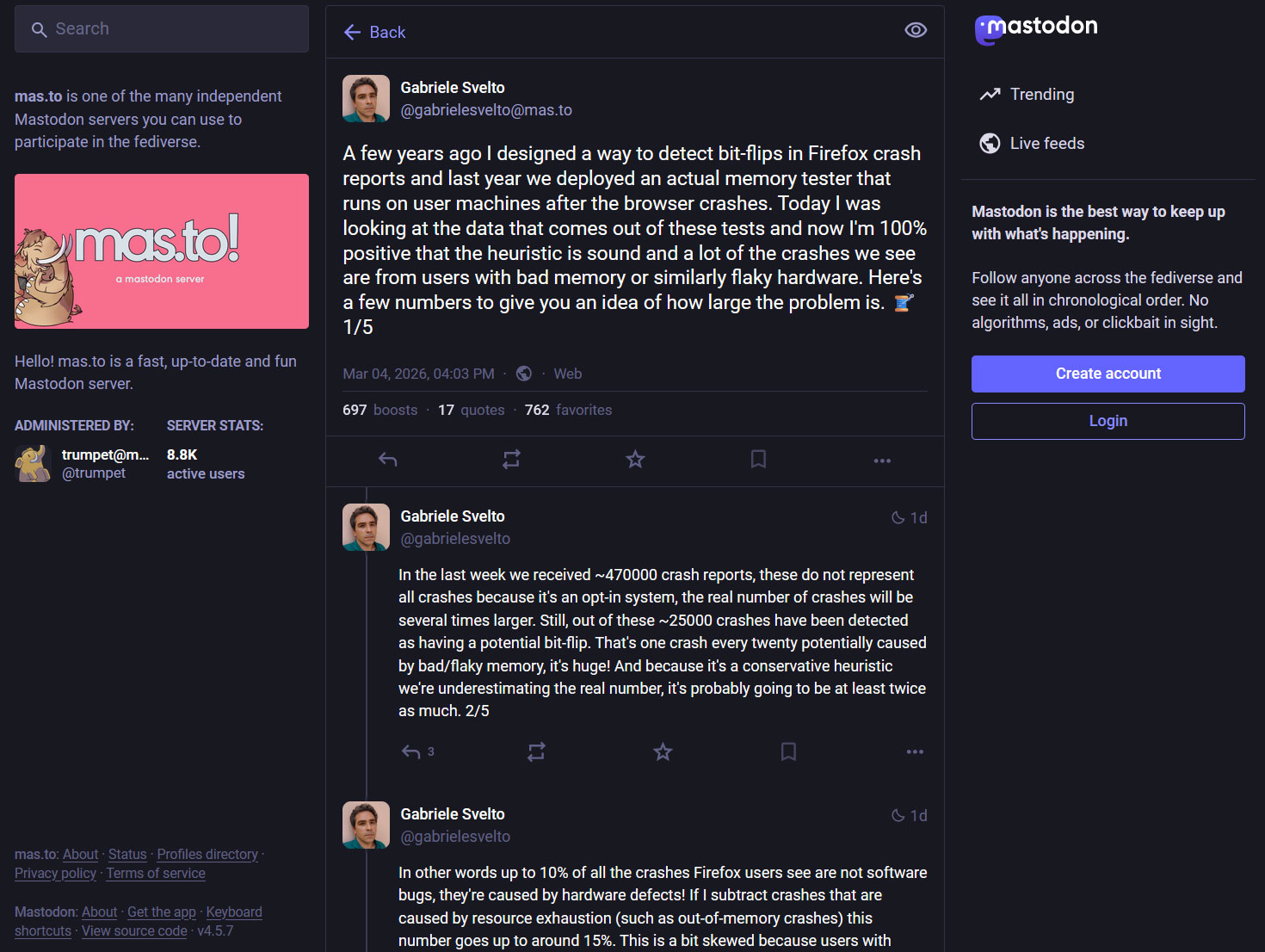
The Mozilla team received nearly half a million auto-submitted crash reports last week (opt-in feature). Data from a recently introduced “memory tester that runs on user machines after the browser crashes,” guided senior engineer Gabriele Svelto towards his eyebrow-raising bit flips, causing 15% of crashes figure, which he admits “dwarfs all the previous estimates I saw regarding this problem.”
Mozilla employed, self-confessed ‘old school nerd’ Svelto says that an initial 10% estimate was revised up because “If I subtract crashes that are caused by resource exhaustion (such as out-of-memory crashes) this number goes up to around 15%.” Moreover, it was determined that one in two bit flip crashes was due to a “genuine hardware issue.” Svelto notes this could be undershooting the real figure as Mozilla’s memory test on crash feature “only checks up to 1 GiB of memory and runs for no longer than 3 seconds.”
Thus, it is hard to drill down to probably the most fascinating statistic of how many Firefox crashes are precipitated by an errant cosmic ray passing though…
As a parting shot, Svelto doesn’t want fancy Arm-based MacBook owners, or any other niche device owner, thinking this is just about PCs with shaky RAM. Every device with memory can be affected by bit flips, asserts the engineer. That doesn’t matter if it’s a Mac, smartphone, or even a printer or router. From that perspective, PC desktop DIYers are probably in a better position, as they can replace any faulty component without throwing away the whole caboodle. But please, great cosmic ray caster in the sky, please don’t make me think I have RAM issues in 2026…

Follow Tom's Hardware on Google News, or add us as a preferred source, to get our latest news, analysis, & reviews in your feeds.





 English (US) ·