

Published Aug 18, 2026, 1:00 AM EDT
Dhruv is a Lead Writer in Screen Rant's New TV division. He has been consistently contributing to the website for over two years and has written thousands of articles covering streaming trends, movie/TV analysis, and pop culture breakdowns.
Before Screen Rant, he was a Senior Writer for The Cinemaholic, covering everything from anime to television, from reality TV to movies.
After high school, he was on his way to become a Civil Engineer. However, he soon realized that writing was his true calling. As a result, he took a leap and never looked back.
Some of the greatest detective crime thrillers, including the ones on HBO, adopt the well-known "whodunit" formula. A murder mystery is introduced in the opening arc, which is followed by a gripping investigation that forces the central detective to face their own personal demons. However, every once in a while, a crime thriller attempts to make this familiar story structure more intriguing.
While more crime thrillers stay grounded in realism, a rare few detective dramas, like True Detective, carefully introduce subtle supernatural elements. True Detective, in season 1, is particularly fascinating because it never explicitly reveals its supernatural underpinnings. Instead, it only hints that something sinister and omnipresent looms above its portrayal of the worst in humanity.
True Detective season 1 also does not wear its literary inspirations on its sleeves. Instead, it attempts to create a very distinct voice for itself in the crime thriller genre, explaining why it is still considered a masterpiece.
However, a closer look at its themes, cinematography, character beats, and philosophical underpinnings makes it hard not to see how it perfectly merges devices from H.P. Lovecraft and Haruki Murakami's storytelling.
True Detective Season 1 Combines Lovecraftian Dread With Murakami’s Melancholy

Nic Pizzolatto's True Detective season 1 draws quite a few direct references to Lovecraftian Cthulhu mythos through Robert W. Chambers’ The King in Yellow. In its 8-episode runtime, it not only name-drops "Carcosa" and "The King in Yellow" but also features many Lovecraftian story elements like multi-generational, incestuous cult and the existence of an ancient overarching evil.
The show's central detectives, Rust Cohle (Matthew McConaughey) and Marty Hart (Woody Harrelson), perfectly represent Murakami’s classic dual protagonists. Cohle, specifically, is portrayed as a detached, hyper-intellectual who chain-smokes and quotes obscure philosophy. This makes him reminiscent of Murakami's protagonists from books like Kafka on the Shore and The Wind-Up Bird Chronicle.
True Detective season 1's philosophical undertones dabble with ideas surrounding memory, time, and dualism. Like Murakami's 1Q84, its characters move through different timelines and experience eerie slips in their memory. Rust Cohle's famous line about how "Time is a flat circle" even turns the show's Murakami-esque obsession with time and nostalgia into a Lovecraftian nightmare.
Speaking of Rust Cohle's quotes from True Detective, he specifically says a few existentialist lines about humanity which seem perfectly in tandem with Lovecraftian horror:
"I think human consciousness is a tragic misstep in human evolution. We became too self aware; nature created an aspect of nature separate from itself. We are creatures that should not exist by natural law..."
The above monologue perfectly aligns with Lovecraftian cosmicism, which suggests humans are evolutionary anomalies that are too self-aware or completely oblivious to their insignificance in the vast, hostile universe. It is even reminiscent of one of H.P. Lovecraft's most iconic quotes from The Call of Cthulhu:
"The most merciful thing in the world, I think, is the inability of the human mind to correlate all its contents. We live on a placid island of ignorance in the midst of black seas of infinity, and it was not meant that we should voyage far."
Beyond these quotes, Cohle's lifestyle alone reminds one of how Murakami often strips the superficial constructs of his characters to show the haunting emptiness beneath their day-to-day lives. Cohle lives in isolation where his apartment is completely devoid of personality and warmth. This comes off as a perfect parallel to the sparse space Murakami's characters often inhabit as they endure loneliness and grief.
True Detective Season 1 Was So Good & Distinct, Its Follow-Ups Couldn’t Replicate Its Magic
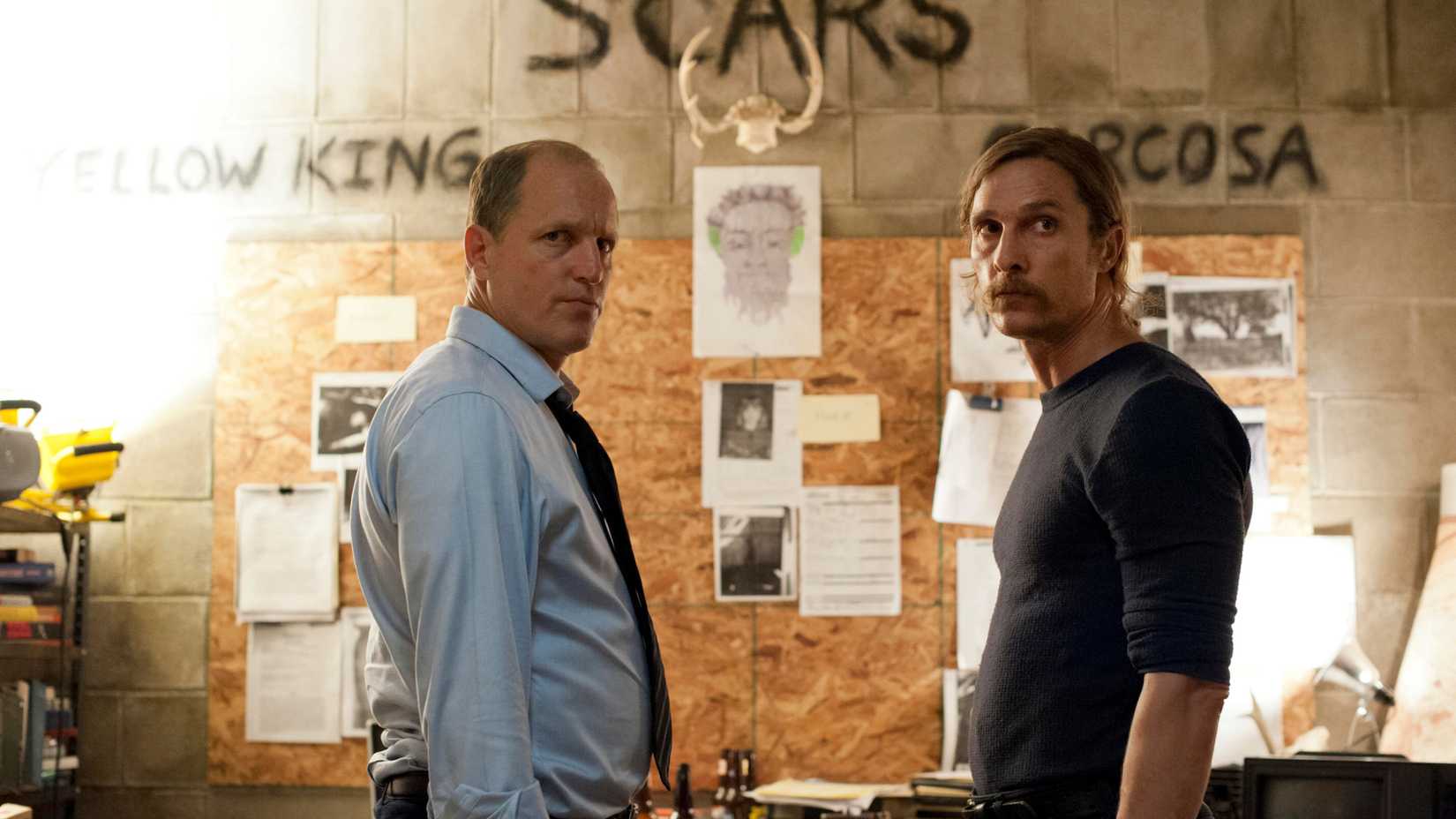 HBO
HBOTrue Detective season 1 captured lightning in a bottle and delivered eight episodes of near-perfect crime drama storytelling that even its direct follow-ups could not replicate. While some of the recent seasons of the show have had their own strengths, they are often overshadowed by season 1's legacy. Season 3, for instance, tried to adopt season 1's formula by bringing a supernatural spin to its central mystery.
Unfortunately, like its predecessors, True Detective season 3 struggled to hit the perfect balance between grounded crime storytelling and cosmic ambiguity. Woody Harrelson and Matthew McConaughey also delivered exceptional performances that are yet to be matched. The show also heavily benefited from the fact that Cary Joji Fukunaga's direction brilliantly captured Nic Pizzolatto's dense writing.
It seems unlikely that even future seasons of the HBO show will have the same cultural impact as season 1. Fortunately, though, since "time is a flat circle," True Detective season 1 almost feels destined to be revisited, rewatched, embraced endlessly.




 English (US) ·