
 3 weeks ago
30
3 weeks ago
30
Entertainment culture is so preoccupied with nowness that last month we were inundated with speculation about how directors under 30 topping the box office would change the industry. The flipside of a youth obsession is the conviction that age will increase irrelevance, and this is something that a new crop of films about ageing artists is zeroing in on. Specifically, Bitter Christmas, Late Fame and The Christophers are films in which artists – all male – indulge in selfishness, vanity and spite, and egotistical behaviour and a loss of creative (and masculine) virility are part of the same phenomenon. None of them is dislikable – they might be catty, pathetic or abrasive, but they’re always entertaining – but they all bend to the ego whispering in their ear, believing it will shield them from the pain of their fading art.

It’s no surprise to discover that an artist is an egotist: in fact encountering a narcissistic creative type may be joyless in the moment but it’s also an affirming – if petty – way of feeling better about ourselves. Plenty of classic films give us a close-up view into what makes an egotist artist tick or self-destruct. But decades on from Sunset Boulevard, 8½ and All About Eve, a sadder, bitterer crop of films has emerged in which self-absorption flourishes to protect an ageing male artist from self-sabotaging fears of his mortality and legacy.
Pedro Almodóvar’s Bitter Christmas, for example, focuses on renowned queer film-maker Raúl (Leonardo Sbaraglia), who is writing a semi-autobiographical drama; in his script, his avatar is a commercials director called Elsa (Bárbara Lennie). Raúl himself is Almodóvar’s own avatar; if the white quiffed hair and beard don’t give it away, the self-degrading jokes about Raúl’s plateauing career do. Elsa and Raúl also take the same artistic liberties, inserting their friends’ personal crises and tragedies into their screenplays. When their insensitivity lands them in hot water, they can’t believe it. “I can only write about what is immediate,” writes Elsa early in the film, while Raúl takes the sentiment to heart, mining the misery of his manager Mónica (Aitana Sánchez-Gijón) for pathos. Because their vampiric dramatic licence results in genuine creative inspiration, Elsa and Raúl resent the criticisms levelled at them – finding a great story is medicine, insensitivity be damned.
Raúl’s fragile self-image, and not his vibrant designer wardrobe and exquisitely designed home, puts him in conversation with the artists central to Kent Jones’s Late Fame and Steven Soderbergh’s The Christophers. In the former, Ed Saxberger (Willem Dafoe) is a New York postal worker whose obscure 1979 poetry collection Way Past Go earns him the reputation of an old master with a niche of hip young writers on the fringes of New York’s art scene. Saxberger (as his new fans insist on calling him) is hesitant but not immune to flattery; the praise he receives from the lively, pretentious Enthusiasm Society – plus the more erotic strain of bohemianism he sees in the group’s oldest and only female member, Gloria (Greta Lee) – reminds him of the rich literary scene of yore, filled with faces and places that once excited him. Happy to be “rediscovered”, Saxberger creeps towards the vanity of being an anointed artist, even though his poet identity is wedded to a lost – and dead – period of his youth.
As in Bitter Christmas, a vain artist is not necessarily a productive one – after agreeing to write a new poem, his first in decades, Saxberger struggles to compose a single line. Saxberger knows the Enthusiasm Society’s image of him as an unsung genius and a potential mentor is distorted by hype and projection, but since he never experienced that fulfilling creative life, why shouldn’t he accept their version?
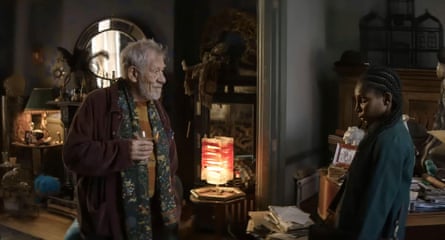
Young fans praising your talent is a privilege; to The Christophers’ Julian Sklar (Ian McKellen), it’s an utter bore. Sick of being treated like a national treasure, the painter sabotages his legacy: having made a spectacle of flogging paintings on the street as an eff-you to agents and dealers, he secludes himself in his cluttered London townhouse, recording crotchety Cameo videos for fans and snipping at his taciturn new assistant Lori (Michaela Coel). Julian’s acclaimed portrait series The Christophers, based on a former lover, has gone unfinished, and the painter’s refusal to let anyone get close to the paintings, his process or himself is a calculated choice. Julian knows that acting like an eccentric, venomous artist will convince outsiders not to probe deeper; if he resembles a walking trope, he can’t be a vulnerable old man devastated that losing his muse cost him his art.
Despite their differing careers and narcissistic flare-ups, Raúl, Saxberger and Julian’s swollen egos have a unifying logic. They are ageing, creatively stifled and confronting the effect that time has on talent and passion. The three films play with the stereotypes about bitter, puffed-up geniuses in a fickle, fast-moving culture, but they question if success (or in Saxberger’s case the suggestion of it) can cure your deepest worries and melancholy. Ego becomes just an easy, overactive defence mechanism from that crushing admission. Bitter Christmas, Late Fame and The Christophers do not surprise us with artists who behave egotistically, but by the end we can forgive them for it.








 English (US) ·