
 3 weeks ago
43
3 weeks ago
43
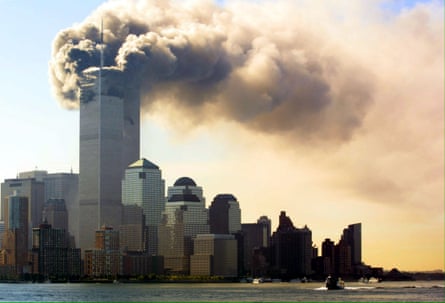
Twenty-five years on, memory is giving way to history. Soon the US will cross the point where half its population were born after 11 September 2001 or were too young to remember the day that terrorists crashed planes into the World Trade Center in New York, the Pentagon in northern Virginia and a field in Shanksville, Pennsylvania.
“When I do that math, I get to the bomb at Hiroshima – that’s how distant it is,” says Brian Knappenberger, 56, director of a new Netflix documentary, Turning Point: Generation 9/11. “When we talk about the second world war, for our generation it seemed like a long time ago but, for the current generation of 20-year-olds, that’s how long ago it was.”
Having previously made series about the “war on terror”, cold war and Vietnam war, Knappenberger felt compelled to address a generation for whom 9/11 is an abstraction they might find in a school history textbook, a solemn annual ceremony or, most disorientingly, a meme circulating on TikTok and Instagram.
Speaking via Google Meet from Los Angeles, he adds: “This film is coming from a place of respecting that experience, not assuming that people understand what it felt like to live through 9/11, which is so ingrained to those of us that did. It’s to illustrate not just what terrorism meant and how frightening that was but also how the decisions made in the days and weeks and years that followed – maybe more than the events themselves – changed us as a country.”
Indeed, Knappenberger’s film captures a paradox: even as 9/11 fades from living memory, we are still living in a vividly 9/11 world. “We are at a place where it is moving into distant history. But I would like people to understand what we went through and record in a documentary what those decisions did to us – and ask what kind of country we want to be.”
Turning Point: Generation 9/11 follows in a long line of documentaries recounting the horror of a day that killed nearly 3,000 people: the morning TV shows jarringly interrupted, the trapped office workers, the final phone calls, the heroic firefighters, the falling towers, the dust-coated commuters, the sombre presidential address.
For older generations, it is a day when everyone remembers where they were and what they were doing. “9/11 changed my life,” Knappenberger reflects. “It changed how I saw the world. It changed how I saw the political system in the United States. It changed the course of my career. It’s hard to even describe with hindsight how profound of a change this was.”
But for anyone born in the late 1990s or later, 9/11 feels like an inheritance. The documentary focuses on young people whose entire lives were directly shaped by the catastrophe. Among them is Laurel Homer, whose father, LeRoy Homer, was the co-pilot of United Flight 93. Laurel was just 10 months old when her father and passengers fought back against hijackers over Shanksville. In the film, she describes feeling like “collateral” in a narrative that consumed her family.
She confides: “I know he was a hero but I wish he didn’t have to be … My entire life was kind of built around this. I’m just still struggling so much and it has taken over, like, my whole life.” Grieving a father she never knew, Laurel finds herself confronting strangers online who send callous direct messages or peddle conspiracy theories claiming the tragedy was an elaborate inside job.
There is also An Nguyen, whose father, Khang Nguyen – an immigrant who grew up amid the Vietnam war before emigrating to the US – was killed while working as an electrical engineer at the Pentagon. An was four years old when his father ran out to kiss him goodbye at the preschool bus on that Tuesday morning, never to return.
Knappenberger observes: “It’s incredibly profound to understand what the children of people who lost their parents, lost their loved ones on 9/11, went through on those days. But it’s more profound when you think about how it changed their lives and those events have stayed with them through the evolution that our country also went through.”
To view the modern US information ecosystem through the eyes of these families exposes the depth of contemporary political cynicism, he continues. There has been “memeification” of the event, where conspiracy theories and jokes about Osama bin Laden or George W Bush circulate on platforms such as TikTok and Instagram.
More perniciously, the “truther” movement rejects the official account of 9/11 in favour of conspiracy theories, including that it was orchestrated by the US government itself.
The director says: “9/11 gave birth to the truther movement – this incredibly dark movement that rises in a disinformation environment, claiming 9/11 wasn’t real or that jet fuel can’t burn steel, that it was an inside job. When you look at these disinformation campaigns through the eyes of children who actually lost loved ones, that makes it even more profound and telling.”
Knappenberger traces a thread from early conspiracy theories to today’s fractured political reality. “There is a direct line from the early 9/11 truther movement through all of the rise of conspiracy theories online, and a direct connection from that to figures like Alex Jones, who became a leading figure in the movement, all the way through the disinformation and misinformation that we see now that divides and tears our country apart.”
The timing proved fateful. Facebook launched in 2004, Reddit in 2005 and Twitter in 2006. “These platforms were coming of age right in the shadow of 9/11 and so you had this massive rise of conspiracy theories and this new technology and ways we’re communicating on social media happening at the same time. I don’t think you can separate these things. The truther movement is an early predecessor to some of the chaotic world of misinformation that we see now.”
The domestic fallout of September 11 was not confined to the internet. The film tracks how the institutional apparatus constructed in the immediate aftermath of the attacks permanently altered civil liberties at home. It visits Brooklyn’s “Little Pakistan” to capture the experience of shopkeepers and families who lived the American dream before 2001, only to find their neighbourhoods subjected to FBI monitoring, harassment and suspicion almost overnight.
Knappenberger highlights the creation of the Department of Homeland Security (DHS) and the subsequent formation of Immigration and Customs Enforcement (ICE) which, under Donald Trump, has been widely condemned for its aggressive enforcement tactics and arrests of people without criminal records in cities such as Minneapolis.
“The violence we see ICE perpetrating on the streets of America has a direct line to 9/11,” he says. “We became fearful and suspicious of Muslim communities in America, and that infrastructure we built needed another place to go, and it continued. That fear dominates us and politicians have capitalised on that fear in order to get elected and to get power.”
He adds: “There’s no question that when you see violence on the streets of America perpetrated by ICE, that is a shock of 9/11. That is the wave of violence that started on 9/11 and a direct result of decisions that were made then. This is a choice about who are we as Americans, what’s important to us and what do we do moving forward. There’s a new generation who will start to have to answer those questions for themselves.”
The US has also projected violence abroad over the past quarter of a century at a cost of millions of lives. The foundational pillar of the “forever wars” was erected just three days after the twin towers fell when Congress passed the 2001 Authorization for Use of Military Force (AUMF) with only a single dissenting vote. Intended to target al-Qaida and those who harboured them, the statute became an elastic legal justification for military interventions, drone campaigns and indefinite detentions across sovereign nations spanning four presidential administrations.
“We created this thing called the AUMF, which is about as simple as it gets,” Knappenberger says. “That’s simply not how it works or the way our country was set up. It’s pretty clear in the constitution that Congress determines if we get a war or not. After 230 years at that point of being a country, of having a constitution, we decided after 9/11 that we weren’t going to do that any more. We decided we’re going to defer that in these cases to the president – not at all how the founders of this country saw our government working.”
The long-term consequence, Knappenberger argues, has been a dangerous expansion of executive power. “That was meant to go after al-Qaida, the people that attacked us on 9/11, and it has morphed into the rationale behind lots of other wars that we’ve engaged in. In that sense we’re still feeling the effects of the ‘war on terror’ in the way that it shifted power in the United States to the executive.
“It said now the president gets to decide if we’re engaging in these wars or not. That’s a huge difference in how America is supposed to operate. In that sense we’re definitely very much feeling the effects of the ‘war on terror’ still – this nebulous war on terror that can be applied and used as a justification for all these other wars.”
If 9/11 was the opening salvo of a new geopolitical era, the chaotic August 2021 evacuation from Hamid Karzai international airport in Kabul after a 20-year war in Afghanistan was the closing of a chapter. The mission suffered a disaster when an Isis-K suicide bomber detonated an explosive vest at Abbey Gate, killing 13 US service members and at least 170 Afghan civilians.
Knappenberger weaves the harrowing experiences of young US marines stationed at Abbey Gate into the narrative. They describe the strange experience of having to coordinate security with the Taliban – the very enemy the US had invaded to depose two decades earlier.
Knappenberger says: “It didn’t seem possible that we would still have troops in Afghanistan 20 years after 9/11, especially with how fast the Taliban was driven out. Here we are 20 years after that with a new generation of people: some weren’t born, some were too young to remember 9/11. They are the ones closing it out in those final harrowing days and of course 13 people were killed in that bombing. It’s profound and on the Taliban side you have people who were also not born yet or were too young to remember the events of that day.”
Alongside the US military trauma, the film foregrounds the plight of Afghan allies who placed their faith in the United States. One former Afghan military pilot, Obaidullah Durani, recounts securing evacuation for his two children to Arizona while his sick wife, Shafaro, was separated from them and left behind under Taliban rule, fracturing the family.
For Knappenberger, the visual parallels between Kabul in 2021 and Saigon in 1975 represent an indictment. “One season of Turning Point was about the Vietnam war and you saw people who believed in the American cause fleeing in fear for their lives at the end of that war. Many people thought this was a tragedy that we should never repeat as a country but it’s something that very much was repeated when the United States left Afghanistan.
“Over the course of 20 years, the United States did some good things in Afghanistan, but when we left so many people who bought into the idea of a new society ended up running for their lives. When you look at history, you think: how do we do this twice? There is no more stark example of the ineffectiveness of these efforts than the fact that these images look almost identical.”
Looking back across a quarter-century defined by overseas conflict, the erosion of institutional trust, rising domestic division under Trump and military operations launched without congressional authorisation, Knappenberger goes back to the strategy articulated by Bin Laden and his al-Qaida terrorist network.
“Osama bin Laden knew that that they couldn’t take on or destroy America; they couldn’t go to war and hurt that many Americans ultimately. He was aware that they could cause America to devour itself, that there was a way of getting America so involved in these other wars and to divide America within.
“That would be a way of destroying America that would be far beyond any kind of terrorist attack. He saw the way to destroy America was to turn it against itself and in that sense it’s hard not to overstate the profound effect those actions had on us.”
Knappenberger is left with questions and the hope that those born after 9/11 will make a different choice. “Who is an American, what is an American, how do we welcome people into our society? Those decisions were made out of fear and they were made out of suspicion, and they changed who we were. We are a different country after 9/11 than we were before. I would like the next generation to not fall into the fear and suspicion that led us down such a dark path.”
-
Turning Point: Generation 9/11 is out on Netflix on 2 September



 English (US) ·