
 5 days ago
12
5 days ago
12
We’ve seen a few dual-mode gaming monitors gracing the lineups from major display manufacturers. They offer flexibility, as they can be quickly switched between complementary resolutions to increase frame rates. Most are 4K natively and double their refresh rate at Full HD resolution, AKA 1920x1080. The only downside is that you have to play at Full HD resolution.
Recently, I reviewed the Asus XG27JCG, a 5K monitor that switches to QHD (2560x1440) at 330 Hz. That’s 5K, as in 5120x2880, which equates to a pixel density of 218 ppi. If you’re willing to go a bit slower, say 5K/60 Hz and QHD/120 Hz, KTC can save you some money with its H27P3. It’s an IPS Black panel with Adaptive-Sync, HDR10, and wide gamut color. How much will you save? Around $300 at this writing. The Asus is a very capable monitor, but it’s $850. KTC offers the H27P3 for $550. Let’s take a look.
Asus PA329Q Specs
Swipe to scroll horizontally
Panel Type / Backlight | IPS Black / W-LED, edge array |
Screen Size / Aspect Ratio | 27 inches / 16:9 |
Max Resolution and Refresh Rate | 5120x2880 @ 60 Hz |
| Row 3 - Cell 0 | 2560x1440 @ 120 Hz |
| Row 4 - Cell 0 | FreeSync and G-Sync Compatible |
Native Color Depth and Gamut | 10-bit (8-bit+FRC) / DCI-P3+ |
Response Time (GTG) | 7ms |
Brightness (mfr) | 500 nits |
Contrast (mfr) | 2,000:1 |
Speakers | None |
Video Inputs | 1x DisplayPort 1.4 |
| Row 11 - Cell 0 | 1x HDMI 2.0, 1x USB-C |
Audio | 3.5mm headphone output |
USB 3.2 | 2x downstream |
Power Consumption | 23.9w, brightness @ 200 nits |
Panel Dimensions WxHxD w/base | 24.1 x 17.9 x 7 inches (613 x 454 x 178mm) |
Panel Thickness | 1.6 inches (41mm) |
Bezel Width | Top/sides: 0.3 inch (8mm) |
| Row 18 - Cell 0 | Bottom: 0.7 inch (18mm) |
Weight | 8.25 pounds (3.75kg) |
Warranty | 3 years |
Now to be fair, the H27P3 is a gaming monitor for casual players. 120 Hz won’t deliver super low input lag or a blur-free experience when the action gets frenetic. But you will get a stunningly smooth image from that 218ppi pixel density. You can literally press your nose onto the screen (don’t do this, grease spots are hard to remove) and never see the dots. If a monitor’s image can be called photographic, this one is. When you view graphics at 5120x2880, it’s a completely different level of sharpness than you’ve seen before. And yes, you can tell it apart from a 27-inch 4K display.
The H27P3 adds wide gamut color to the resume with a measured 110% coverage of DCI-P3. It’s spot-on accurate out of the box, too. My sample was so close to perfect that I could not improve it with calibration, not even slightly. It’s bright in SDR mode as well, with over 500 nits peak from an edge-LED backlight. HDR10 is supported with an automatic signal switch.
To improve the gaming experience, the H27P3 includes a decent overdrive with fixed levels and a variable option. Though refresh rates are relatively low, Adaptive-Sync effectively eliminates frame tears in both resolution modes. You also get MPRT backlight strobing, which works instead of Adaptive-Sync. You can pair the H27P3 with Nvidia or AMD video cards and get the same capabilities.
The game enhancement suite includes aiming points, sniper modes, night vision, timers, and a frame counter. There are USB ports for peripherals and three video inputs, one each of HDMI, DisplayPort, and USB-C. The latter includes 65 watts to charge phones, tablets, or laptops.
Physically, the H27P3 is minimalist. It’s super slim and has a basic stand that only tilts. There is no LED lighting, nor are there internal speakers. But it’s a 5K monitor with wide gamut color for $550. That’s going to make it hard to fault.
Assembly and Accessories
The H27P3 comes in a simple carton with no frilly graphics. Crumbly foam disgorges three bits: panel, upright, and base. The stand is slim but all metal and rigidly constructed. Cables include an external power supply plus USB-C and HDMI. You’ll need a Phillips-head screwdriver for assembly, and a small one is included.
Product 360
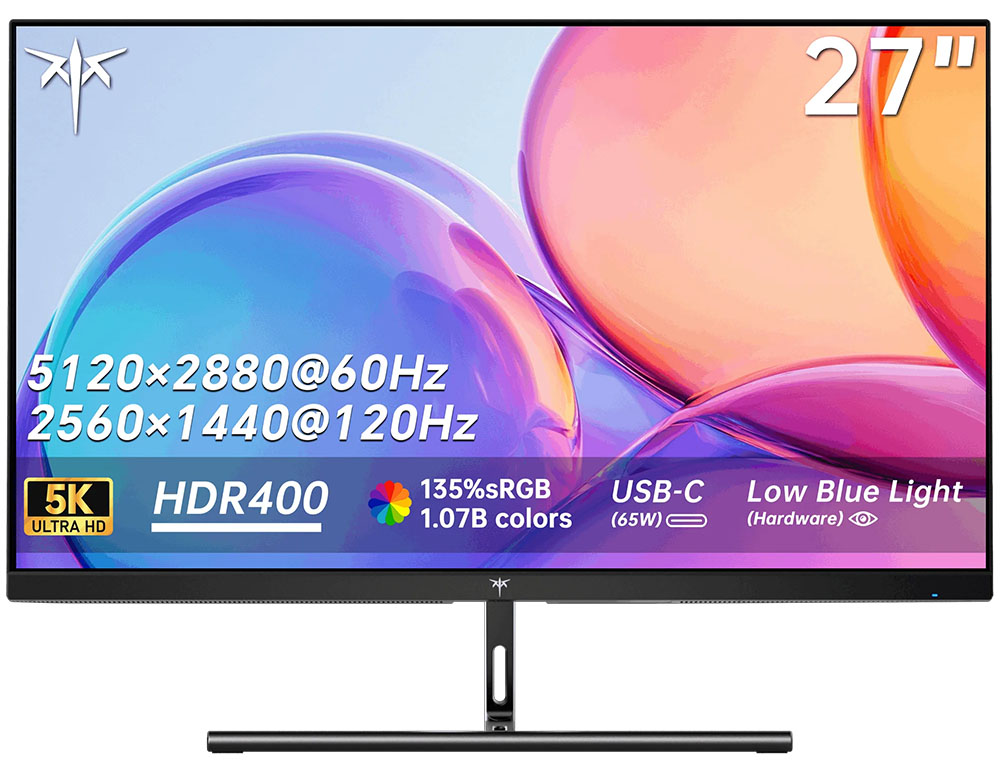
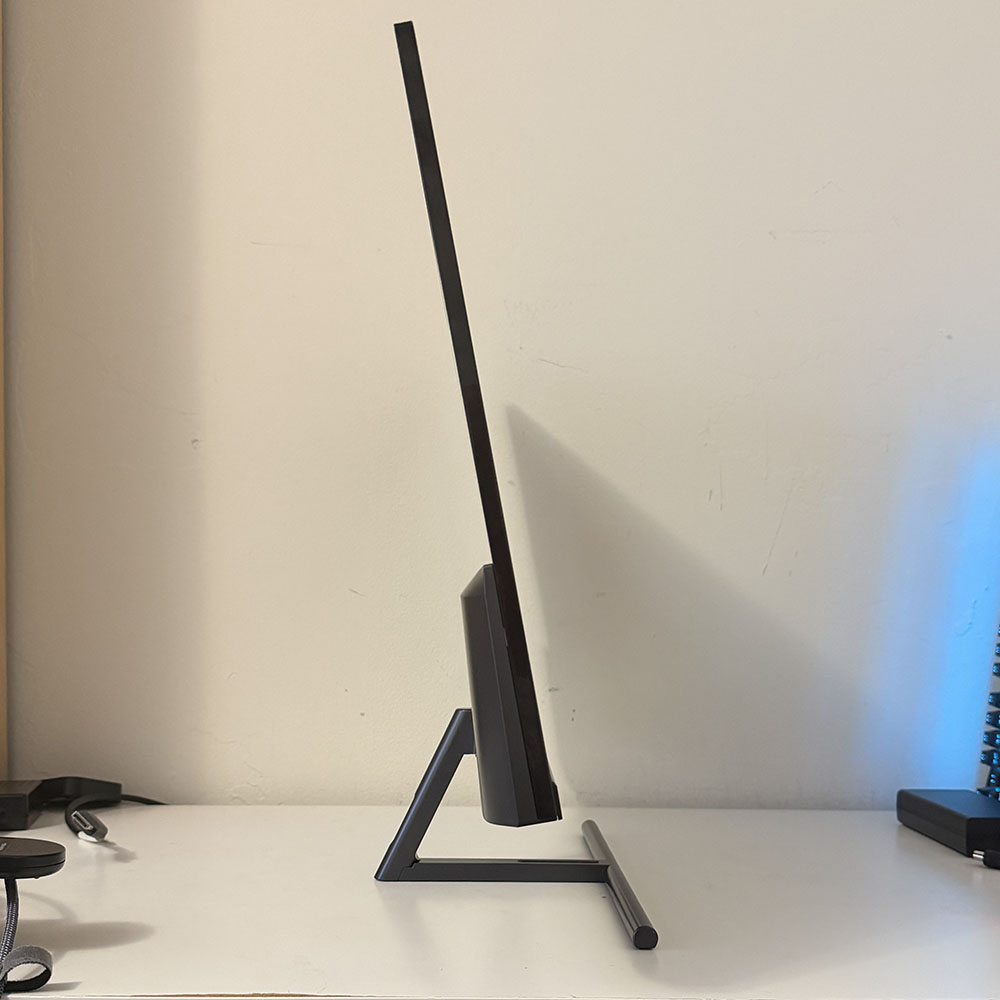
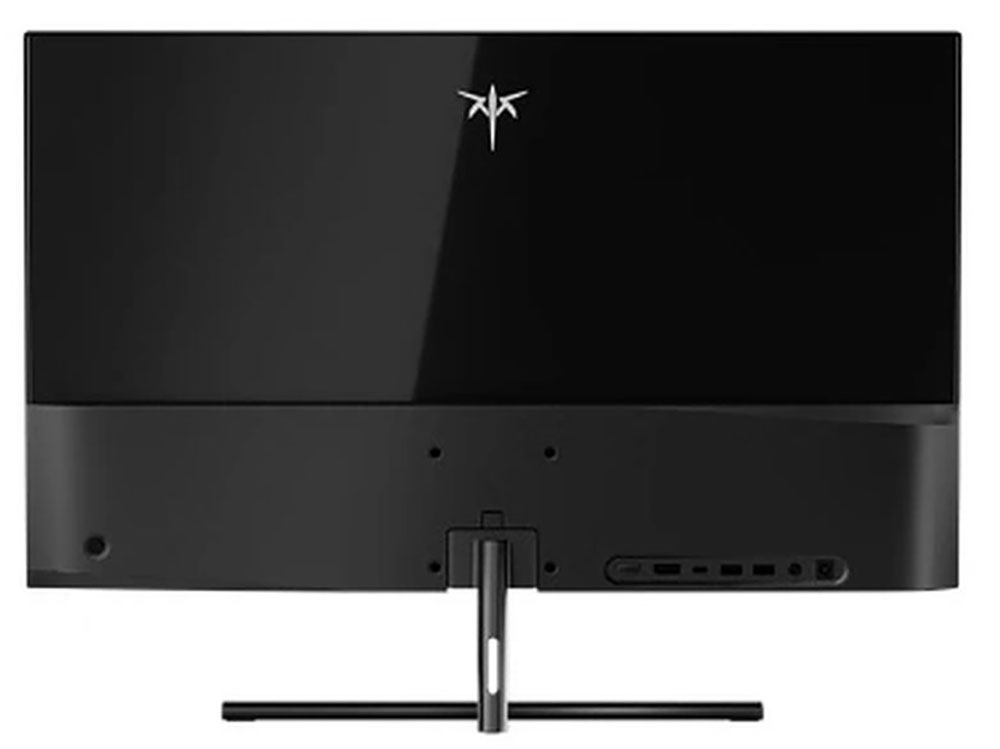
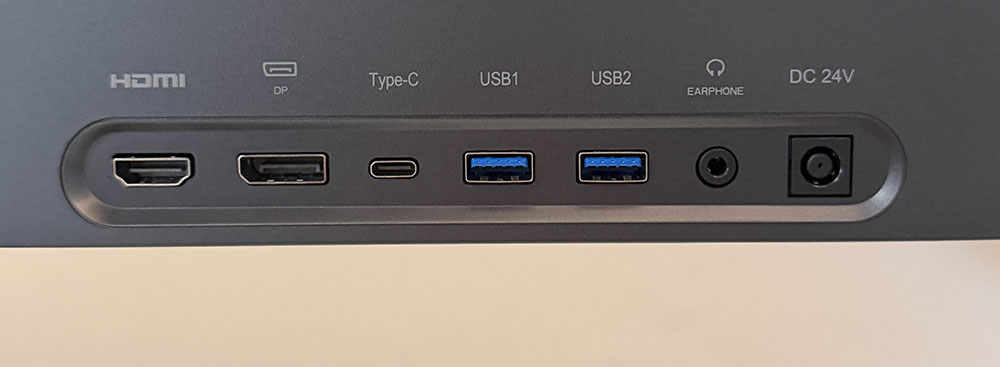
Looking at the photos, you’d think the H27P3 is easy to topple, but that couldn’t be further from the truth. The slender stand is made of cast aluminum and is very rigid. It’s also perfectly balanced so that the panel sits right over the center of gravity. It ain’t goin’ nowhere. That minimal design means you only get tilt, 5/15 degrees. And the panel hinges at the bottom, meaning adjustments take the top of the screen away from you. If you’d rather use an arm, there’s a 100mm VESA mount in the back, but you’ll need to provide your own fasteners.
The back view is marked only by a KTC logo on top. The slim part of the panel is finished in shiny black plastic, while the component bulge below is matte. The stand snaps in and out easily. In the lower right corner, as you look from the front, there’s an OSD joystick that controls all monitor functions. A tiny hole graces the upright for cable management; fat connectors need not apply.
The input panel faces backward and includes one each of HDMI 2.0, DisplayPort 1.4, and USB-C (DP Alt) with 65 watts of power. HDMI is limited to 3840x2160 @ 60 Hz, which is not a multiple of 5K’s 5120x2880. That means a 4K image will look a bit rough. Stick to native resolution or QHD, and you’ll be fine. DP and USB-C support full-bandwidth and dual-mode operation. The input panel ends with two USB ports and a headphone jack.
OSD Features
KTC is the only manufacturer I’ve seen that lets you change the OSD color. It’s a small thing but unique, nonetheless. The H27P3’s menu has six logically laid-out sections.
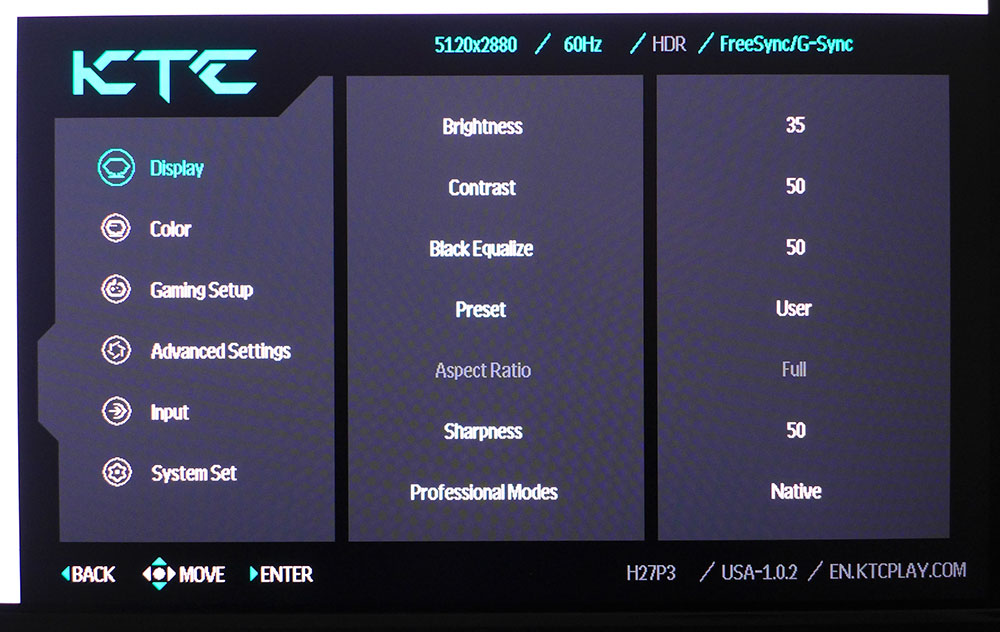
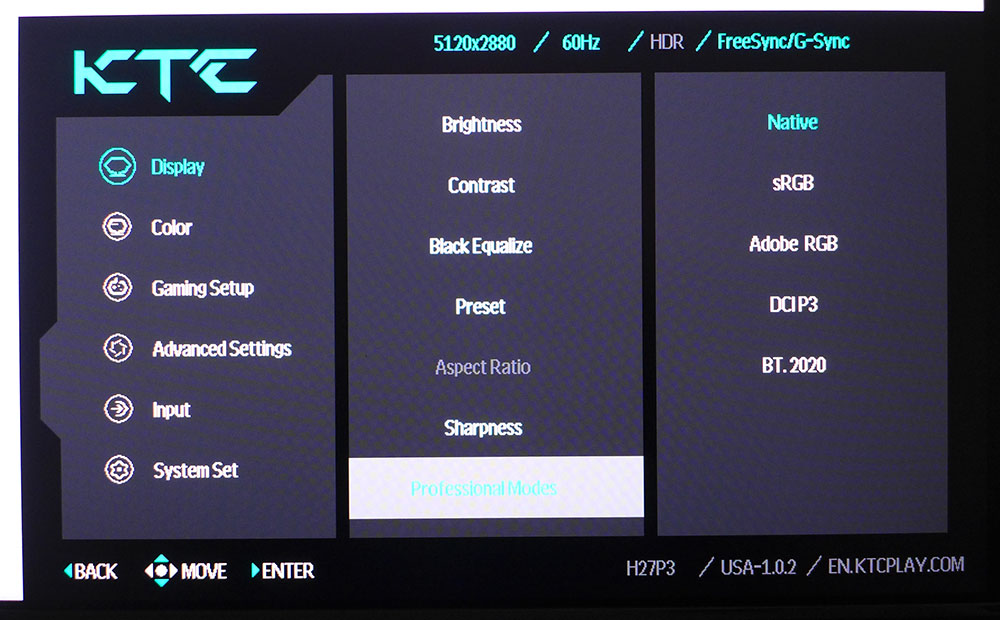
The Display menu has luminance controls, black equalize, seven picture modes, and gamut selection, called Professional Modes. You get sRGB, Adobe RGB, DCI-P,3 and BT.2020, all of which are handy for color-critical tasks. They’re all very accurate as well. Native delivers the H27P3’s full gamut, which covers over 110% of DCI-P3. It’s one of the most colorful monitors you can buy, period.
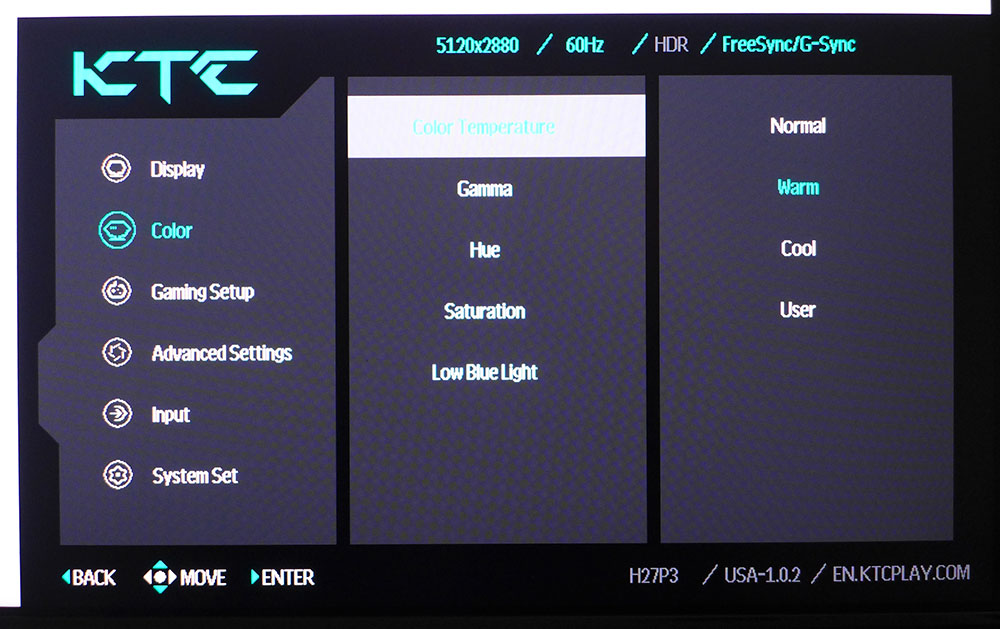
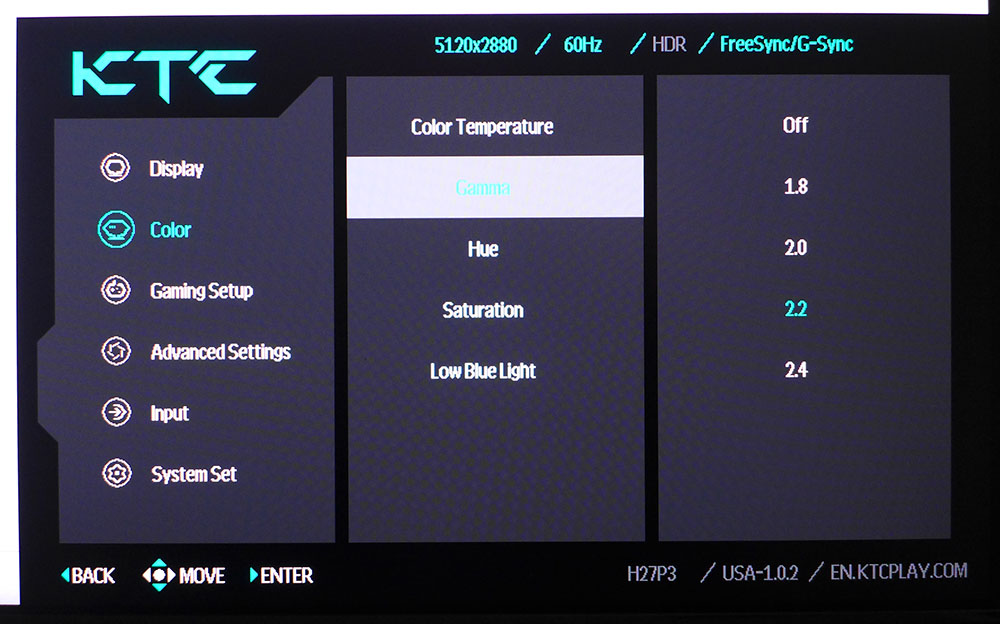
In the Color menu, there are color temp presets, three fixed and one with RGB sliders. There are four gammas, hue and saturation for all six colors, and a low blue light mode. Though you can calibrate with precision, it’s completely unnecessary.
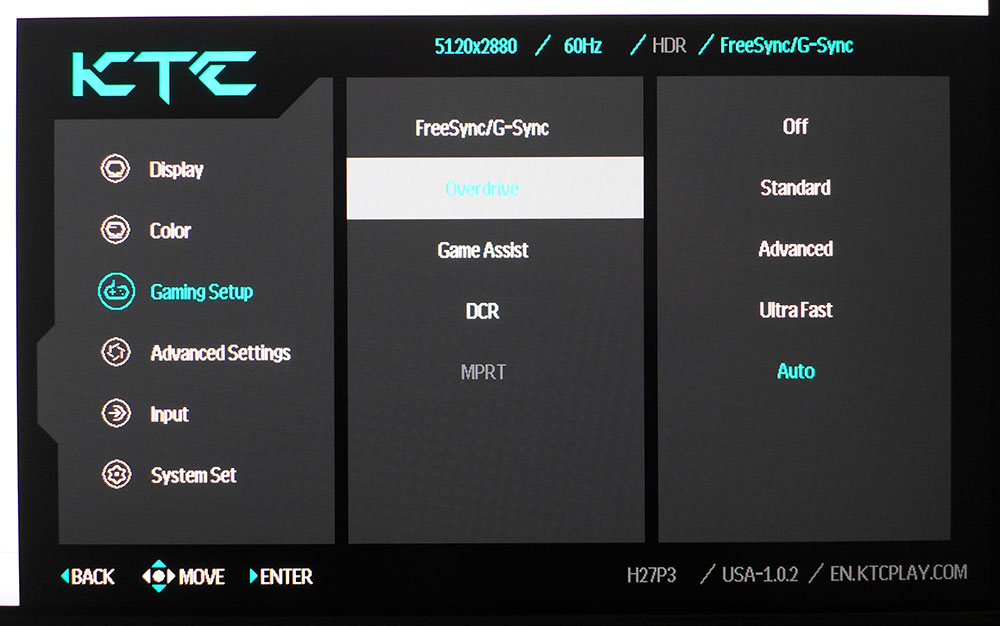
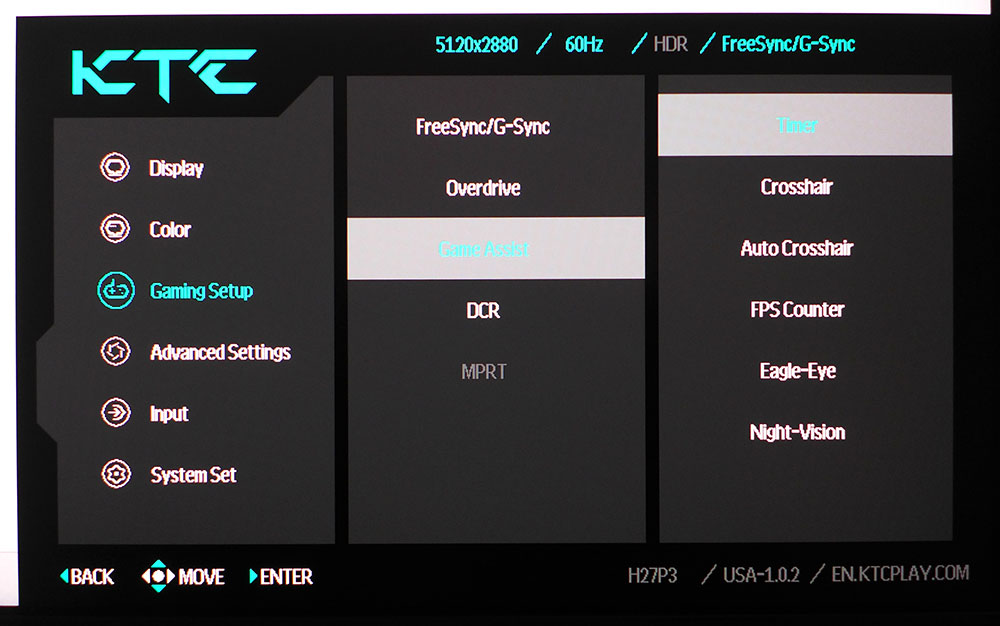
Gaming Setup includes four overdrive settings, one of which is variable, as in, it varies with frame rate. It cuts blur well, but the H27P3 is limited by its 120 Hz refresh rate in QHD resolution. The Game Assist sub-menu includes fixed and variable-contrast crosshairs, a frame counter, sniper mode, and night vision.
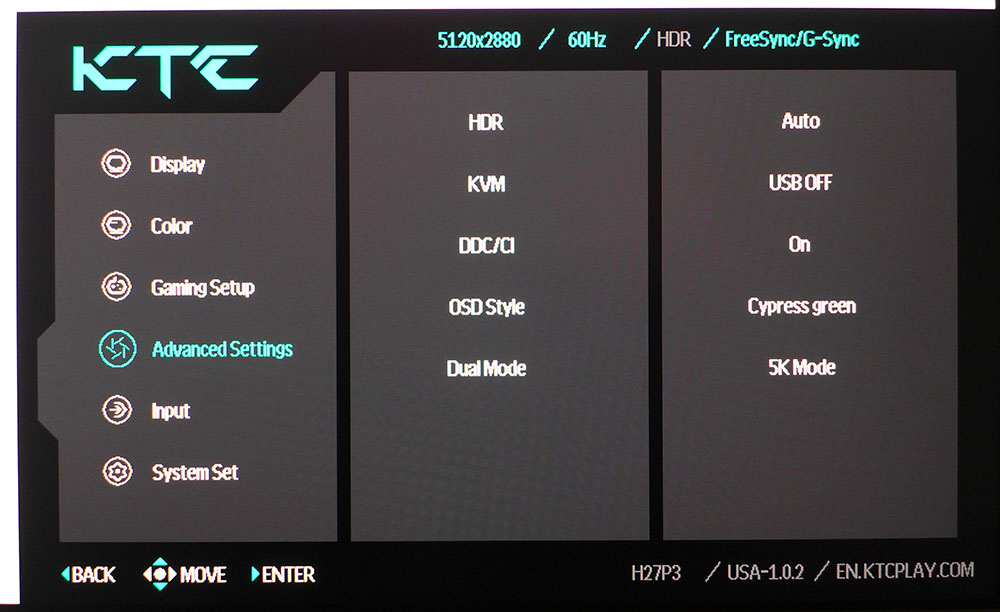
Advanced Settings is where you’ll find the HDR toggle (leave it on Auto for automatic switching), KVM for the two USB ports, the OSD color, and the Dual Mode toggle. It switches between 5K/60 and 2K/120. Once you set up the two resolutions in Windows, the change is quick and easy.
KTC H27P3 Calibration Settings
The H27P3 is one of the most accurate out-of-the-box monitors I’ve ever reviewed. It includes a full set of calibration controls, but I didn’t need any of them. Just set the brightness to taste and enjoy. I noted that changes to the color space, called Professional Modes, retained access to the color temps and brightness slider, but all other picture controls were greyed out. Only Native has full calibration ability. My SDR settings are below. For HDR, there is only one setting, Auto.
Swipe to scroll horizontally
Picture Mode | User |
Brightness 200 nits | 33 |
Brightness 120 nits | 16 |
Brightness 100 nits | 13 |
Brightness 80 nits | 9 |
Brightness 50 nits | 3 (min. 40 nits) |
Contrast | 50 |
Gamma | 2.2 |
Color Temp | Warm |
Gaming and Hands-on
Like any dual-mode monitor, the H27P3 must be set up in Nvidia Control Panel or Radeon Settings. First, make sure it runs at 5120x2880/60 Hz, then switch to 2K mode and set the 2560x1440 speed to 120 Hz. Then, the H27P3 will switch back and forth between the OSD without needing to change software settings. I noted that HDR won’t always stay active, so you might need to switch that back in Windows Display Settings.
The picture in 5K mode is stunningly sharp. It’s super colorful too, in either resolution, thanks to that IPS Black panel. It delivers more color volume than many of the Quantum Dot screens I’ve experienced. I also noted a VA-level contrast with deep, convincing blacks. While you won’t mistake the H27P3 for an OLED, it is more textural than the average IPS monitor. With over 500 nits available, it’s brighter than many OLEDs as well.
When watching video in 5K mode at 60fps or less, it looks solid with minimal blur. I found the best overdrive setting to be Auto, since it varies the overshoot with frame rate. Gaming required some compromise, though. Playing casual titles with slow rendering, like Myst, is a superlative experience on 5K. The pixel density is incredible, with not even the slightest suggestion that the image is made from dots. If you like to sit inches from the screen, this monitor is for you.
When the action intensified, I found myself reaching for the 2K mode right away. Playing Doom Eternal and other 3D shooters at full resolution and 60 Hz was a challenge. I’m very spoiled by speedy monitors and OLEDs, and the H27P3 just isn’t one of those. To be fair, gaming at 60fps on any LCD won’t be fun. Motion blur makes aiming difficult with the moving background constantly smearing. If you want to explore at a leisurely pace, it’s fine. But if fragging is the goal, this isn’t a great monitor. I did find it responsive, though. Input lag in 5K mode is lower than you might expect.
Work tasks were a pleasure thanks to the sharp and smooth-toned image. Color is a level above most other monitors. Only the best QD screens I’ve reviewed can match the H27P3’s volume and accuracy. I discovered in testing that it was spot-on out of the box, with calibration unnecessary. This would be a great display for color grading and Photoshop. It was also great for documents because text of all sizes looked like fine printing on high-end paper.
Physically, I wished for more adjustments from the stand. Though it is solid and elegant, I had to tilt the panel upward to my eyepoint. I prefer a vertical stance, and you can only achieve that with the H27P3 if you put it on a pedestal or arm. I also missed internal speakers. I did appreciate the inclusion of USB ports and KVM, though.
Takeaway: The H27P3 is only a fair gaming monitor thanks to its relatively low refresh rates, but it is stunning to look at when the action is laid back. It’s gorgeous for photos and video, too, with tremendous color saturation and precise accuracy. I enjoyed its elegant styling and slim profile, but wished for a more adjustable stand. Overall, it’s impossible to deny the value factor. You’re getting a 5K monitor for $550. That’s pretty amazing.
MORE: Best Gaming Monitors
MORE: How We Test PC Monitors
MORE: How to Buy a PC Monitor







 English (US) ·