
 2 hours ago
6
2 hours ago
6
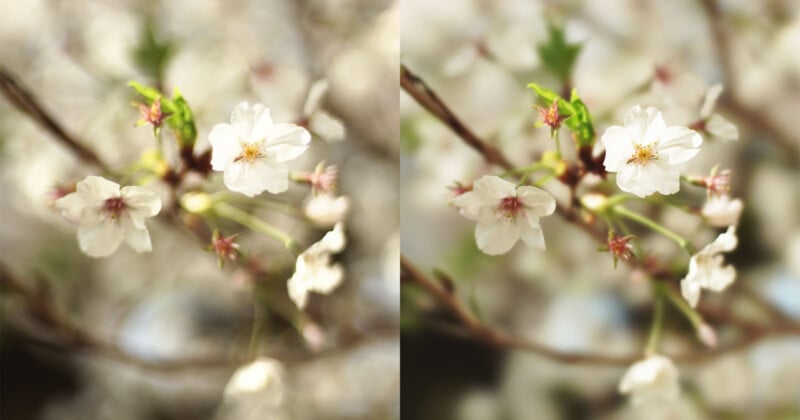
Japanese company BBL offers a special lens modification service that promises to smooth out lens bokeh and reduce harsh edges in out-of-focus areas.
As the company tells PetaPixel, the modification reduces the harshness of the transition between light and dark at the edge of the blur in the background of an image. The harder this transition is, the less smooth out-of-focus areas appear in photos.
 An illustration of a perfectly round bokeh with a very hard light to dark transition.
 A bokeh with a moderately smooth transition from light to dark.
 An even smoother gradation, which is what bokeh looks like after BBL modification.
BBL’s modification aims to make the boundary between light and dark much smoother by “superimposing” a circular gradient on top of the boundary line. This means that the modification adds a specialized optical mechanism to the lens. Since BBL doesn’t change any of a lens’s existing optics, the modification process remains entirely reversible.
“The optical mechanism is adjusted to optimize the lens structure and imaging characteristics,” BBL tells PetaPixel.
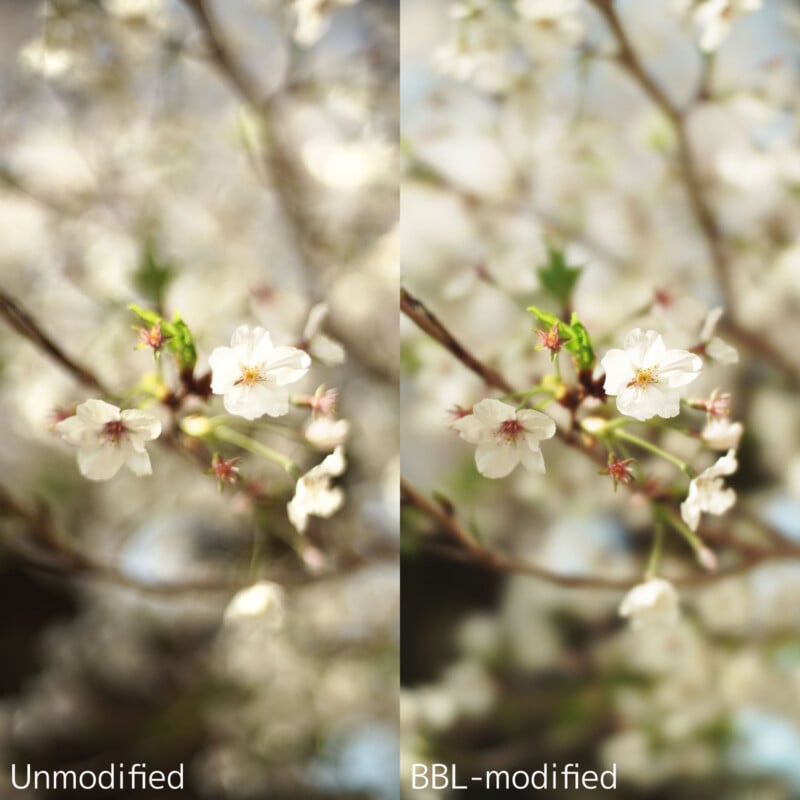
 After modification, in-focus areas remain extremely sharp. The modification does not make lenses softer, but only makes out-of-focus areas smoother.
Since optics with a radial gradient are being added to a lens, the modification also impacts aspects of lens performance beyond the promised smoother bokeh. The amount of blur at maximum aperture is smaller after the modification, although, as BBL says, the bokeh’s quality is improved.
The modification also reduces brightness by about two stops, although the degree of this change depends on the specific lens being modified. The company sends the measurement results back to the photographer alongside the modified lens, so they know precisely how exposure is affected for their specific lens.
Depending on the specific lens and shooting environment, BBL adds that a lens’s white balance may shift slightly after modification, either becoming slightly warmer or tending toward cyan. These are easily corrected during post-processing, although a camera’s automatic white balance setting should also handle any changes accordingly.
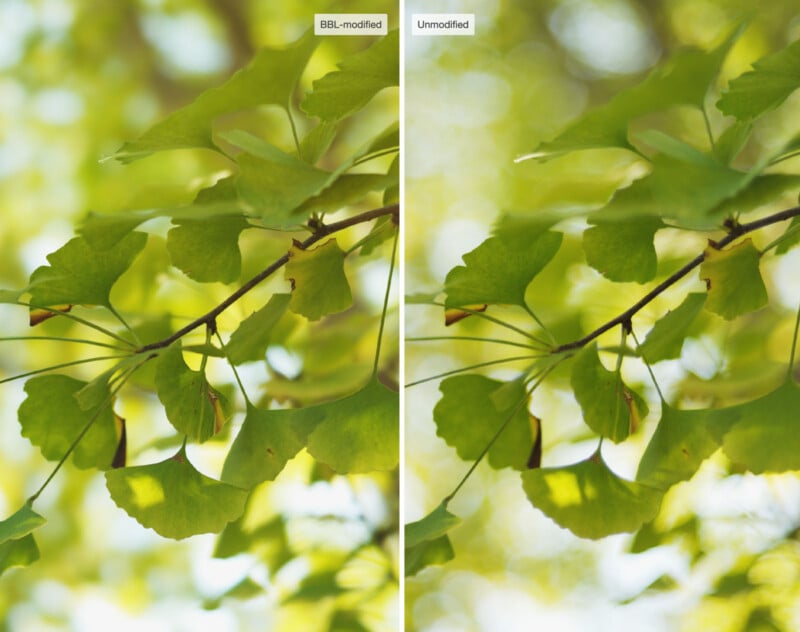
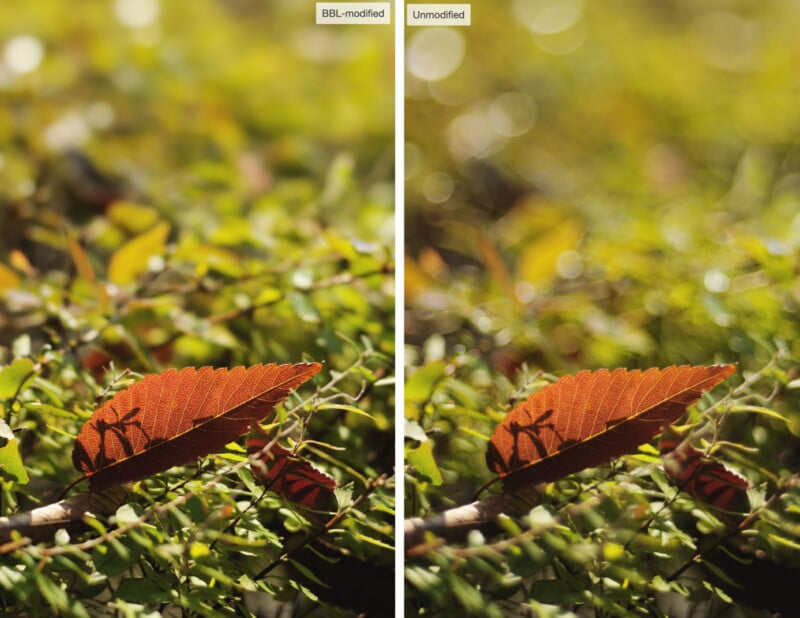 This is a strong example of how much smoother bokeh can be after BBL’s modification. Notably, the bokeh is also smaller.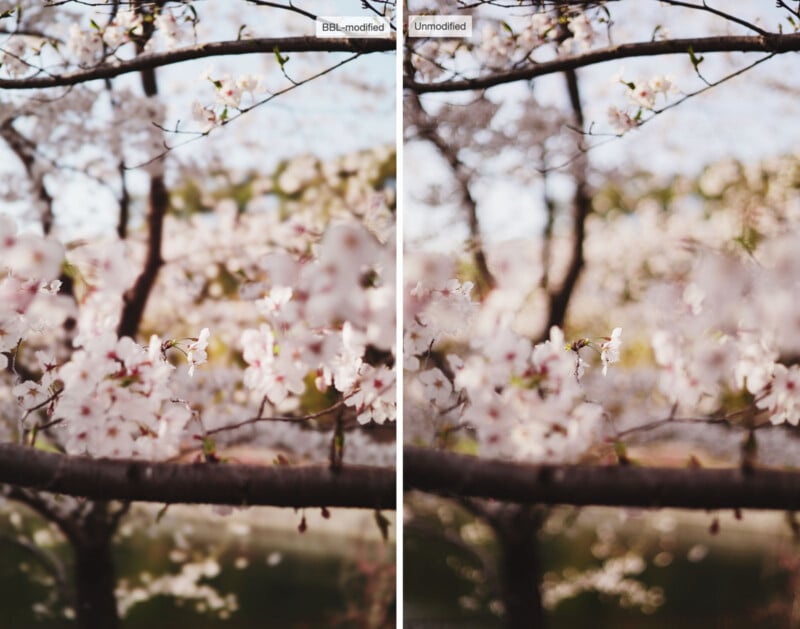
A lens may also be more prone to ghosting and flare after modification, and, depending on the lens and camera, autofocus performance may be reduced, presumably due to reduced light traveling through the lens.
With that said, BBL recommends that photographers only modify lenses with large, fast apertures, so it is unlikely that autofocus performance will be noticeably harmed in most cases.
“We recommend a lens with a long focal length, small maximum aperture, and short shooting distance,” BBL writes.
BBL has a lengthy list of lenses it has successfully modified, including lenses like the Canon RF 50mm f/1.8 STM, Nikon Nikkor Z 40mm f/2, Sony FE 50mm f/1.8, Nikon Nikkor Z 50mm f/1.8 S, Sigma 85mm f/1.4 DG DN Art, Sigma 135mm f/1.8 DG HSM, and more, to name just a handful. Prices range from 25,000 to 40,000 yen, or about $160 to $260 at current exchange rates. However, the company will consider modifying other lenses, and has not yet damaged a lens during modification. In the unlikely event that a lens is damaged during modification, BBL will replace it, so the company says it may decline to modify very rare or expensive lenses. BBL can also reverse any of its modifications at any time.
Although BBL does not use the term “apodization” to describe its lens modifications, the described modification process and the resulting images do seem similar.
Photographers may be familiar with apodization filters, as multiple major manufacturers offer lenses with them. For example, Fujifilm’s now-discontinued XF 56mm f/1.2 R APD lens features an apodization filter. This filter promises to deliver pleasing, smooth out-of-focus areas. The filter, like BBL’s modification, impacts exposure values, as evidenced by secondary T-stop values on the lens barrel that show equivalent light transmittance at designated f-stops.
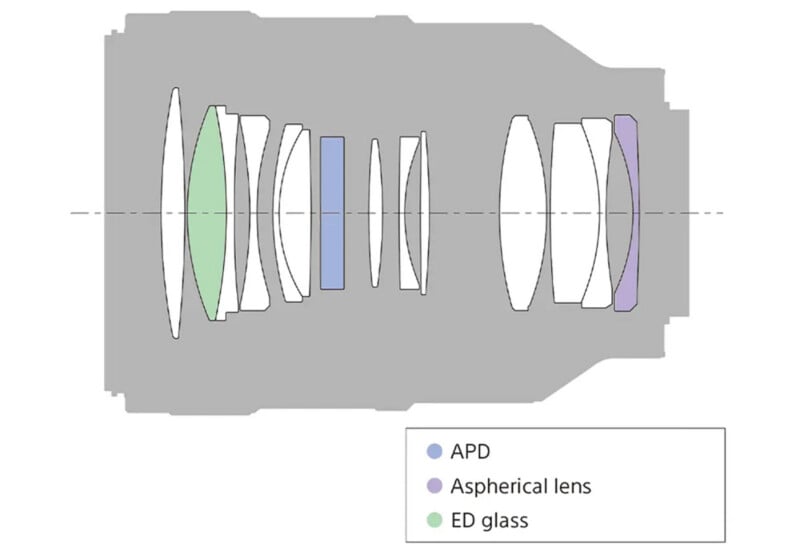 The Sony FE 100mm f/2.8 STF GM OSS lens has a dedicated apodization filter near the middle of its optical design. | Credit: Sony
In 2017, Sony announced the FE 100mm f/2.8 STF GM OSS lens, which uses what Sony calls “Smooth Focus Technology” to smooth bokeh. Sony is very clear about it works though, saying specifically that the lens features an apodization filter.
“Optical design incorporates an apodization (APD) element that helps to improve the quality of bokeh. This element, which resembles a radially graduated ND filter that tapers from clear in the center to denser around the edges, produces more circular out-of-focus highlights for more pleasing selective focus and shallow depth of field effects,” Sony says of its 100mm f/2.8 STF G Master prime. Sony notes that while the lens has an f/2.8 aperture, the apodization filter results in a T-stop of 5.6 at f/2.8, a dramatic reduction in light transmission.
Much more recently, Canon released its RF 85mm f/1.2L portrait prime in two versions, a standard one and one with “Defocus Smoothing.” The DS version employs a specialized coating to deliver “beautifully smooth, eye-catching bokeh.” Unlike Fujifilm’s approach, which incorporated a physical optical element, Canon simply applies its lens coating to existing lens elements. The RF 85mm f/1.2L DS has the same optical construction as the standard RF 85mm f/1.2L, albeit with two of its elements coated differently. The coating adds $300 to the lens’s price, by the way.
As Canon describes, the Defocus Smoothing coating progressively smooths the edges of out-of-focus areas, which sounds an awful lot like what BBL does. Effectively, light transmission gradually decreases toward the edges, resulting in more diffuse, softer bokeh.
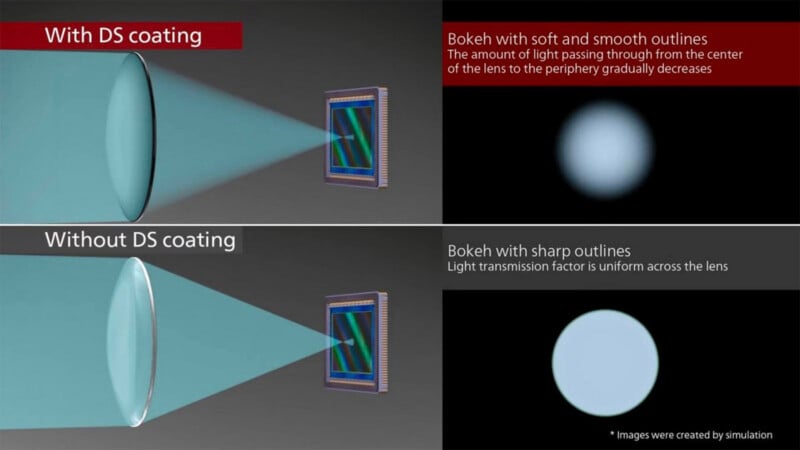 Instead of using an apodization filter, Canon uses specialized coating to achieve the same result — radial gradation on elements to smooth the edges of bokeh. | Credit: Canon
As expected, this impacts light transmittance. The brightness of the RF 85mm f/1.2L DS at maximum aperture is about 1 and 1/3 stops darker than at f/1.2. Canon EOS R-series cameras still function as expected when using automatic exposure.
As for BBL, it currently offers its lens modification service only to photographers in Japan, although the company tells PetaPixel it is considering expanding to overseas photographers in the future. It’s a neat service that can help fast-aperture lenses deliver even more pleasing, smoother bokeh, so hopefully BBL can find a way to work with photographers outside of Japan. Photographers, especially portrait photographers, have long loved apodized lenses, so bringing this distinct optical technology to more photographers is great news.
Image credits: BBL unless otherwise noted.







 English (US) ·