
 3 weeks ago
51
3 weeks ago
51
In a house near Maidenhead in Berkshire, a group of sweaty teenagers are throwing a party. Vodka bottles line the staircase, snogs are shared on lumpy sofas and gossip is exchanged. The windows are covered with multicoloured fabrics to ward off prying eyes. Suddenly, as the vibes start to flag, the music cuts out and a voice bellows: “You’re having the time of your lives, remember!”
The voice belongs to the director Wash Westmoreland; the very real house – situated next to the noisy A308 – stands on the grounds of Bray Studios in Berkshire. As for the partygoers, well … they’re some of the most famous young faces on the planet.
It’s week six of a seven-week shoot on Heartstopper Forever, the final chapter of Netflix’s quietly revolutionary queer, coming-of-age teen drama. Adapted from Alice Oseman’s hugely successful graphic novels, the series focuses on Nick (Kit Connor) and Charlie (Joe Locke), whose burgeoning romance is played out with a pastel-hued idealism against a backdrop of homophobia, eating disorders and anxiety.
Released in 2022, the show was an instant success (season one clocked nearly 24m viewing hours a week at its height), turning its two leads into Hollywood superstars and doing similar things to a supporting cast including Yasmin Finney, whose breakout role as the transgender artist Elle Argent led to her being cast in Doctor Who.

Nearly two years since season three, the Heartstopper story is ending with a feature-length film, focusing on the now 17- and 18-year-old Charlie and Nick as they navigate university, gap years and impending adulthood. For the more stoic Nick, the thought of leaving the occasionally fragile Charlie leads to alcohol dependency, while Charlie is haunted by jealousy. The stakes feel higher, the takes longer. Hence the slightly tense feeling undercutting the sweltering house party. As everyone is positioned into place for take seven (or is it eight?), someone’s phone goes off. There’s a chilly silence before Westmoreland delivers a teacherly: “That must have been my imagination!”
Upstairs, next to a room full of empty bottles, some of the cast are brought in for brief interviews. The room is empty save for a clothes rail and some jackets. If this were a real house party, this would be where you’d come for a little lie down. Connor and Locke settle into place, before being promptly called back on set to rehearse another scene. When they return, they seem slightly frazzled by the multiple takes – later, we’ll have to step over Connor, collapsed on the staircase after being called to yet another rehearsal.
“There have been moments where I’ve had flutters of emotion,” Connor says about the end of Heartstopper. “Will [Gao, who plays Tao, Elle’s on-off boyfriend] and I did our last scene together the other day, and I was like: ‘Oh fuck, this is quite upsetting.’ These characters have meant a lot to us over the years and we’ll always carry them with us.”
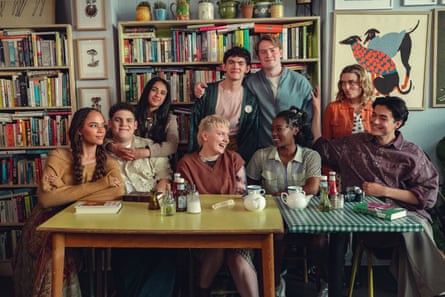
Locke continues: “It’s more than friendship; it’s family,” mentioning WhatsApp groups among the cast and the fact the young actors lived together while filming seasons two and three. “I know these people will always be in my life.”
When we meet again – 11 months later at Netflix’s London office, the film ready to go – Connor and Locke still haven’t quite got their heads around the fact that it’s over. “Heartstopper changed my life in every single way,” says Locke, who had never acted previously, yet became part of the Marvel universe in 2024 via the TV series Agatha All Along. “I wouldn’t be able to live in London at 22 without it. I wouldn’t be doing acting. My life would be completely different.”
While Locke still looks very much like Charlie, only with a stylist, Connor, also 22, is almost unrecognisable. There’s designer stubble, for a start, while Nick’s floppy fringe has been artfully hacked. A battered denim jacket and chunky silver rings give him the air of a box-fresh rock star.
“Obviously, I’ve grown up in these new circumstances, and these [experiences] make such a huge difference to the way that you perceive the world,” he says. “They’ve given me a different perception of myself as well, which is beautiful.”
The characters have aged with the actors. While the film is not quite at Euphoria levels of debauchery, there’s a lot more sex. “If I’d had my way, I would have had Nick and Charlie cheating on each other and doing all those stupid things,” laughs Connor. “Because young people do that and don’t necessarily need to be villainised for it. Heartstopper Forever takes a step in that direction of not being so rose-tinted about being human.”
In an early scene, the pair engage in sexual activity on a pier, while there are also scenes of mutual masturbation. “It’s a line that you have to walk: ‘How far are we going to take this?’” says Connor. “But at the end of the day, it did feel like these two guys are really attracted to each other at the age where they probably would have been doing it.”
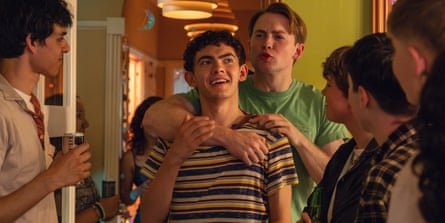
Locke adds: “It would be weird if we hadn’t shown it. Just because our show is a more earnest version of a queer representation doesn’t mean that sex [shouldn’t be shown]. It’s still a big thing for anyone in the world.” That the characters are in love is an added bonus, Locke says, but it’s not about valorising monogamy. “I don’t think Heartstopper is ever trying to say anything bad about casual sex,” he says with a shrug. “It’s just nice to see two boys in love.” The act of filming those scenes is something they’re still not used to, however. “In a silent room with lots of middle-aged men,” laughs Connor. Locke adds: “A camera right next to your face while you’re wearing a cock sock.”
The pair are newly minted executive producers on the film, roles that gave them “a lot more say and involvement in the whole process of script edits”, Connor says. “Obviously, Alice [Oseman] knows Heartstopper better than anyone and we would never want to get our grubby little hands on it too much.” Heartstopper, he adds, “isn’t just Alice’s any more. It’s everyone’s.”
I ask about reports that suggested the reason Heartstopper is ending with a film, as opposed to a season, is because of falling viewing figures for the third instalment (down about 30% compared with season two). It’s a topic Oseman had touched on during the set visit last year, citing myriad “complicated” factors that went into the decision.
Locke, who seems less at ease during the interview than his more eager castmate, bristles at the idea of declining interest. “I don’t know how true that figure is, but the Heartstopper audience has been loyal throughout. I didn’t feel like season three had any less of an impact.” When I suggest it was perhaps becoming harder to reach its desired audience in an increasingly hostile environment for LGBTQ+ people, Locke adds: “That makes it more important. What’s great is that Netflix is everywhere. So even in these countries where you can’t be so openly queer, Heartstopper is still on Netflix and people still have access to it.”
By spotlighting queer representation – be it homosexuality, bisexuality or asexuality – and the joy of trans lives, Heartstopper has always felt political. Within the world of the show, and now the film, it offers a blissful antidote to the culture wars that rage just outside its bubble.
Occasionally, however, that reality has crept in. In season three, for example, Elle’s appearance on a radio show to discuss her art is transformed into an interrogation about her trans identity, while in the film she gives an impassioned speech that touches on trans rights.
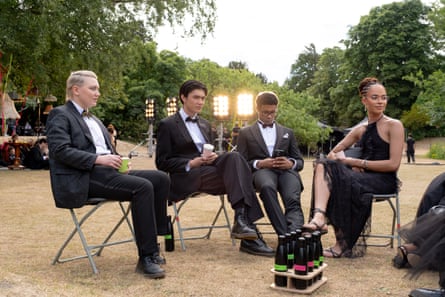
“Heartstopper is a form of escapism for queer people,” Finney tells me on set. “It’s not about: ‘Look what’s happening in the world, feel sorry for us.’ It’s more: ‘This is what queerness can be and it’s beautiful and it transforms in many different ways.’ But I think it’s just as important to have realism as it is to have escapism. Because we’re still living in an epidemic where trans people are constantly being ridiculed. Every day I try to just focus on the present and stay positive.”
While the film looks to the future, offering a taste of what each of the main character’s post-school lives might be like, there’s also a sense of looking back. Nick and Charlie are shown poring over old pictures of themselves as “babies” (AKA 14- and 15-year-olds) and reminiscing about their youths. So what advice would Connor and Locke give their younger selves at the start of their own Heartstopper journeys, before the sudden fame and pressure of carrying a cultural juggernaut?
“Just enjoy it,” Locke says immediately. “It’s a very weird and strange and stressful thing, and I know I got in my head about it.”
Connor looks over like a protective older brother. “I’d probably say something similar. It shouldn’t be scary. Heartstopper is one of the more beautiful things you could ever do. So embrace the beauty of it.”
Having each other helped. “I can’t imagine how you’d deal with it on your own,” Locke says. “It’s happened to all of us at the same time, so it’s really nice to just have that support. Especially as it’s such a unique thing.”
Connor’s and Locke’s final Heartstopper scenes together took place in Burnham Park in Buckinghamshire, a location that has appeared throughout the series. “It was just us two, which is a nice way to end it, like a very nice loving scene,” says Locke, smiling.
They both wonder if they’re in denial about the whole enterprise being over. “This press tour is a way of telling your brain that: ‘Oh yeah, it’s not actually done yet,’” says Connor. “But after this, then I think it may hit us, because there’s a feeling of: oh, wow, it’s in the past.” He pauses, still taking it in. “That’s it, school is out.”






 English (US) ·