
 6 hours ago
9
6 hours ago
9
A few days ago, we covered the modding efforts of kryptonfly, a community member who managed to get a Bartlett Lake CPU running on an Asus ZZ90 motherboard. At the time, the Core 9 273QPE used for the experiment successfully booted but didn't go beyond the POST screen. Since then, several users have been hard at work over on the Overclock.net forums, and today, their efforts have finally paid off. Bartlett Lake can not only boot inside Windows now, but it's actually stable enough to run benchmarks.
Go deeper with TH Premium: CPU
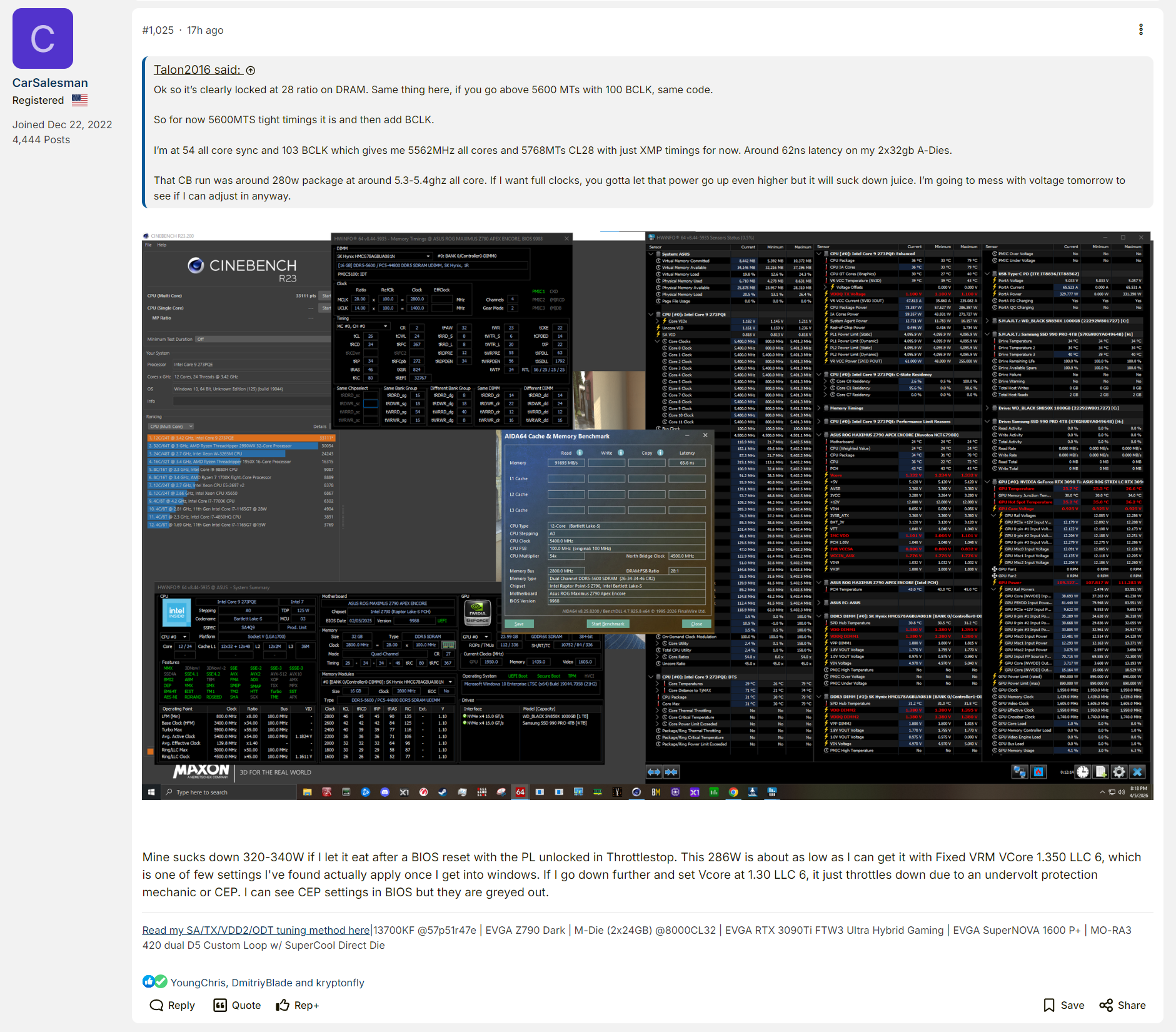
Thanks to tipster HXL, we found out about one of the Cinebench R23 scores on the forum, but there are at least three more with varying degrees of performance. First up is CarSalesman, who achieved 33,111 points in the multi-core test while their Core 9 273QPE sucked up 286W of power, and boosted to 5.4 GHz across all cores. That score puts it just above the Ryzen 9 9900X3D on average, and below Intel's own Core i7-14700 — impressive for an OEM-only chip that was never meant to run like this.
Article continues below
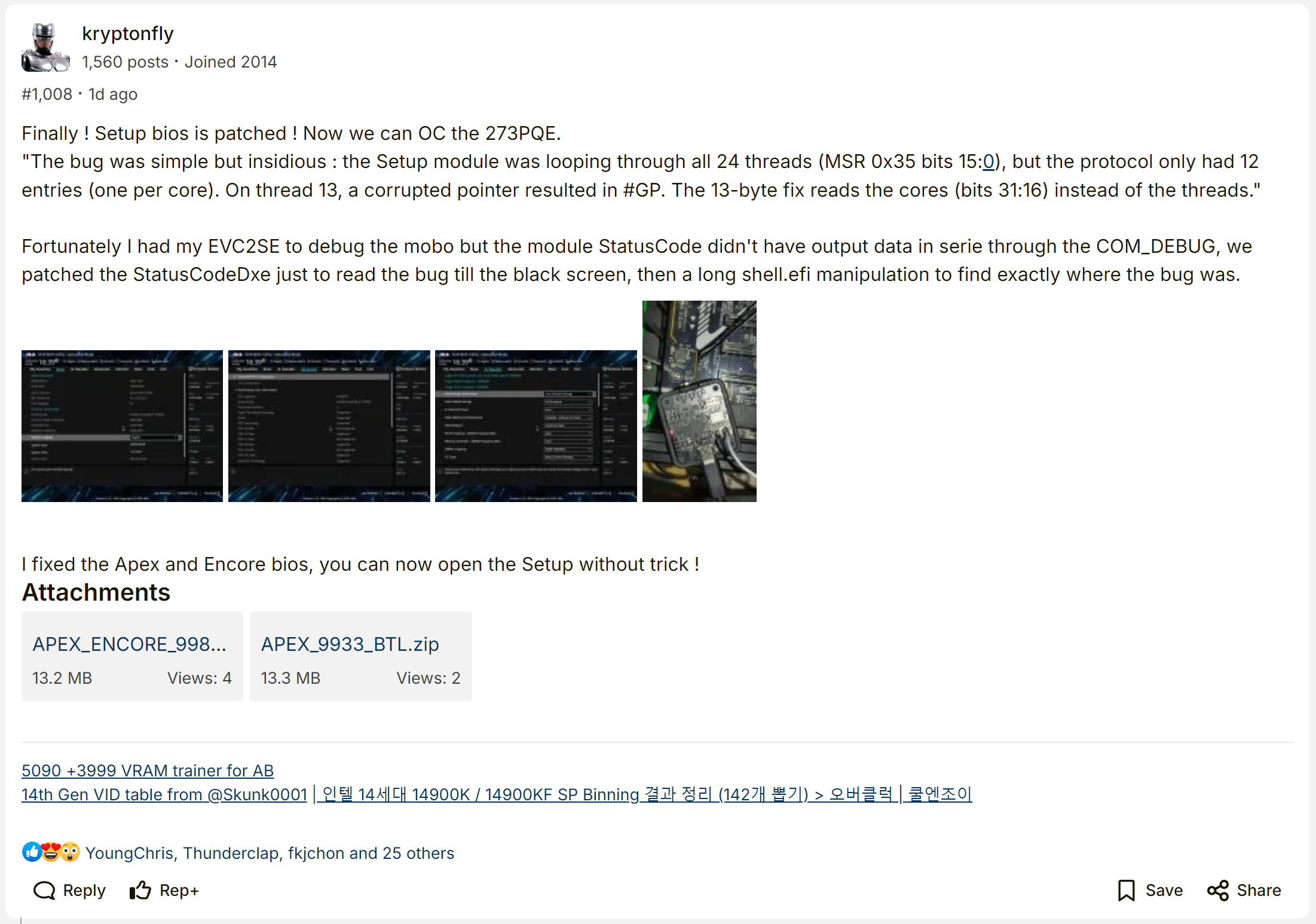
All of this was made possible by kryptonfly's efforts, who was able to patch the setup BIOS, injecting code that forced it to recognize the Core 9 273QPE. Since this is a unique 12-core CPU, featuring all 12 P-cores with Hyperthreading and no E-cores like other Raptor Lake chips, the Z790 BIOS wasn't directly compatible with it. Bartlett Lake CPUs feature only (Raptor Cove) P-cores and aren't designed for consumer setups.
Therefore, the modder applied a patch that essentially told the BIOS it should allow 12 physical P-cores. Previously, as soon as the BIOS tried to access the 9th P-core, it would exceed the hardcoded limit of 8 P-cores found in consumer firmware and just crash to a black screen. This is because standard 13th and 14th Gen CPUs only had up to 8 P-cores with Hyperthreading, even if they have a higher total core count due to E-cores without Hyperthreading.
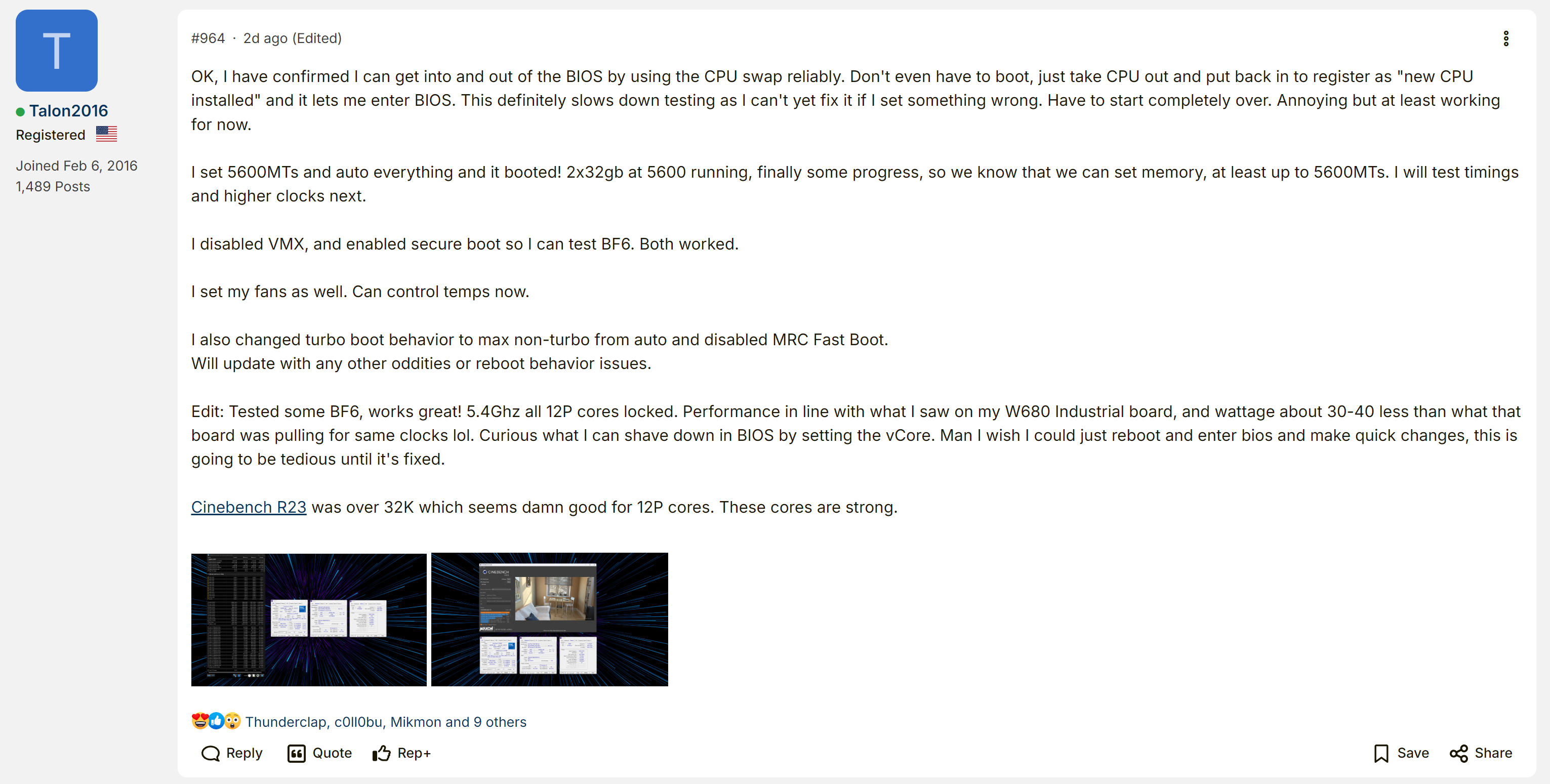
Another user by the name of Talon2016 was able to score 32,288 points, which puts them in Core i9-13900K territory. More importantly, though, Talon said they were able to actually play Battlefield 6 with Secure Boot enabled in the BIOS, achieving a similar 5.4 GHz boost clock across all cores. The test config consisted of an Asus ROG Maximus Z790 Apex motherboard kitted with 64 GB of DDR5 RAM running at 5,600 MT/s. The same user scored 33,818 points in a future run posted on the forum as well.
The thread is alive with a lot of enthusiasts kicking in with their questions, testing, and gratitude, all contributing to this project's progress in some way. Getting Bartlett Lake running on consumer hardware is a significant milestone, considering these chips were never meant to be distributed outside edge and industrial OEMs. They share the same LGA 1700 socket as other 13/14th Gen chips, so they were always physically compatible — it was only a matter of making them electrically compatible, too.

Follow Tom's Hardware on Google News, or add us as a preferred source, to get our latest news, analysis, & reviews in your feeds.





 English (US) ·