
 13 hours ago
15
13 hours ago
15
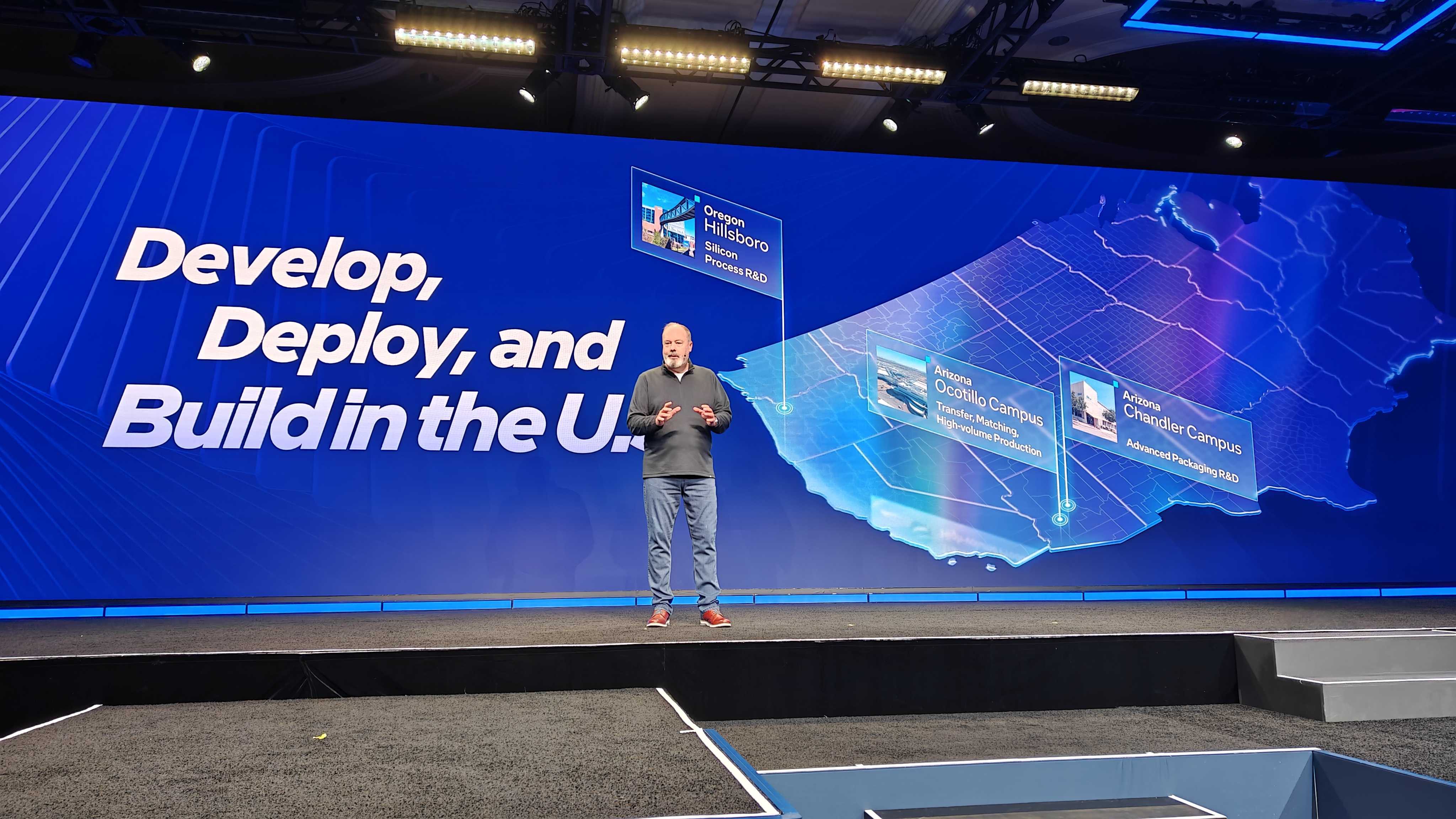
Following Intel's keynote at CES 2026, where it formally launched consumer Panther Lake products, our resident CPU reporter Jake Roach attended a press Q&A at CES in Las Vegas, featuring some of the senior staff behind Intel's Panther Lake architecture. The following article is a transcript of that Q&A session. We've edited some elements for flow and clarity, and have made notes where we couldn't quite make out what was being said. As speakers did not introduce themselves at the beginning of our transcript, we have denoted them as Journalists, denoted in the sequence that they spoke in.
Some highlights include Intel being particularly proud of making the lineup significantly easier to understand, combining the benefits of Arrow Lake and Lunar Lake, while also making fewer SKU denotations, making the lineup easier to parse as a whole. Additionally, while Intel did not announce any EVO processors at CES 2026, the company is still keeping the brand alive, with 'stricter' qualifications in place for the future.
Intel Core Ultra Series 3 Launch Event Livestream | Intel - YouTube
So, now that you've learnt a little bit more about what Panther Lake offers, here's our full, slightly edited press Q&A session. This session was around 25 minutes long, and while recording in a noisy, ambient environment, some things can get lost in the audio mix, and have been denoted as such in the copy.
Shalini Singh: Hi. My name is Shalini, Technical Marketing, Intel CCG (Client Computing Group, with me, Damien, who leads technical marketing as well. [laughs]
Damien Triloet: Yep, Technical Marketing, a lot of time spent on graphics and [inaudible]
Mitch Lum: I'm Mitch Lum, I'm the Product Manager for both Core Ultra Series 3 and Core Series 4.
Client Product Team Lead: I'm [inaudible], I lead the client product team.
Journalist 1: So, my first question is, you guys are using a lot of panthers in the presentation. It was nice. And we are used to [having], like, the codename. And when we have the product, the codename disappears. You guys don't use the code name anymore just presenting the unique architecture [...] But you guys are using a lot of panthers in design. [...] Are you guys using [Panthers] to represent this generational product for clients? The guys actually buying the product?
Client Product Team Lead: I was just gonna say, you did see the panther walk away. We will focus on [the naming convention of] Core Ultra Series 3.
Shalini Singh: Like previously, [you] will see many places where we'll continue to use the codename. Then there's just no going behind it. But the brand police will come to us and tell us "you always have to use the [inaudible] Core Ultra 3 [laughs]."
Mitch Lum: What's your advice?
Journalist 1: I know it's easier to understand names when it's just a numeral sequence, you know? But you can see how it's easy to identify this. Oh, this is a new thing. This is the Panther thing, and whatever the next thing is, the new codename [...] and you can [...] see the difference in generations this way as well. It's a good visual representation of the product.
Damien Triolet: It's a good visual representation of the product.
Journalist 1: Yeah, especially when [it's] a nice thing, a panther is a cool thing. So if you're using cool things as code names, maybe it works.
Shalini Singh: And also, for you guys, after you've seen so many panthers, it's difficult to unsee it.
Journalist 1: I mean, I mean, 300 series, 400 series. I can see where this is going, but it's a number. It's not as cool, I guess.
Client Product Team Lead: Oh yeah, we'll have it in the [press pack] that will look different, so that there'll be all the retail differentiators, and in any tech related areas, you'll see it's called call out as Panther Lake, but in end user facing [materials and assets] is going to be Core Ultra Series 3, Series 4. So, that's the least offensive way of describing the products, and I could keep going. But they'll have codenames.
Journalist 2: Do you guys see any sort of ripple effects from the ongoing price hikes, with RAM and storage as an example, like [...] Copilot+ PCs, I believe, have a minimum spec of 32 gigabytes [this is not correct, and was quickly clarified as a 16GB requirement]. So if that's true, does that affect the sales of AI PCs or Copilot PCs, going into the new year?
Client Product Team Lead: So in general, a lot of the OEMs, and you can talk to them in detail, they plan for nine months to 12 months in terms of allotment of their [products] so in the beginning through towards the end of the year, I think a lot of them are going to be reasonably okay in terms of memory. But, in general, we have to wait and see. It's like, if we can predict the memory prices, we would all also invest in the stock market, that kind of thing. So it is going to be a challenge, which we are carefully monitoring and trying to work as much as we can closely [presumably meaning with OEMs].
Journalist 3: Are we really going to be seeing developers using [inaudible, but the question pertains to AI TOPS and NPU performance]
Damien Triolet: One interesting detail about NPU 5 is that our first [inaudible, potentially Blackwell?] compatible, and PYP. So it will help developers move the roles they've done on NPU 4, and then keep investing into NPU so we see increasing traction.
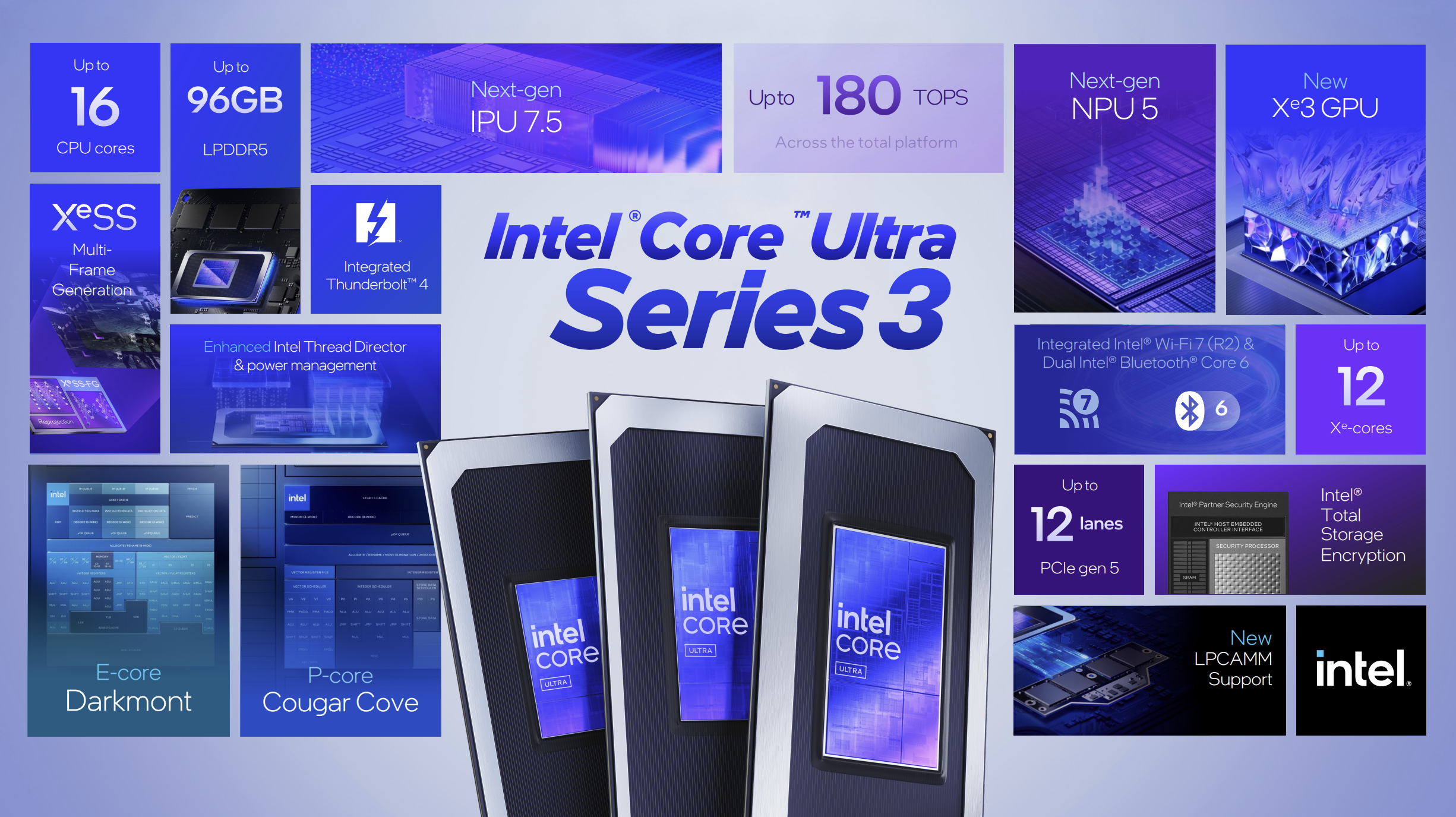
Client Product Team Lead: A lot of the time, we want to make sure they're using the right engine for the right workload. So from an Intel perspective, it's not just about the NPU. AI means it's the GPU, NPU, and CPU. So as long as they're using the right engine, we're good. And from an NPU 5 perspective, our biggest thing was we shrunk it down in size so that we can fit a lot more inside Panther Lake. So from Lunar Lake to Panther Lake, the peak TOPS, it's fairly similar.
Mitch Lum: It's 40% more die area, if you think about Lunar Lake and the kinds of systems that it went into. Now we're going into many more kinds of laptops, and we wanted to make sure that we had that scalability.
Shalini Singh: But, it's probably the only x86 product to have fully featured XPU engines to run a performance GPU. You will not see that from any of our competitors.
Damien Triolet: And you will see that in the mlperf data that we have in the project, you should have a look later. When you look at the way our different engine, GPU and NPU, behaves in approach like LLM are very consistent. Both engines have, like, full access, memory bandwidth, a ton of compute for AI. That's not something you will see on the company's source product. They will either have the GPU enable something, or the NPU enable something. We fully enable both of them. And this gives a niche set [of tools] to developers [offering] the flexibility to target the right engine, for the right competitors.
Shalini Singh: In most cases, when they don't have either the fully labeled GPU or the NPU. They even have hybrid solutions, CPU plus NPU. You probably know that, right. But our GPU and NPU solutions in most cases [inaudible].
Journalist 4: I also expect this will require all four of you to answer. Why did you add X to the names?
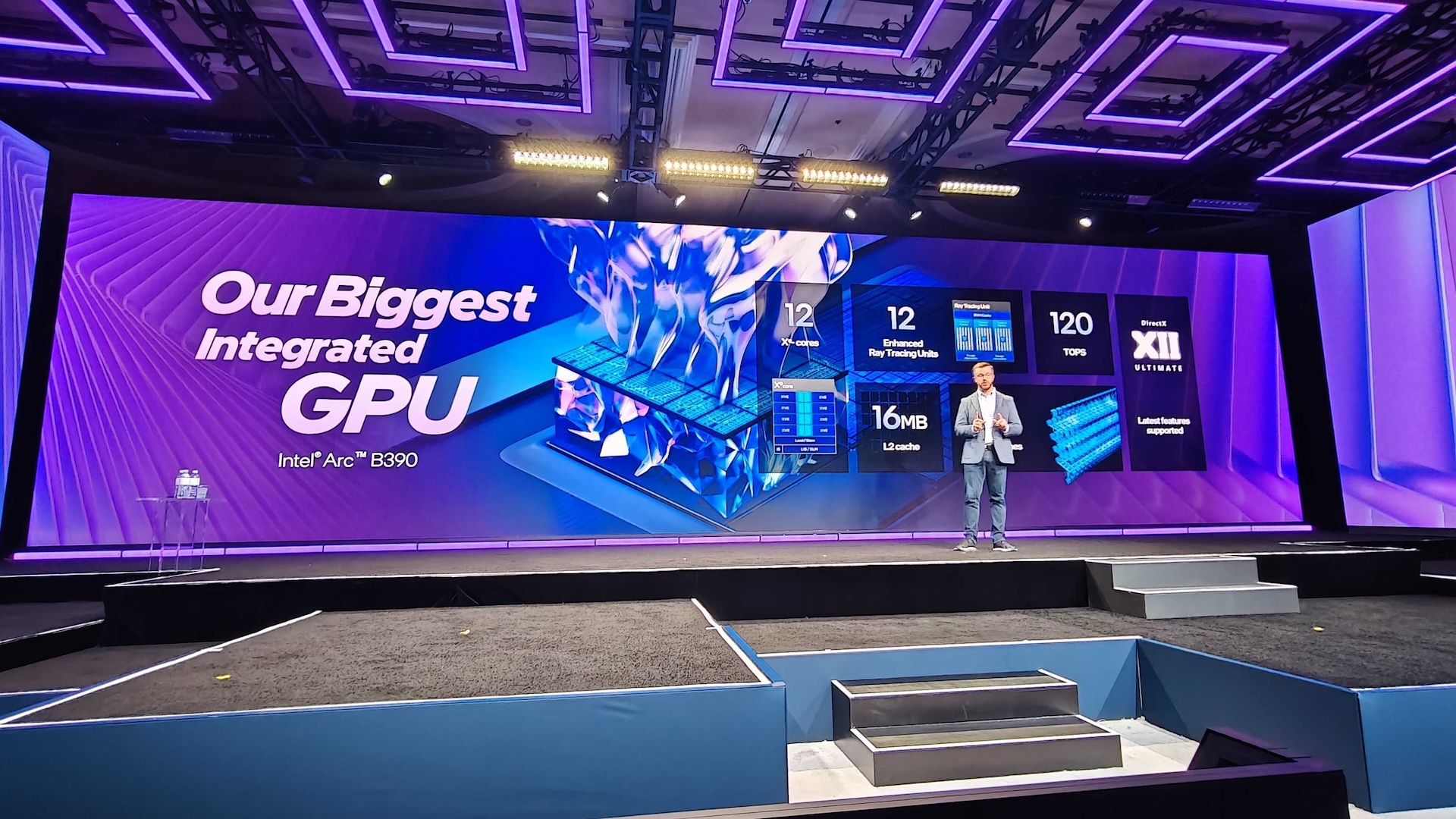
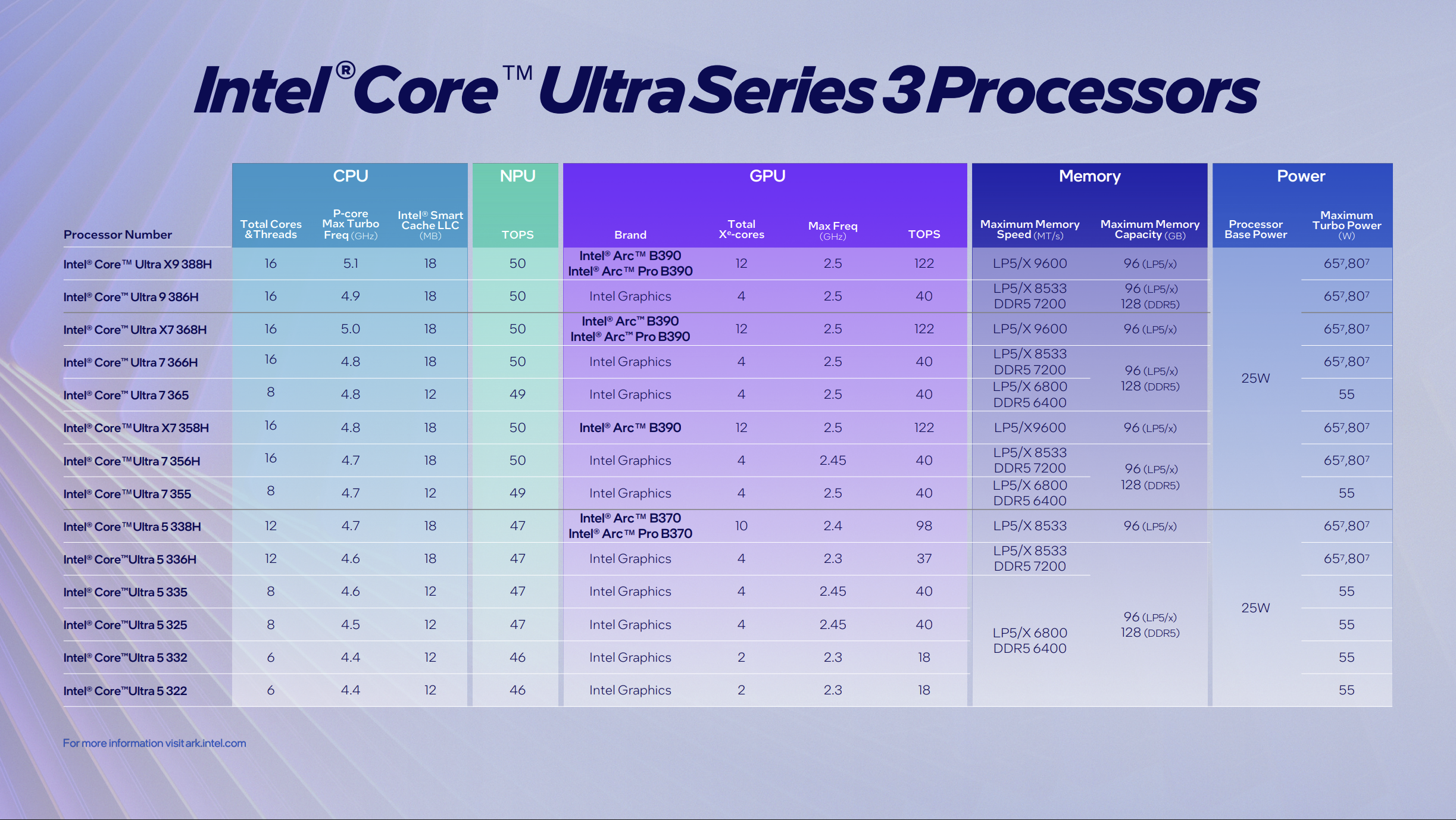
Client Product Team Lead: In terms of X's, there was [...] strong retail feedback. There are 12 [Xe3 cores]. They needed an easy way for customers walking to be able to identify that. So those [products with X in the name] will have the 12 Xe [cores], the bigger graphics, Arc graphics. So that is an easy way to identify that.
Shalini Singh: It's also the highest-end config. So most of the data that you see in the press deck will be based on that config.
Tom's Hardware: I have two questions focused on the Ultra 5 range. First, we know the core split for the eight-core configurations, and the 16-core configurations. I'm just wondering what the core split is for the 12-core configurations. And then there is a core Ultra 5 that has 10 Xe3 cores in it, but it didn't get that Core Ultra X5 branding, and I'm just wondering why that's the case.
Mitch Lum: Yeah, so, on that one, the 10 xe3 [cores], it [has] our B370. There's B390, it's 12 Xe, 370 is 10 Xe. We wanted to make sure it was really clear with the X designation that we were really referring to our top configuration, which is the B390. So that's the first piece. And then I think your second question was that [Core] Ultra 5, we've got a 12-core configuration. That's 4P, 4E and 4LP-E.
Journalist 4: I had a question on the Xe cores and the GPU. Now, are you finding most of your improvements from just increasing the number of cores? Or, were the cores redesigned? And what sort of improvements are you seeing internally today?
Damien Triolet: So the bigger part of the improvement is coming from a larger configuration. But as you've seen, some of the general numbers that we share is over 70% so there's obviously a little bit more coming to that. There's a clock increase, that's part of it, and then the IP improvements, as we've detailed, at ITT if you were there.
Mitch Lum: And, also the bigger cache, so the GPU has a bigger cache.
Client Product Team Lead: 50% more cores, double the amount of cache.
Journalist 5: Yes, you guys told us that on stage, that Panther Lake [has] 15% better performance per watt compared to last year's chips. How is that translated in real use cases, like how many more hours [of battery life] people can have on their laptops?
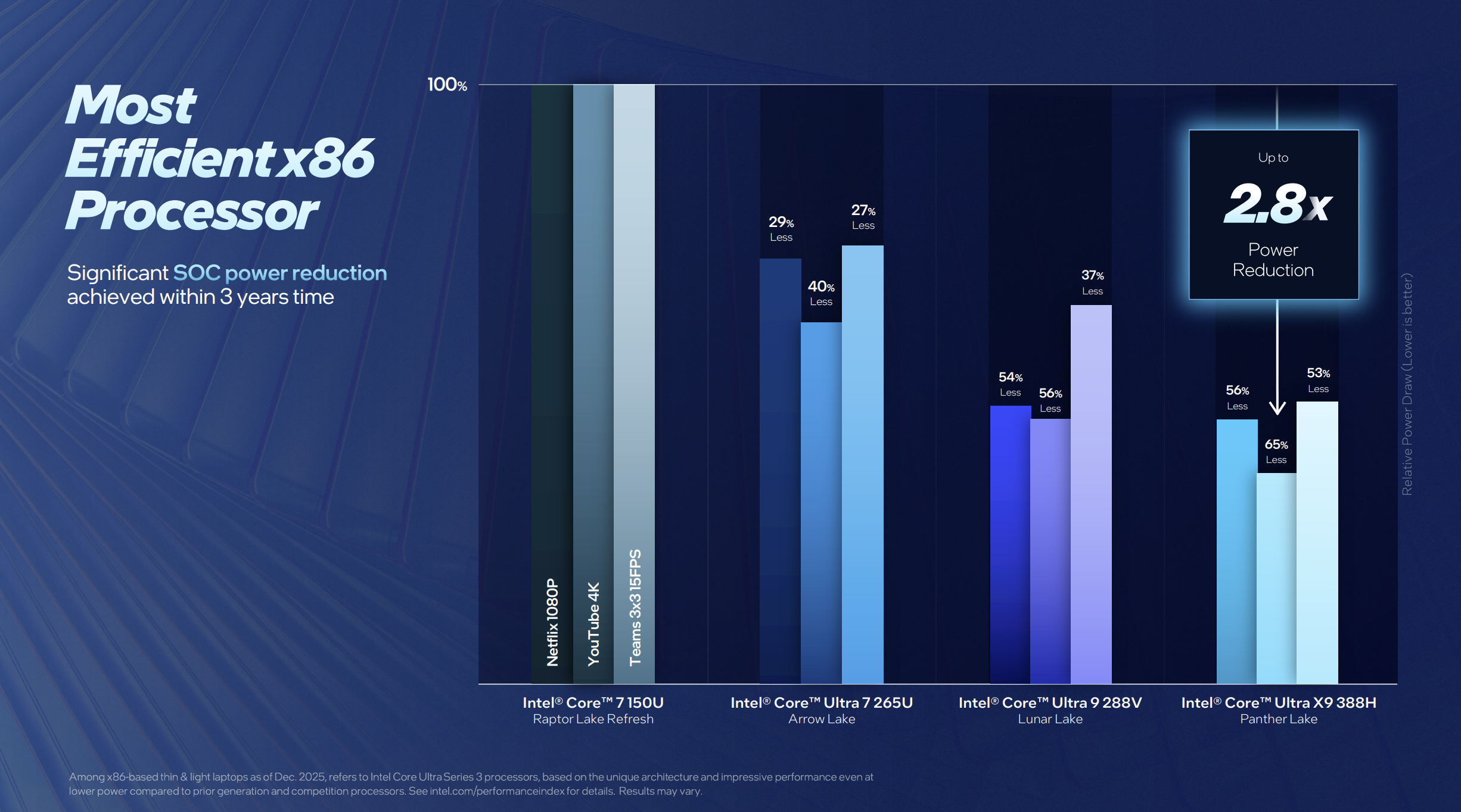
Shalini Singh: We expect to deliver Lunar Lake level efficiency. The exact battery life translation will obviously depend on the overall design. It depends on the display, the battery capacity, [and] other components that they will have on the PC. But in most cases, at the most when we when we measure power at the SOC level, Panther Lake is more efficient than Lunar Lake.
So we are seeing power savings compared to Lunar Lake itself. If you have one, or if you tested it, you probably know it's really good on battery life. So Panther Lake is very similar, and so it's basically a combination; Lunar Lake efficiency and Arrow Lake performance, right?
So, you'll see about a 60% increase in multithreaded performance, battery life, and all the SOC, power savings are going to translate to a similar to better battery life [when] compared to what you had in Lunar Lake, because it also has a [higher] number of cores. So there's going to be a little bit of a balance there.
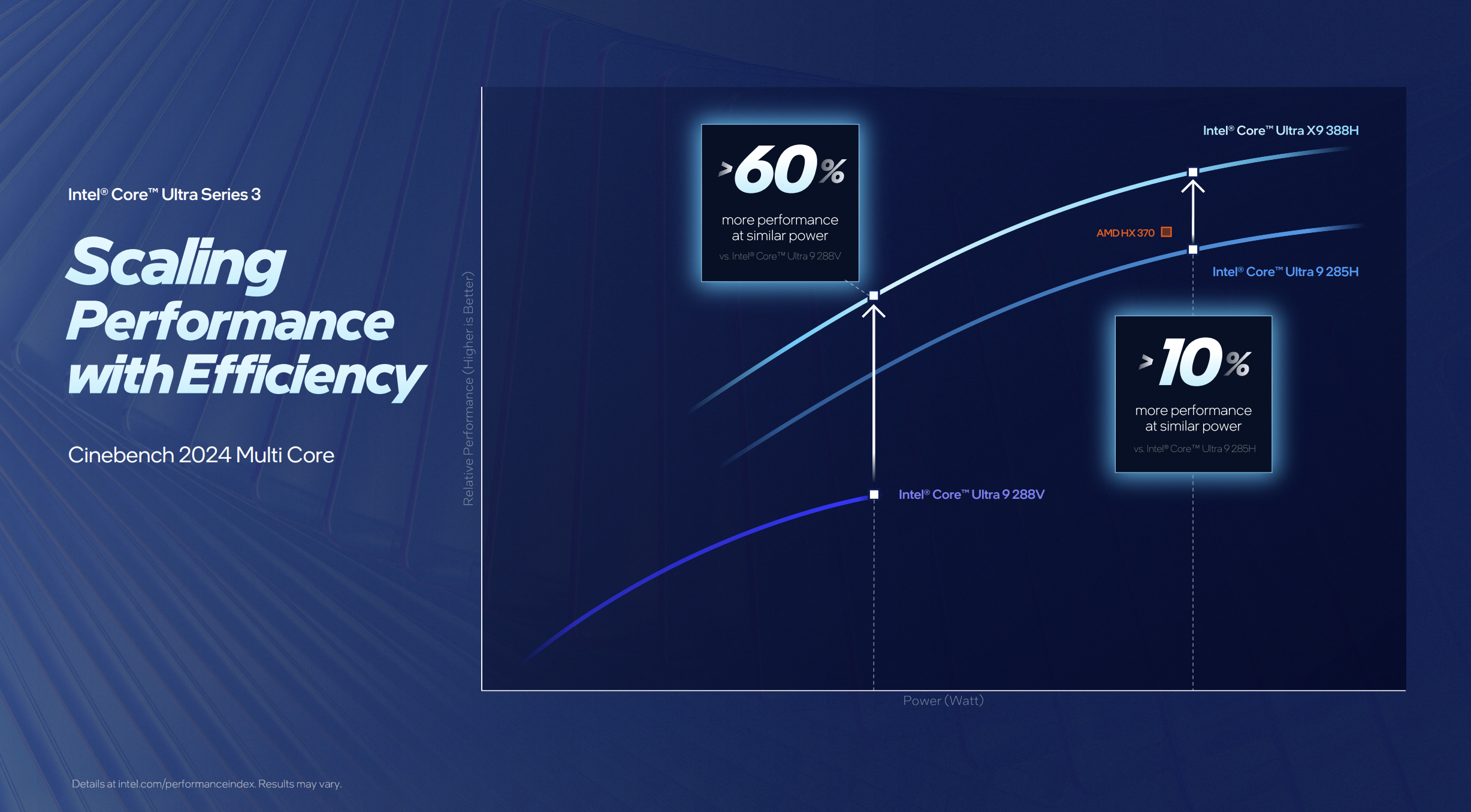
Mitch Lum: There was the 15% number from the very beginning of the keynote, when we were talking about process technology. [...] I think that was specifically comparing at a transistor level, 18A transistor performance per hour, versus [the previous generation].
Client Product Team Lead: The Lunar [to] Arrow numbers would be much higher. It's in the press deck [inaudible].
Shalini Singh: Yeah, you'll see that in the press deck. Basically, we're delivering similar performance [to] both Lunar and Arrow at 40% lower power. So [in] Arrow Lake, obviously, there is a big efficiency [gain] to be had, versus Arrow Lake, but even versus Lunar Lake, like you said, was quite good as it is. To be able to drive the efficiency further was amazing.
Journalist 5: So I was really impressed with the integrated graphics FPS [...] so I guess my question is; Do you see [integrated graphics] being kind of the future of gaming laptops, not needing that GPU anymore because you have [...] more efficiency, less heat... How do you guys see the industry moving?
Client Product Team Lead: At the highest level, I mean, this is more like the [entry-level], right? Similar to [the RTX 4050]. Clearly, there is a lot higher [power] discrete graphics, mobile display graphics available.
So, we don't see that going away anytime soon. That said, this is the first step in terms of getting to that discrete graphics level. And over time, there is going to be also creation where a lot of AI systolics in that integrated graphics [segment] is going to help. So we see this as a new breed of things that we want to build and see where AI is going to enable [Intel] to take it to another level... But in the near future? It's not going to go away. You will still see discrete graphics.
Shalini Singh: No, just to add, basically, you know, we do expect this level of graphics performance to be able to replace entry-level discrete cards, right? In some cases, even something a little bit more than that, like a 4050, like 4060, whatever. But yes, like he said, the high-end, we don't expect that to go anywhere. So those will continue to be there, but [Intel will] absolutely challenge the entry [level] domain.
Mitch Lum: And we will have Core Ultra Series 3 laptops that have big discrete graphics in them [inaudible].
Damien Triolet: As Shani mentioned, at the entry level for discrete, it is a good point for integration, for the simple reason that memory capacity for entry-level discrete is relatively limited, and more modern workloads require way more memory. So integration is a thing about how to get more accessible at that.
Client Product Team Lead: Speaking of the previous question on memory shortages... [laughs]
Journalist 6: So is Arc built into the entire [Core Ultra] Series 3 components?
Mitch Lum: There are some SKUs that are Intel graphics, and then there are some SKUs that are Arc.
Journalist 6: What about Iris, is that Intel Graphics?
Mitch Lum: Iris is a brand that we EOL'd.
Journalist 6: Is that dead?
Mitch Lum: Yeah, we end-of-life'd that brand... probably three generations ago.
Journalist 6: I'm really up to speed on that, I was asking for a friend [laughs]
Client Product Team Lead: Just to the previous point, that 'X' is there for that reason. Anything with an 'X', like X9 [or] X7, is going to have Arc integrated graphics.
Mitch Lum: So if it doesn't, there's no Arc.
Client Product Team Lead: It'll be Intel Graphics, the 4 Xe version of the...[inaudible]
Mitch Lum: There's one nuance of that at the Core Ultra 5 level with the 10 Xe/ B370, the one place you might see that is in mobile workstations.
Damien Triolet: The smaller, non-Arc Intel graphics are using exactly the same technology, but [with a] smaller configuration, because of the smaller...
Journalist 6: The same as Arc, or Iris?
Damien Triolet: The same as Arc. Between Arc and Intel Graphics on Core Ultra Series 3 is the same technology. A smaller configuration on Intel graphics, and because of that, you're not going to get the type of experience that we want to be part of the Intel Arc [product line]. We want a certain level of performance to define.
Mitch Lum: So we bifurcated. There's a 4 Xe native configuration, and 12 Xe... Because not everybody needs that 'Arc' level of performance. If you think about your general purpose IT machine not doing a lot of 3D rendering.
So, customers have said, "Hey, can we get something that has more modest graphics", or systems that are putting in discrete graphics [...] So, on Intel Graphics, you're just running Office and that kind of stuff. I mean, you can actually run games at like, okay, [framerates], but it's just not really [something to] write home to your friends about.
Client Product Team Lead: So all the IPs in terms of the system. IPs, in terms of systolic AI [...] are still very powerful AI engines. So, it will be used for a lot of AI use-cases, and all the other basic graphics.
Tom's Hardware: I just want to clarify, it's Xe3 across the board, right?
Mitch Lum: Yes, absolutely.
Journalist 6: One of the numbers that jumped out was the battery savings [while] streaming, or energy efficiency. Can you shed a little more light on those processes? And, how much was there [inaudible].
Shalini Singh: Basically, the way we measured it... the process was simple. We just did a pure rundown, right? Just ran the workload until the time the laptop died.
Journalist 6: [What about] the engineering process behind getting that efficiency?
Damien Triolet: Part of the role [...] on the engineering side was to make the communication between the different engines, the media engine, the CPU, the display engine, more efficient. And, for example, when we do a lot of the video processing, we don't need to activate the GPU part at all. The media engine can communicate directly with the display engine. And these are the types of things that we use to reduce...
Mitch Lum: Architectural [changes] impacts graphics. Media and display would be a consolidated tile. Now, our graphics tile is for rendering and the [inaudible], whereas we have display and media on the actual compute tile, so you can power the IP that you don't even need at all, much more power efficiently.
Client Product Team Lead: and also, [regarding] the overall architecture, your P-Cores... Now we have [them] in the performance cluster, which has access to L3 cache, so when you need to balance power, you don't always default to the P-cores. You can run it on the E-cores. And we also bring the Lunar Lake efficiency cluster with it. So a lot of those are just building on all the technologies which we already have. And we are also doubling down on some platform technology. So Intel Intelligent Display [and] Intel Wi-Fi cut [a] significant amount of power when it runs. So all of those are going to be exclusive to Intel platforms, and they help displays a big part of [inaudible].
Shalini Singh: The low-power island basically adds to what he's saying. We started this journey back with Meteor Lake. [...] You know, the low-power island had 2 E-Cores, then with Lunar, we had doubled the quantity, and we had four [E-cores in Lunar Lake]. This time, we have eight [total E-cores, including LP-E]. So it's continuing to be like a significant portion, where workloads can now be sustained on that low-power island.
Journalist 7: Usually, we have a process watch, will we hear a little about EVO?
Client Product Team Lead: Yes. Short answer. In this generation, [...] our focus is going to be more quality than quantity. So there will be less EVO devices, but we will have stricter specs to showcase the best.
Journalist 7: You said, stricter, stricter, KPIs, like, what do they exactly look like?
Client Product Team Lead: Like in terms of resolution, in terms of battery life [...] instead of having two different cut-off points [For EVO SKUs], there will be [fewer] exceptions.
Journalist 8: When you guys were doing the comparisons between Lunar and Panther Lake, you said 77% faster gaming and 60% for other stuff, but we looked into the small print, it says that you're comparing the V SKUs to other H SKUs. One's more GPU efficient, one's more AI efficient, so [inaudible]
Damien Triolet: So if you go to the press deck, you're gonna see the comparison between all of them, right? In the keynote, we simplified. We take a few points. In general, you will see that both AI and gaming are faster [in Panther Lake SKUs] than the previous generation. The 70% plus [performance uplift in Panther Lake] for gaming, for example, applies to both Arrow Lake H and Lunar Lake, so you will see the same type of improvements. On AI in general, the improvement versus Alder Lake H is higher than versus Lunar Lake, especially on the NPU side. In Lunar, we're already at a relatively large NPU.
Mitch Lum: And maybe implicit to your question is the PL setting. So when we compare [the] Core Ultra Series Three versus the 288V. It's at 25 watts.
Shalini Singh: It's basically peak performance, right? So Lunar Lake's peak performance was about 25 to 30 watts.
Mitch Lum: So we compared it, apples to apples. So 25 watts versus Lunar Lake, 45 watts versus Arrow Lake.
Client Product Team Lead: And this is where the core name versus the [inaudible] company, all of Lunar Lake had the V-series. Arrow Lake had H. So when we compare talking Lunar Lake, it's always going to be V. right, and then that's why Damien said we have both numbers in the press deck, you'll see some Arrow Lake H.
Journalist 8: So all of these [CPUs] that are announced today, H?
Client Product Team Lead: We have H and non-H. So in Panther Lake, there are products that have an H, and there [are] products without an H suffix.
Journalist 8: Okay, what [are] the ones without the suffix?
Shalini Singh: You just have a number. You do not have [an] H. But think about it this way, the product transition for Panther Lake is basically [that] there were two products we announced last year, Lunar Lake and Arrow Lake, right? Arrow Lake was generally for higher performance, more cores, at a little bit of a higher PL1 (sustained power limit). Lunar Lake was more [about] power efficiency, battery life, good performance, and a lower power level. Both of those are basically transitioning to Panther Lake this year. So whether Yes, so whether you go with the suffix or...
Journalist 8: Why do you guys make this so confusing? So, now this series will have H, and...
Shalini Singh: Non-H. We're not doing any more V-series.
Journalist 8: [...] There's no more HX?
Client Product Team Lead: HX is in a higher category. [...] So the way to think about it is, U,V,Y,H, all of this creates an overlapping power level. With Panther Lake, we are going at a similar TDP. So all of Panther Lake starts at 15, and goes to 45 or 65 [Watts] depending on the SKUs. So what we did is we tried to simplify it, and in that range, you just have H or no [H suffix], that's it. So you don't have any more V's, no Y's, no U's. [...]
Mitch Lum: Just to tie up on that, so the parts with no suffix are basically eight-core based. You know how we show the die package combination? Those are eight-core based, the 16-core base all starts with H, so that's how you know you get more [inaudible].
Tom's Hardware: So, on gaming performance [of Panther Lake], you were comparing to Arrow Lake H, which I believe is not at ISO power...
Shalini Singh: It is.
Tom's Hardware: Is that ISO at 45?
Shalini Singh: Yes, 45. We're actually comparing to Arrow [Lake], we're comparing to Lunar [Lake], we're also comparing to Nvidia.
Tom's Hardware: Do you have numbers at peak power, for 115 [Watts] on Arrow Lake H, compared to 65 [Watts] on...
Shalini Singh: No, we're doing it at sustained PL1. So, 45 to 45, 45 to 25, and then for the competition, whatever their out-of-the-box sustained power is.
Tom's Hardware: Yeah, I was just curious for efficiency.
Client Product Team Lead: Arrow Lake H peak power, as in the high-end PL1 is 55...
Tom's Hardware: Max turbo?
Client Product Team Lead: 110 et cetera, will be the system power, if you're putting in discrete graphics. The CPU itself is 55 [this is incorrect, as many Panther Lake SKUs have PL1 of 65W].
[Session ends]
Stay tuned to Tom's Hardware Premium, where we'll be posting much more from CES 2026 over the coming days.





 English (US) ·