
 4 hours ago
7
4 hours ago
7
The mid-range CPU segment has become more competitive than ever, with both Intel and AMD refreshing their lineups and pushing aggressive pricing. In one corner, we have the Intel Core Ultra 7 270K Plus, an important reset for Intel that prioritizes class-leading productivity performance over efficiency, while also offering solid value. In the other corner is AMD's newly launched Ryzen 7 7700X3D, a more affordable, slightly lower-clocked alternative to the 7800X3D.
This faceoff is particularly interesting because the two chips take very different approaches despite costing about the same price. The Core Ultra 7 270K Plus packs 24 cores and excels in productivity workloads, while also delivering Intel's strongest gaming performance in years. The Ryzen 7 7700X3D, meanwhile, relies on AMD's proven 3D V-Cache technology to deliver gaming performance within 5% of the 7800X3D, although it trails significantly in single- and multi-threaded workloads.
While the Ryzen 7 7700X3D is aimed at gamers looking for X3D performance at a lower price, it faces stiff competition from Intel's aggressively -priced Core Ultra 7 270K Plus, as well as its own sibling, the Ryzen 7 7800X3D, which is often available for only a little more.
So, is AMD's gaming-focused approach enough to beat Intel's well-rounded Arrow Lake Refresh processor, or has Intel finally found the right balance of price and performance to reclaim the mid-range crown? In this six-round faceoff, we compare these two sub-$350 CPUs to find out which one comes out on top.
Features and Specifications: Intel Core Ultra 7 270K Plus vs AMD Ryzen 7 7700X3D
Swipe to scroll horizontally
Core Ultra 7 270K Plus |
$320 ($300) |
Arrow Lake Refresh |
24 / 24 (8+16) |
3.7 / 5.4 |
3.2 / 4.7 |
76MB (40+36) |
125W / 250W |
DDR5-7200 |
Ryzen 7 7700X3D |
$330 |
Zen 4 |
8 / 16 |
4.0 / 4.5 |
N/A |
104MB (8+96) |
120W / 161W |
DDR5-5200 |
Taking a look at the technical specifications, it's clear that each chip adopts a distinct strategy for the mid-range market. While Intel has optimized its architecture for a higher core and thread count along with improved interconnect speeds, AMD continues to leverage its stacked cache to maintain gaming dominance on a long-lived platform.
The Intel Core Ultra 7 270K Plus is based on the original Arrow Lake-S family, utilizing the same microarchitecture that we saw on the 265K, built using TSMC’s 3nm process. It matches the flagship 285K with a 24-core configuration (8 Lion Cove P-cores and 16 Skymont E-cores) and operates with a 125W TDP. The chip can scale to a 250W Maximum Turbo Power (MTP), which is the maximum power limit that this CPU can consume for short periods when running at maximum turbo boost frequencies
Intel has also standardized several enthusiast-level performance tweaks for Arrow Lake Refresh, most notably a 900 MHz increase in die-to-die frequency and a 400 MHz fabric speed boost. It also officially supports faster DDR5-7200, along with 20 lanes of PCIe Gen 5 and 76MB of total cache. Possibly the only major concern with the Core Ultra 7 270K Plus is the LGA 1851 platform. With Intel's next-generation Nova Lake processors expected to launch later this year, the current platform will have a relatively short lifespan, restricting any future upgrade options.
The AMD Ryzen 7 7700X3D serves as a more affordable, lower-clocked variant of the 7800X3D, featuring the same eight Zen 4 cores with a peak boost clock of 4.5 GHz. Its primary architectural strength is its 104MB of total cache including 64MB of vertically stacked L3, which is specifically tuned to eliminate memory latency bottlenecks.
The chip is rated at a 120W TDP with a 162W Package Power Tracking (PPT) limit, though it frequently operates well below these levels during gaming. A major selling point for Team Red is motherboard flexibility as the 7700X3D can be used with existing AM5 motherboards (600 and 800-series chipsets), and AMD has committed to supporting the socket through at least 2029.
⭐ Winner: Intel Core Ultra 7 270K Plus
While AMD offers a more stable platform and superior gaming efficiency thanks to its large cache size, Intel’s hardware package is more comprehensive for the price. The 270K Plus offers triple the core count, significantly higher frequencies, and faster memory support.
Gaming Benchmarks and Performance: Intel Core Ultra 7 270K Plus vs Ryzen 7 9700X
To evaluate the gaming performance of these two chips, we conducted our testing at 1080p resolution using an Nvidia GeForce RTX 5090. We used this setup to prevent the GPU from becoming the bottleneck, allowing each CPU's gaming performance to shine through. By removing the graphics card as a limiting factor, we can see exactly how the 7700X3D’s 3D V-Cache stacks up against the higher core count and clock speeds of the 270K Plus.
Image 1 of 22
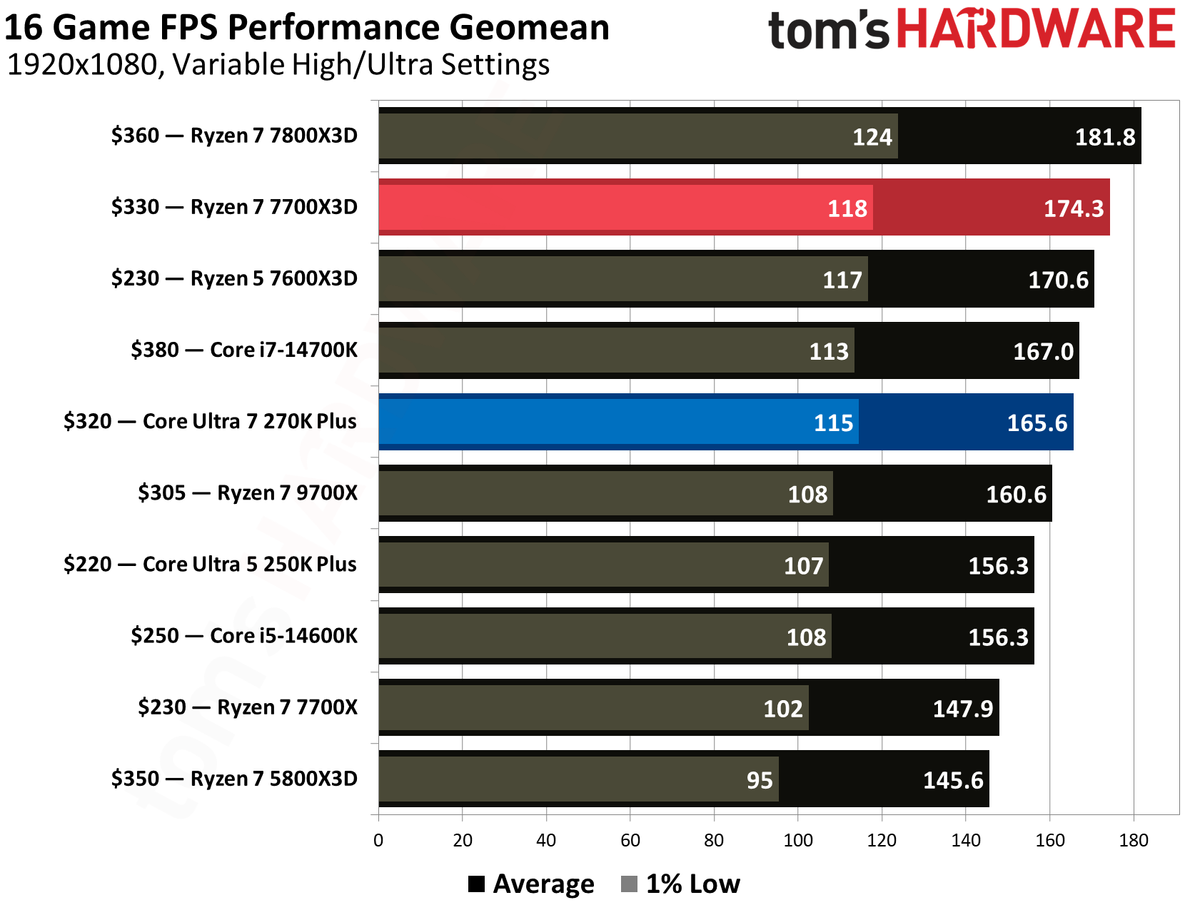
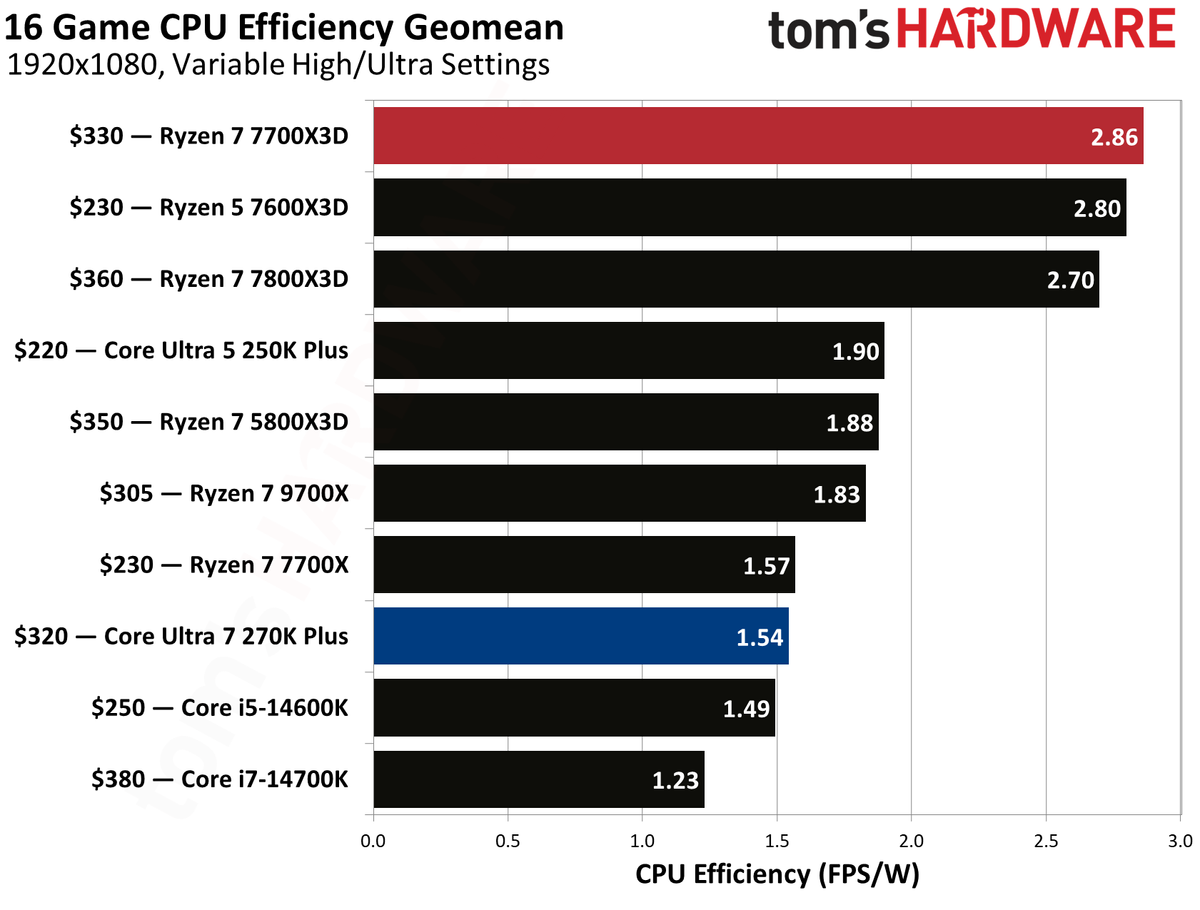
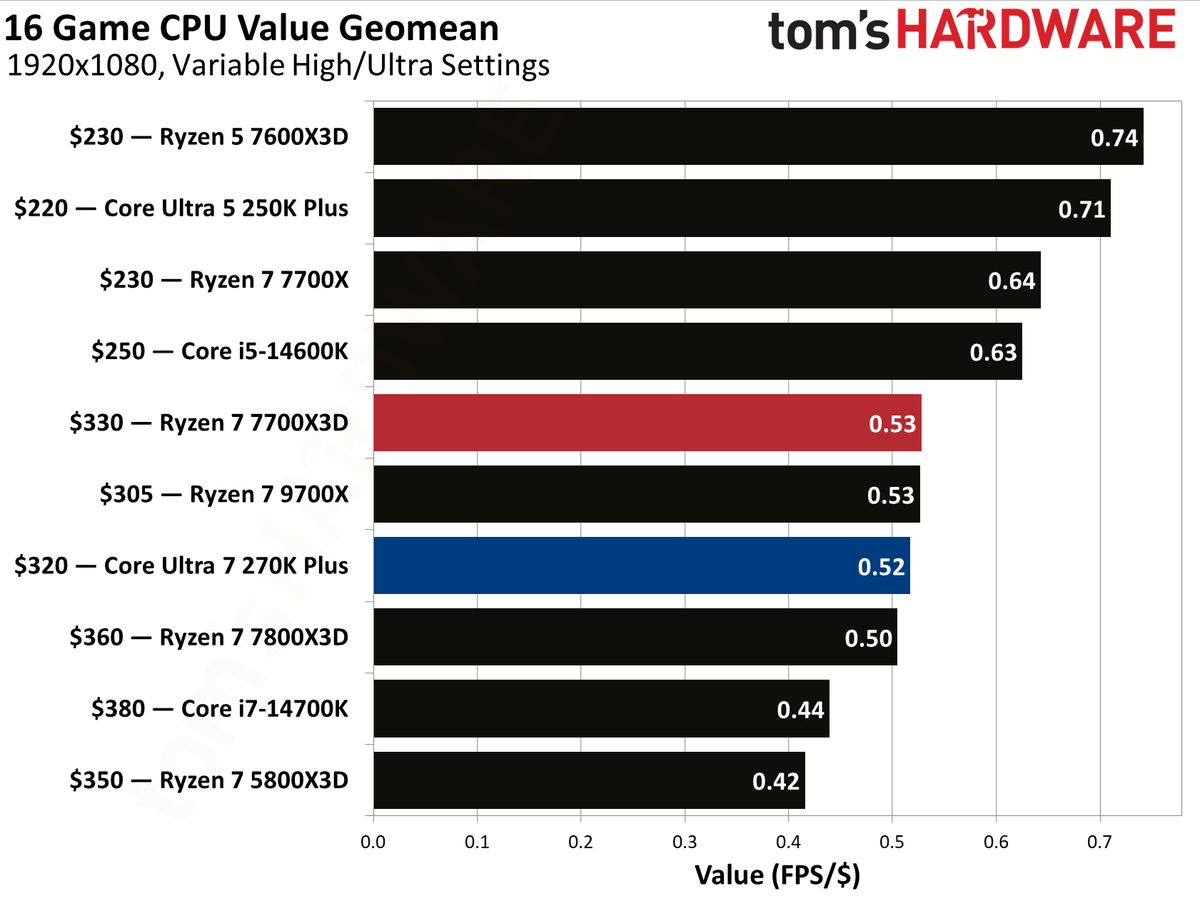
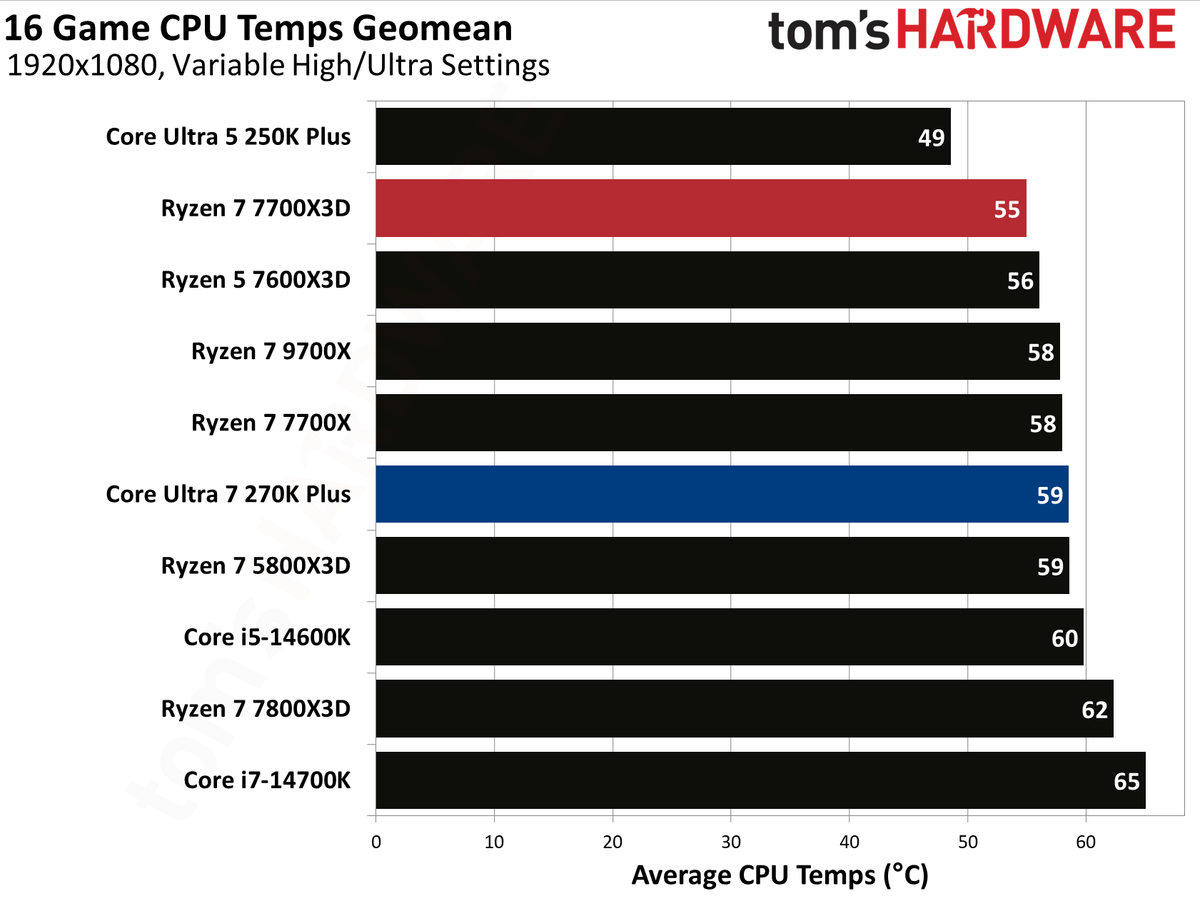
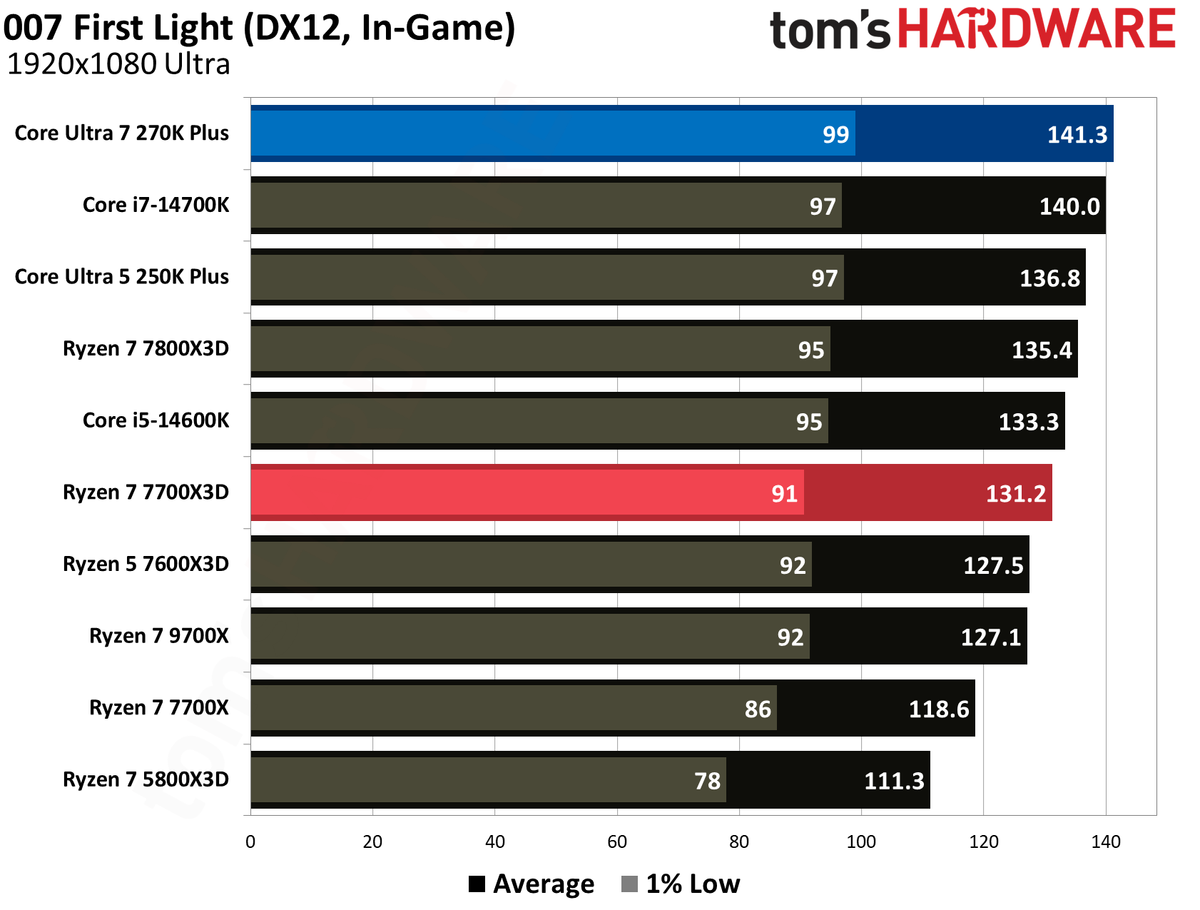
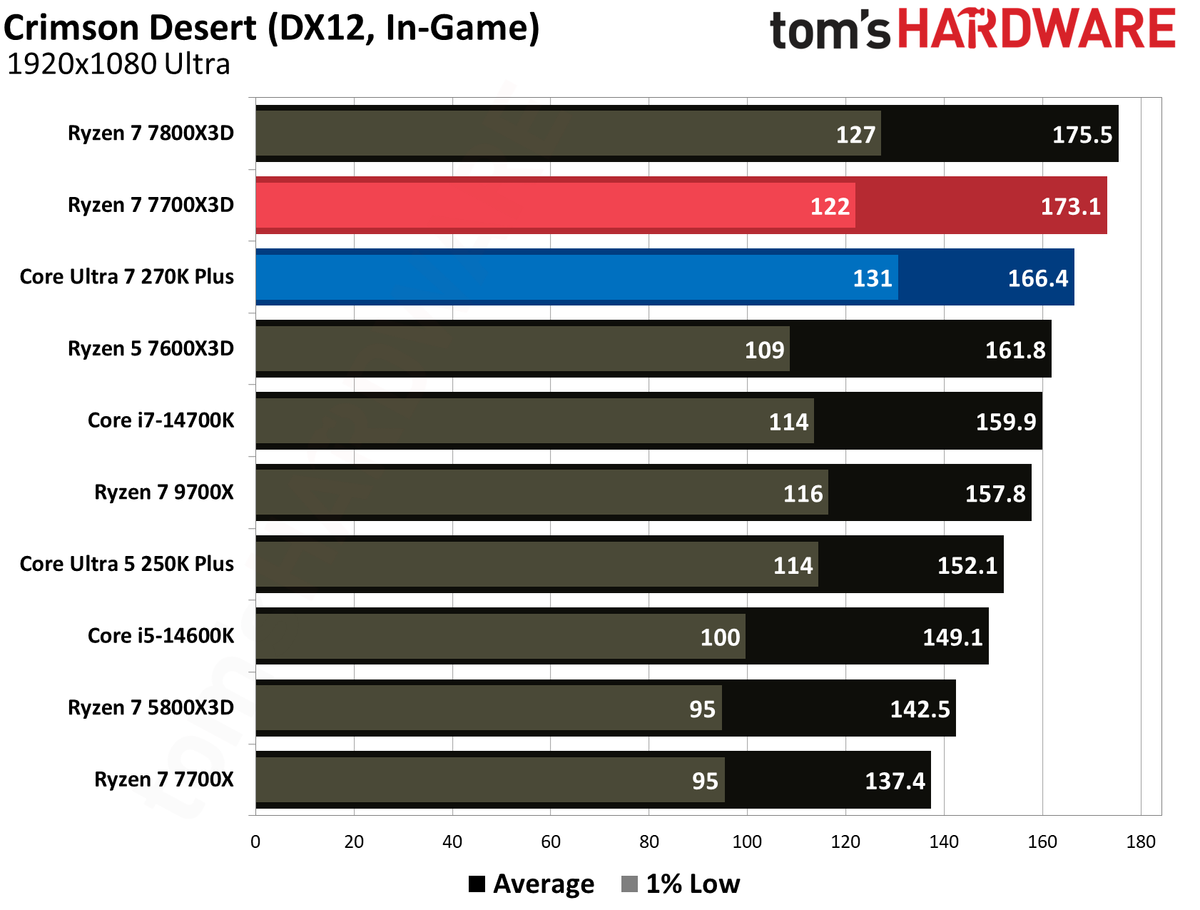
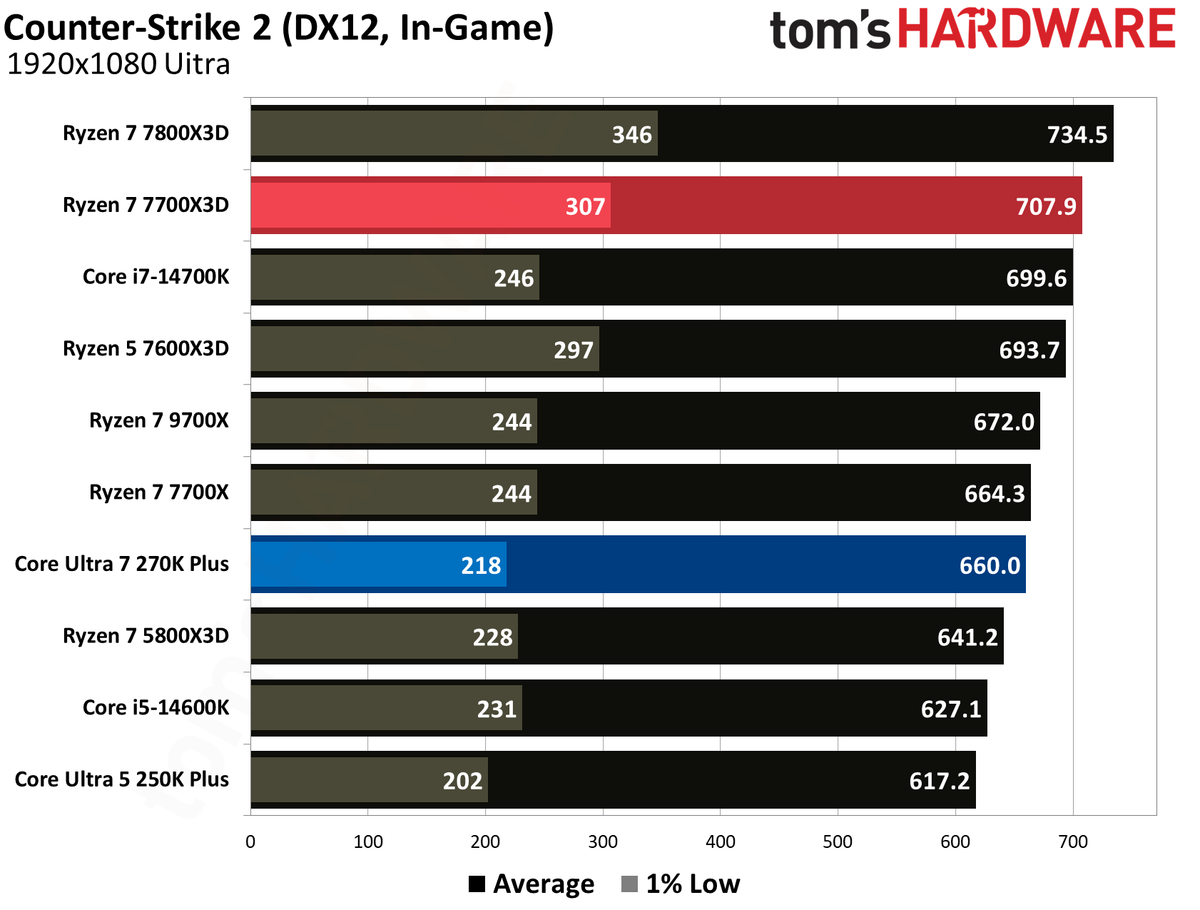
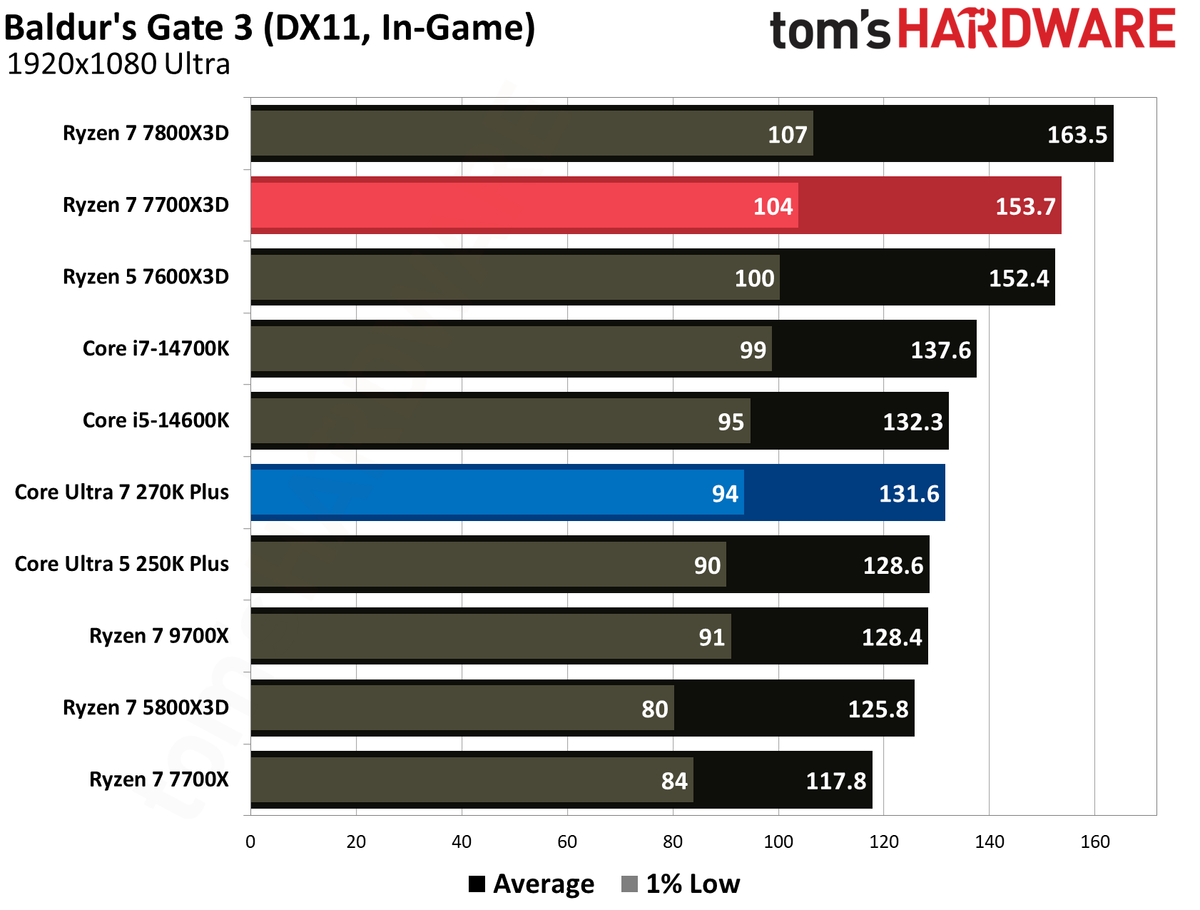
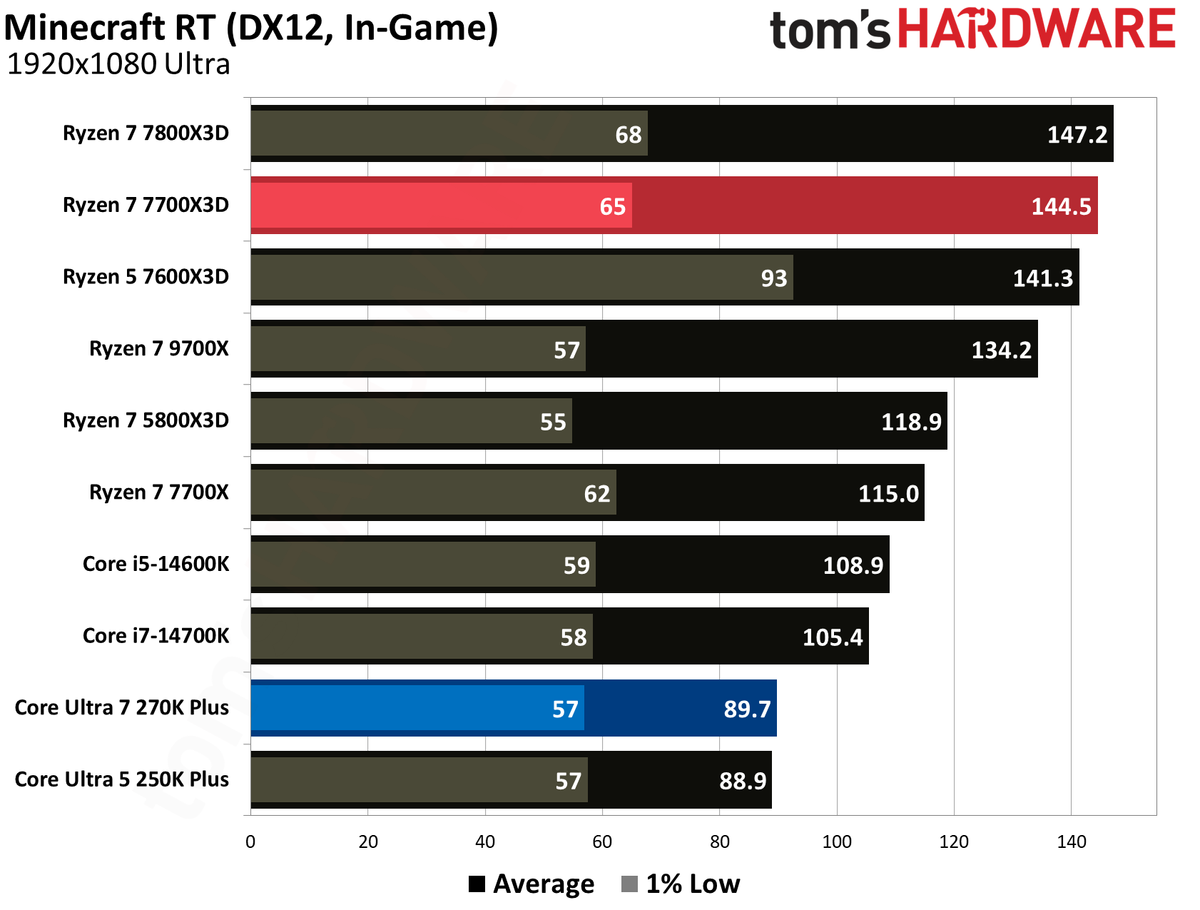
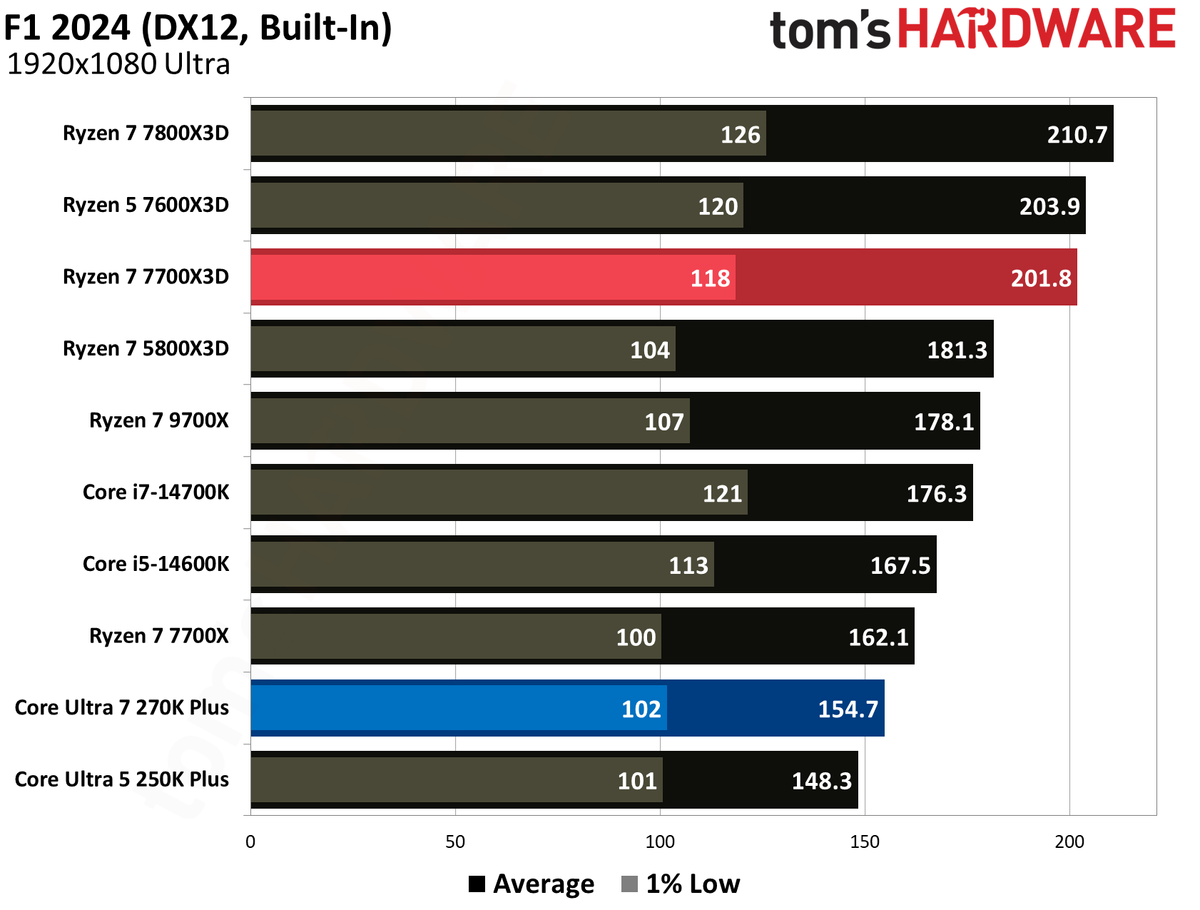
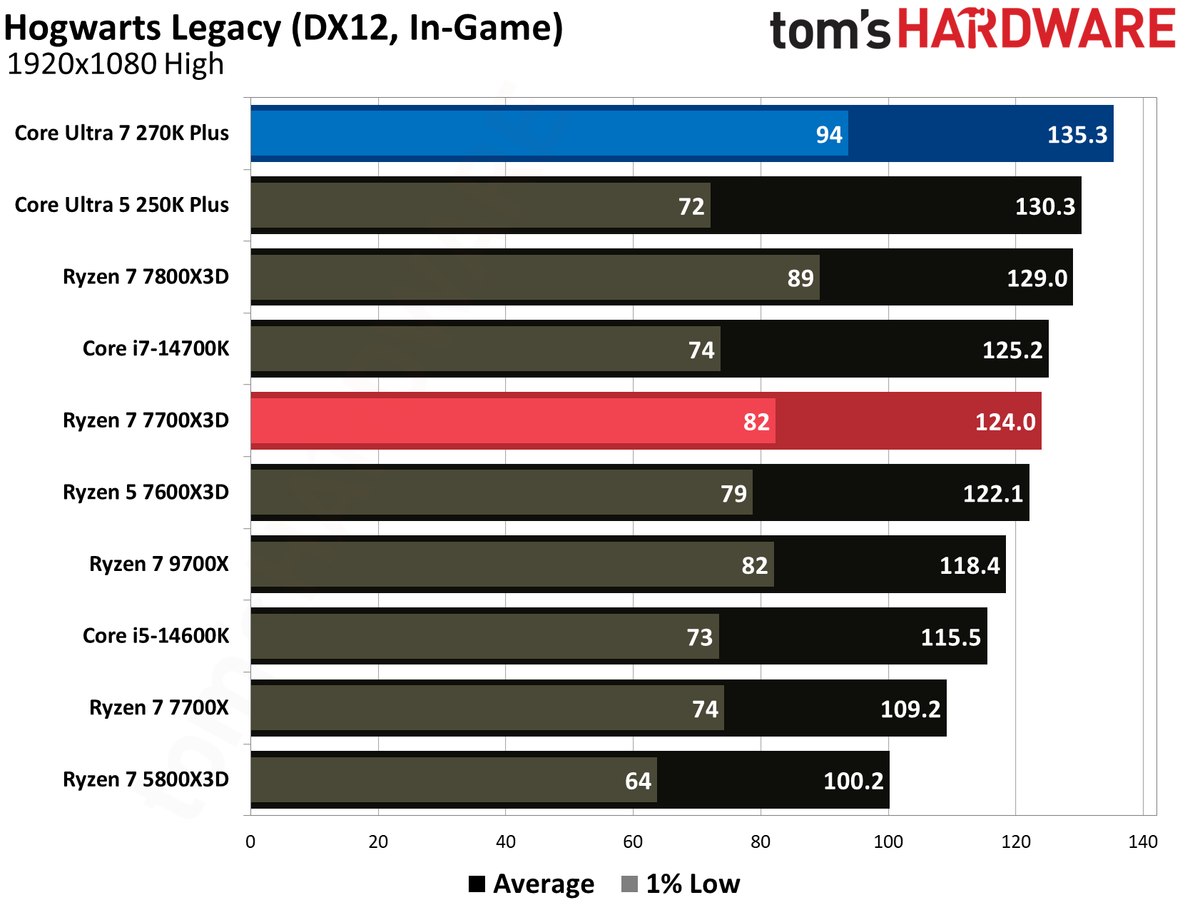
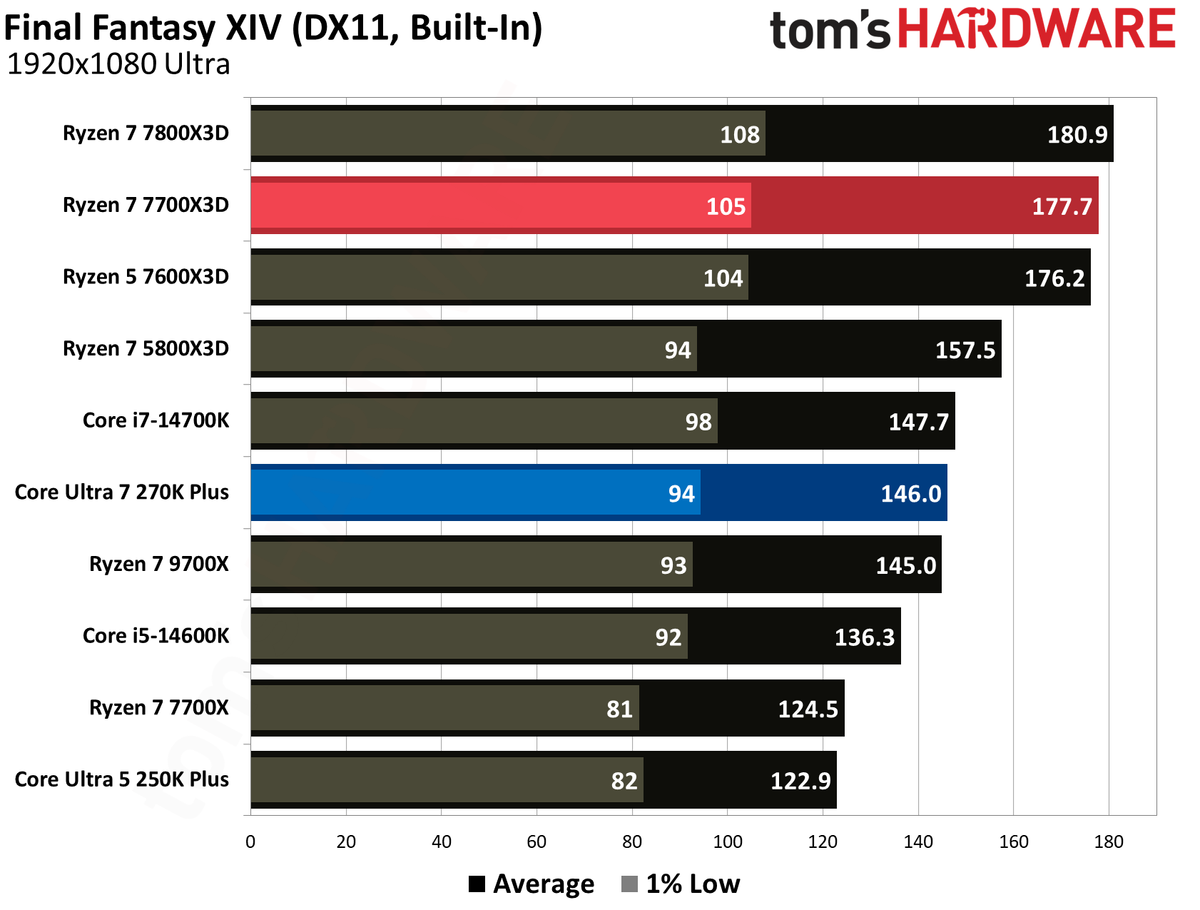
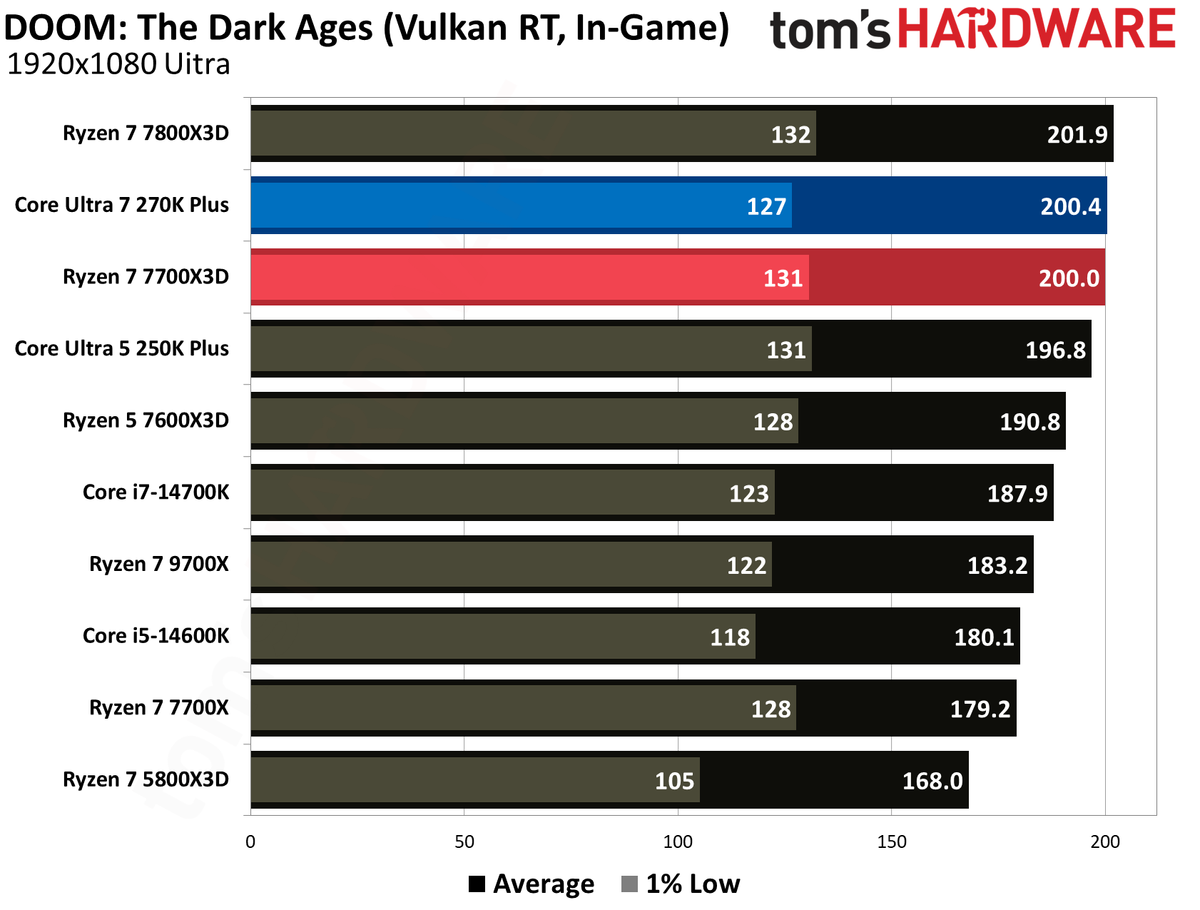
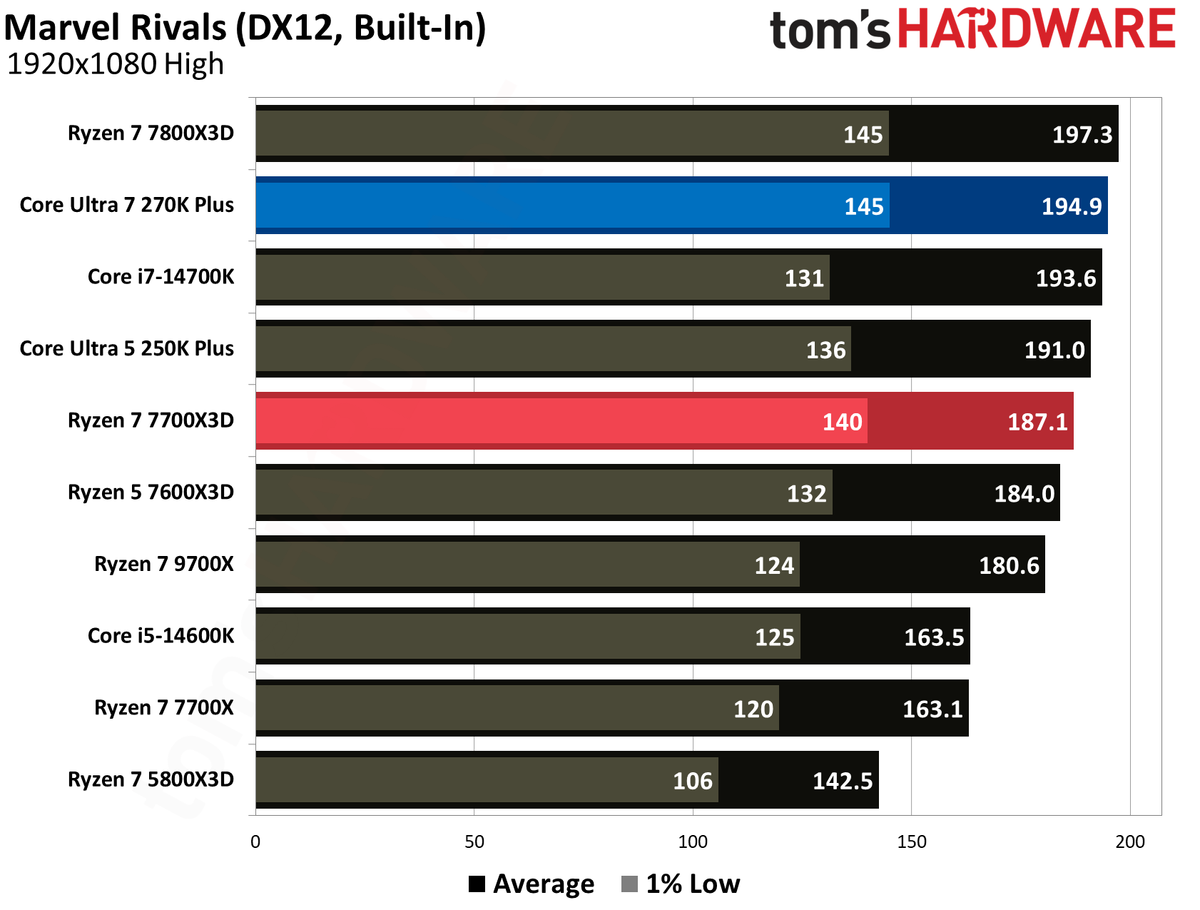
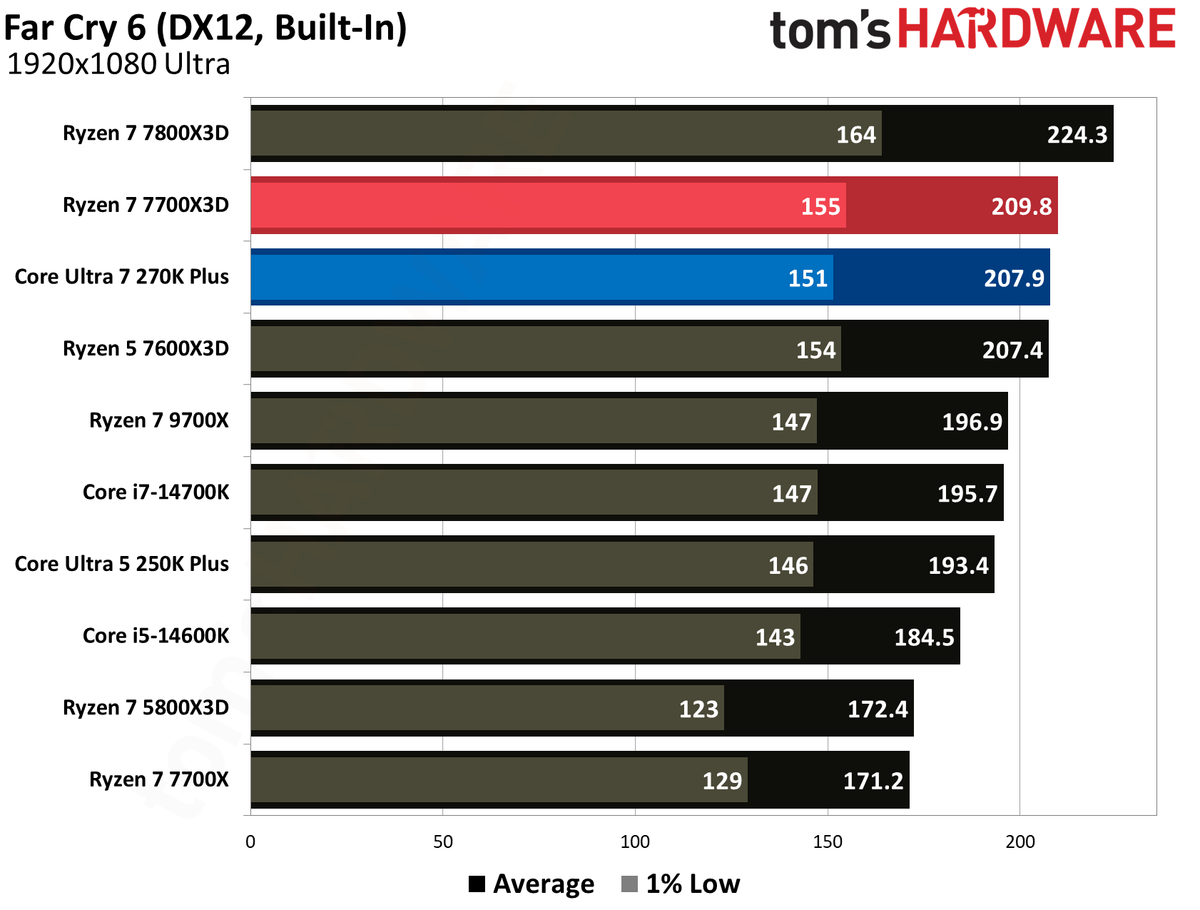
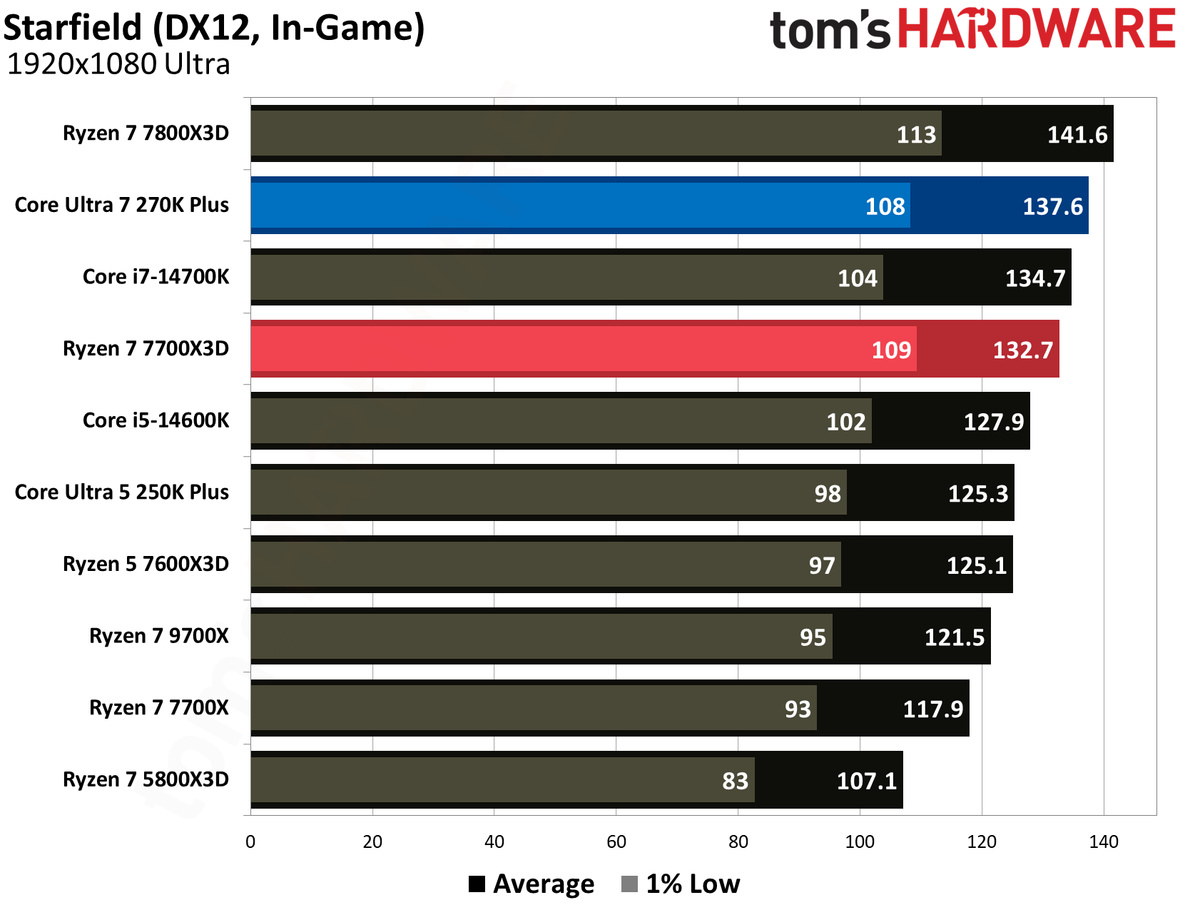
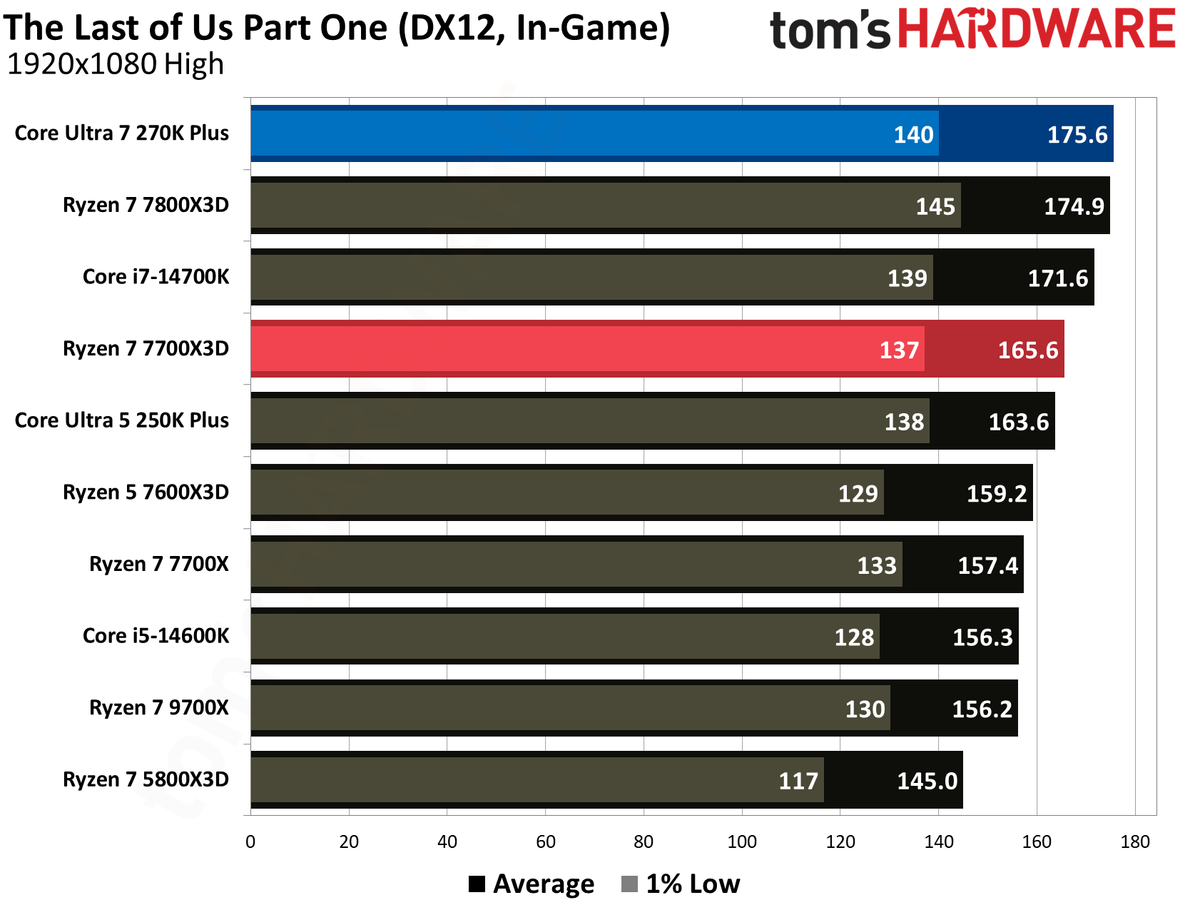
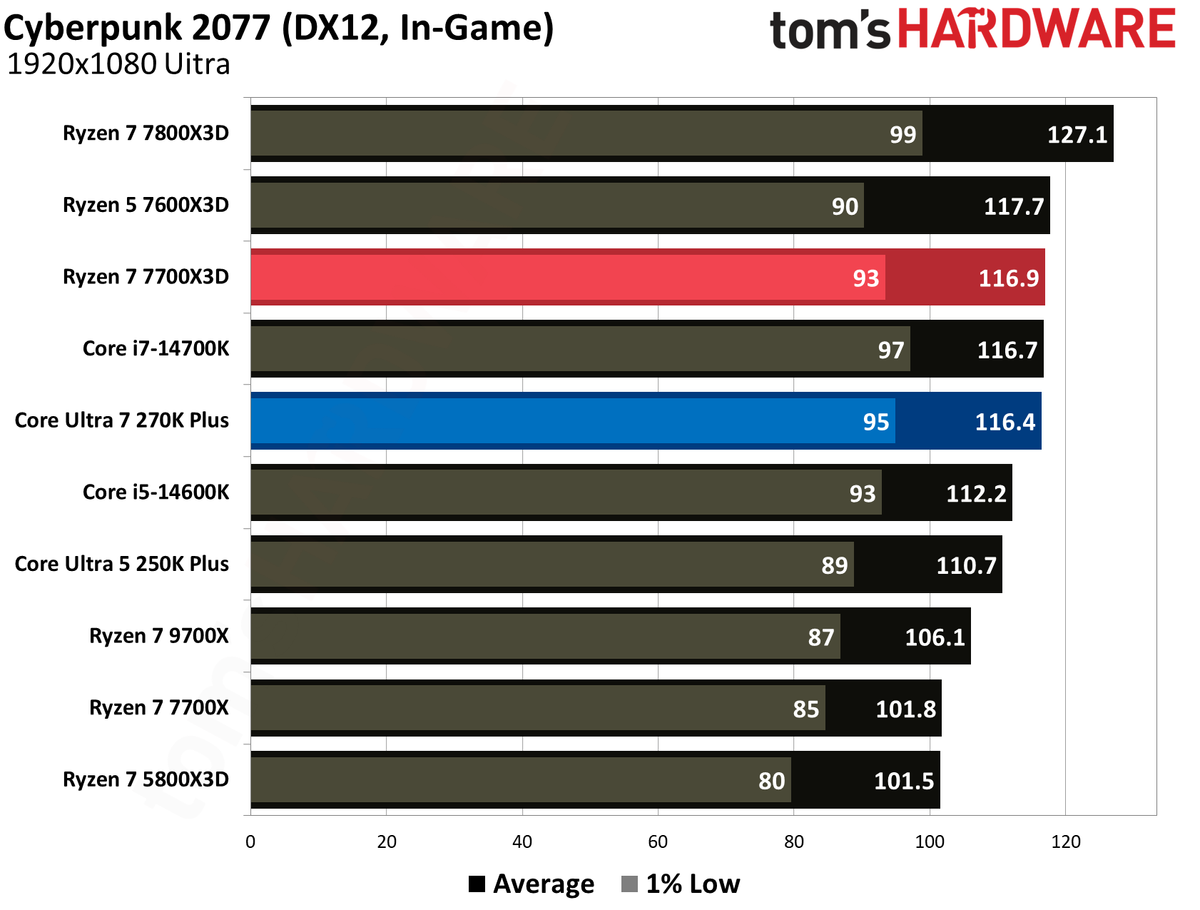
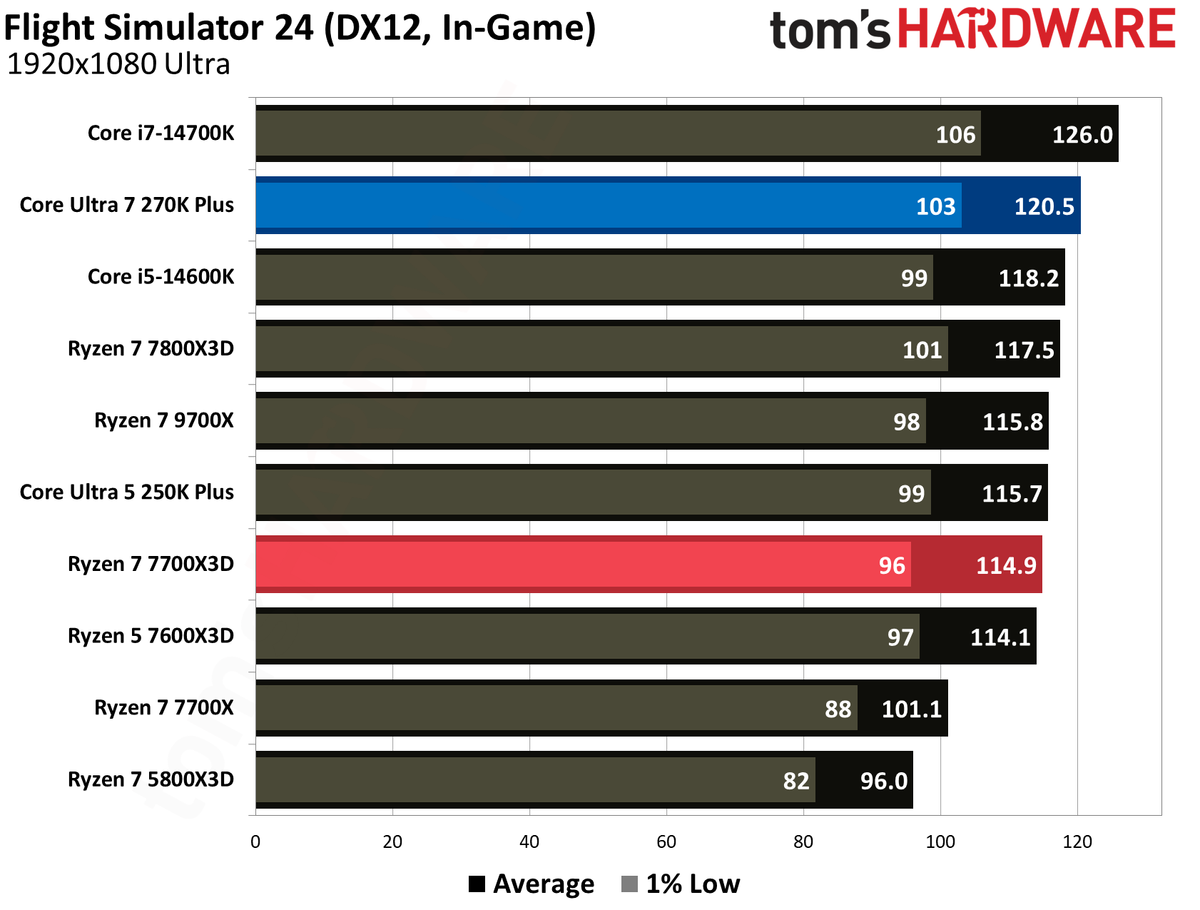
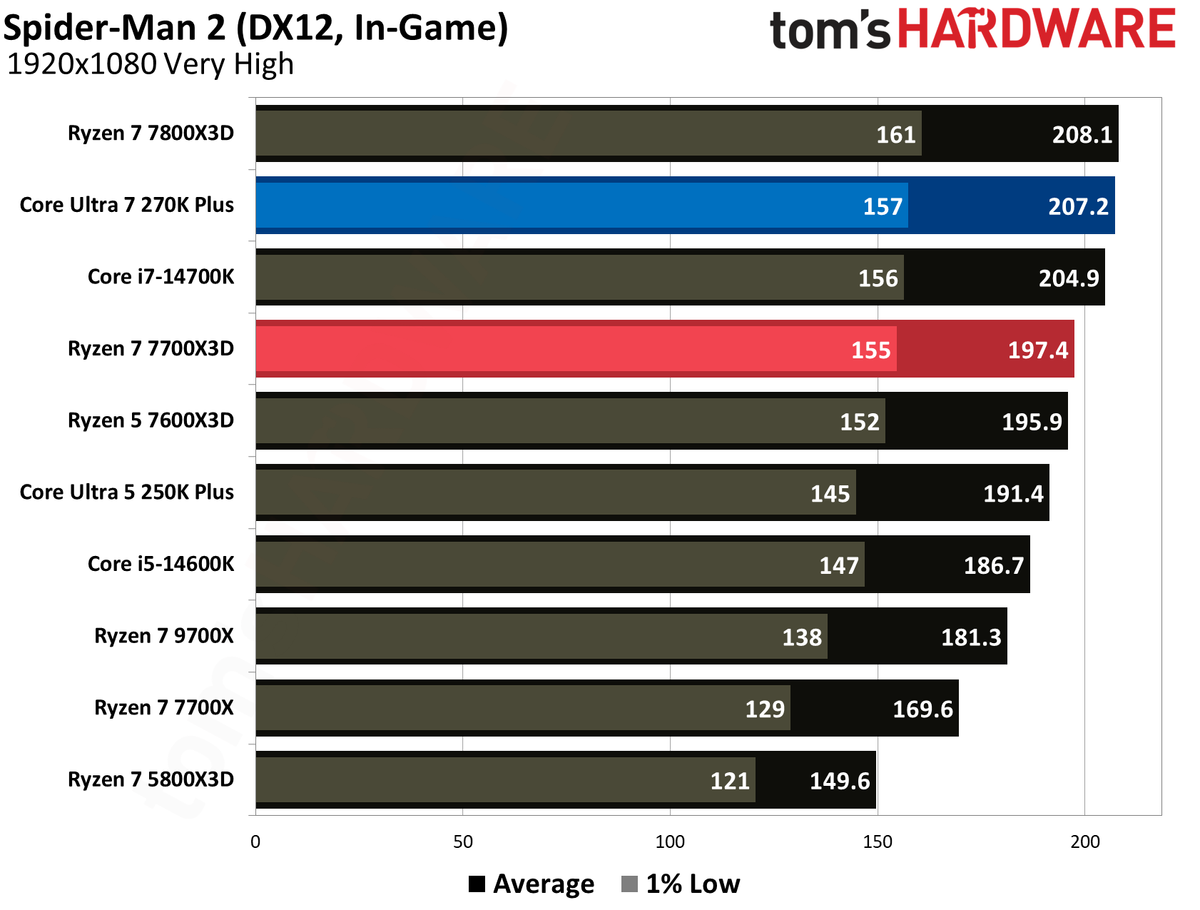
Across a comprehensive 16-game geomean, the AMD Ryzen 7 7700X3D holds its position as the superior gaming chip, delivering a 174.3 FPS average. This represents a 5.3% performance lead over the 270K Plus, which produced a 165.6 FPS average. While Intel's latest flagship has significantly narrowed the gap compared to the original Arrow Lake silicon, AMD’s 3D V-cache architecture continues to provide a higher performance in the majority of tested titles.
Even when examining the 1% low frame rates, which is the perceived smoothness while gaming, the 7700X3D maintains a slight edge with a 118 FPS average compared to the 115 FPS from the 270K Plus.
AMD's stacked cache gives the 7700X3D a clear edge in games that are sensitive to memory latency. For instance, in Minecraft RT, the 7700X3D delivered 144.5 FPS average, dwarfing the 89.7 FPS produced by the 270K Plus for a massive 61.1% performance advantage. We see similarly dominant leads for AMD in F1 2024, where it leads by 30.4% (201.8 vs. 154.7 FPS), and in Final Fantasy XIV, where it holds a 21.7% lead (177.7 vs. 146.0 FPS). Even in esports titles like Counter-Strike 2, the 7700X3D maintains a comfortable 7.3% lead with 707.9 FPS over Intel’s 660.0 FPS.
Intel’s Core Ultra 7 270K Plus is no slouch, however, as it leverages its higher boost frequencies and the new iBOT runtime translation layer to take the lead in several games. Intel manages a win in Hogwarts Legacy, producing 135.3 FPS for a 9.1% advantage over AMD’s 124.0 FPS, a result directly attributed to iBOT. Team Blue also edges out victories in The Last of Us Part 1 with 175.6 FPS (6% lead) and Spider-Man 2 with 207.2 FPS (5% lead).
In many other modern titles, the two processors are essentially locked in a dead heat. For example, in DOOM: The Dark Ages, the 270K Plus delivers 200.4 FPS while the 7700X3D is right beside it at 200.0 FPS. The story is similar in Flight Simulator 24, where Intel's 120.5 FPS and AMD's 114.9 FPS result in a negligible difference during actual gameplay. These results indicate that while the 7700X3D is the more consistent gaming choice, especially in cache-heavy titles, the 270K Plus is a highly competitive gaming chip that delivers impressive results for its $300 price tag.
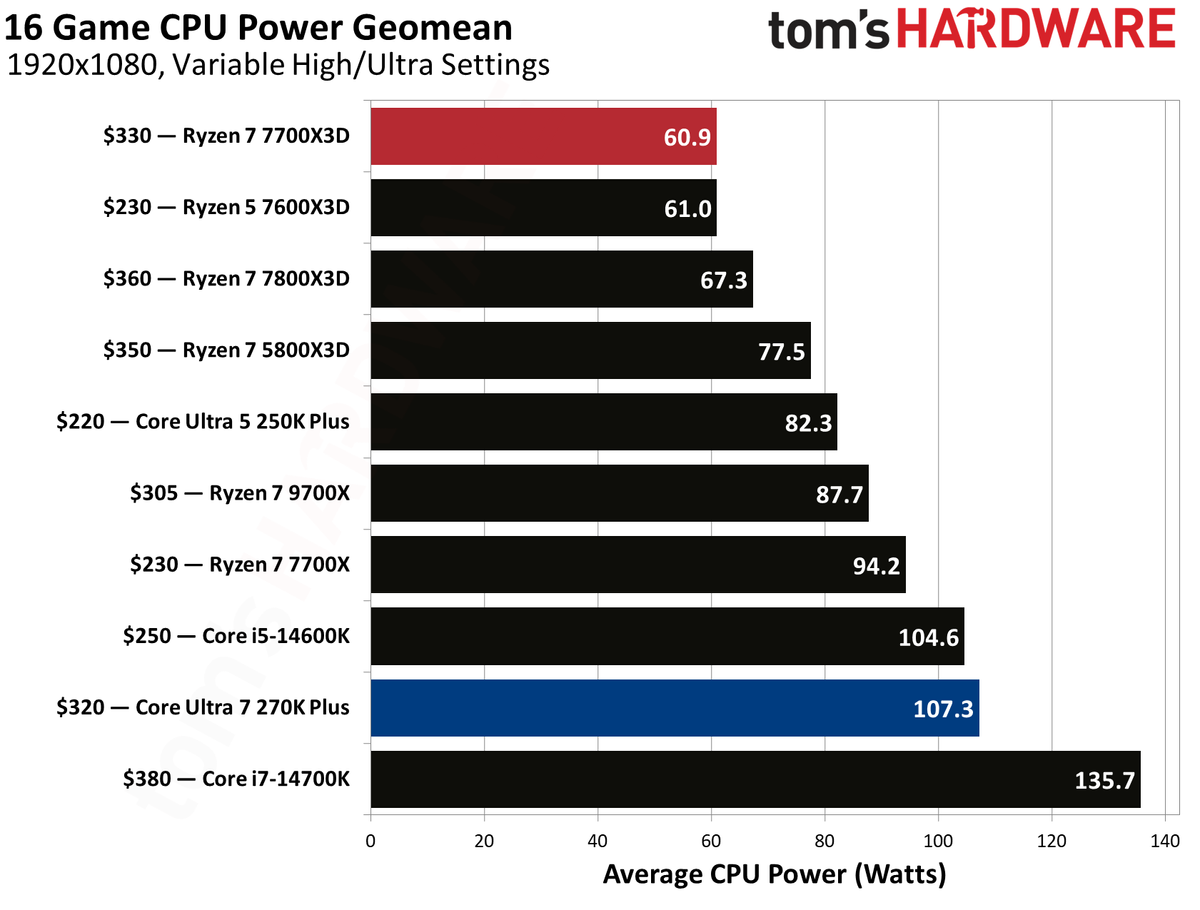
The biggest difference between these two architectures is noticeable when analyzing power consumption and efficiency metrics. Based on our 16-game CPU power geomean, the 7700X3D is clearly way more efficient, drawing an average of just 60.9 watts while gaming. In comparison, the 270K Plus consumed 107.3 watts on average, which is a significant 76.2% increase in power. This results in a massive gap in gaming efficiency where the 7700X3D delivers 2.86 FPS per watt, making it roughly 85.7% more efficient than the 270K Plus, which trails at 1.54 FPS per watt.
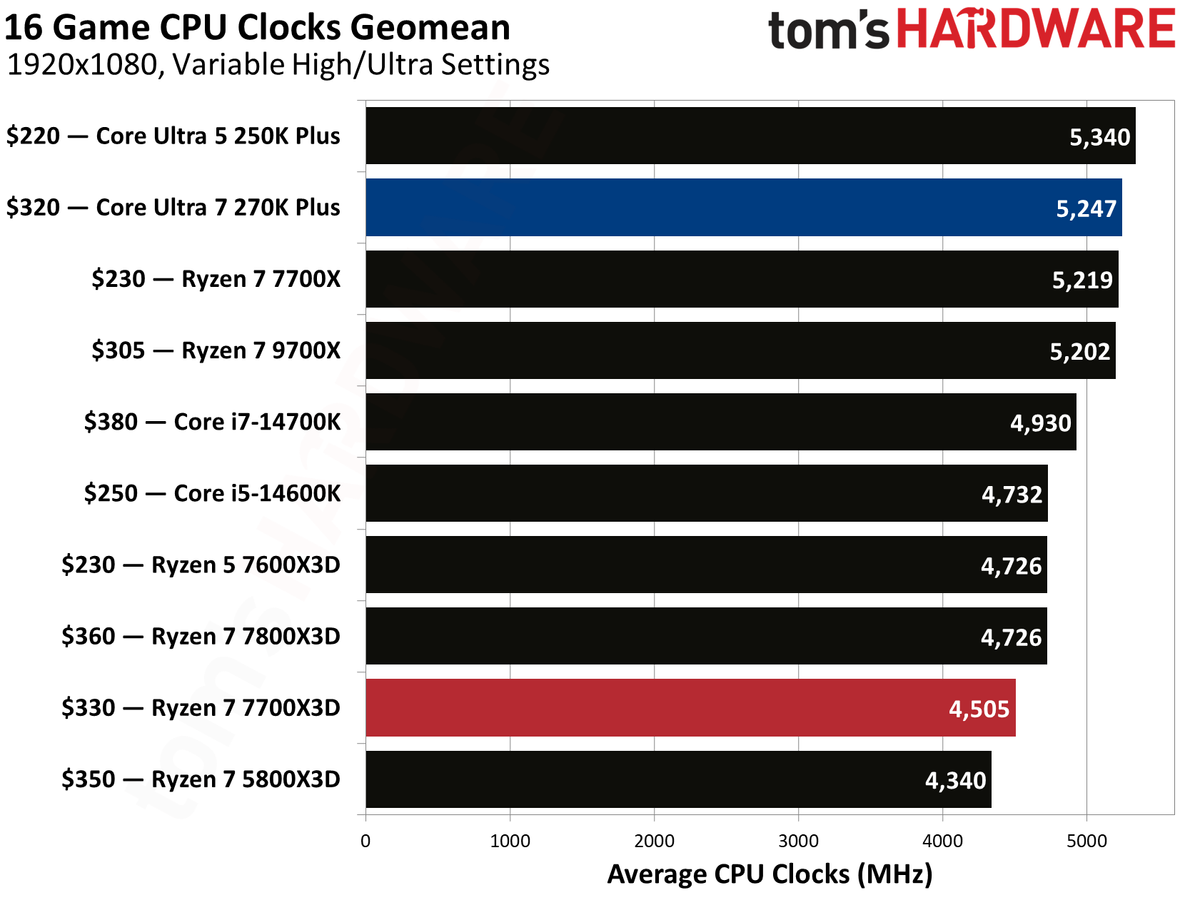
Intel does take the lead when it comes to raw frequency, with the 270K Plus maintaining an impressive 5,247 MHz average clock speed across our gaming suite. This is over 700 MHz faster than the 7700X3D, which averaged 4,505 MHz. Despite the much higher clocks and power draw of the Intel chip, its thermal management remains surprisingly competitive when paired with the right cooling solution. The 270K Plus averaged 59°C during gaming, though it still runs warmer than the 7700X3D, which stays at a cooler 55°C average.
When factoring in the cost of the silicon, the competition for the best bang for your buck is incredibly tight. The Ryzen 7 7700X3D provides a value of 0.53 FPS per dollar, narrowly edging out the Core Ultra 7 270K Plus, which sits at 0.52 FPS per dollar.
⭐ Winner: AMD Ryzen 7 7700X3D
The 7700X3D’s overall higher average frame rates and excellent efficiency makes it the more attractive option for a dedicated gaming build. Since raw gaming performance, efficiency, and thermals all favor Team Red in this category, the Ryzen 7 7700X3D takes the win for this round.
Productivity Performance: Intel Core Ultra 7 270K Plus vs AMD Ryzen 7 7700X3D
AMD's X3D processors are widely known for their gaming prowess. However, they have historically struggled to maintain the same level of dominance in productivity performance. The Ryzen 7 7700X3D is no exception, as its cache-focused architecture and lower clock speeds result in relatively weak single- and multi-threaded results.
In contrast, Intel has managed to maintain its standing in the productivity segment even when its gaming performance faced challenges. The 270K Plus is a productivity workhorse that is capable of delivering excellent productivity performance making it a standout choice for users who need a balanced system for both work and play.
Image 1 of 11
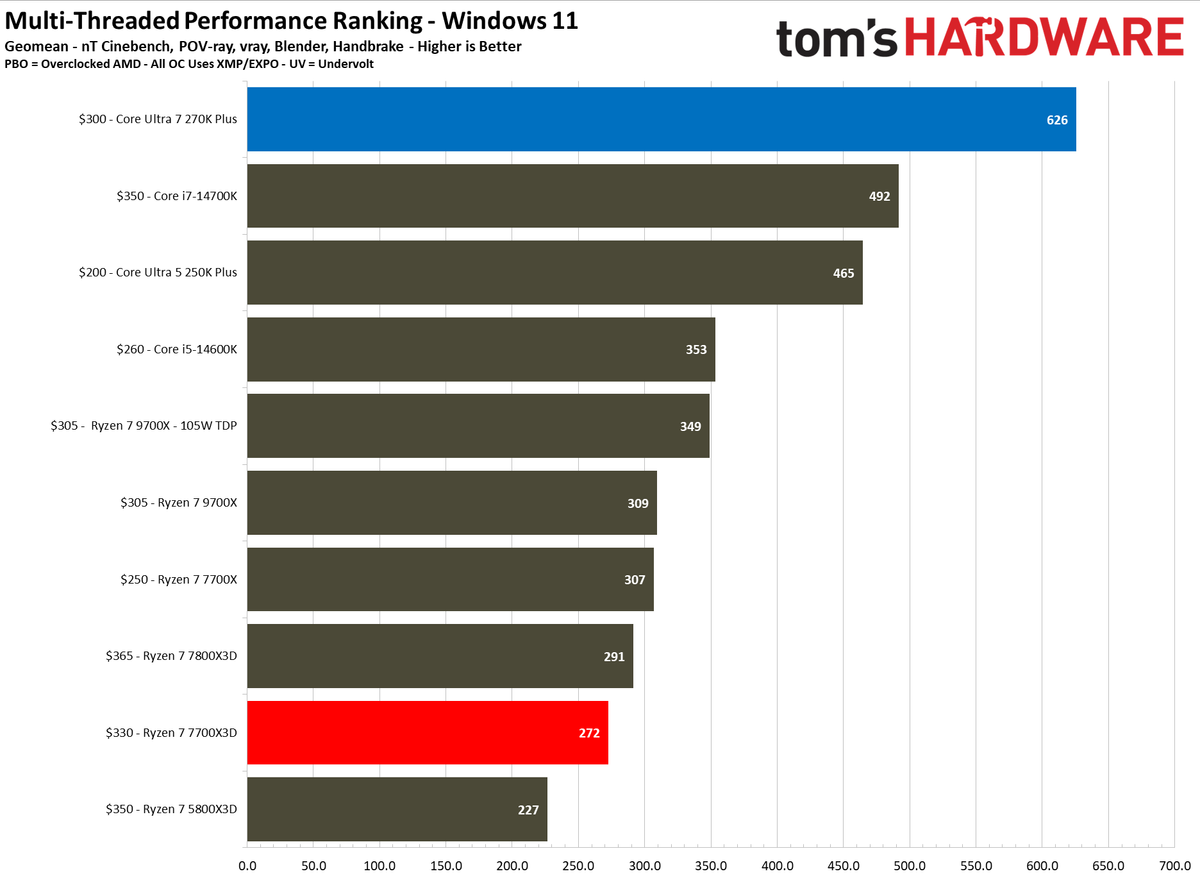
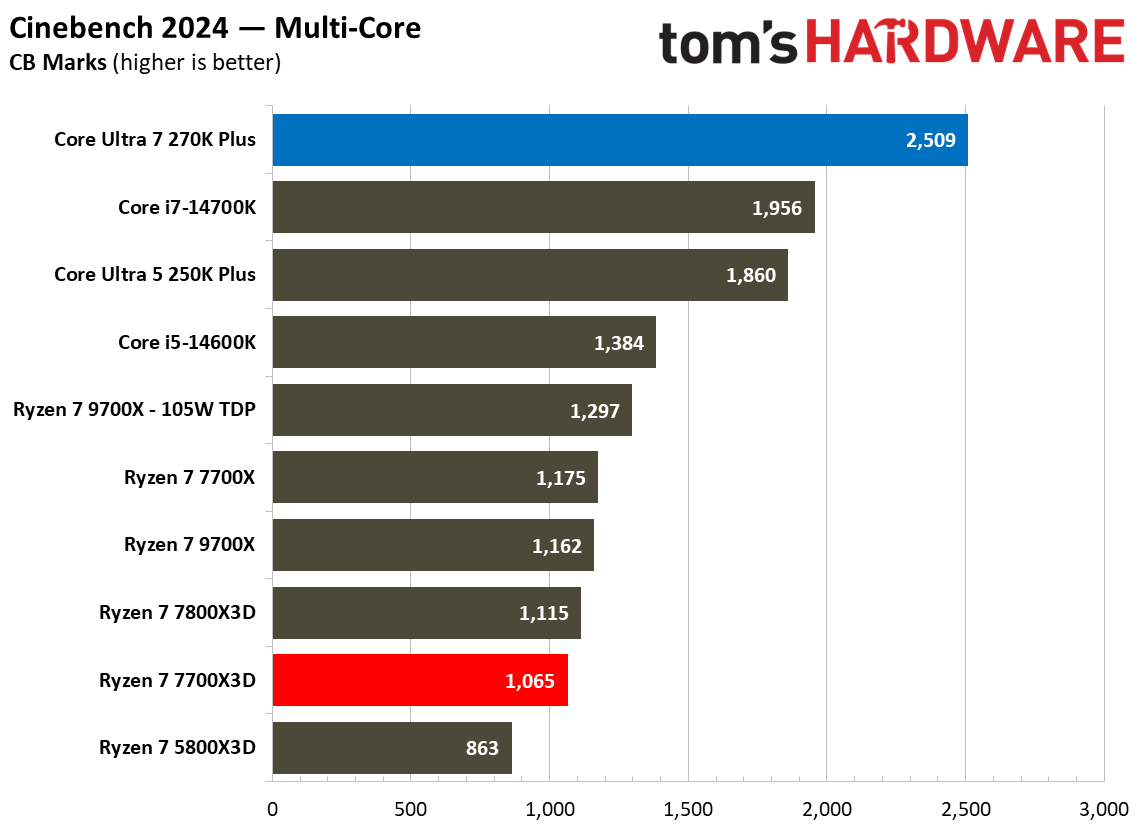
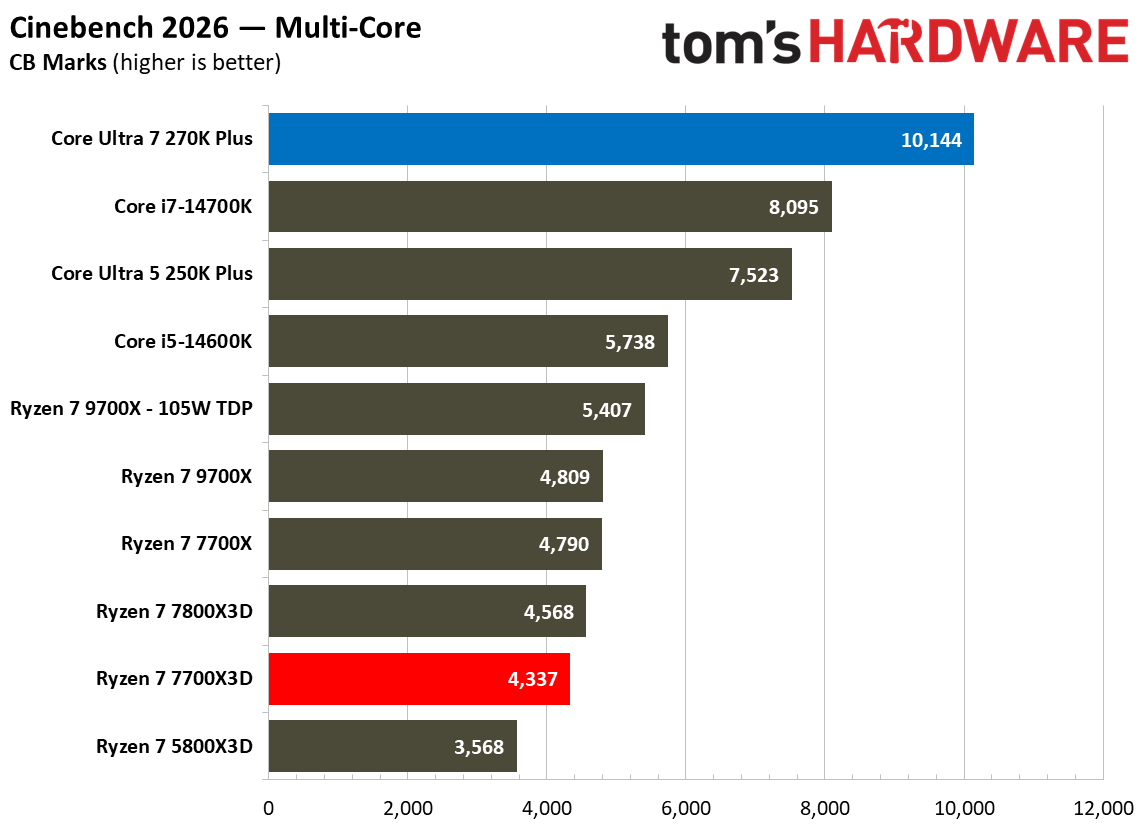
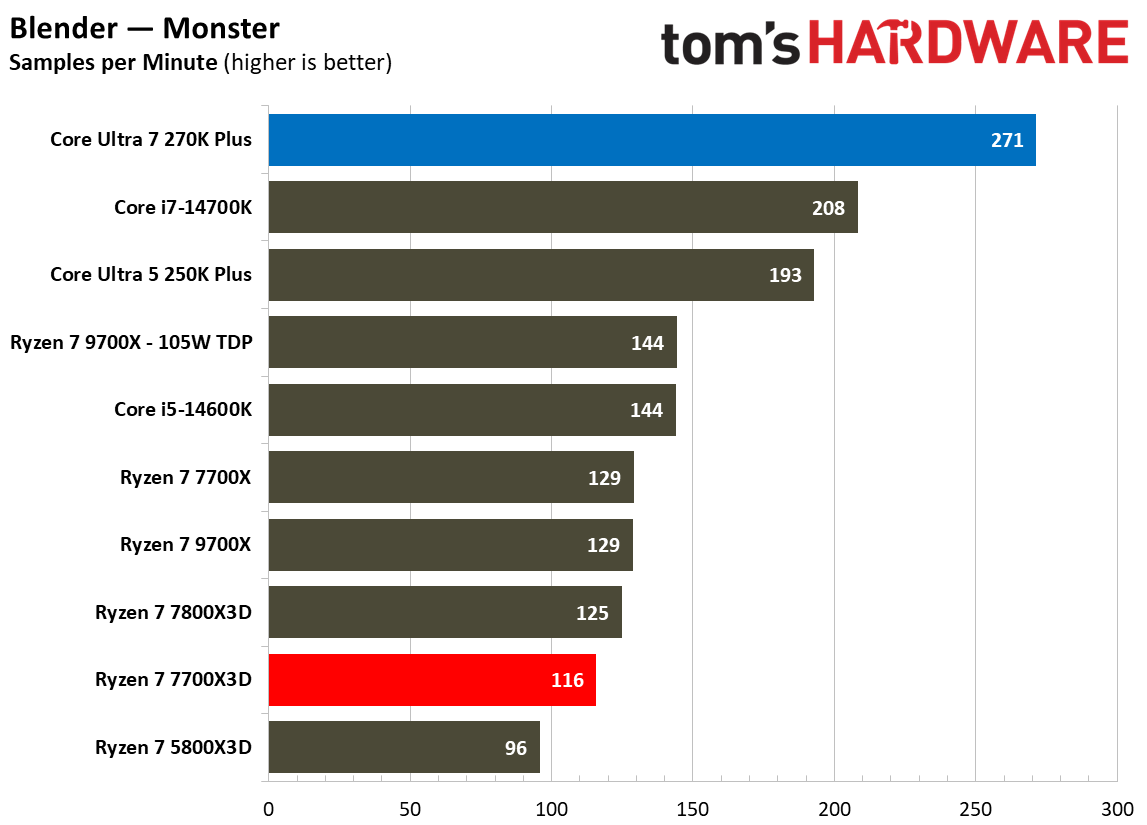
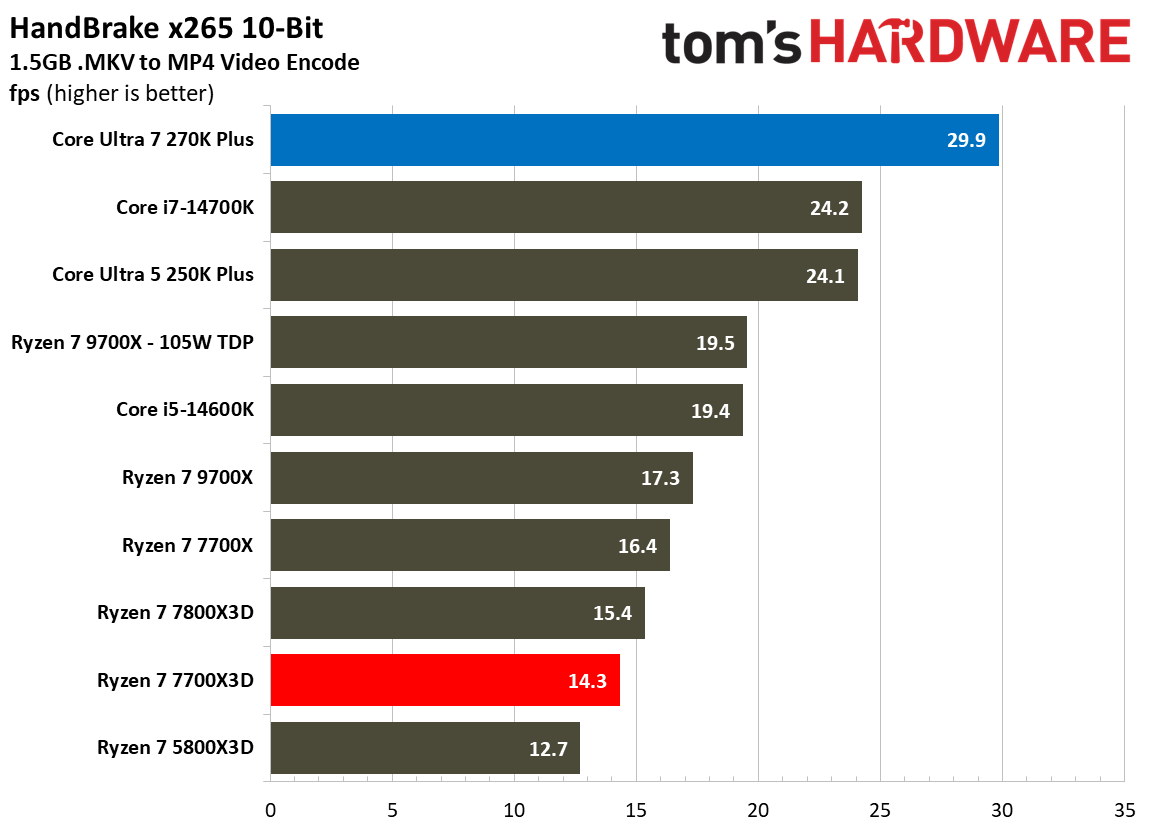
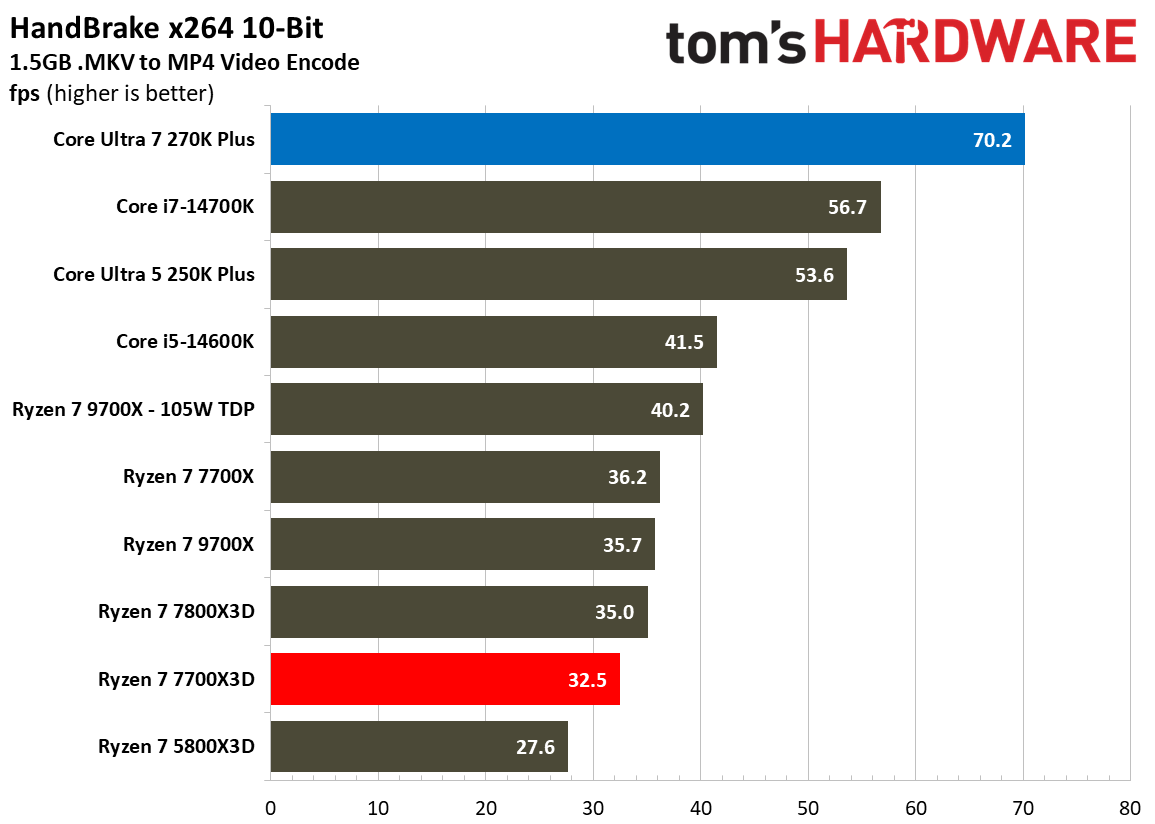
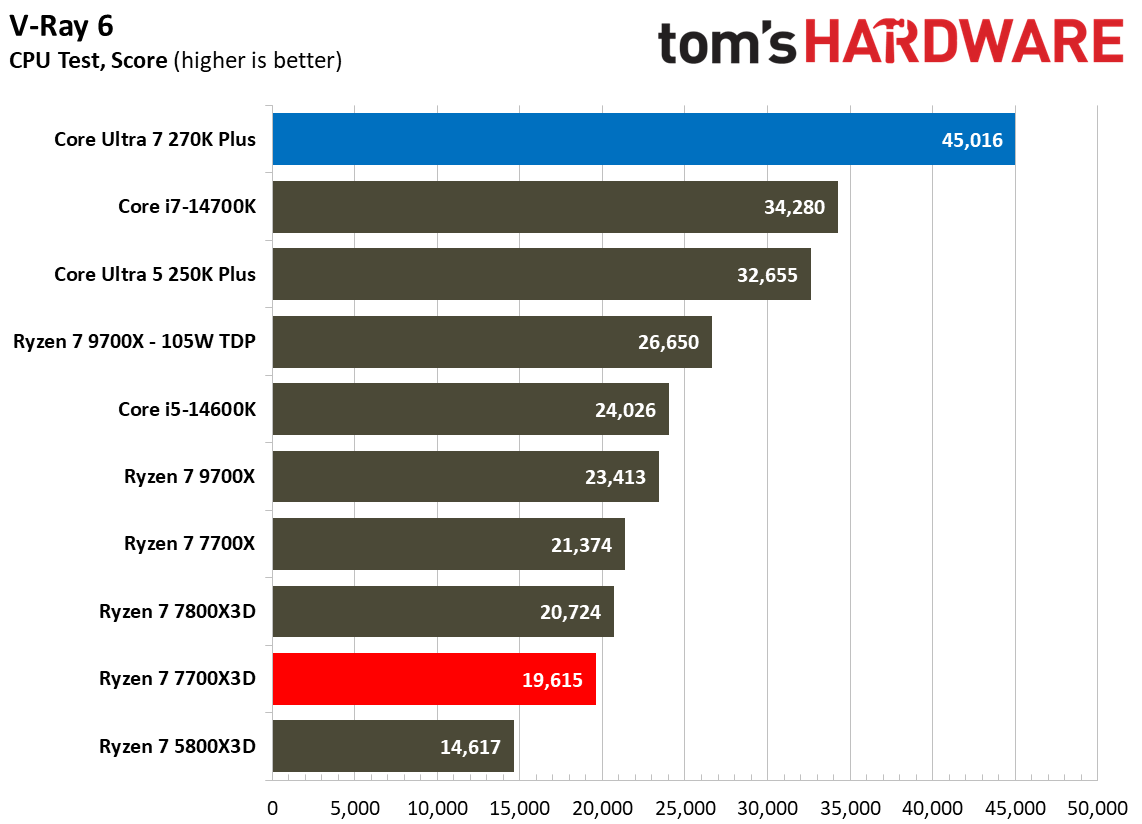
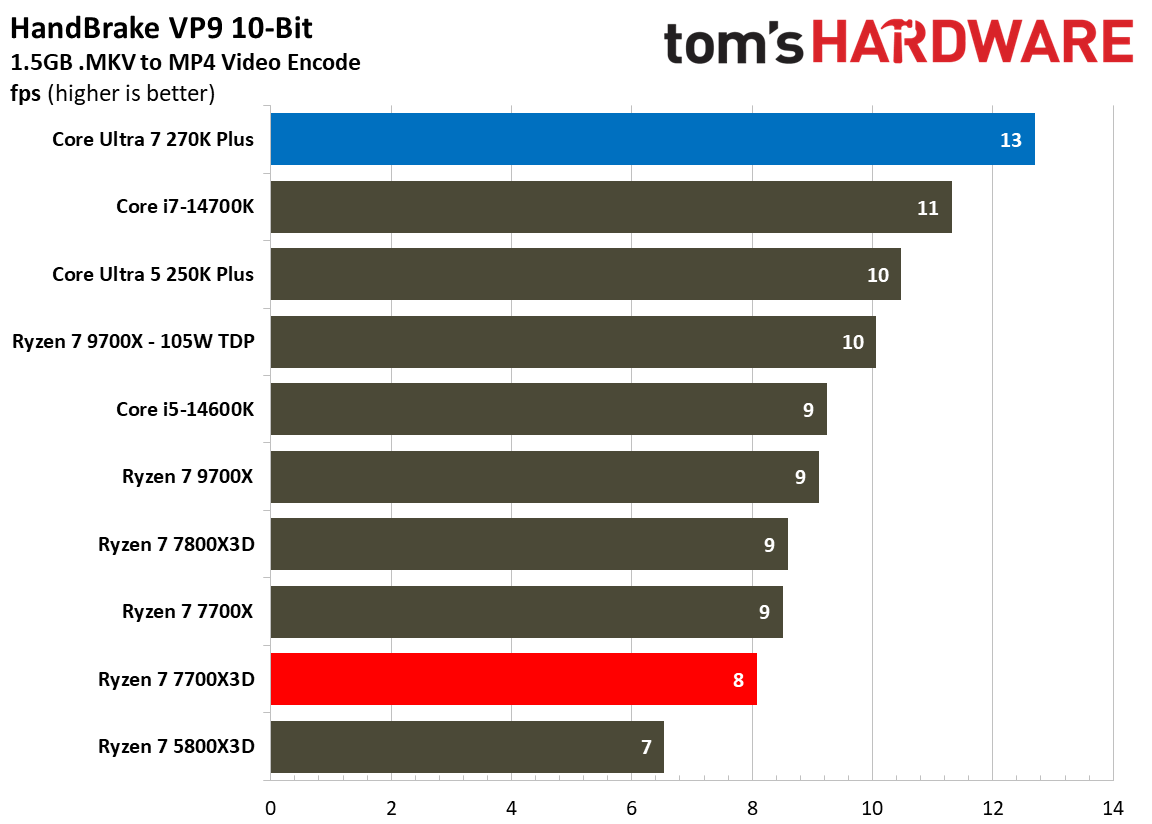
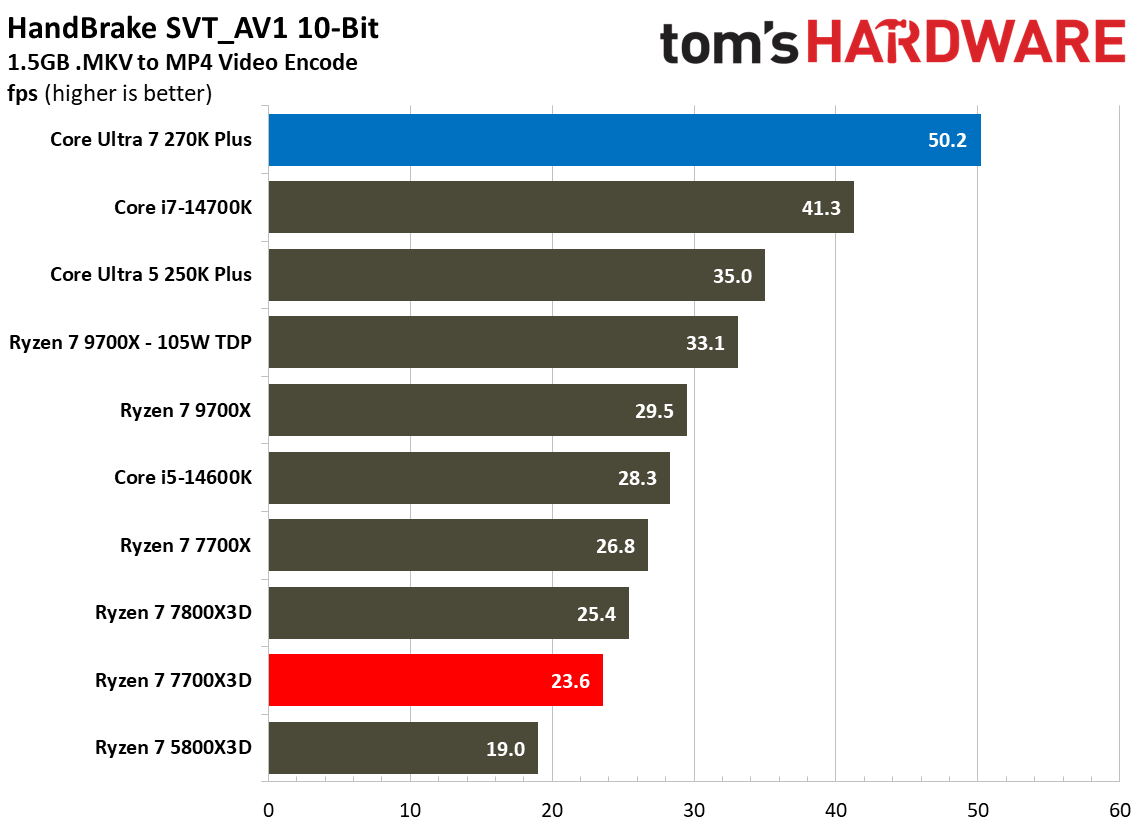
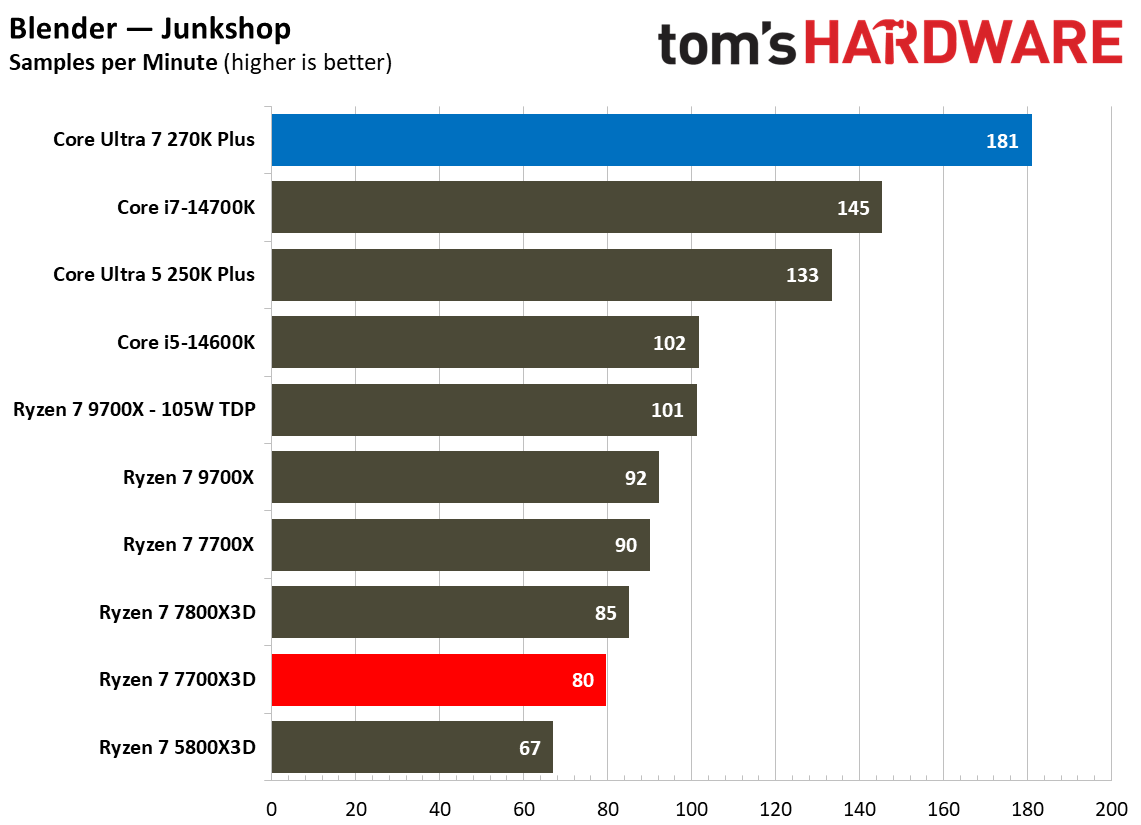
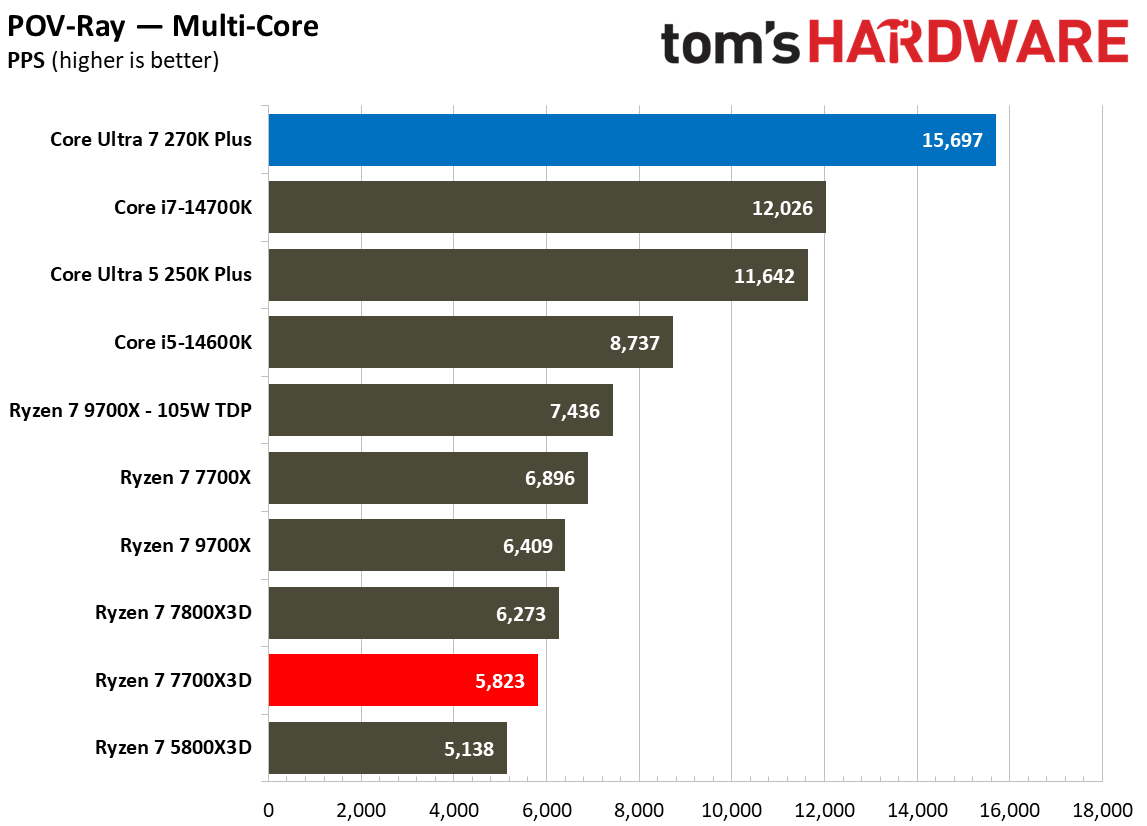
In multi-threaded workloads, the performance gap between these two processors is pretty massive, primarily driven by Intel's higher core count advantage. Across our multi-threaded performance ranking geomean, the Intel chip delivers a score of 626 compared to the 272 produced by the 7700X3D, representing a staggering 130% performance lead for Team Blue. This level of parallel processing power places the 270K Plus in a completely different performance tier, making it more comparable to much more expensive flagship processors.
Individual benchmarks further highlight this lopsided victory for Intel across various professional tasks. In Cinebench 2024’s multi-core test, the 270K Plus scores 2,509 points, which is roughly 135.6% faster than the 1,065 points achieved by the 7700X3D. This trend continues in POV-Ray, where Intel leads by approximately 169.5% (15,697 vs. 5,823 PPS), and in V-Ray 6, where it maintains a massive 129.5% advantage (45,016 vs. 19,615). Even in intensive video encoding tasks via HandBrake x265, the Intel chip more than doubles the performance of its AMD rival, delivering 29.9 FPS compared to just 14.3 FPS for the 7700X3D. These results demonstrate that for heavy rendering or data-crunching workloads, Intel is the undisputed leader in this price bracket.
Image 1 of 6
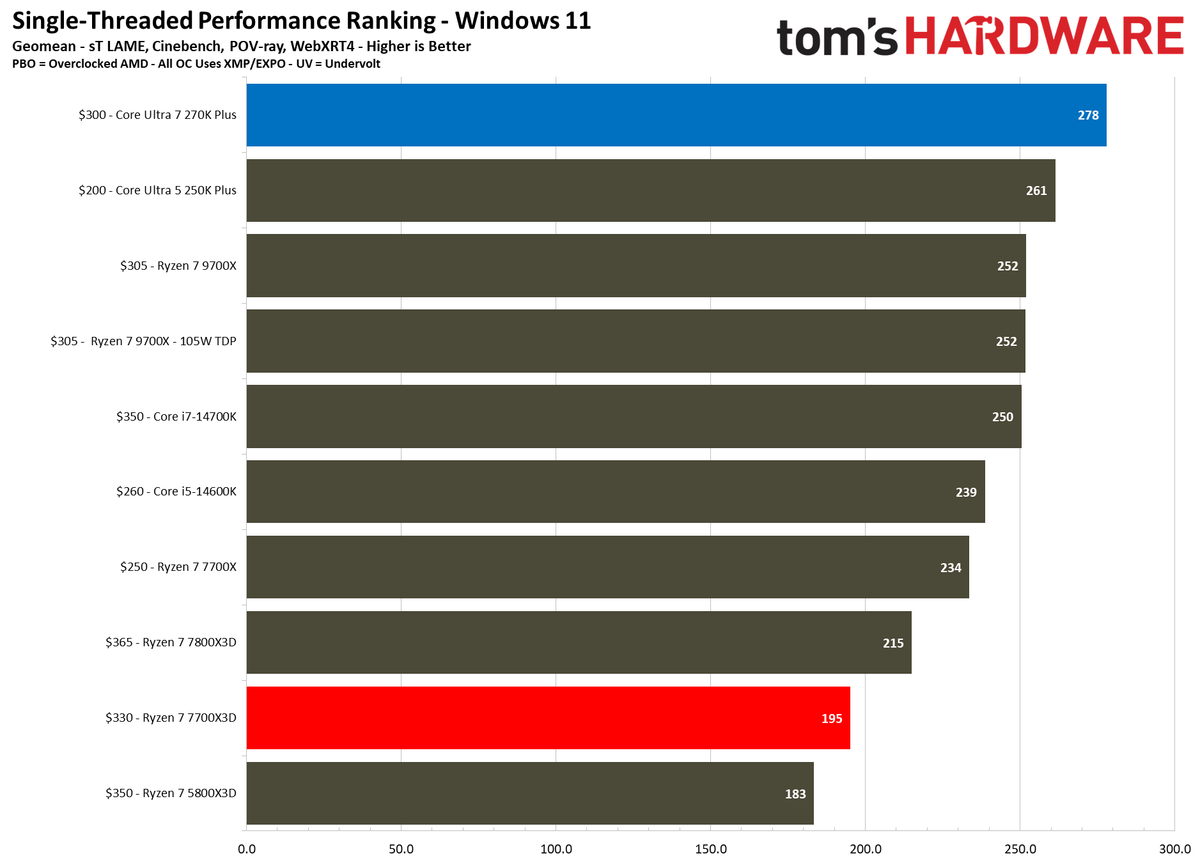
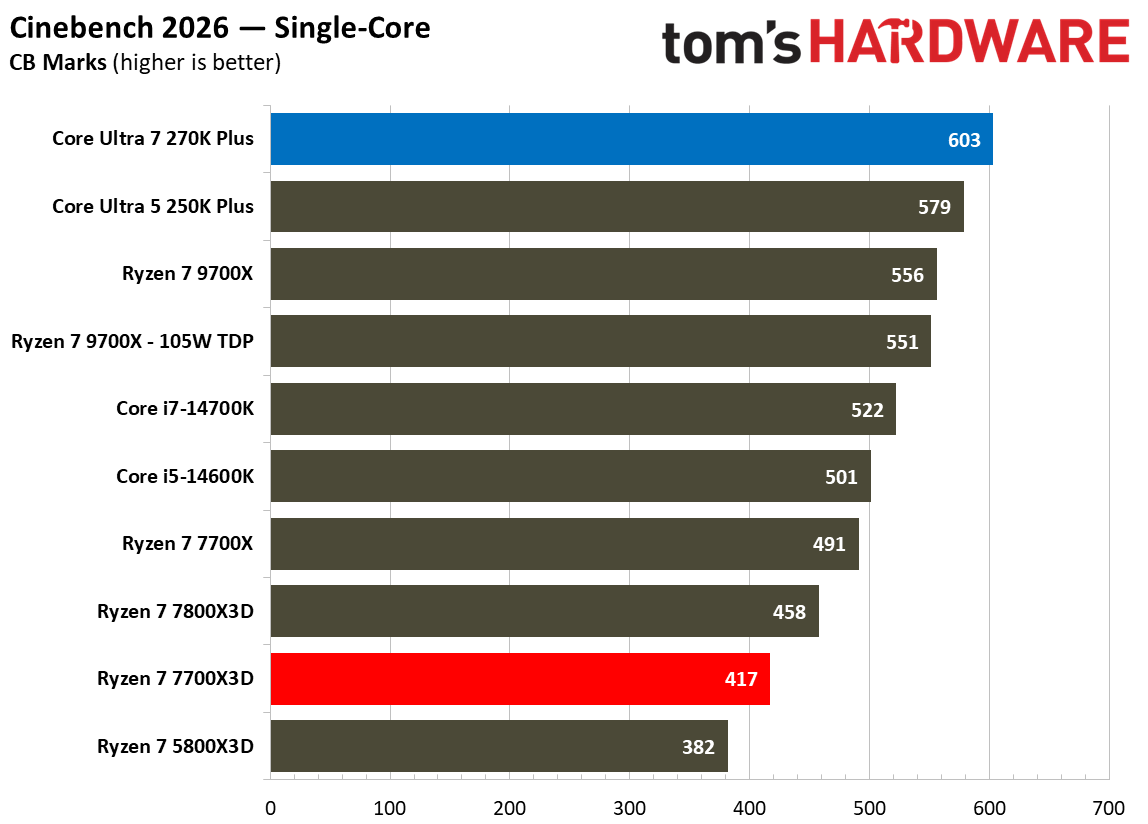
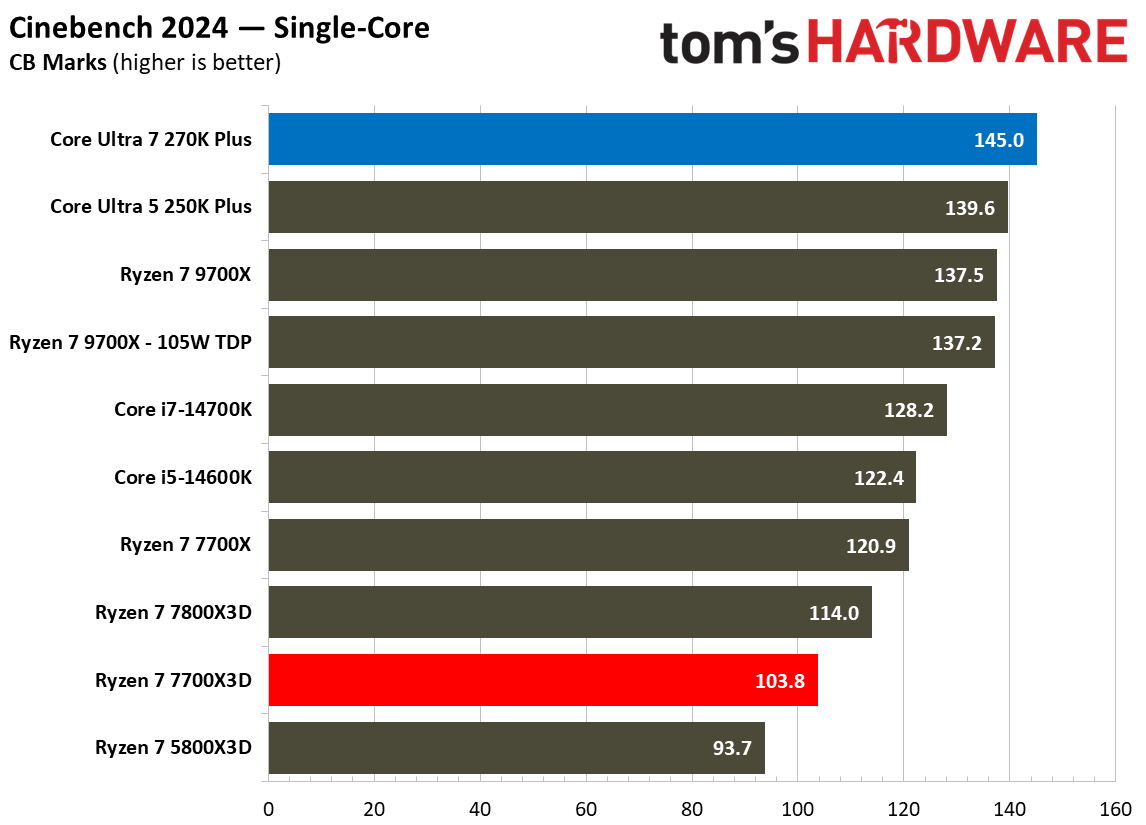
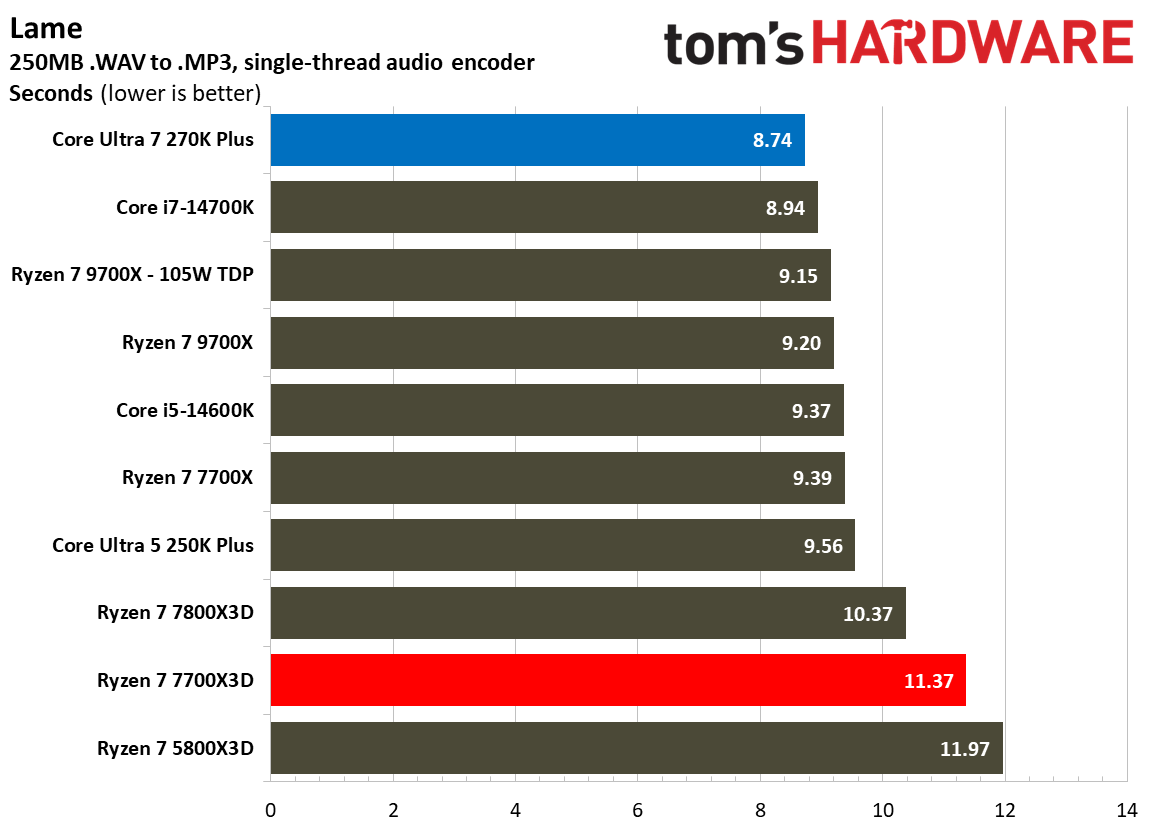
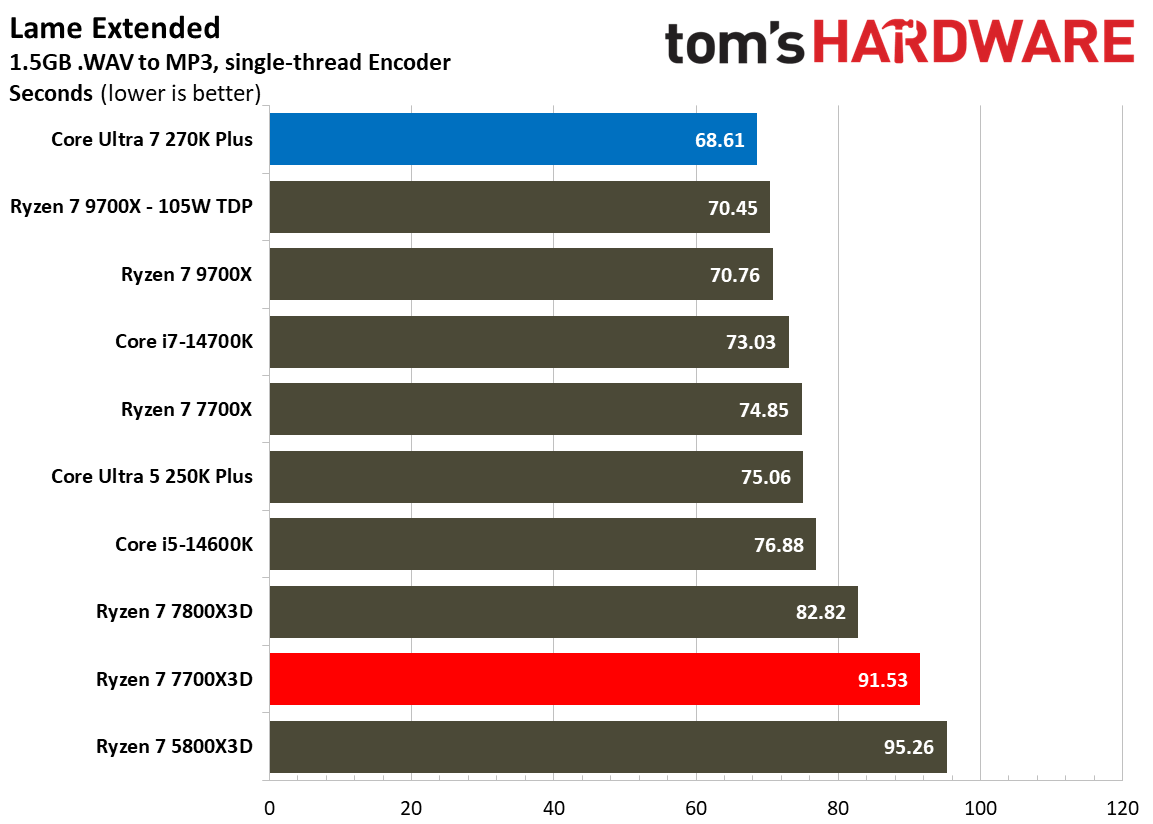
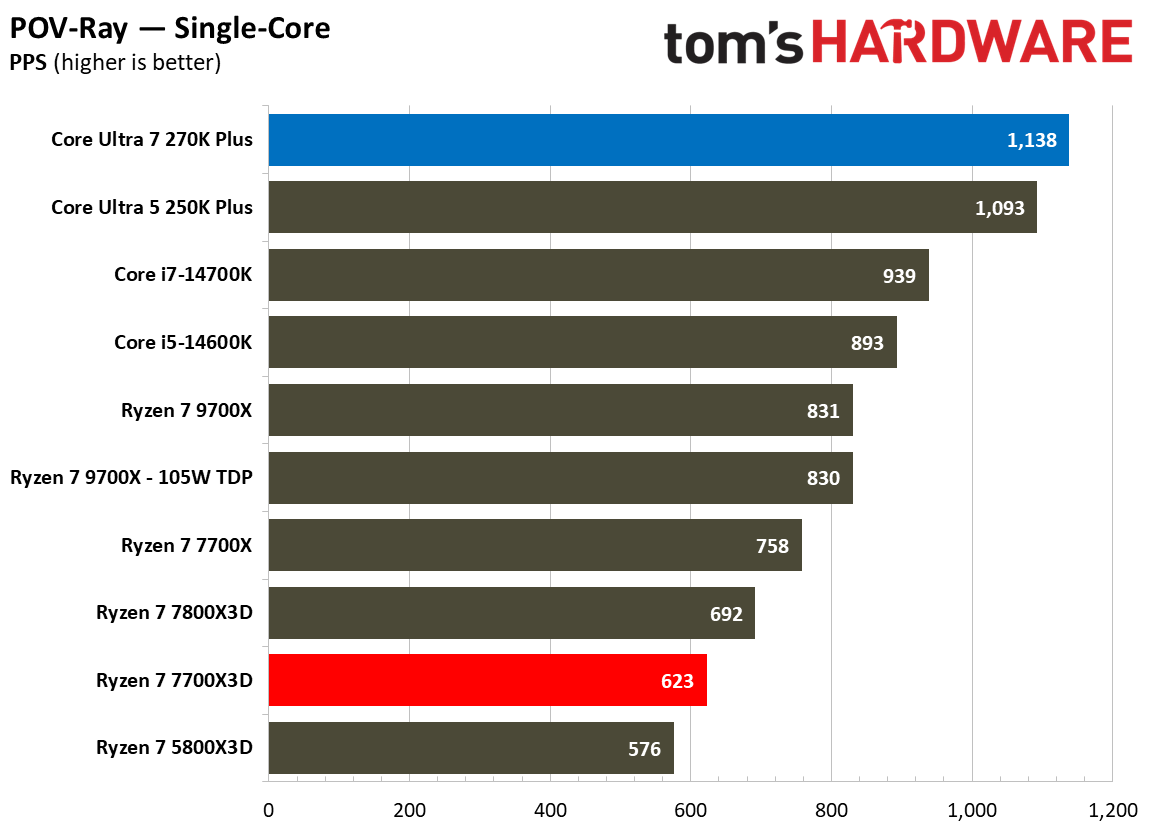
A similar trend can be seen when examining single-threaded performance, a crucial metric for general system responsiveness and applications that do not scale across multiple cores. In our single-threaded geomean, the 270K Plus scores 278 points, which is 42.5% faster than the 195 achieved by the 7700X3D. Specific tests like Cinebench 2024’s single-core benchmark show the 270K Plus maintaining a 39.7% lead over the 7700X3D (145 vs. 103.8 points), while the lead grows to a staggering 82.6% in POV-Ray’s single-core test (1,138 vs. 623 PPS). Even in audio encoding, the Intel chip finishes the Lame Extended task in 68.61 seconds, whereas the 7700X3D trails at 91.53 seconds.
⭐Winner: Intel Core Ultra 7 270K Plus
Ultimately, the 270K Plus simply blows the competition out of the water when it comes to productivity. While the 7700X3D is a highly efficient and specialized CPU for gaming, it cannot match the raw horsepower that Intel offers. For any user whose daily routine involves video editing, 3D rendering, or heavy multitasking, the 270K Plus is the obvious choice and should be the clear favorite for a multi-purpose system.
Overclocking: Intel Core Ultra 7 270K Plus vs AMD Ryzen 7 7700X3D
While both manufacturers provide tools to squeeze extra performance from their silicon, the Intel Core Ultra 7 270K Plus is built as an enthusiast-friendly, fully unlocked processor. The AMD Ryzen 7 7700X3D, on the other hand, is a more restricted processor designed primarily for out-of-the-box gaming efficiency.
For the Intel Core Ultra 7 270K Plus, overclocking is a centerpiece of the experience. As a fully unlocked K-series SKU, it offers users granular control over per-core voltages, power limits, and clock speeds via an unlocked multiplier. While these changes can be done by entering the BIOS, one can also download the Intel XTU (Extreme Tuning Utility) software to fine tune the CPU.
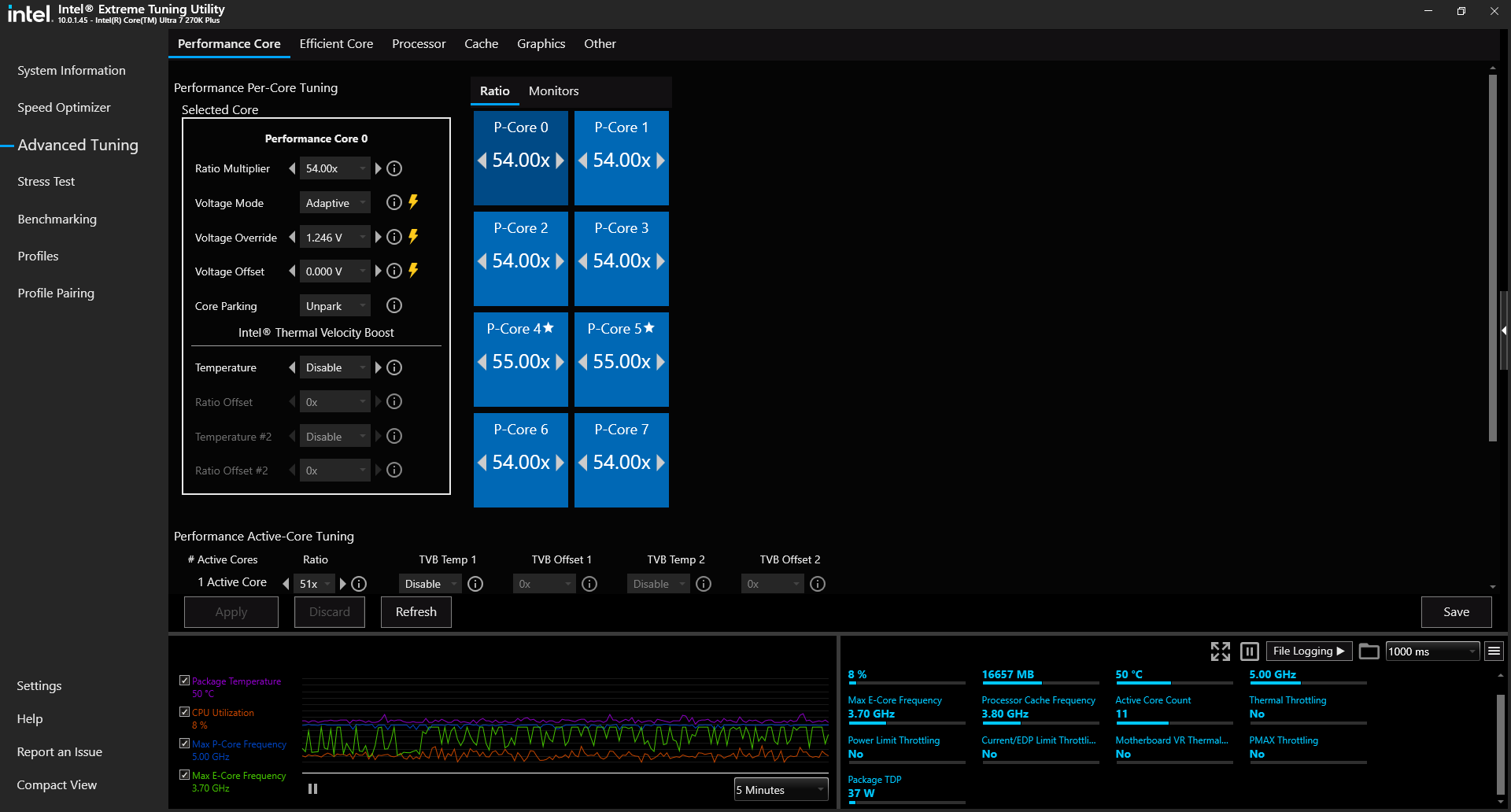
One of the most significant changes seen on Arrow Lake Refresh is that Intel has standardized several high-end performance tweaks including the 900MHz die-to-die frequency bump and the 400MHz fabric speed increase. This means users receive enthusiast-level interconnect performance without necessarily needing a premium Z-series motherboard. That said, Z890 boards are still necessary as they offer sophisticated tools for manual tuning and pushing the CPU to its limits.
In contrast, the AMD Ryzen 7 7700X3D follows the same path as previous Zen 4 X3D processors including a locked multiplier, which prevents traditional manual overclocking. Users are instead limited to automated and semi-automated features like Precision Boost Overdrive 2 (PBO2) and Curve Optimizer. PBO2 allows the CPU to dynamically adjust its frequencies based on available power and thermal headroom, while Curve Optimizer enables more advanced fine-tune voltage offsets for each of the eight Zen 4 cores.
While these tools can lead to sustained higher boost clocks, the sensitive nature of the 3D V-Cache stack leads to thermal challenges that limit frequency headroom. Thus, overclocking gains on the 7700X3D are often minimal compared to the flexibility offered by the Intel chip.
⭐Winner: Intel Core Ultra 7 270K Plus
The 270K Plus is a far more overclocking-friendly product. It offers a vast suite of features that AMD simply cannot match due to its architectural restrictions and locked multiplier.
Power Consumption, Efficiency, and Cooling: Intel Core Ultra 7 270K Plus vs AMD Ryzen 7 7700X3D
This is a crucial section of the faceoff as it highlights the most significant architectural divide between these two processors. While the 270K Plus prioritizes raw performance throughput, the 7700X3D focuses on extreme efficiency. This is immediately evident in their official power ratings where Intel specifies a 125W TDP with a massive 250W Maximum Turbo Power (MTP), while AMD utilizes a 120W TDP with a 162W Package Power Tracking (PPT) limit.
Image 1 of 12
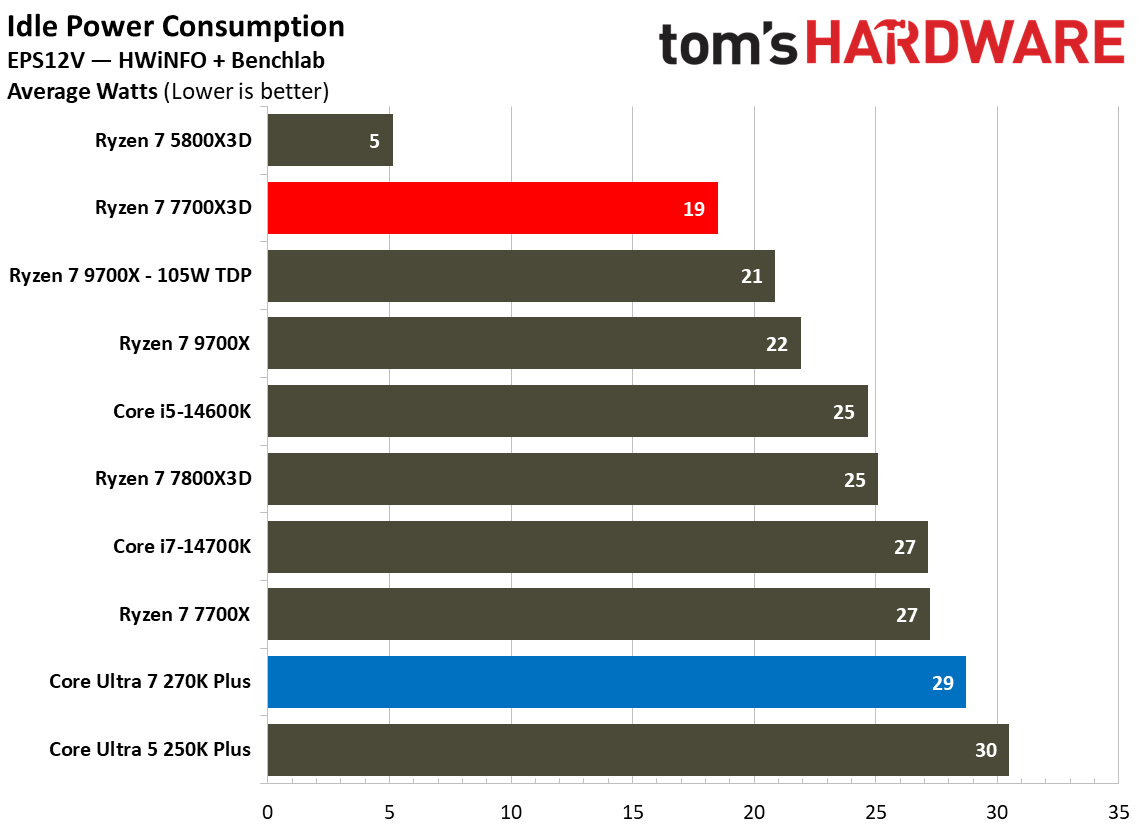
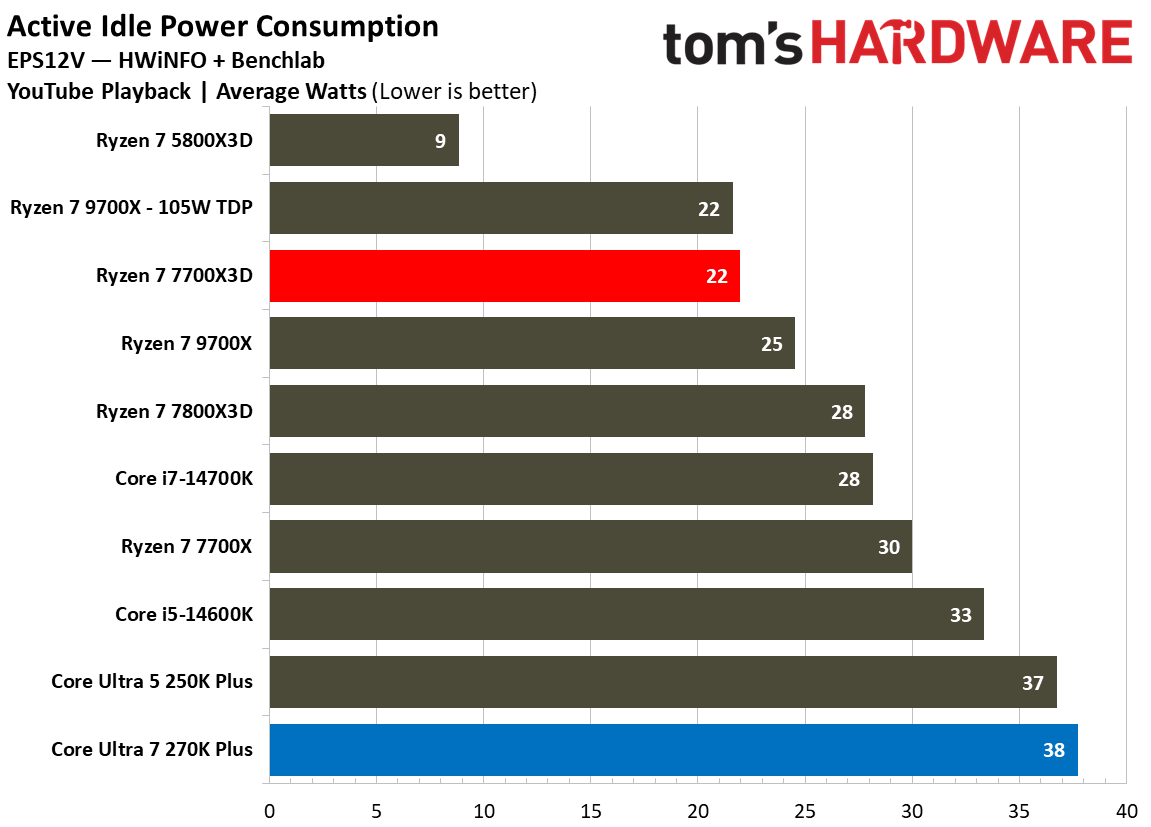
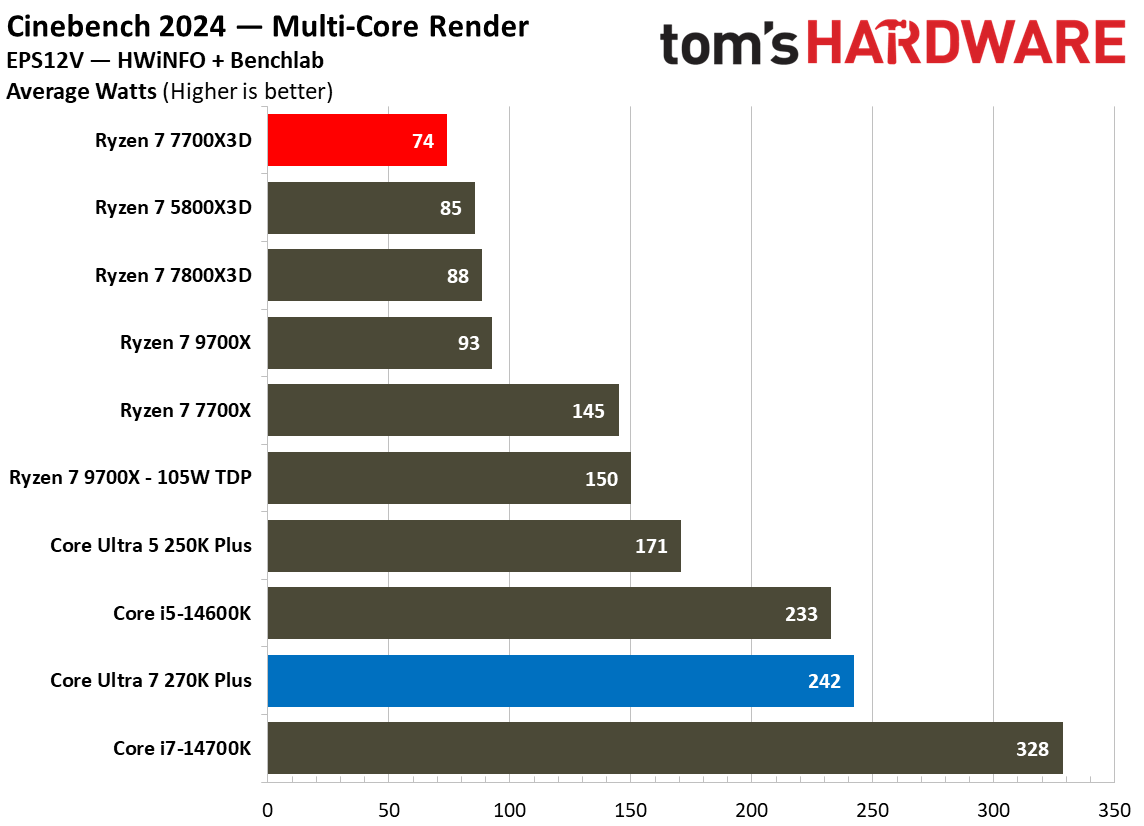
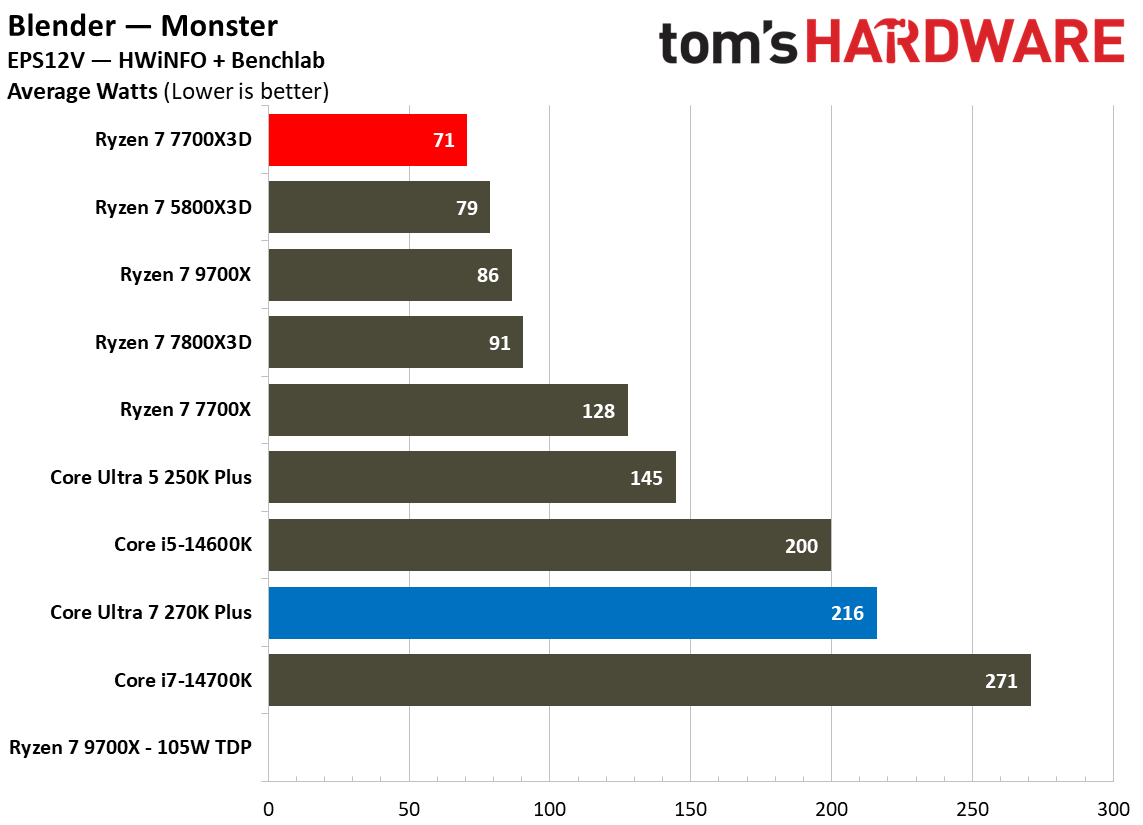
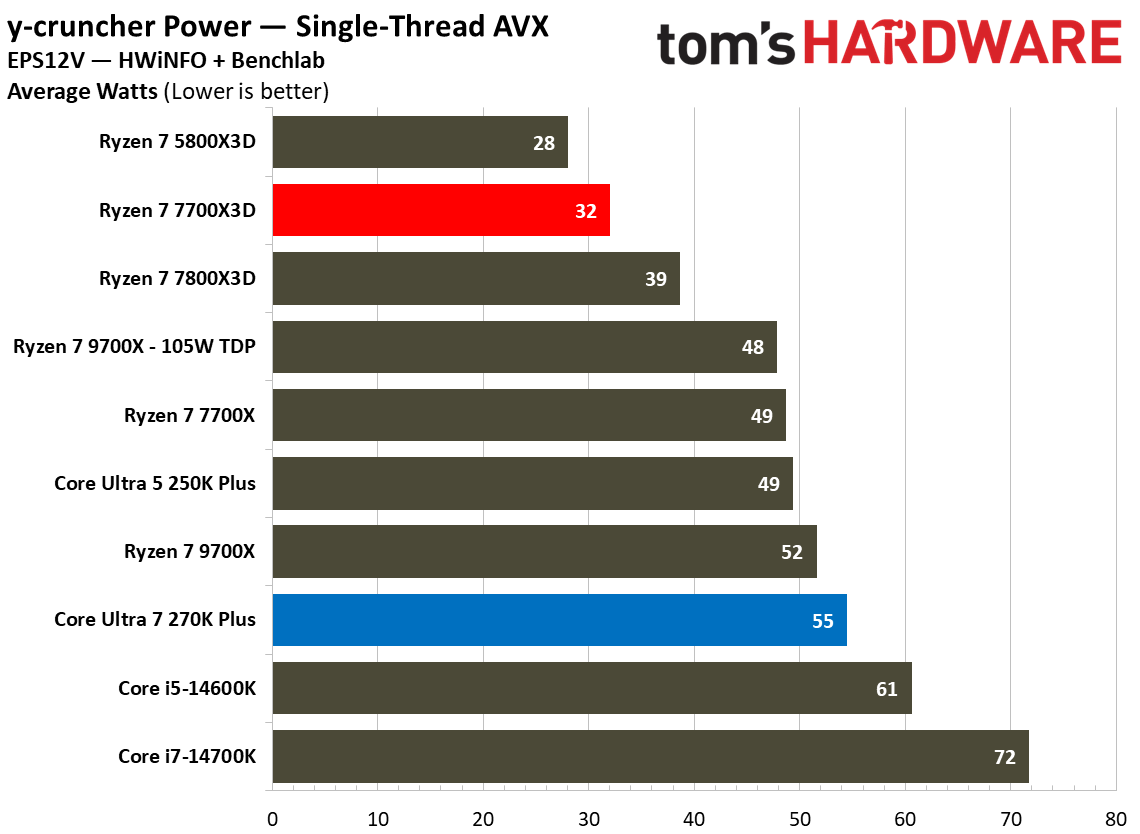
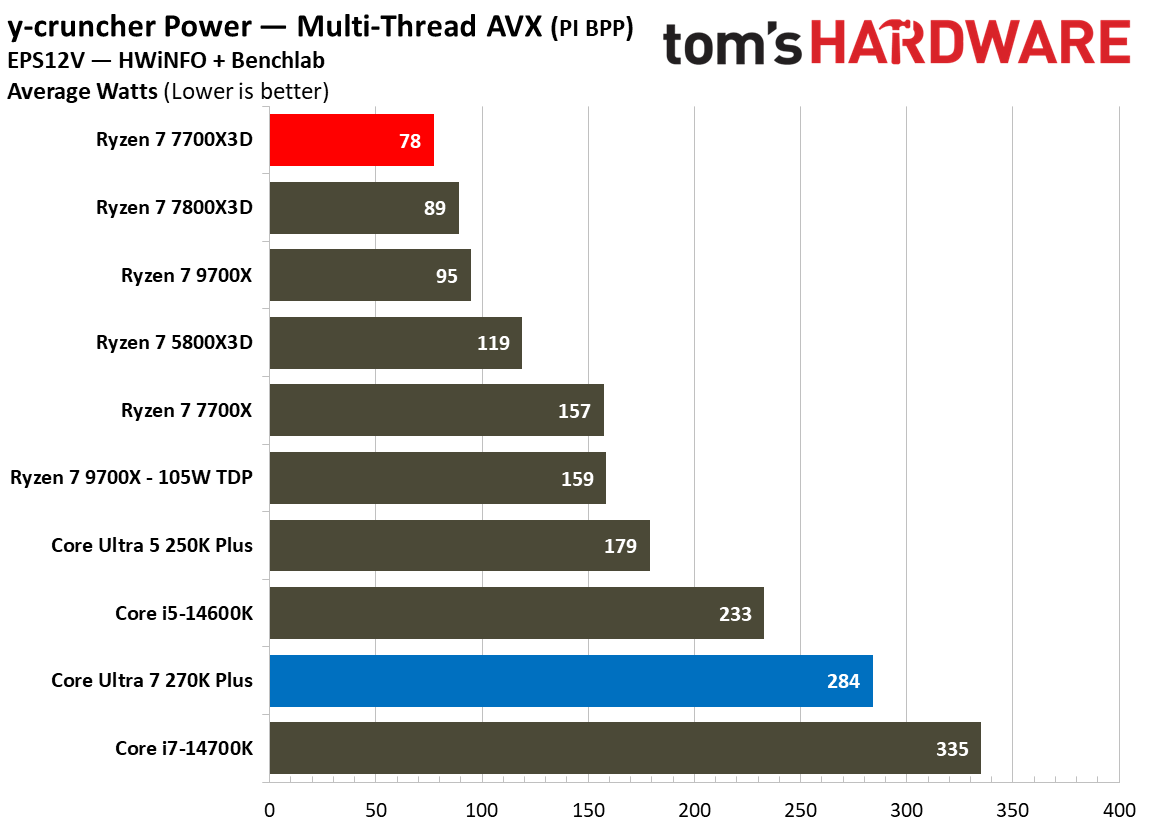
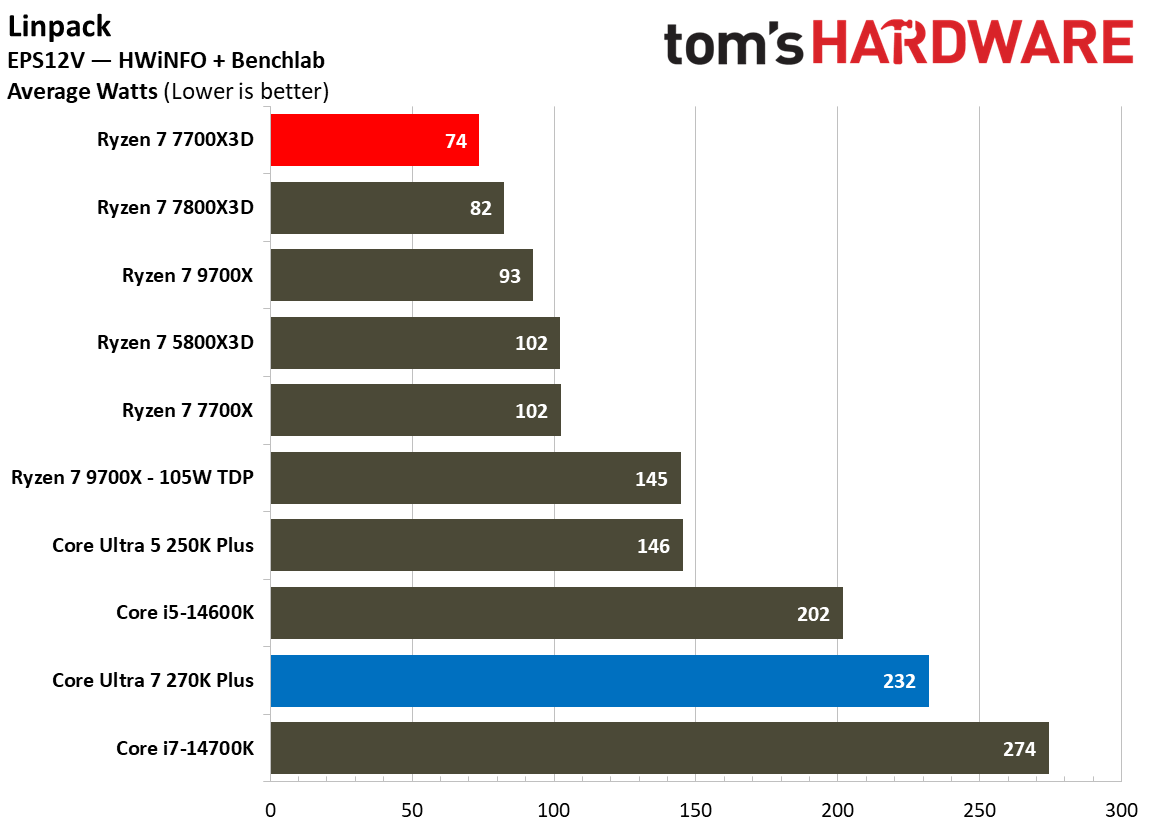
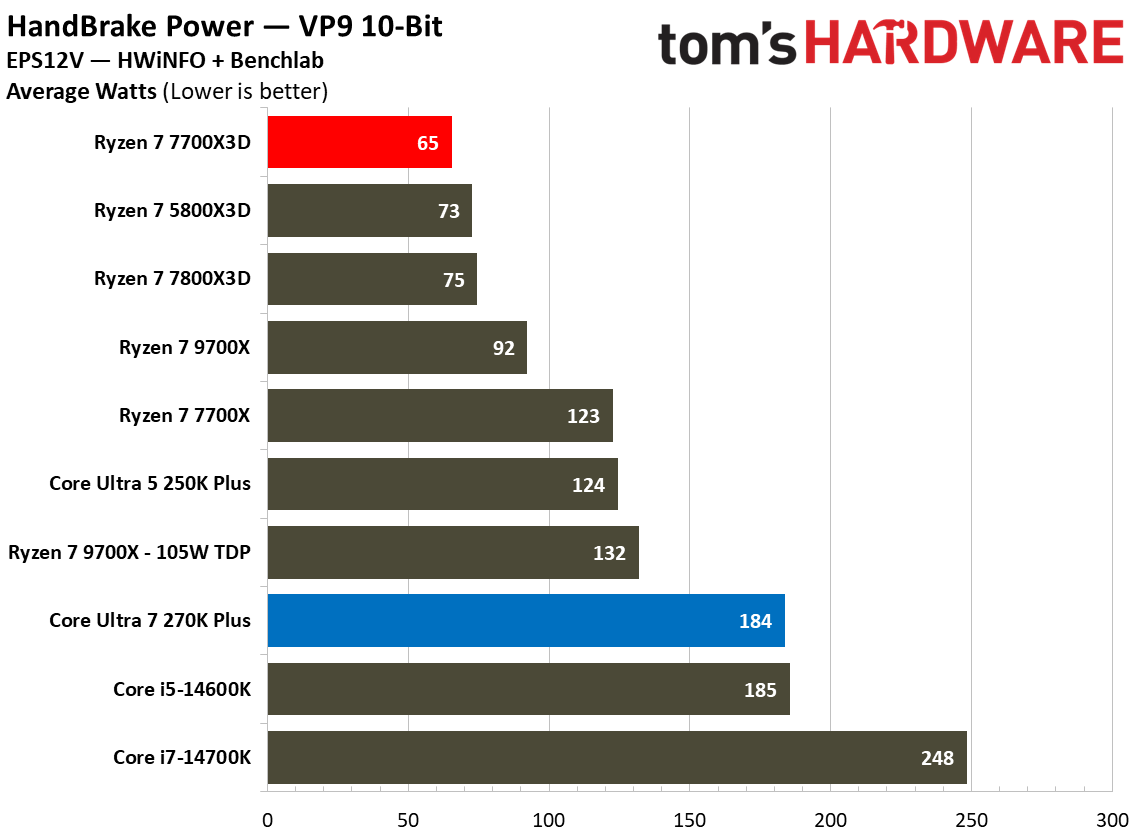
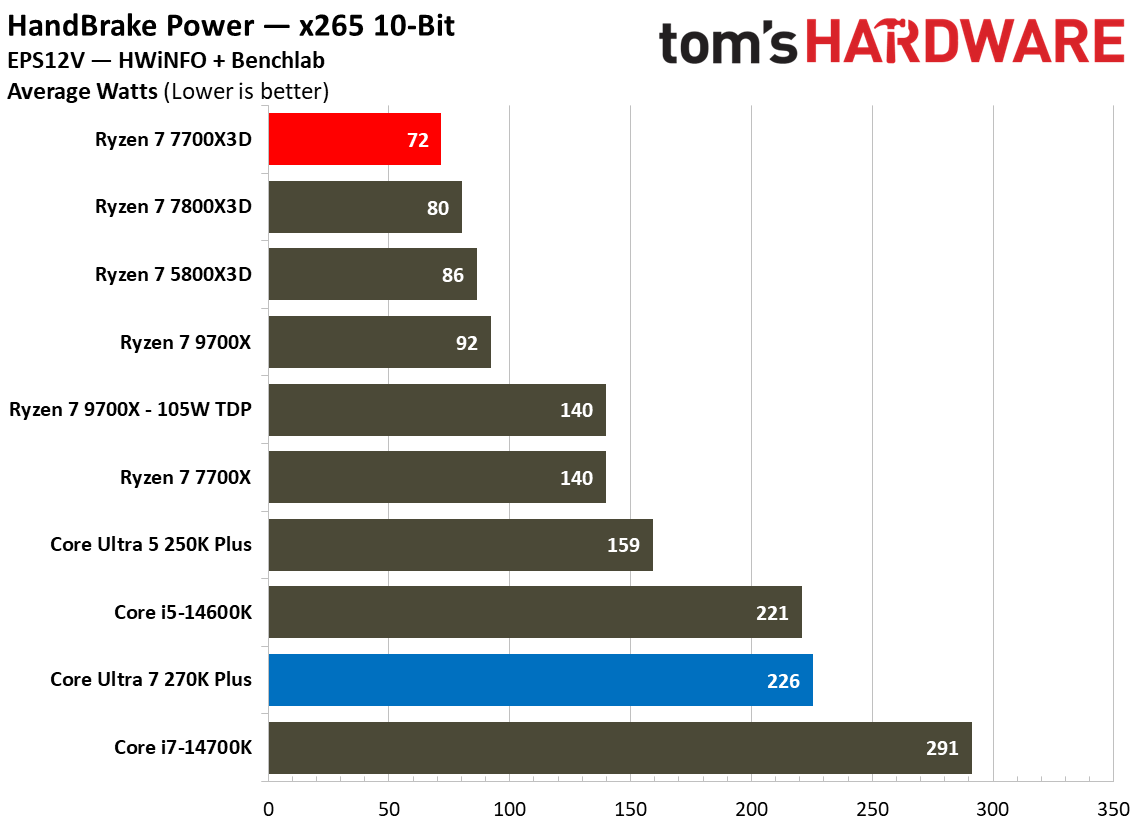
In synthethic multi-threaded workloads, the difference is quite evident. While running HandBrake x265 10-bit encode, the 270K Plus consumes an average of 226W, which is more than triple the 72W required by the Ryzen 7 7700X3D. A similar trend appears in VP9 encoding, where Intel draws 184W compared to AMD’s efficient 65W. Even in lighter tasks like single-threaded y-cruncher AVX workloads, the Intel chip requires 55W while the AMD chip stays at a modest 32W. Idle power consumption also favors Team Red where the 7700X3D idles at 19W and draws 22W during YouTube playback, whereas the 270K Plus sits higher at 29W and 38W, respectively.
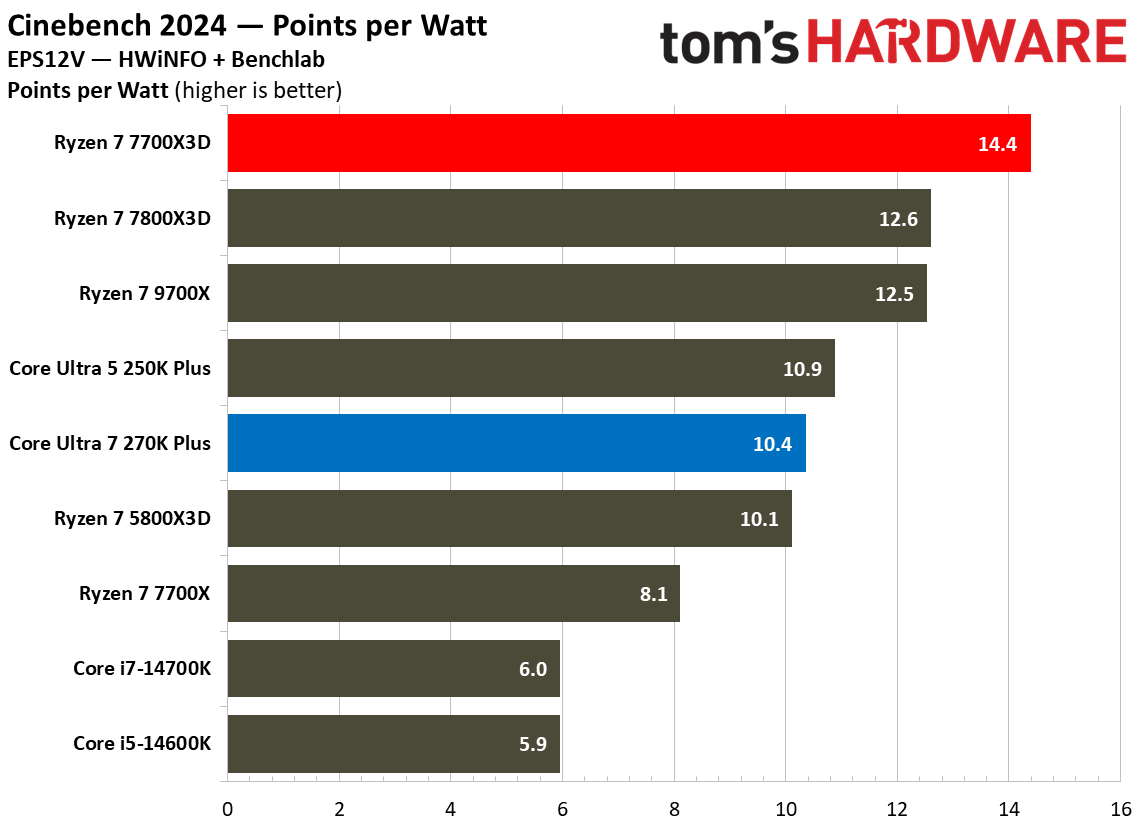
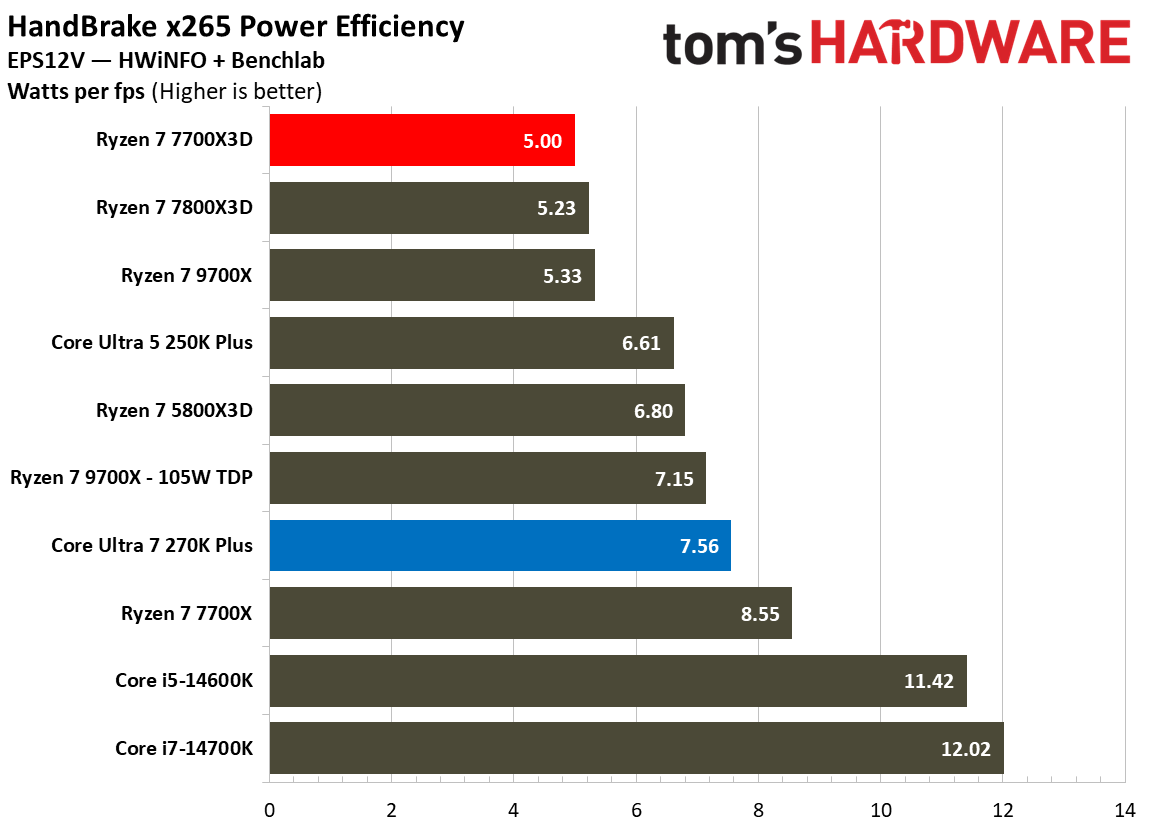
When we translate these power figures into efficiency metrics, AMD’s lead tends to stay ahead in most traditional benchmarks. In Cinebench 2024, the 7700X3D produces 14.4 points per watt, significantly outperforming the 10.4 points per watt from the 270K Plus. In HandBrake x265, AMD achieves a superior efficiency rating of 5W per FPS , while Intel trails at 7.56W per FPS.
Image 1 of 3
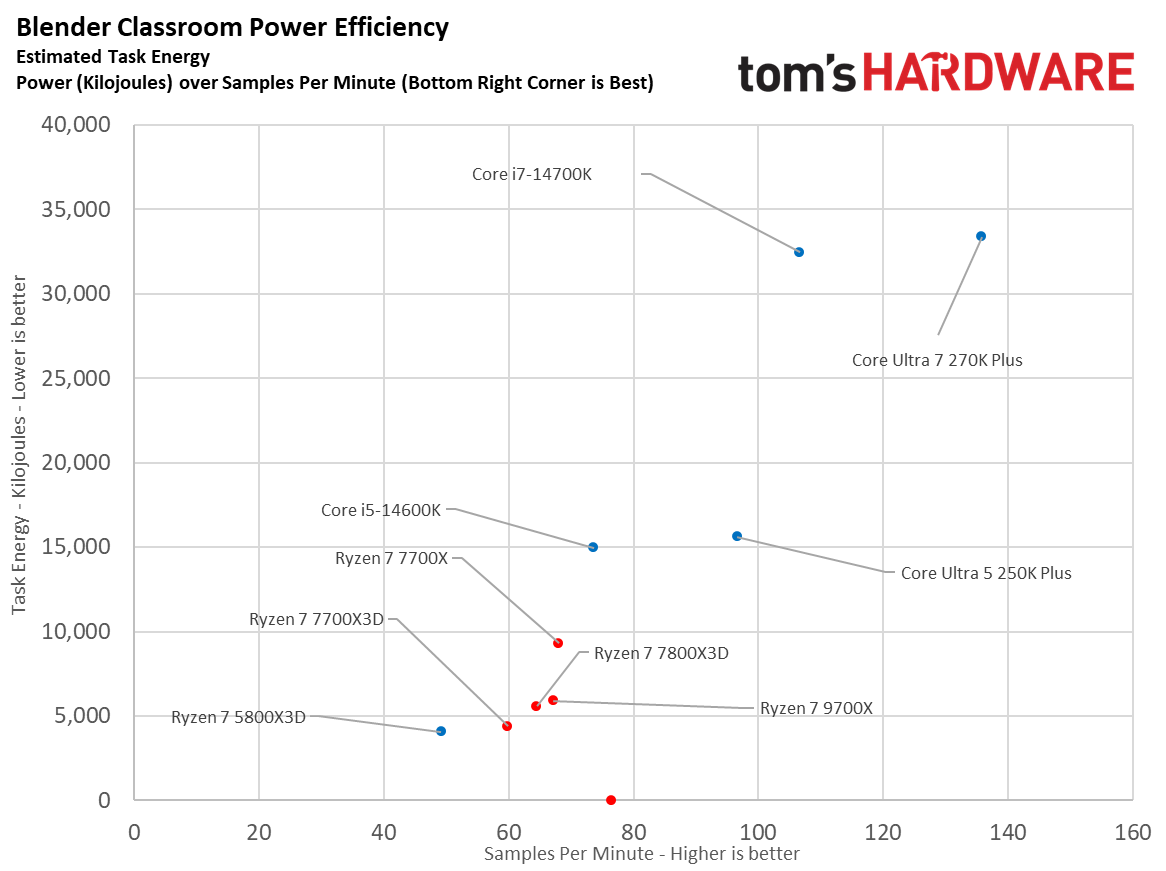
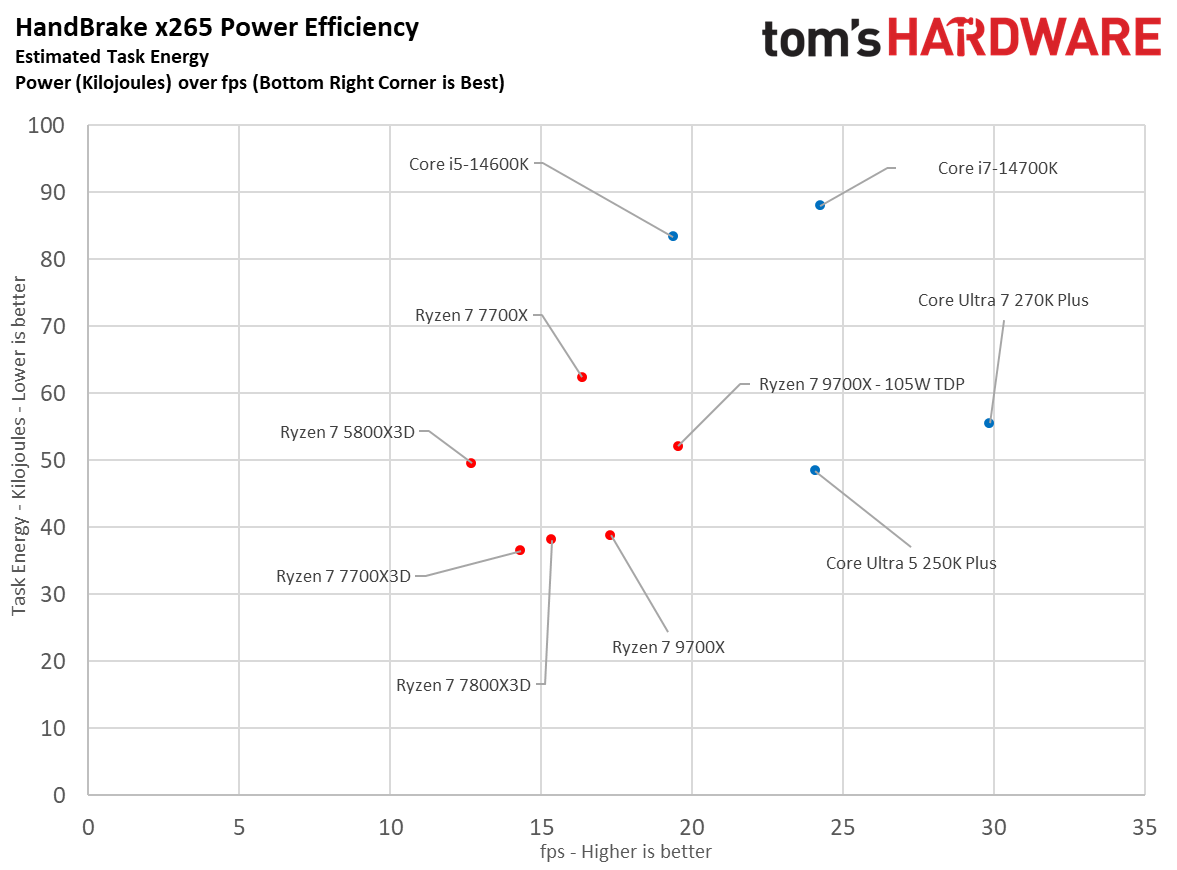
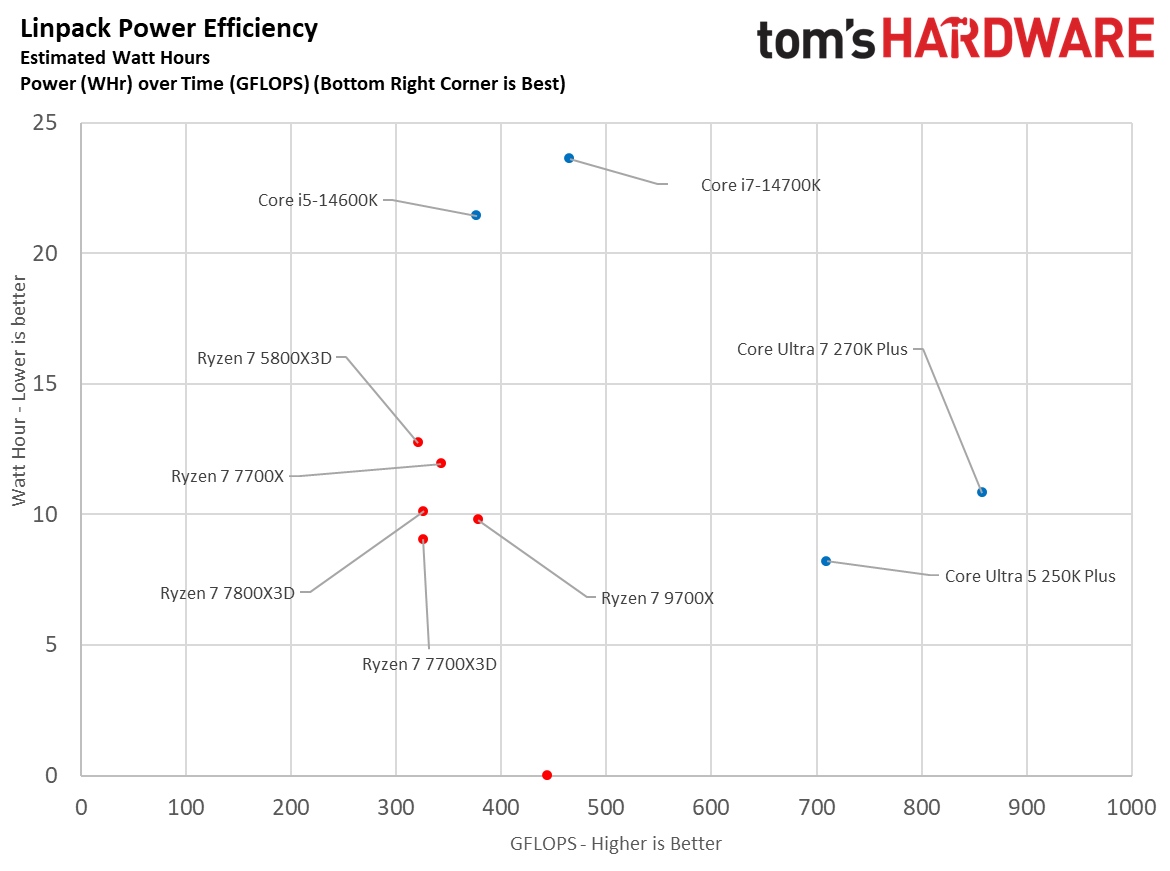
However, the efficiency scatter plots provide a more nuanced look at how performance scaling impacts total energy consumption. In the Blender Classroom scatterplot, the 270K Plus delivers a much higher performance of roughly 135 samples per minute, but it consumes over 33,000 kJ of task energy. In contrast, the 7700X3D finishes with only around 60 samples per minute but uses significantly less total energy at roughly 4,500 kJ.
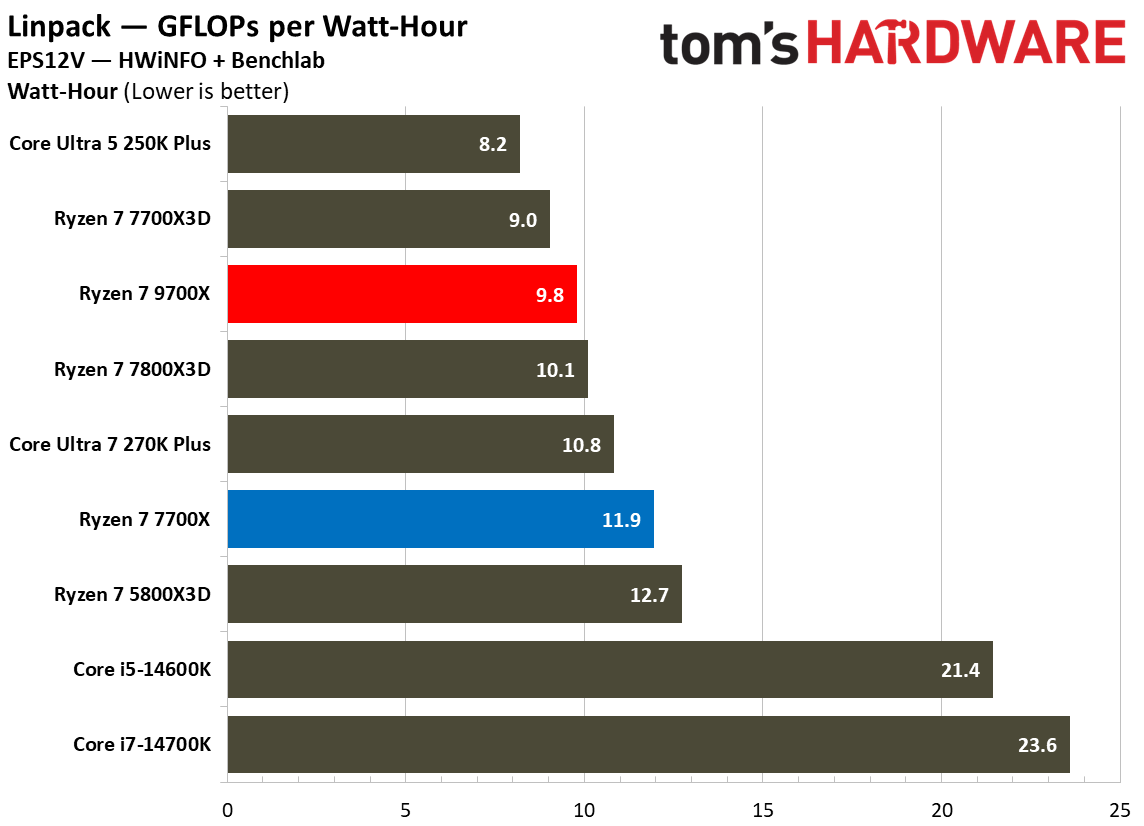
The HandBrake x265 scatterplot shows a similar trade-off where Intel reaches 30 FPS but consumes over 55 kJ, while AMD provides 14 FPS at roughly 36 kJ. Interestingly, the Linpack scatterplot shows the 270K Plus reaching over 850 GFLOPS with roughly 11WHr of energy, making it slightly more efficient in terms of performance-per-energy than the 7700X3D, which delivers roughly 340 GFLOPS for 10Whr.
From a cooling perspective, the 250W MTP on the 270K Plus means that it requires a robust cooling solution, like a 360mm AIO, to avoid thermal throttling during extended all-core loads. The 7700X3D is far easier to manage, remaining remarkably efficient and manageable with a mid-range air cooler. While the 270K Plus delivers class leading performance, it does so by significantly compromising efficiency in heavy workloads compared to AMD.
⭐Winner: AMD Ryzen 7 7700X3D
Pricing: Intel Core Ultra 7 270K Plus vs AMD Ryzen 7 7700X3D
The Intel Core Ultra 7 270K Plus was initially introduced with a justified $300 price tag, but you'll now find it between $300 and $320. The AMD Ryzen 7 7700X3D made its debut just last month and carries a $330 MSRP, placing it right under the 7800X3D. Essentially, there is not a major difference when it comes to the chips themselves, however, the true financial divide becomes apparent when we look at the total platform cost.
The Core Ultra 7 270K Plus demands a more substantial investment to reach its full potential. While one can opt for a B860 motherboard, a compatible Z890 motherboard is necessary in order to access premium overclocking and tuning features. These typically start around $150-$200, and can go as high as $600 packed with premium features. To handle the processor′s 250W Maximum Turbo Power(MTP) during heavy productivity tasks, a high−end 360mm AIO liquid cooler ($100-$150) or a dual-tower air-cooler ($50-$100) is recommended.
In contrast, the AMD Ryzen 7 7700X3D offers a much more budget-friendly entry point. A solid B650 motherboard can be found for around $120-$150 and the chip can be effectively cooled with a modest $50 air cooler.
Unfortunately, both platforms are held back by the ongoing global shortage of memory, which has caused prices to shoot up significantly. Since both CPUs require DDR5 RAM, builders are stuck in a RAMpocalypse where a basic 32GB kit costs over $400. This extra cost is bad news for both sides as it cancels out any price advantage.
Overall, the lower upfront platform cost makes the 7700X3D a slightly more attractive option for users prioritizing their budget. Furthermore, the AM5 socket offers a clear upgrade path through at least 2029, ensuring that your motherboard investment remains viable for future CPU generations. That is not the case with Intel, as the LGA 1851 socket is expected to be replaced once the next-generation of Nova Lake CPUs arrive.
⭐ Winner: AMD Ryzen 7 7700X3D
Ultimately, while both the chips are available at a very similar price range, the AMD Ryzen 7 7700X3D is the smarter financial play for a majority of users. Its significantly lower platform costs, superior gaming efficiency, and guaranteed platform longevity provide a level of value that the more power-hungry Intel refresh cannot quite match.
Bottom Line: Intel Core Ultra 7 270K Plus vs AMD Ryzen 7 7700X3D
Swipe to scroll horizontally
| Row 0 - Cell 0 | Intel Core Ultra 7 270K Plus |
AMD Ryzen 7 7700X3D |
Features and Specifications |
❌ |
Row 1 - Cell 2 |
Gaming |
Row 2 - Cell 1 | ❌ |
Productivity Applications |
❌ |
Row 3 - Cell 2 |
Overclocking |
❌ |
Row 4 - Cell 2 |
Power Consumption, Efficiency, and Cooling |
Row 5 - Cell 1 | ❌ |
Pricing |
Row 6 - Cell 1 | ❌ |
Total |
3 |
3 |
The Ryzen 7 7700X3D and Core Ultra 7 270K Plus are designed for very different users, even though they sit in roughly the same price range. Like previous X3D chips, AMD's latest processor is built with gaming in mind, using its large 3D V-Cache to deliver excellent frame rates while keeping power consumption impressively low. Intel, on the other hand, combines a 24-core design with higher clock speeds and platform improvements to create one of the strongest productivity processors in its class without giving up much gaming performance.
The final score is tied at three rounds apiece. AMD comfortably wins gaming performance, power efficiency, and platform value, three factors that matter a lot for buyers shopping in this price segment. The AM5 platform also provides a significantly longer upgrade path, allowing users to drop in future processors without replacing their motherboard.
Intel, however, deserves recognition for what it has accomplished with the 270K Plus. It delivers outstanding single- and multi-threaded performance, offers a fully unlocked overclocking experience, and narrows the gaming gap to just a few percentage points in many modern titles. If your workload includes video editing, software development, 3D rendering, or other heavily threaded applications, the 270K Plus is the obvious choice and justifies its higher power draw.
For everyone else, the Ryzen 7 7700X3D is the more compelling CPU. It offers faster gaming performance, exceptional efficiency, lower platform costs, and a future-proof AM5 ecosystem. Unless your workload regularly extends beyond gaming into demanding productivity applications, AMD's latest X3D chip is the easier processor to recommend.
⭐ Winner: Tie







 English (US) ·