
 4 hours ago
6
4 hours ago
6
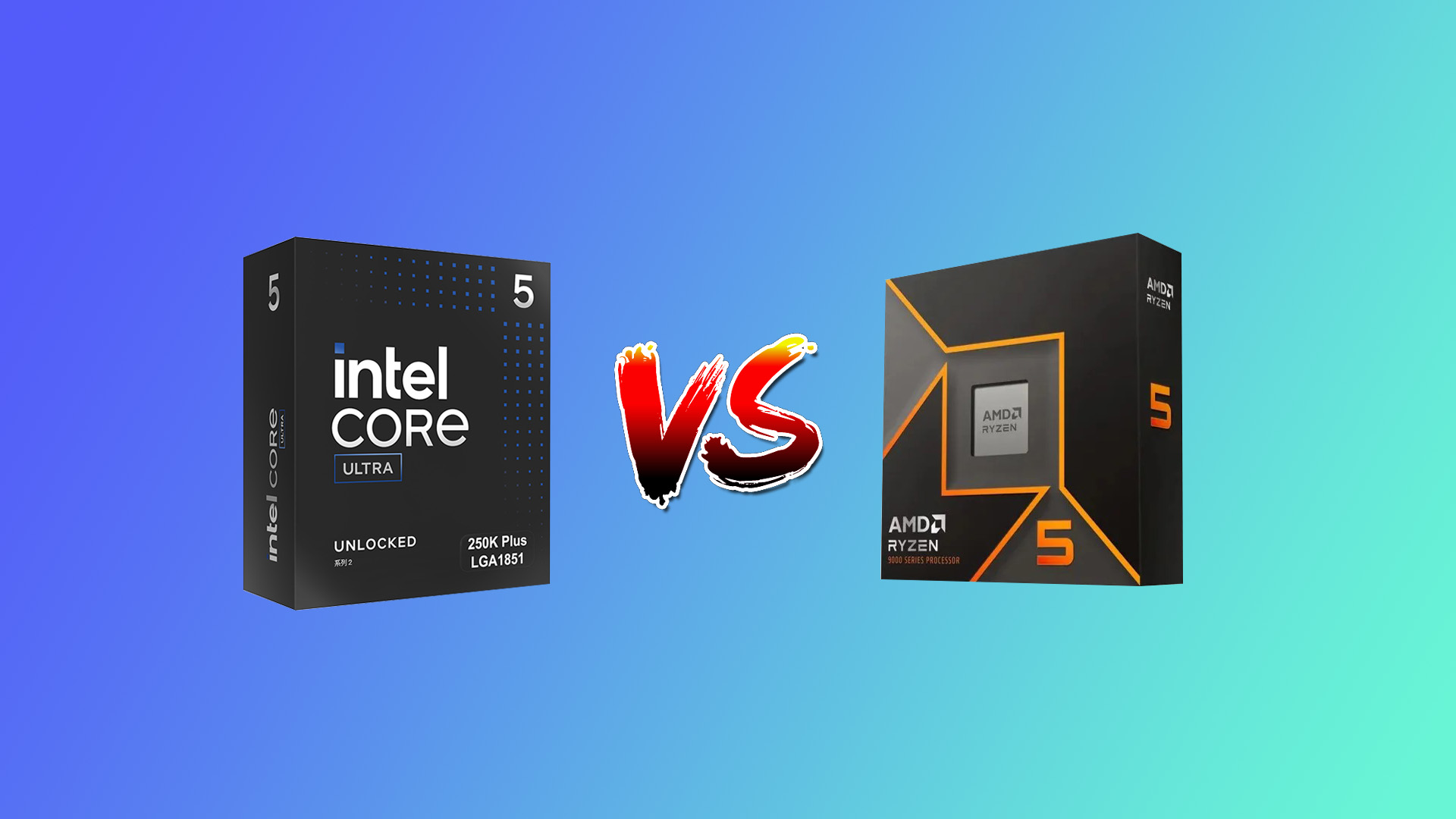
The mid-range CPU segment has become competitive once again with Intel releasing new desktop CPUs as part of its Arrow Lake refresh lineup. We recently compared the Core Ultra 7 270K Plus with the AMD Ryzen 7 9700X, where Intel emerged as the winner in our six-round gauntlet. Today we are going to take a look at the more affordable Core Ultra 5 250K Plus, which offers excellent value thanks to its aggressive pricing of $200, with gaming performance that outperforms the more expensive Core Ultra 7 265K and a price that earned it a spot among our best CPUs for gaming.
Competing against Intel's new value chip is the AMD Ryzen 5 9600X, an efficient Zen 5 CPU that targets mainstream gaming and productivity without breaking the bank. While both CPUs look promising at their current market price, it is important to understand that real-world behavior can differ depending on the workloads. The 250K Plus comes with a significantly higher number of cores compared to the 9600X, which sticks to a more traditional design with fewer cores but competitive clock speeds and a lower TDP. This contrast makes the comparison even more interesting.
Article continues below
Features and Specifications: Intel Core Ultra 5 250K Plus vs AMD Ryzen 5 9600X
Swipe to scroll horizontally
Intel Core Ultra 5 250K Plus | $219 ($199) | Arrow Lake TSMC N3B (3nm) | 18 / 18 (6+12) | 4.2 / 5.3 | 60MB (30+30) | 125W / 159W | DDR5-7200 MT/s |
AMD Ryzen 5 9600X | $185 ($279) | Zen 5 TSMC 4nm | 6 / 12 | 3.9 / 5.4 | 38MB (6+32) | 65W / 88W | DDR5-5600 MT/s |
The Core Ultra 5 250K Plus is part of Intel's Arrow Lake refresh lineup which is built on TSMC’s 3nm process. Like the rest of the Arrow Lake lineup, it features a hybrid architecture with a total of 18 cores divided into six Lion Cove performance cores and 12 Skymont efficiency cores. Since Intel no longer offers Hyperthreading on its Core Ultra series CPUs, you get a total of 18 threads.
In terms of clock speeds, the P-cores on the 250K Plus can boost up to 5.3 GHz with the E-cores going up to 4.6 GHz. Intel has also bumped up the total cache on the CPU to 60 MB, with 30 MB dedicated to L3 cache, similar to the Core Ultra 7 265K. Additionally, the 250K Plus supports faster DDR5-7200 memory, which should give the CPU an advantage in specific tasks requiring higher memory bandwidth, especially at this price. Power limits have been kept similar to the Core Ultra 5 245K with 125W TDP and an MTP (Maximum Turbo Power) of 159W. It also comes with an unlocked multiplier for overclocking purposes and the chip continues to use the LGA 1851 socket with support for all Intel 800-series motherboards.
As for the Ryzen 5 9600X, it is based on AMD's Zen 5 architecture on TSMC's 4nm node. It continues to offer a more conservative six-core, 12-thread design which has been around ever since the Ryzen 5 1600X. The 9600X holds a minor advantage in clock speeds as it can boost up to 5.4 GHz, and has a slightly higher L3 cache of 32 MB. The CPU supports DDR5 memory at 5600 MT/s along with a rated TDP of 65W. The optional 105W TDP can boost power higher while still being covered under AMD's warranty.
Like the Intel chip, the 9600X can also be overclocked, although one may not gain a lot of benefits. As for motherboard compatibility, it is compatible with AMD's AM5 platform meaning it can run on both 600 and 800-series motherboards running on the latest firmware.
Coming to the price, the 250K Plus launched with an official MSRP of $199, making it one of best value for money Intel desktop CPUs today. The 9600X launched almost two years ago with an introductory MSRP of $280. The tables have turned with pricing now. The 9600X is slightly cheaper at between $180 and $190, while the 250K Plus has crept up to around $220.
⭐Winner: Intel Core Ultra 5 250K Plus
There's no clear winner here, but the Intel Core Ultra 250K Plus looks promising with its significantly higher core count, larger cache pool, and support for faster memory. On paper, it's a more capable CPU all around, even if the Arrow Lake architecture has some oddities we'll explore more in this faceoff.
Gaming Benchmarks and Performance: Intel Core Ultra 5 250K Plus vs AMD Ryzen 5 9600X
This section is the most crucial part of this comparison as both 250K Plus and 9600X sit right in the mainstream sweet spot for gamers. To test the gaming performance on both CPUs, we paired them with the Nvidia RTX 5090 to avoid any bottlenecks and ran a range of modern games at 1080p resolution.
As per our 1080p gaming FPS geomean, the 9600X and 250K Plus are equally matched with Intel just edging out a 1% lead. That said, if we look at individual game results the 250K Plus offers better gaming performance in 11 out of the 17 games that we tested.
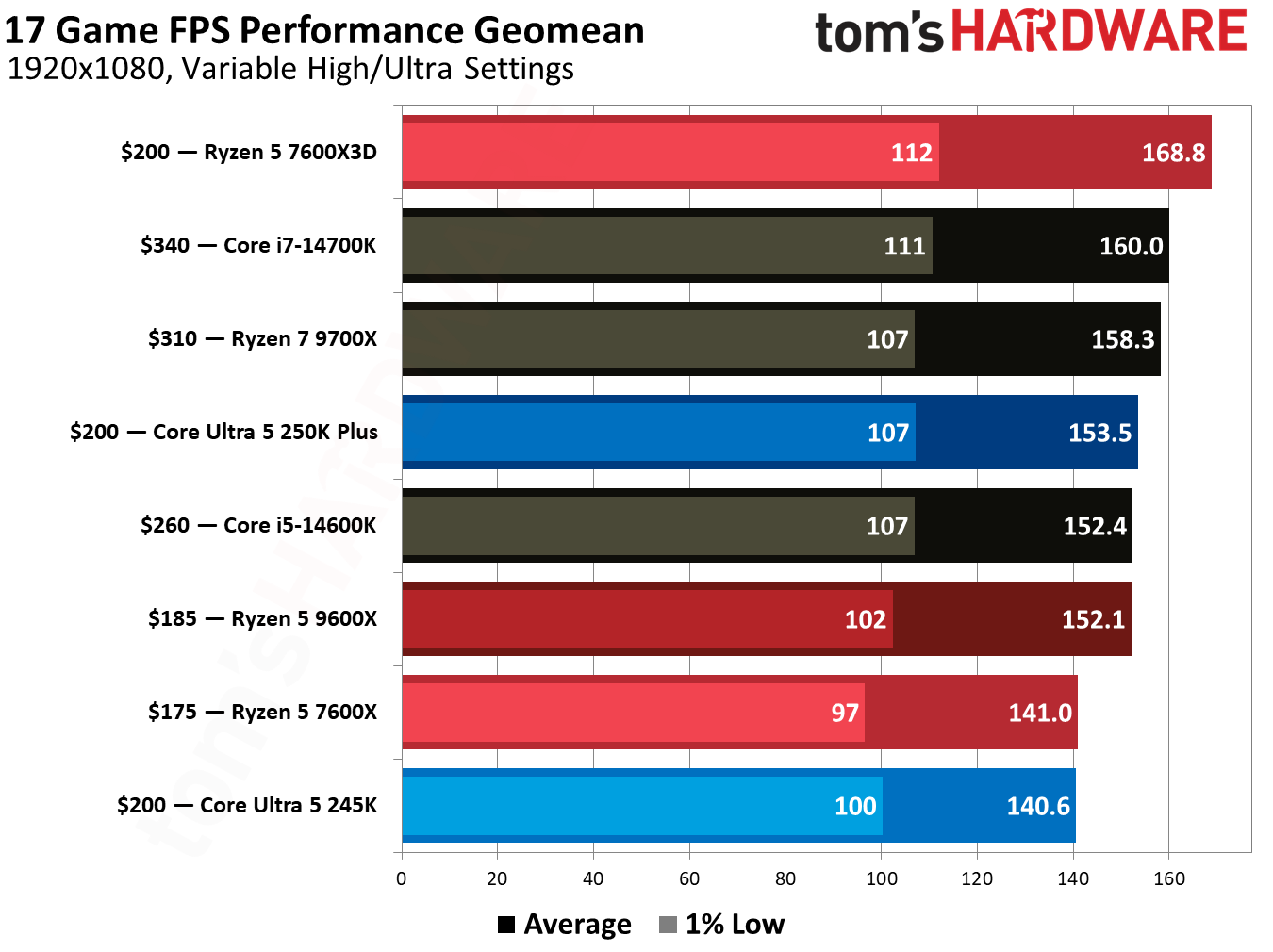
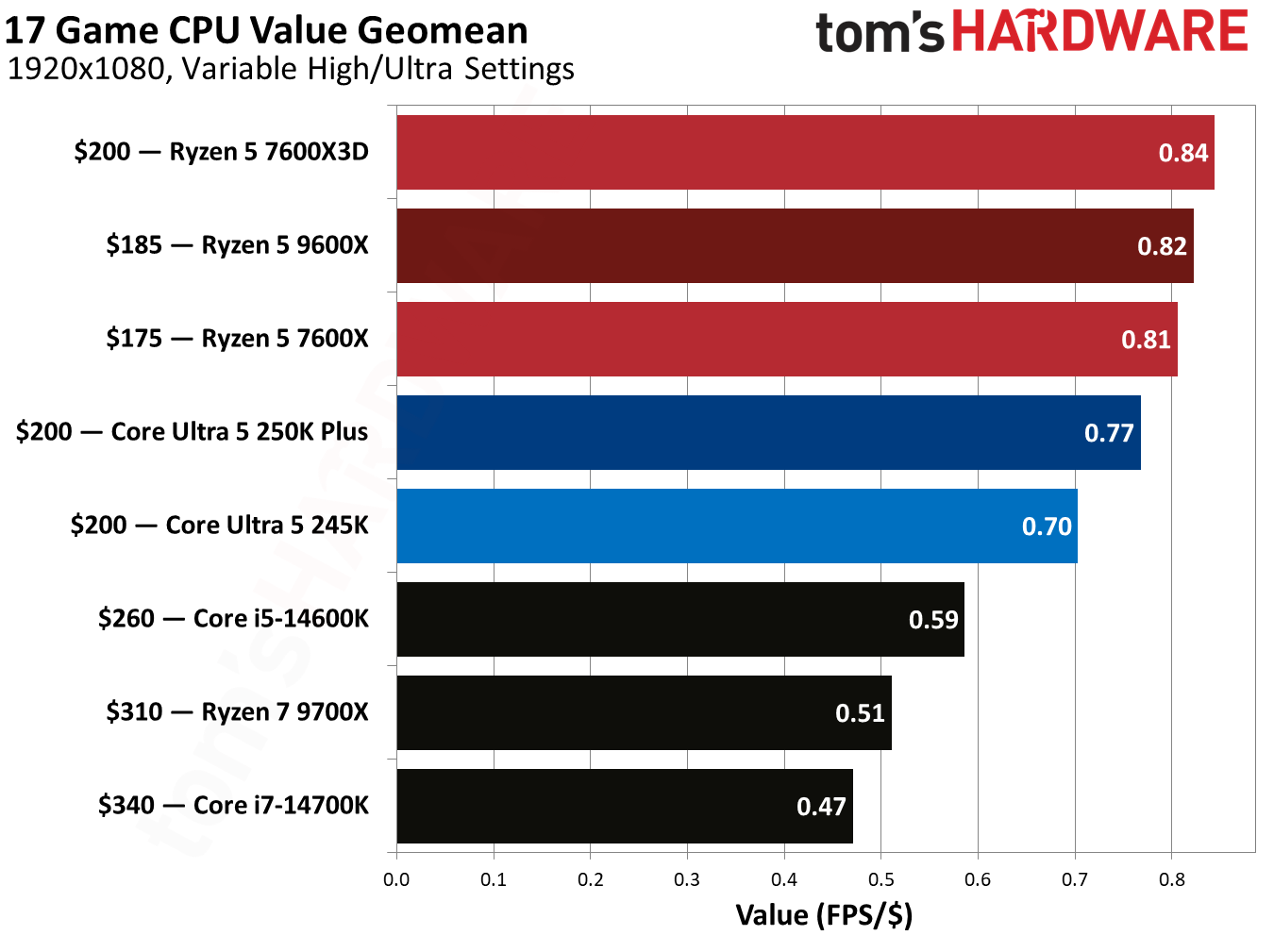
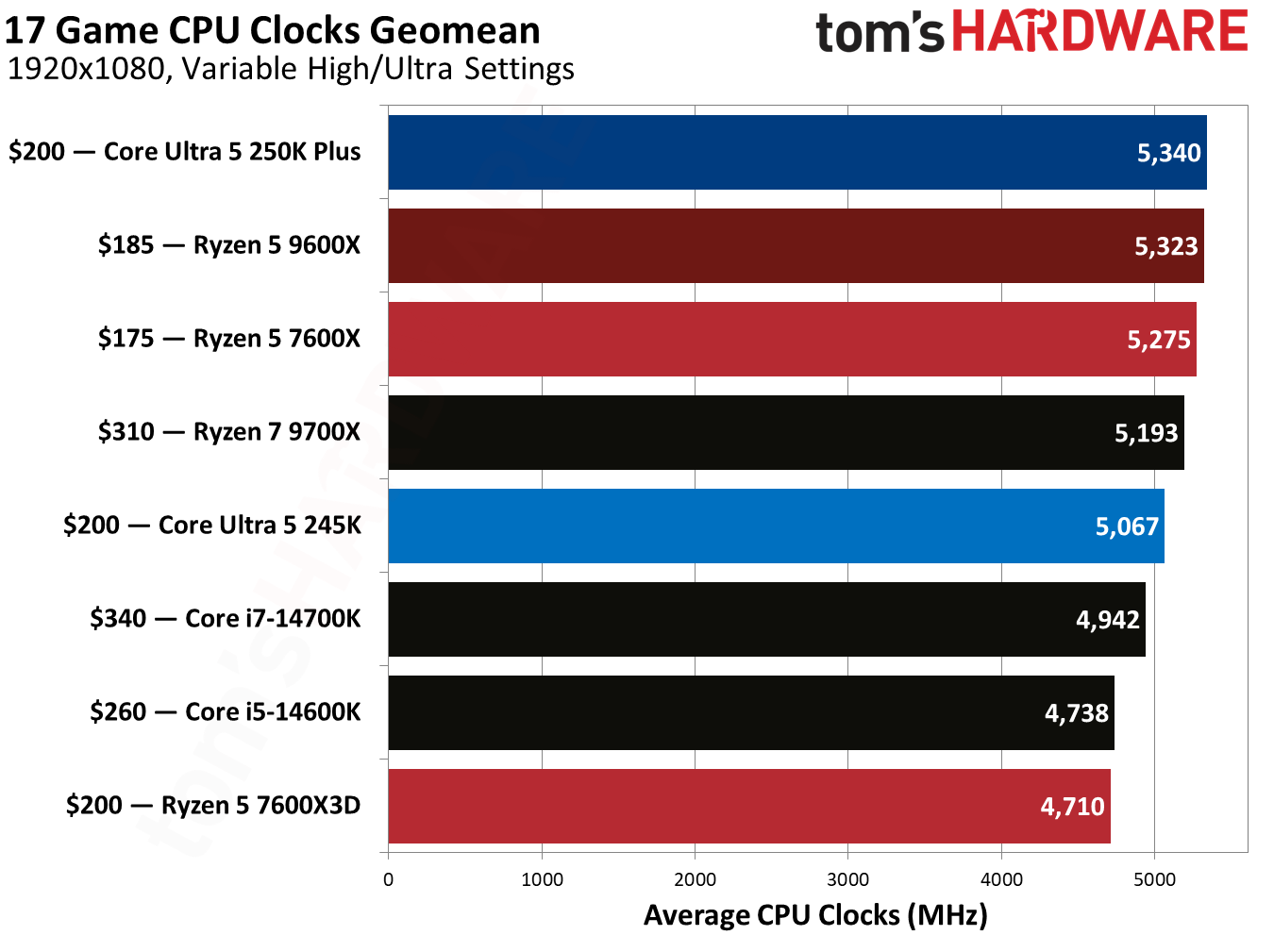
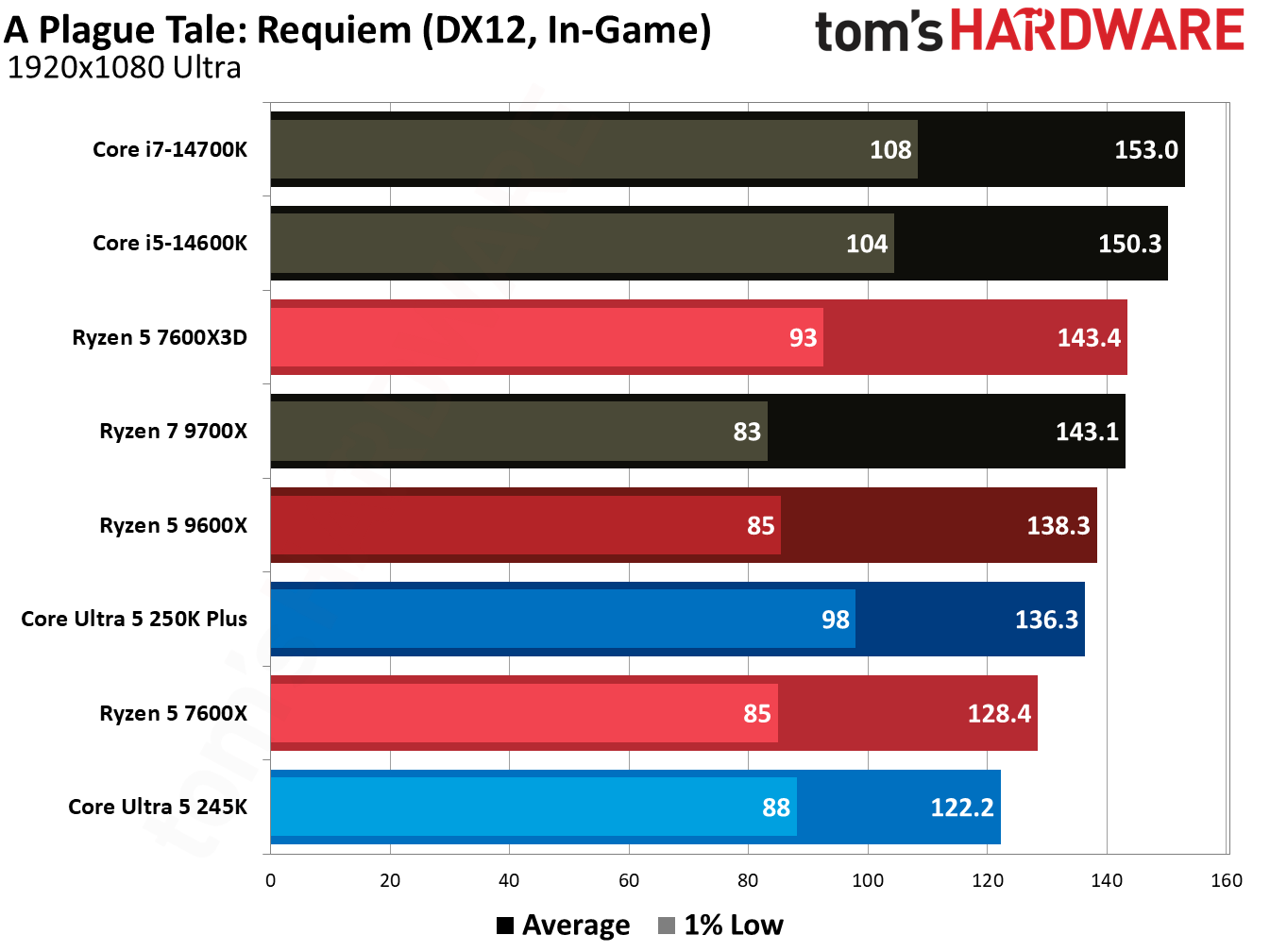
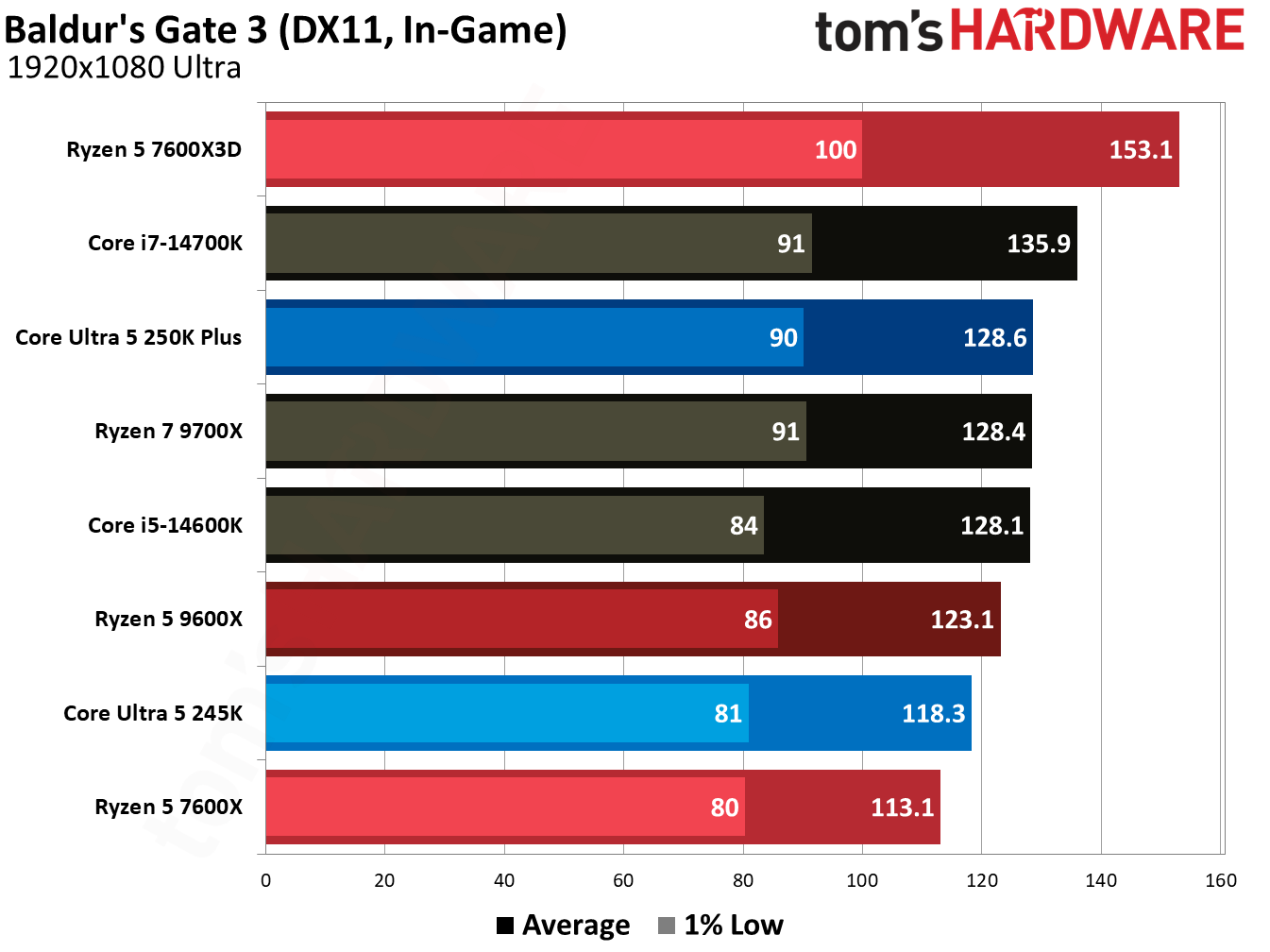
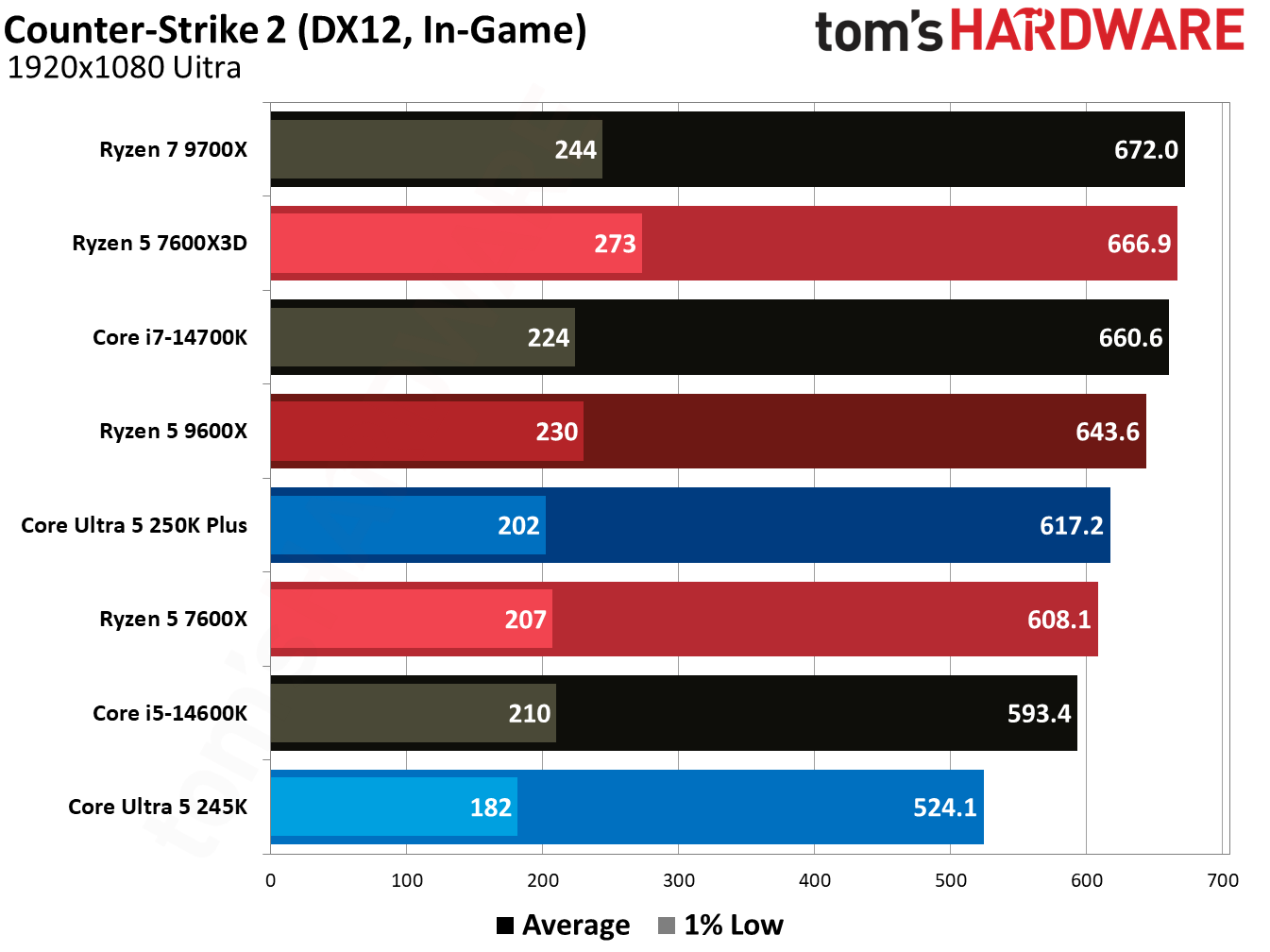
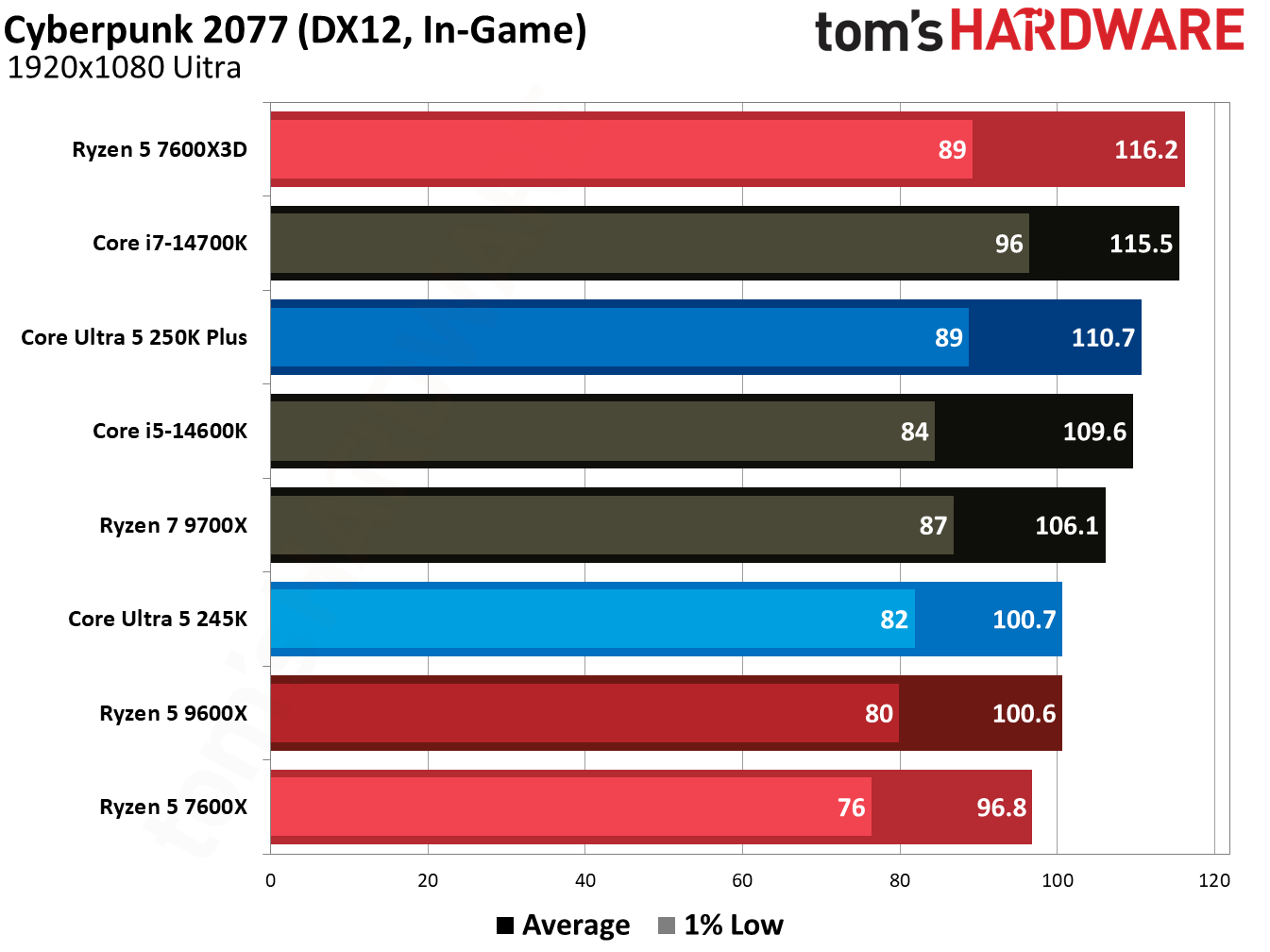
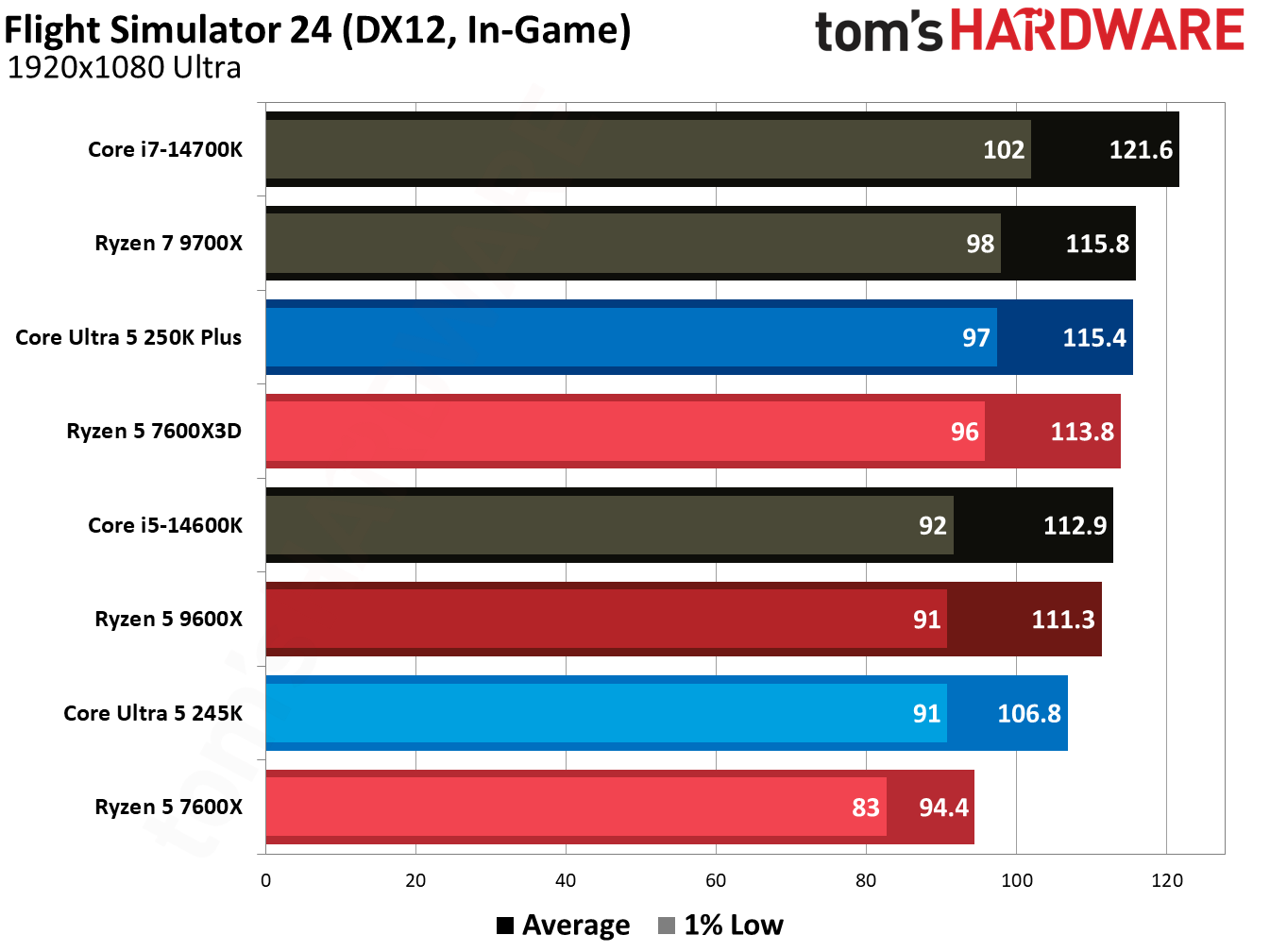
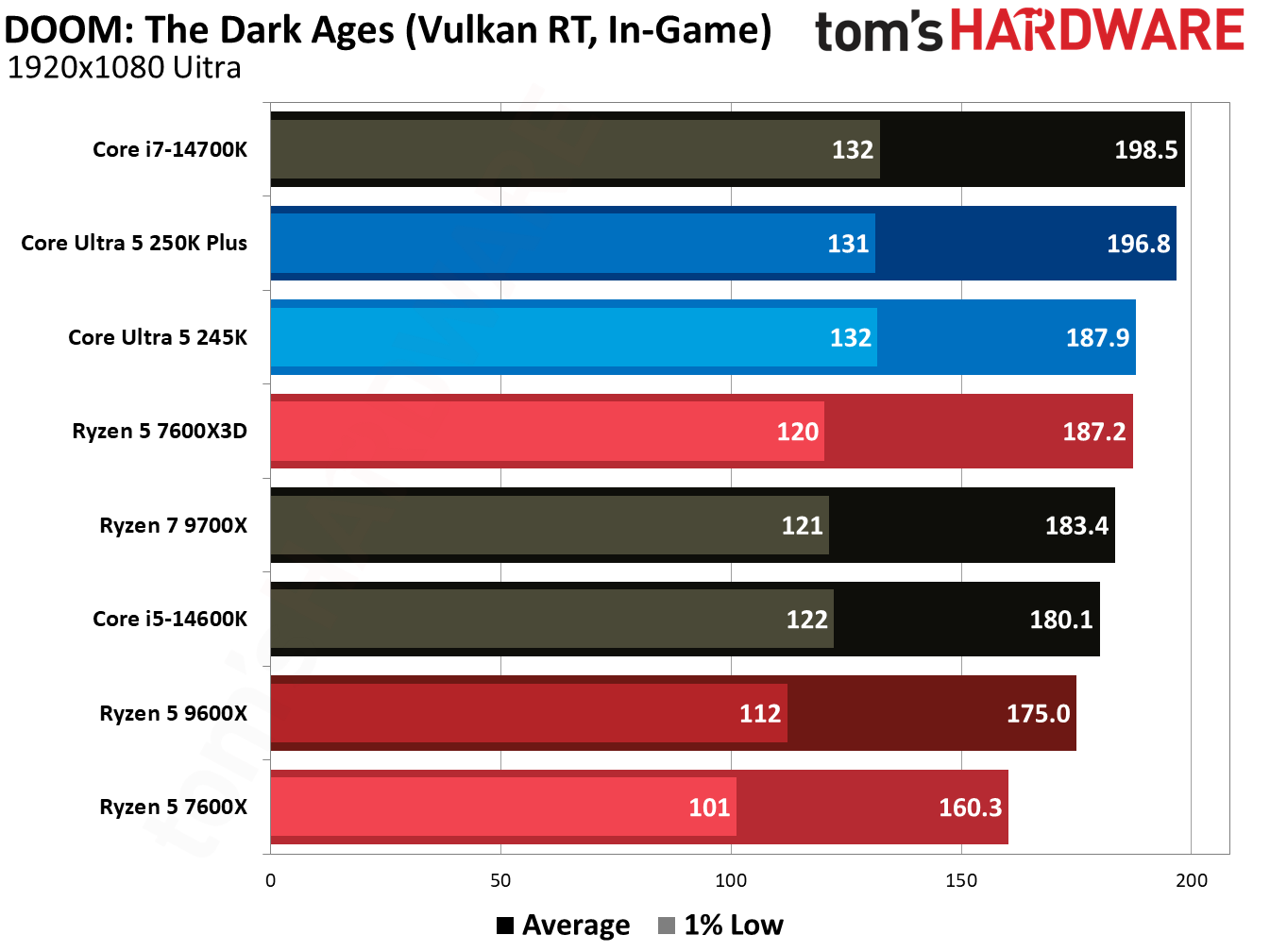
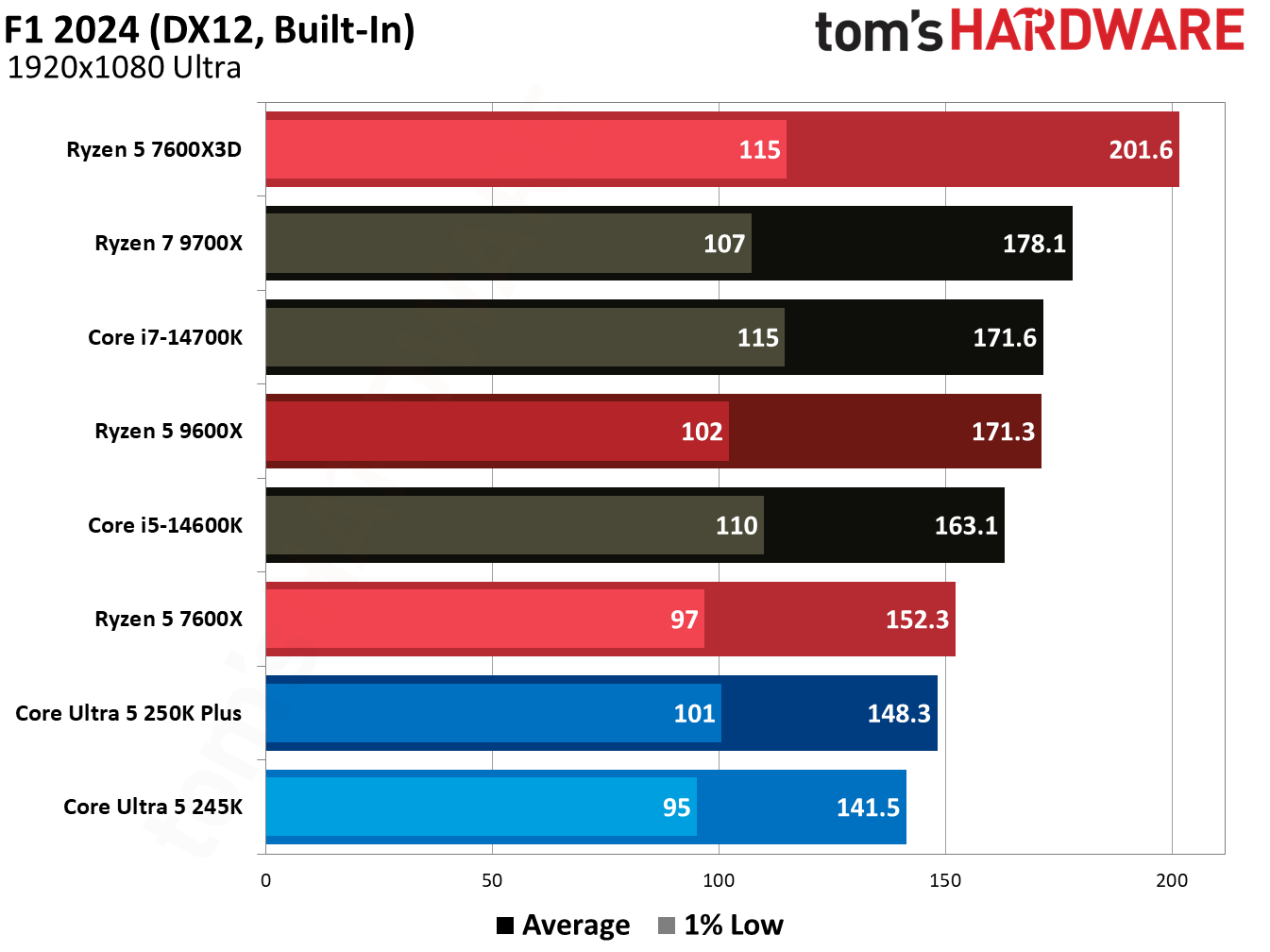
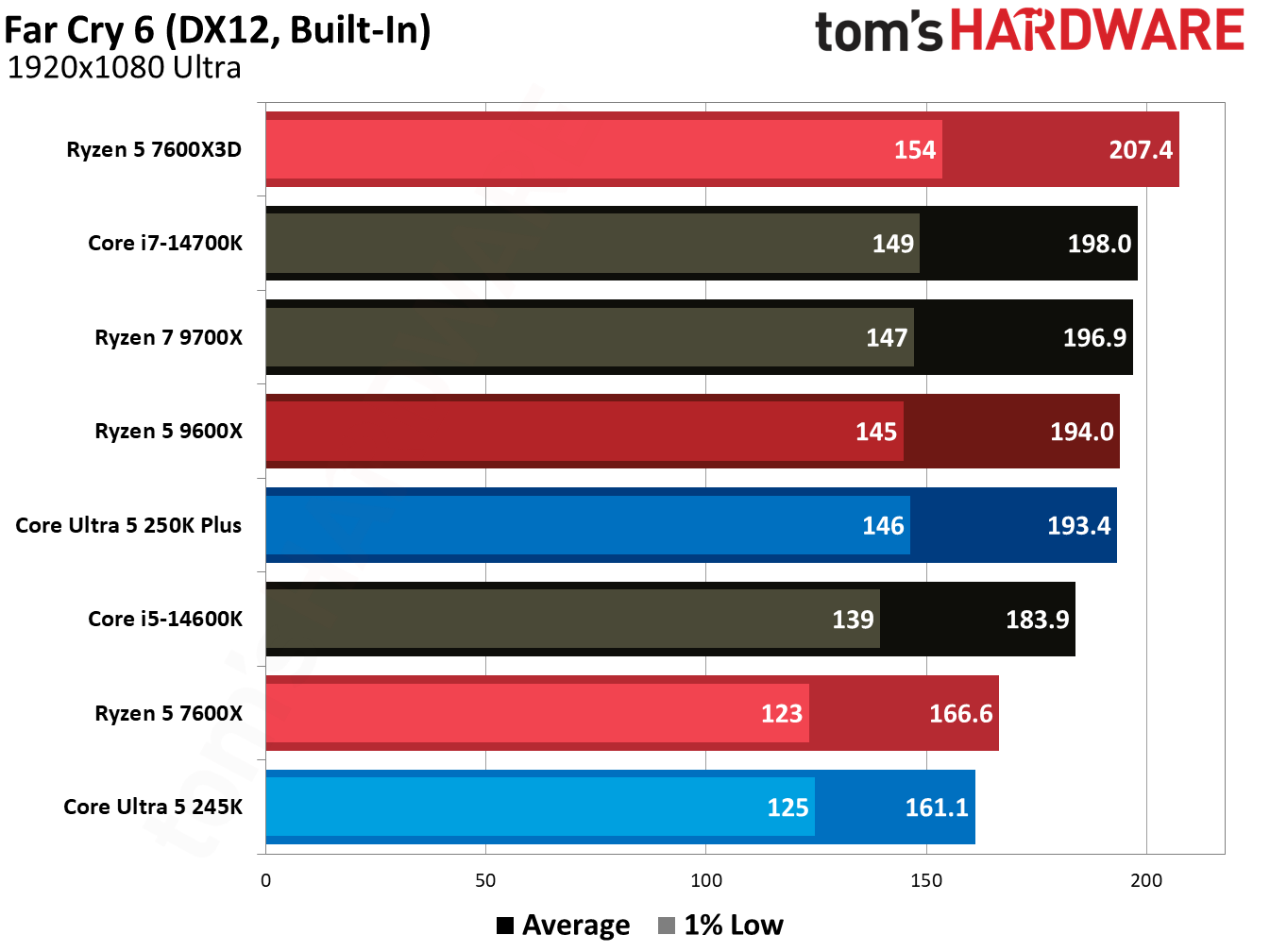
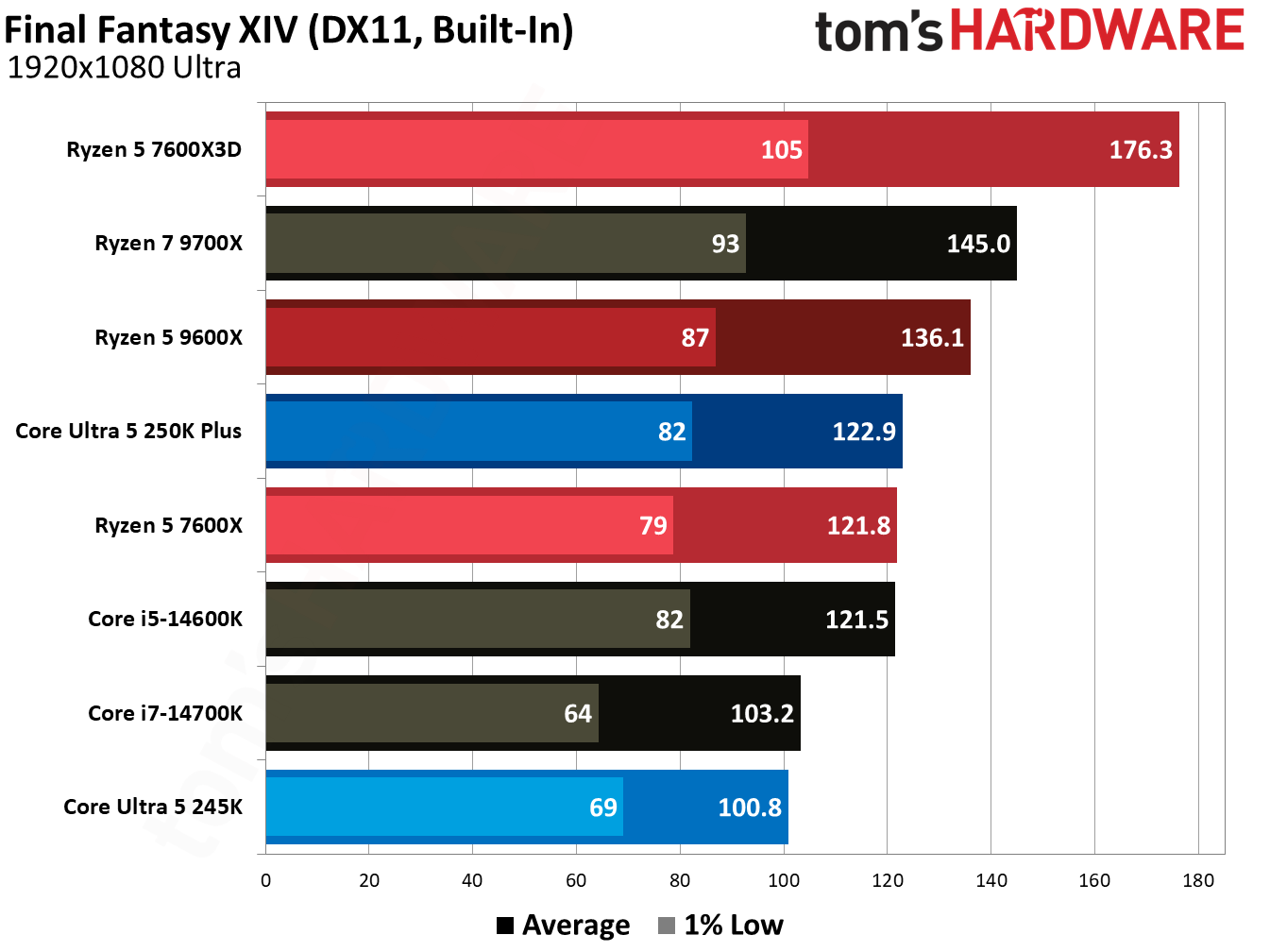
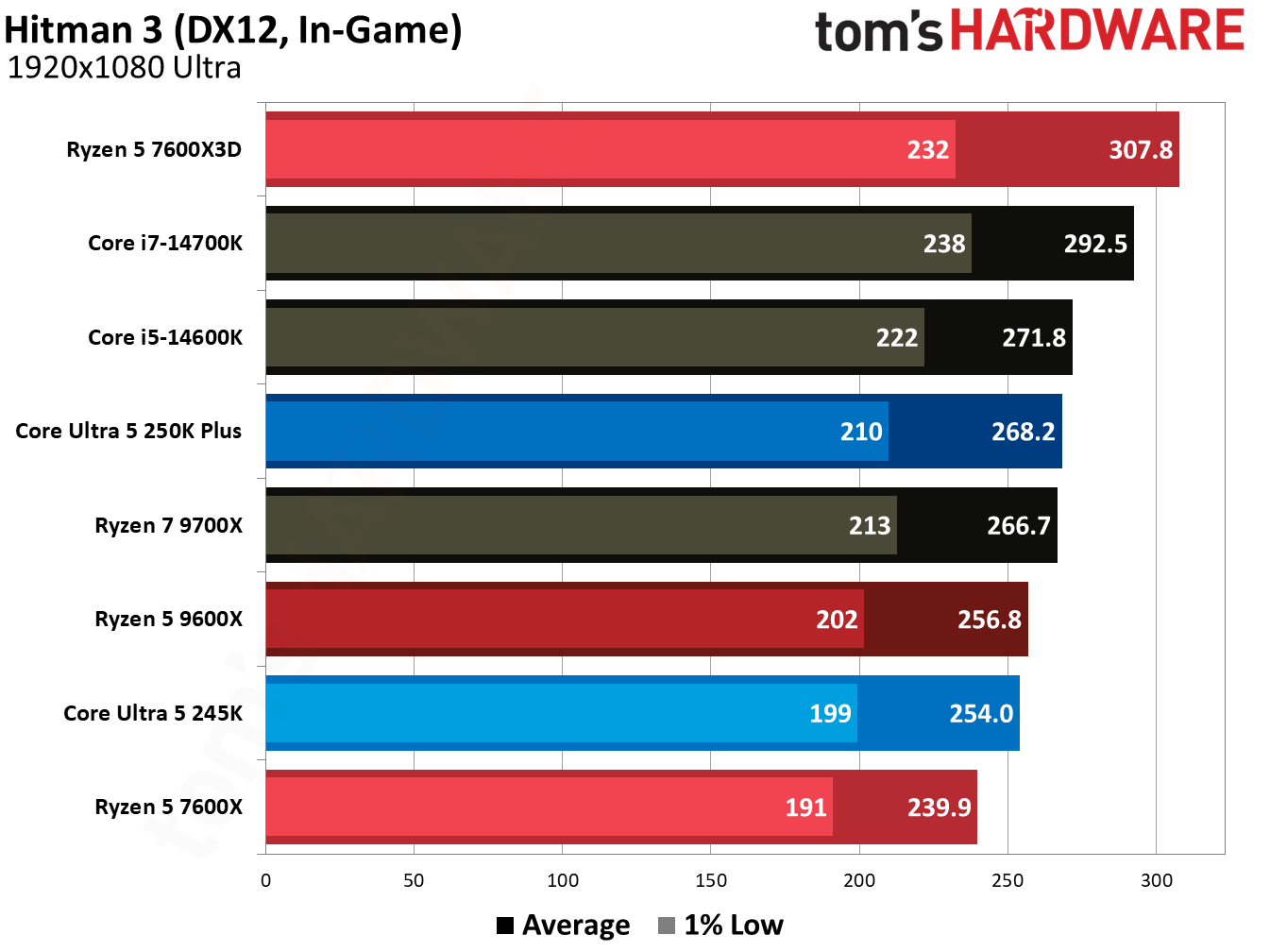
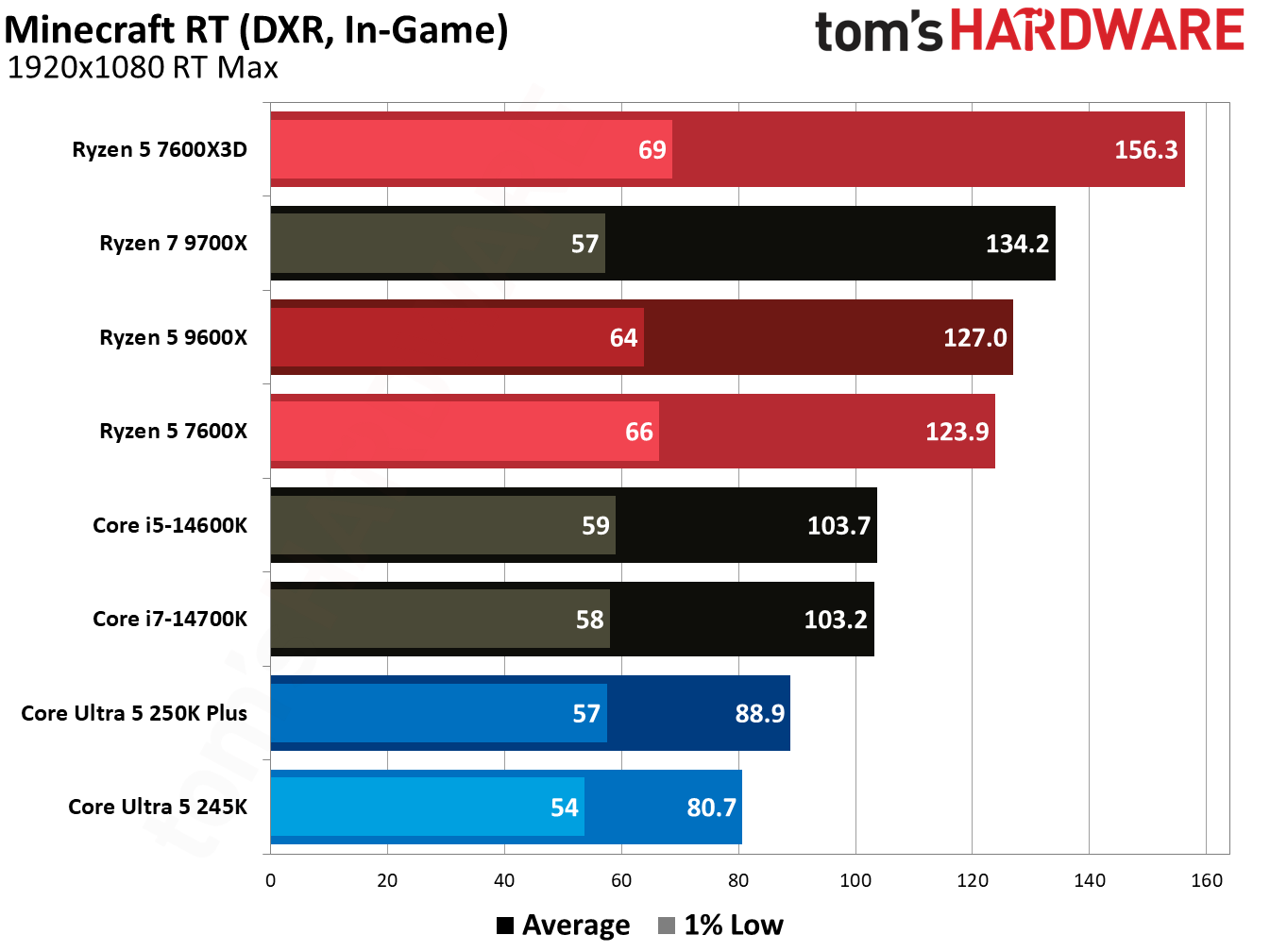
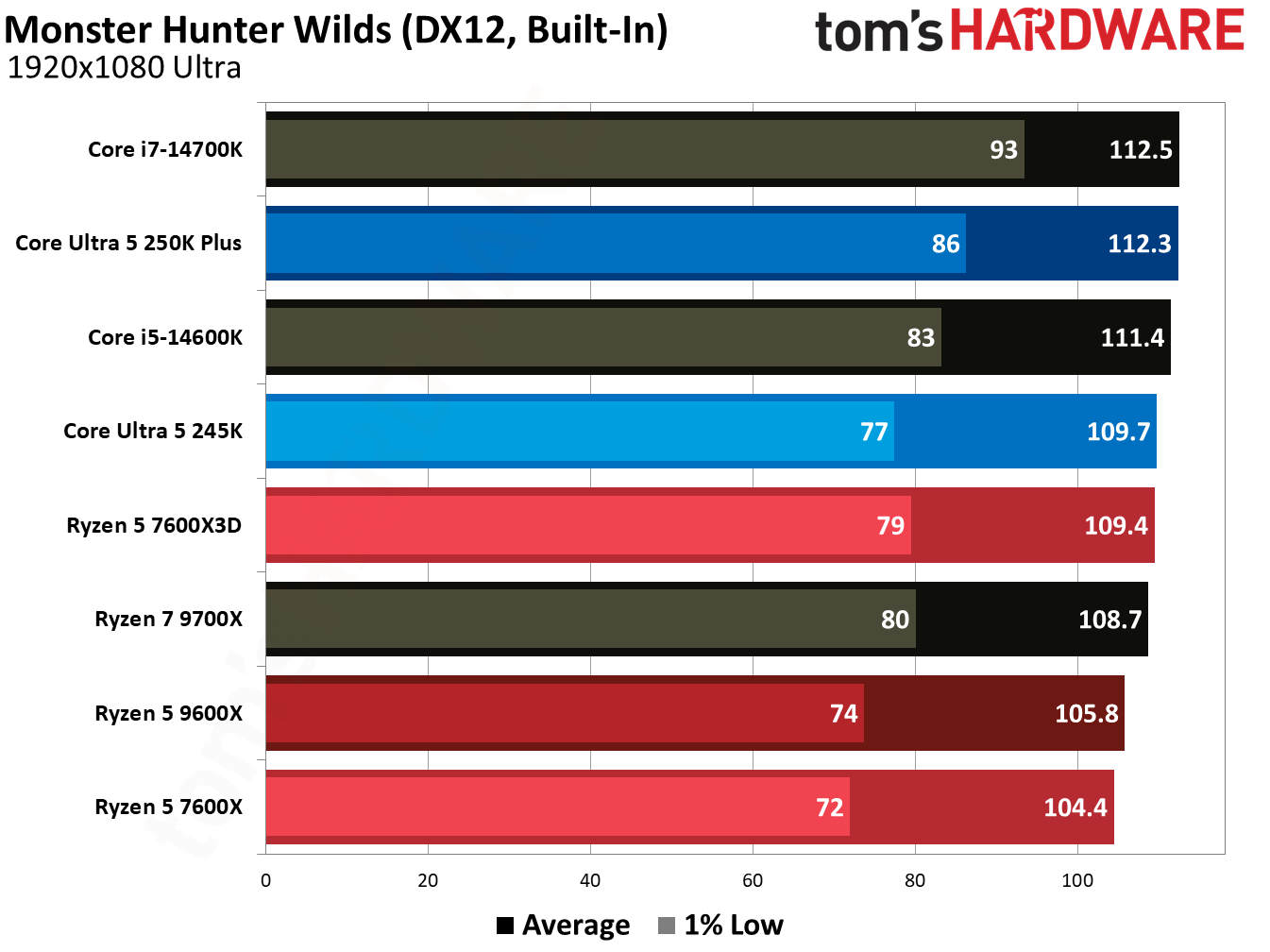
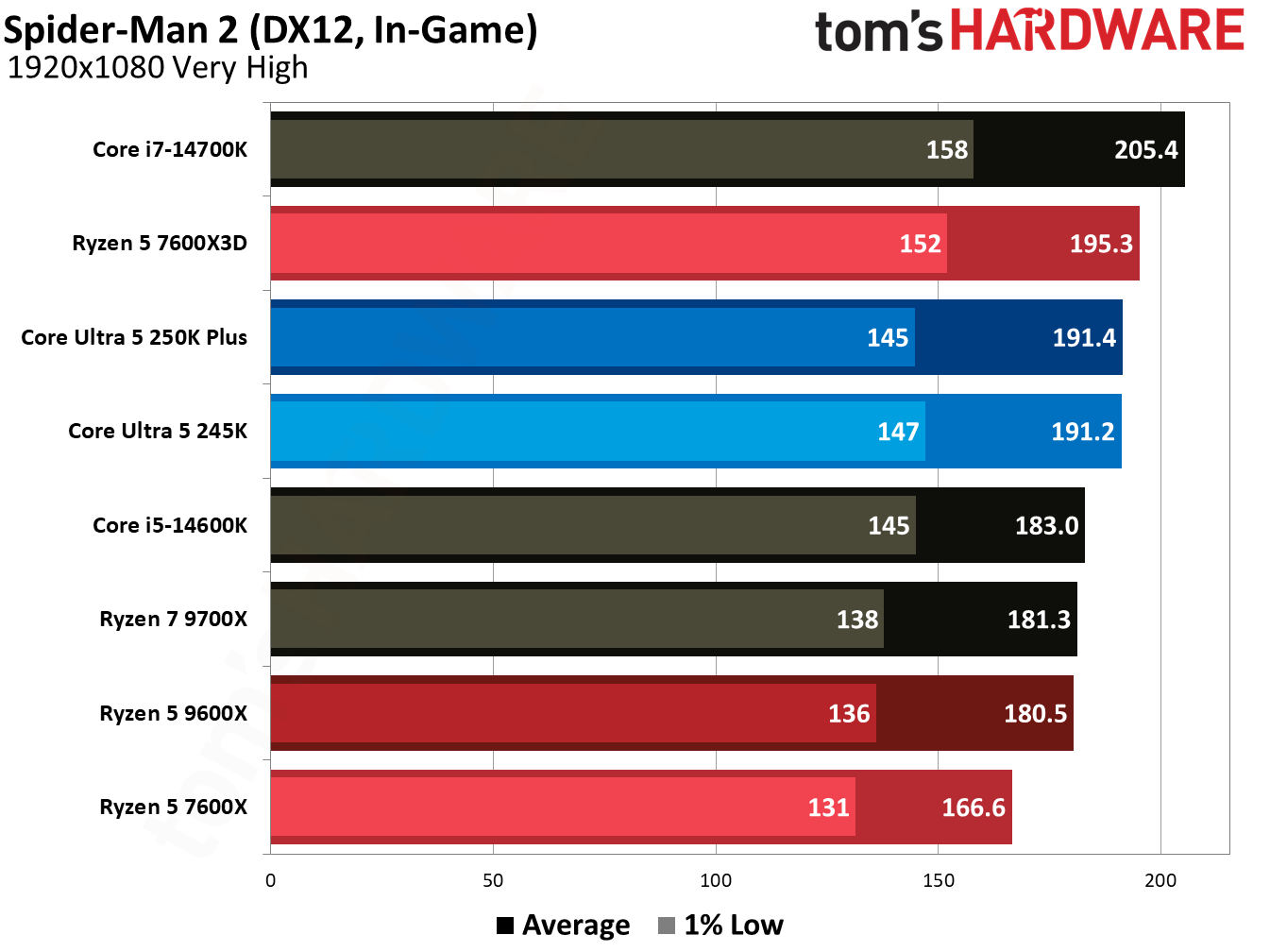
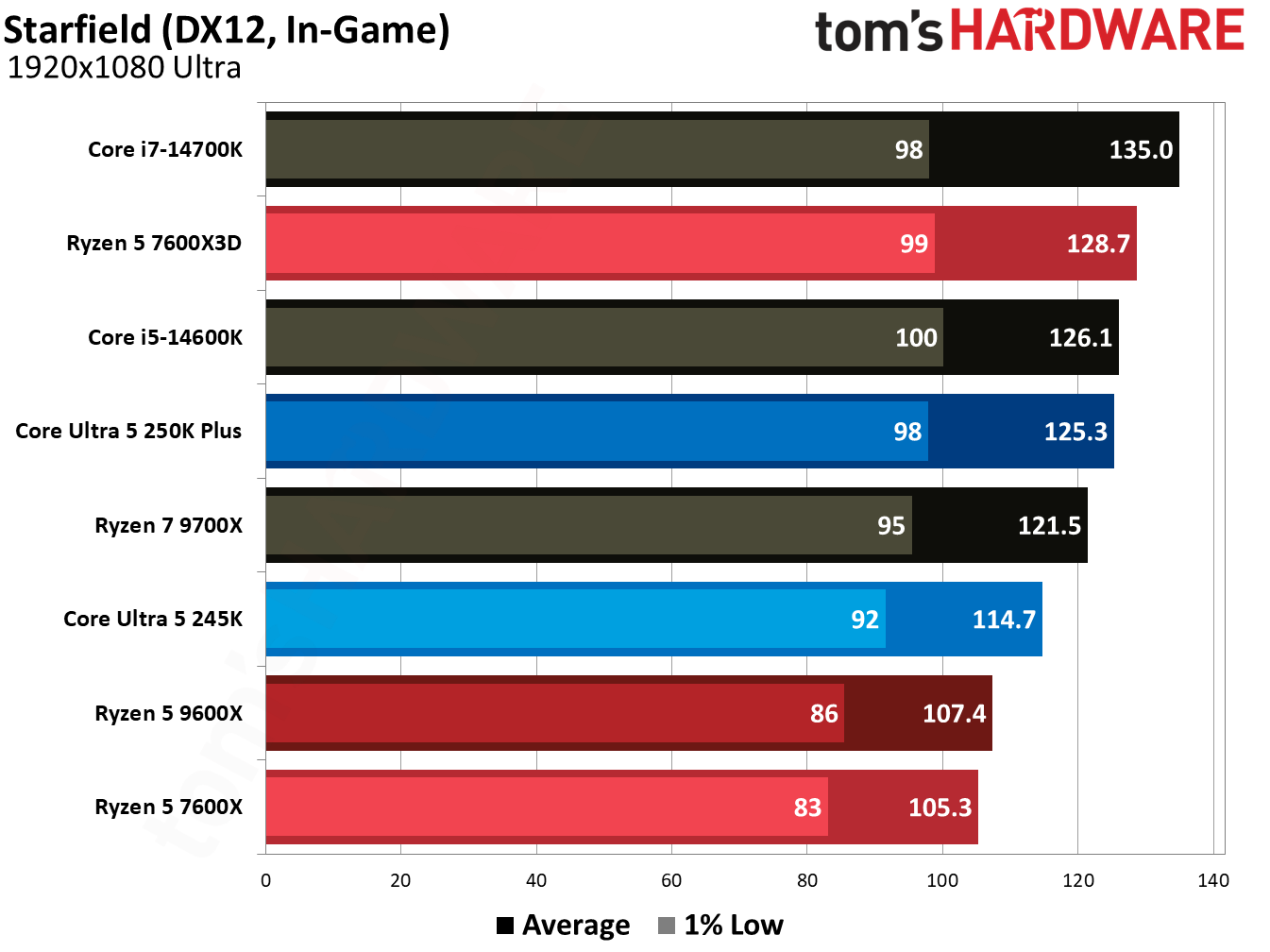
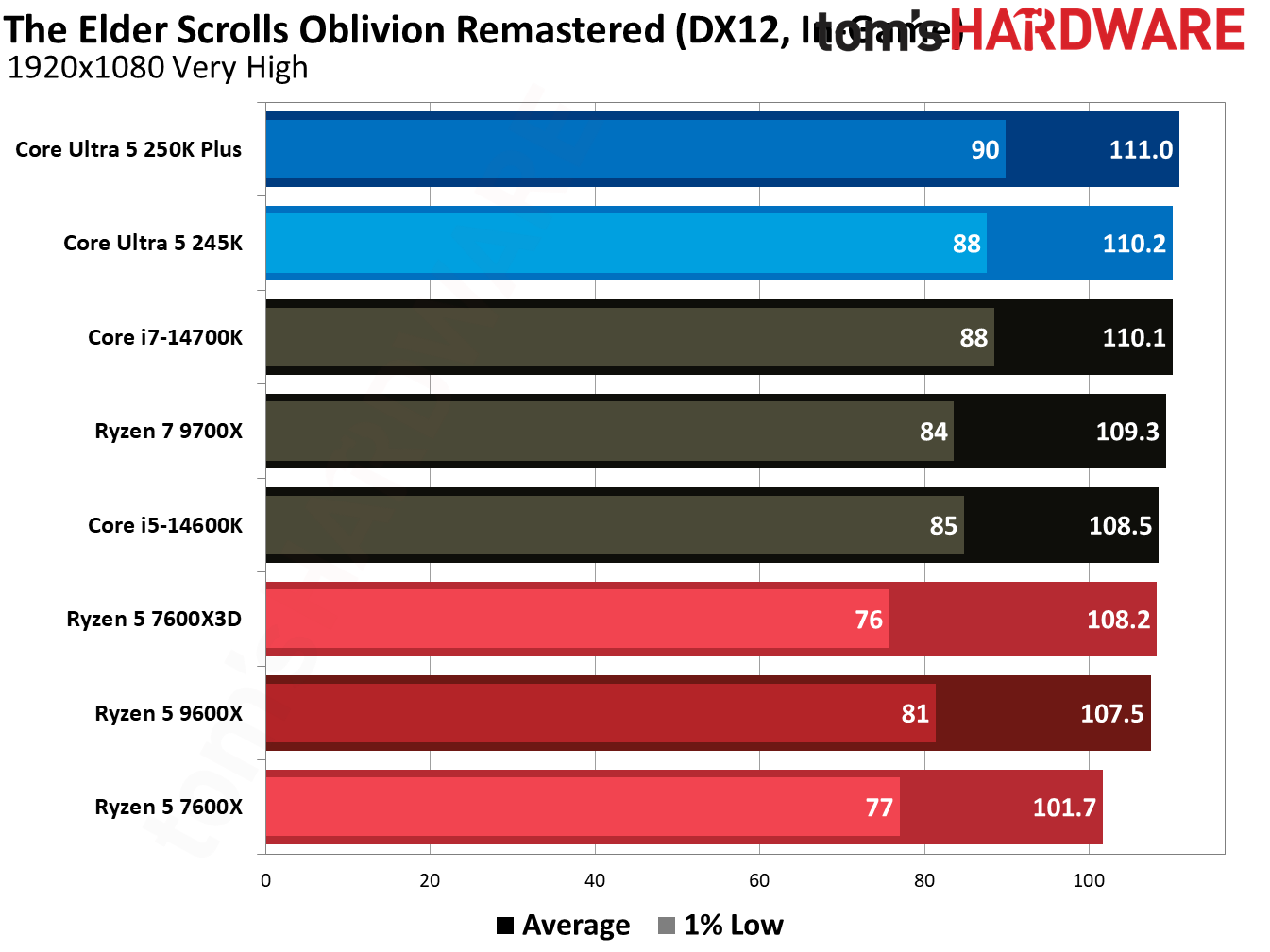
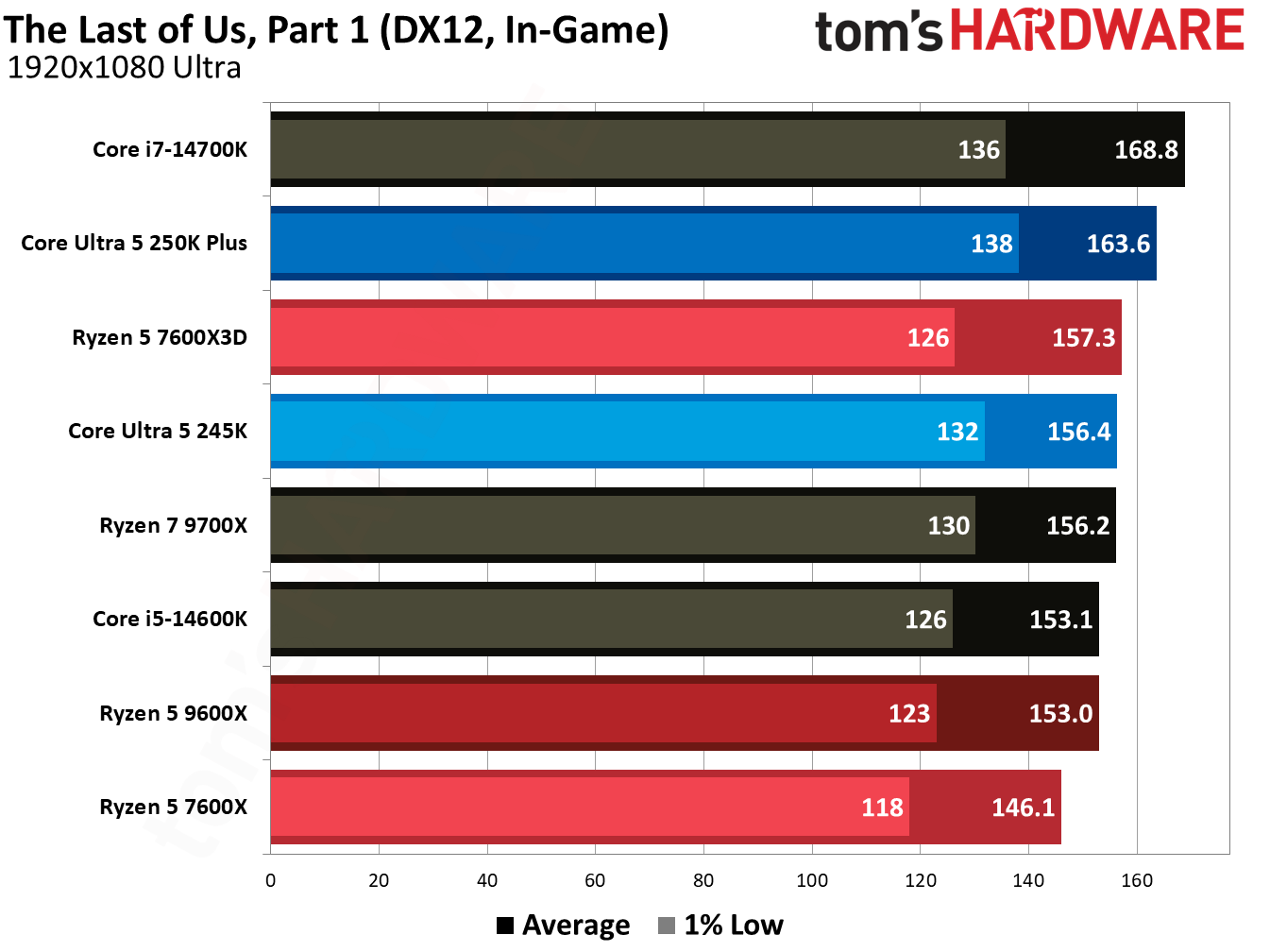
The 9600X gains a lead in a handful of titles with respectable margins in select scenarios. In F1 2024, it scored an average of 171.3 FPS (frames per second) versus 148.3 FPS, giving AMD a strong 13.4% advantage, although 1% lows remain nearly identical (102 FPS vs 101 FPS). Final Fantasy XIV also favors AMD at 136.1 FPS versus 122.9 FPS on the 250K Plus, which is a 9.7% lead. The most extreme result comes from Minecraft, where the 9600X delivers 127 FPS compared to just 88.9 FPS on Intel, which is a massive 30% lead. Other titles like A Plague Tale: Requiem and Far Cry 6, also favored the AMD chip over Intel.
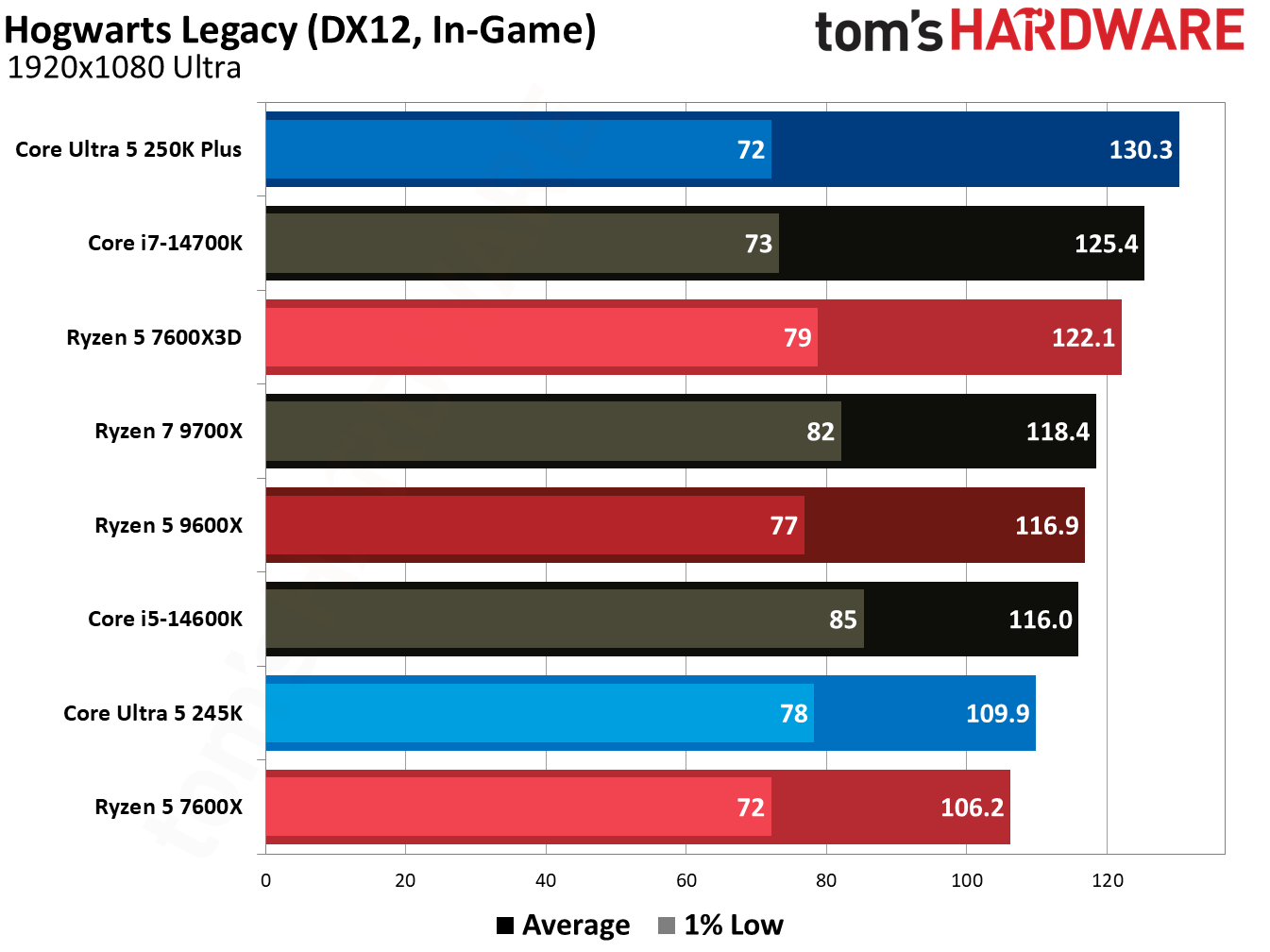
The 250K Plus, on the other hand, had more wins. In Cyberpunk 2077, we got an average of 110.7 FPS vs 100.6 FPS on the 9600X, a 9.1% advantage. Doom: The Dark Ages shows an even bigger gap at 196.8 FPS vs 175 FPS, translating to an 11% lead, alongside significantly better lows (131 FPS vs 112 FPS). In Starfield, Intel gained its biggest win at 125.3 FPS vs 107.4 FPS, a 16.7% lead. The CPU also gained an advantage in titles like Baldur’s Gate 3, Hitman 3, Spider-Man 2, and The Last of Us Part I, with healthy 1% lows across the board.
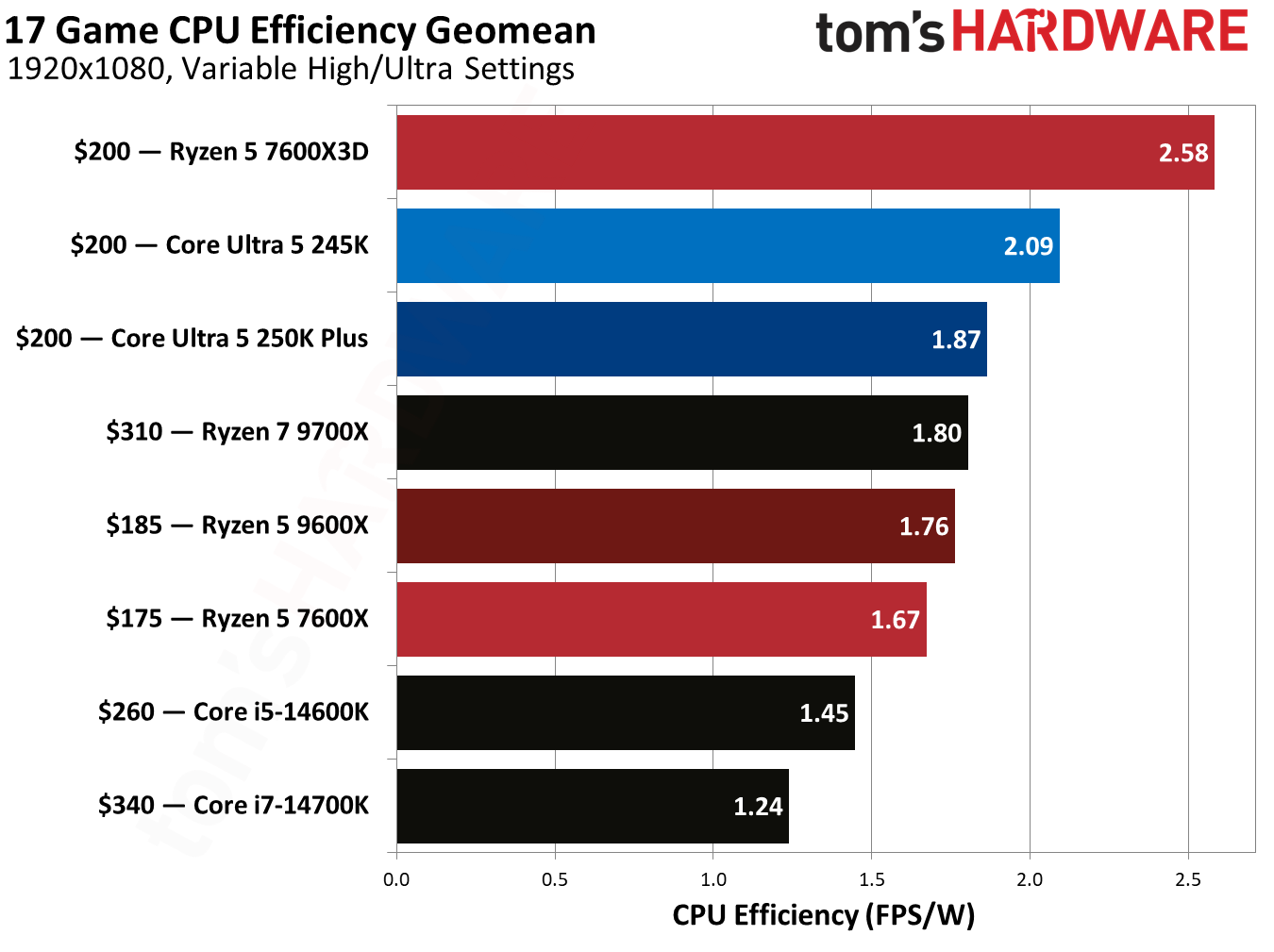
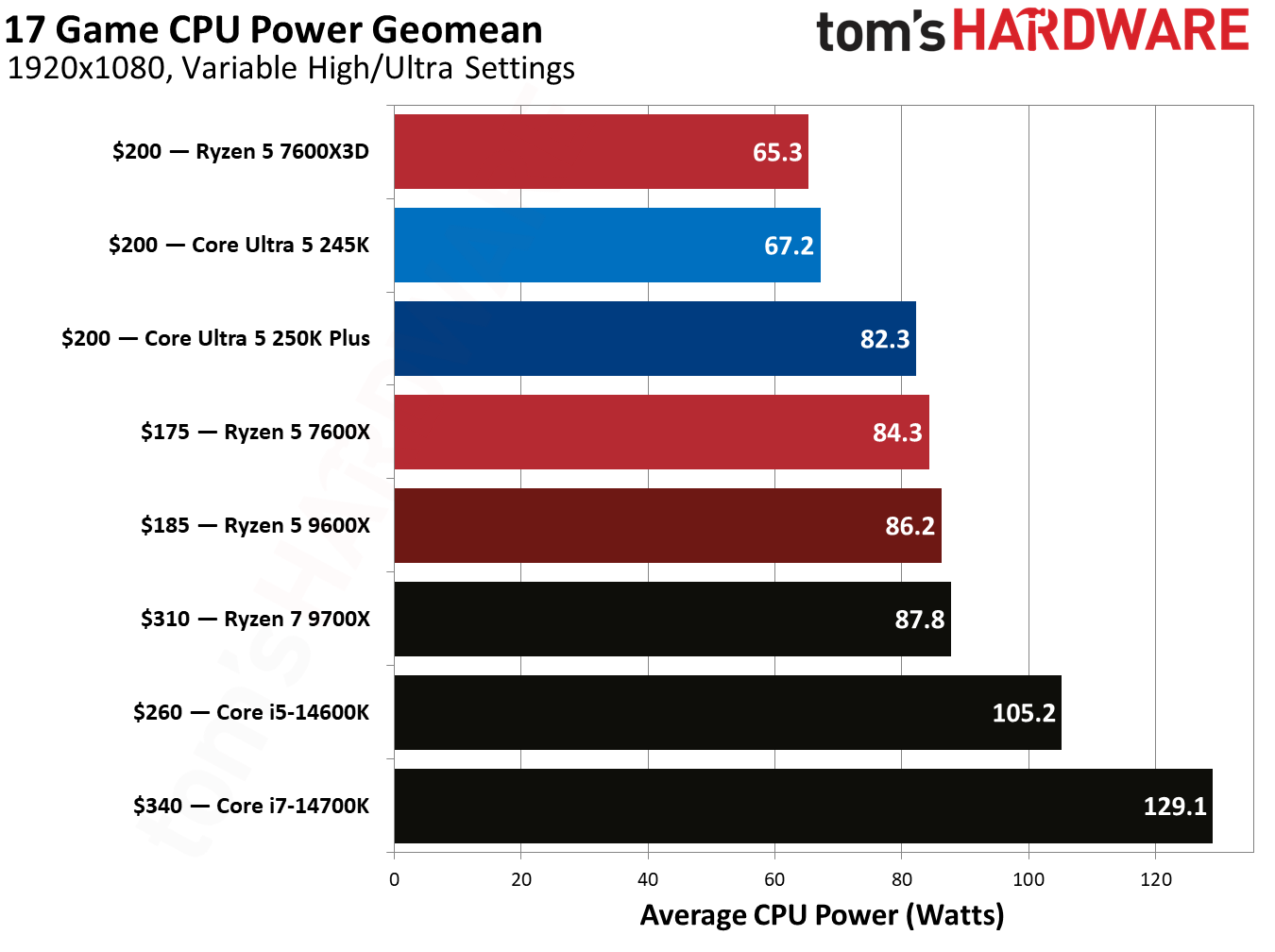
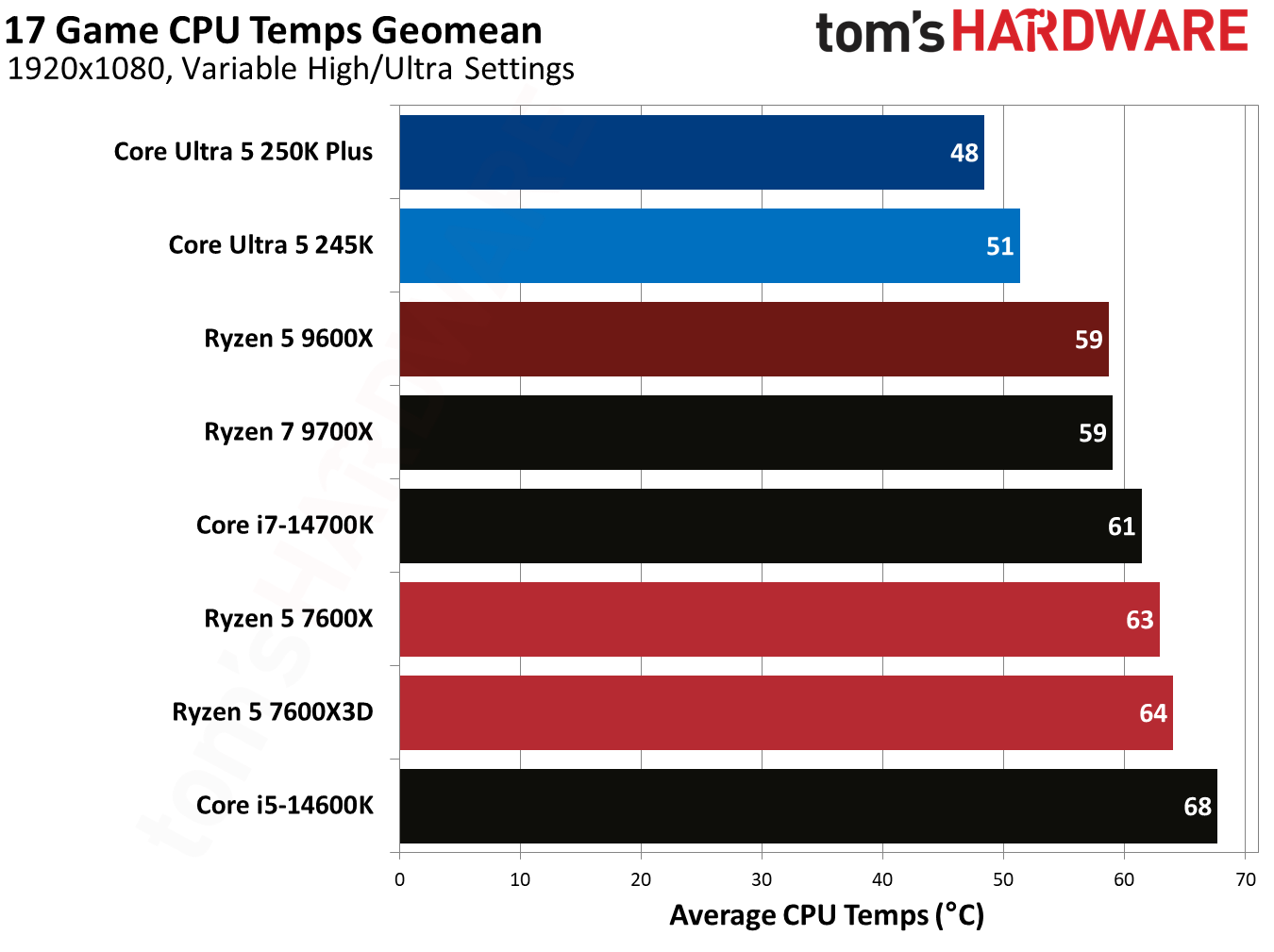
It’s a similar story when it comes to efficiency as the hybrid architecture on the 250K Plus helps it gain a small margin of 1.87 FPS/W compared to the 9600X’s 1.76 FPS/W. The 250K Plus also consumes less power on average during gaming at 82.3W while the AMD chip went up to 86.2W. This allows the Intel chip to run cooler, with a 17-game CPU temperature geomean of 48 degrees Celsius compared to 59 degrees on the AMD chip, making it 11 degrees cooler overall.
⭐Winner: Intel Core Ultra 5 250K Plus
While the 9600X is a capable gaming CPU delivering strong results in select titles, the 250K Plus takes the lead in a majority of games. One may argue that the margins are not as significant, however, Intel surprisingly delivers better efficiency alongside lower average power consumption and temperatures.
Productivity Benchmarks and Performance: Intel Core Ultra 5 250K Plus vs AMD Ryzen 5 9600X
The 250K Plus has a clear edge in productivity workloads, primarily due to its higher core and thread count. This shows up clearly in our multithreaded geomean results, where the 250K Plus scores 465 points. The 9600X with 260 points puts it roughly 79% behind Intel, highlighting a major gap in multi-threaded workloads. In single-threaded tests, the gap is much smaller, though the Intel chip manages to stay ahead by approximately 5% in the geomean results. You'll find results here for both the 65W and 105W TDP modes for the Ryzen 5 9600X, the latter of which offers a minor improvement in multithreaded performance.
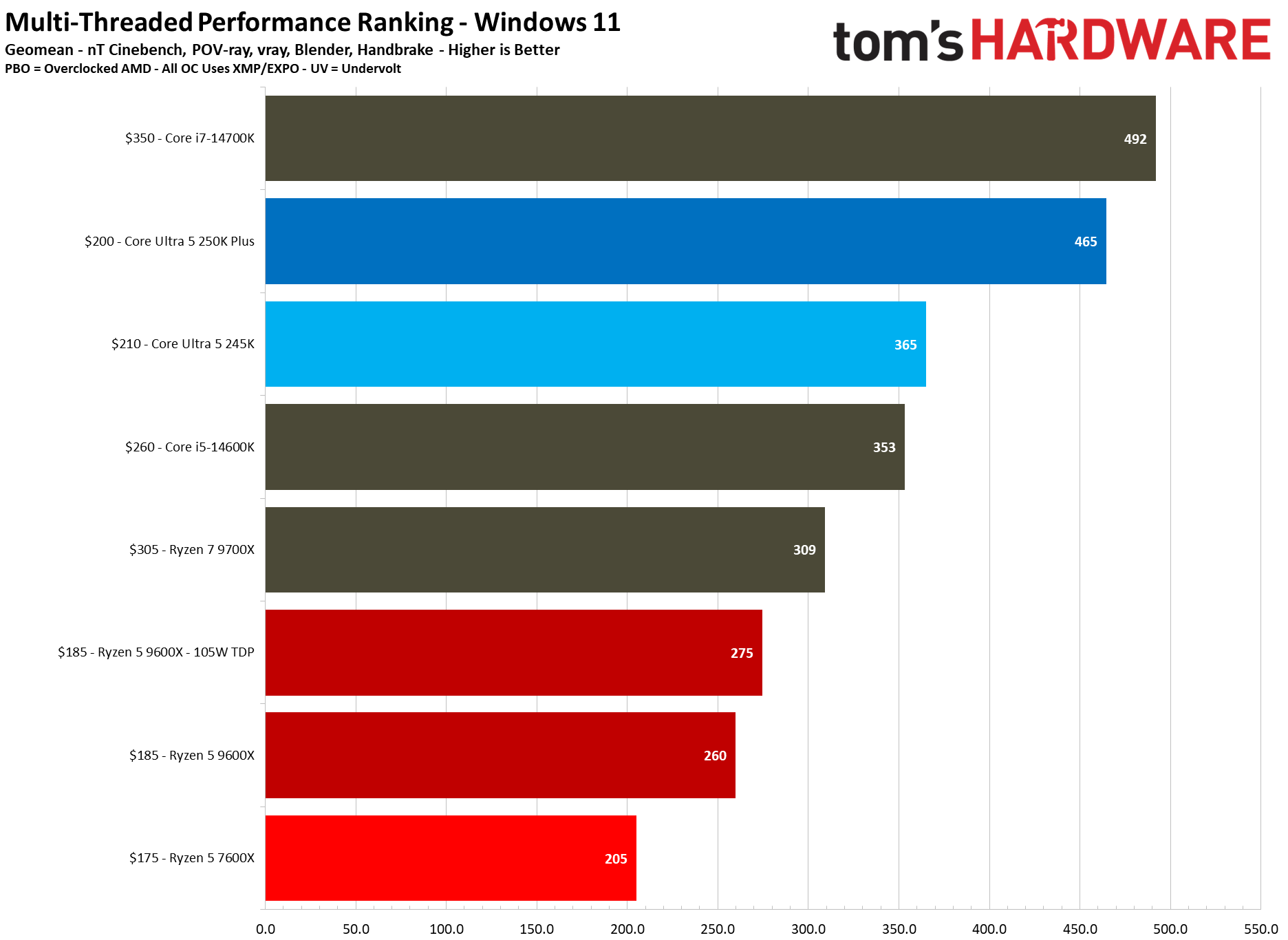
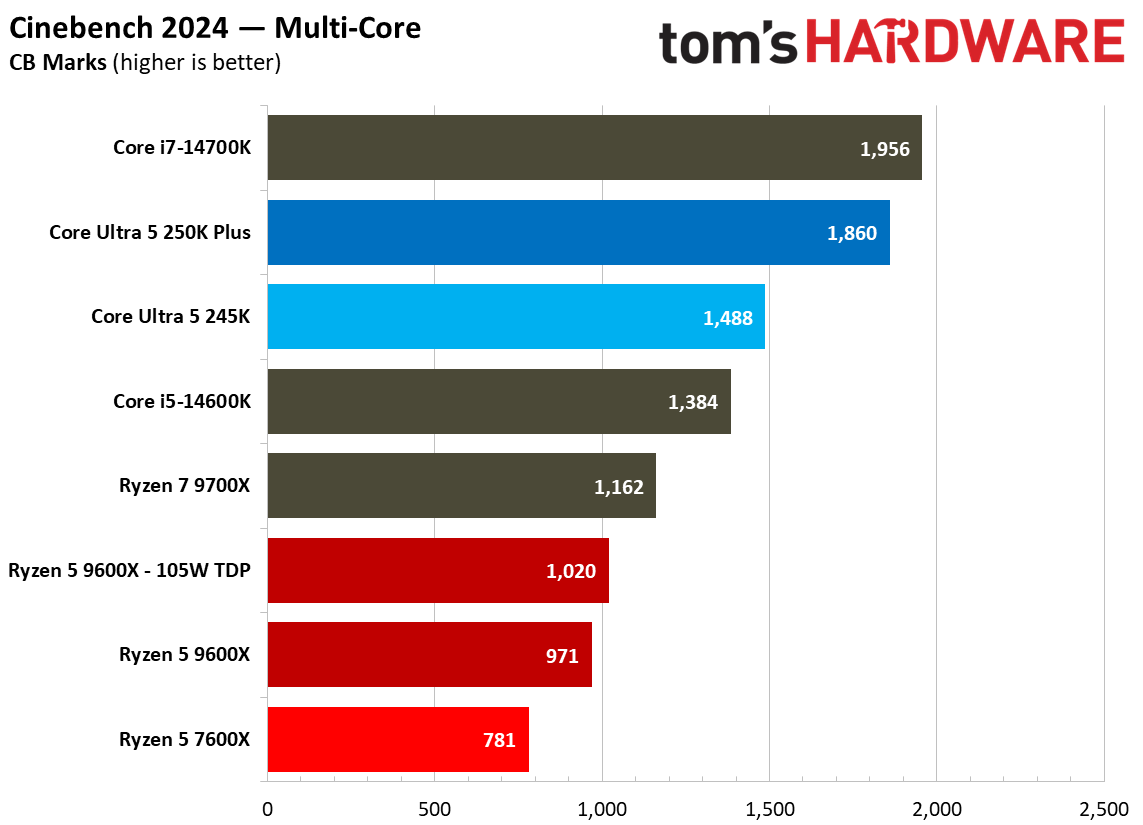
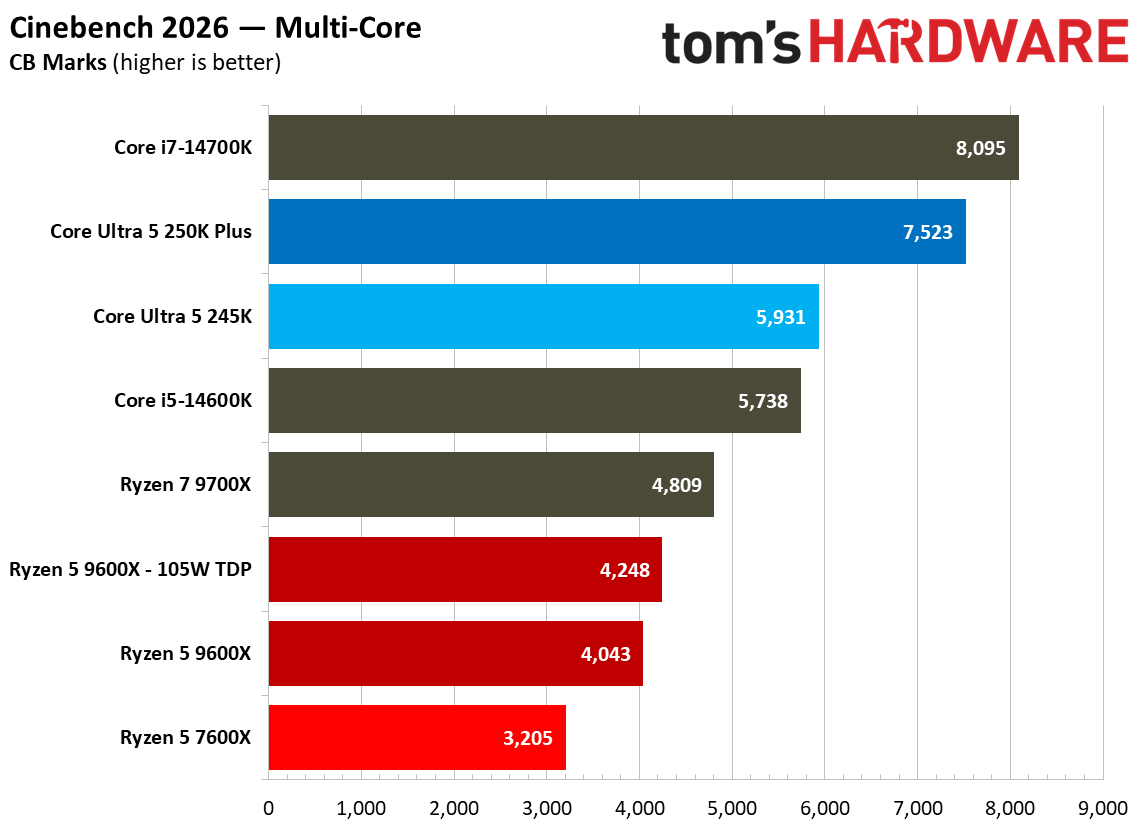
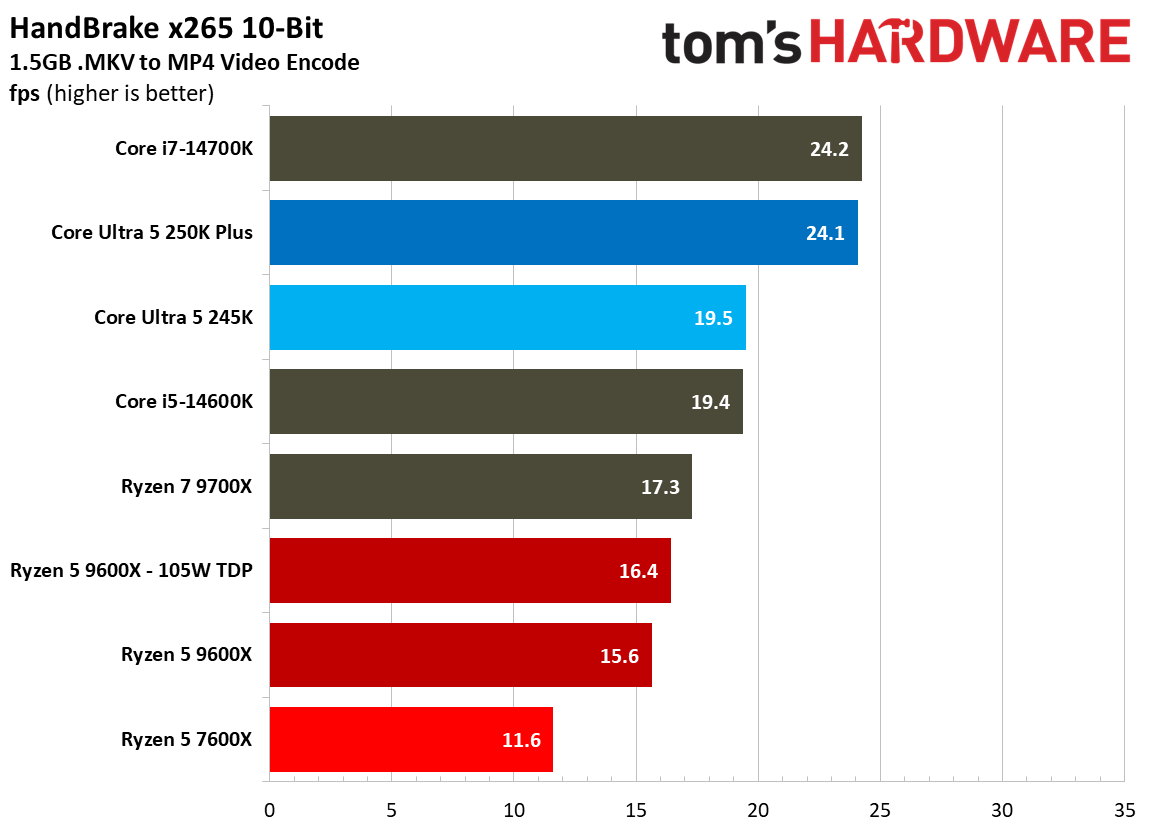
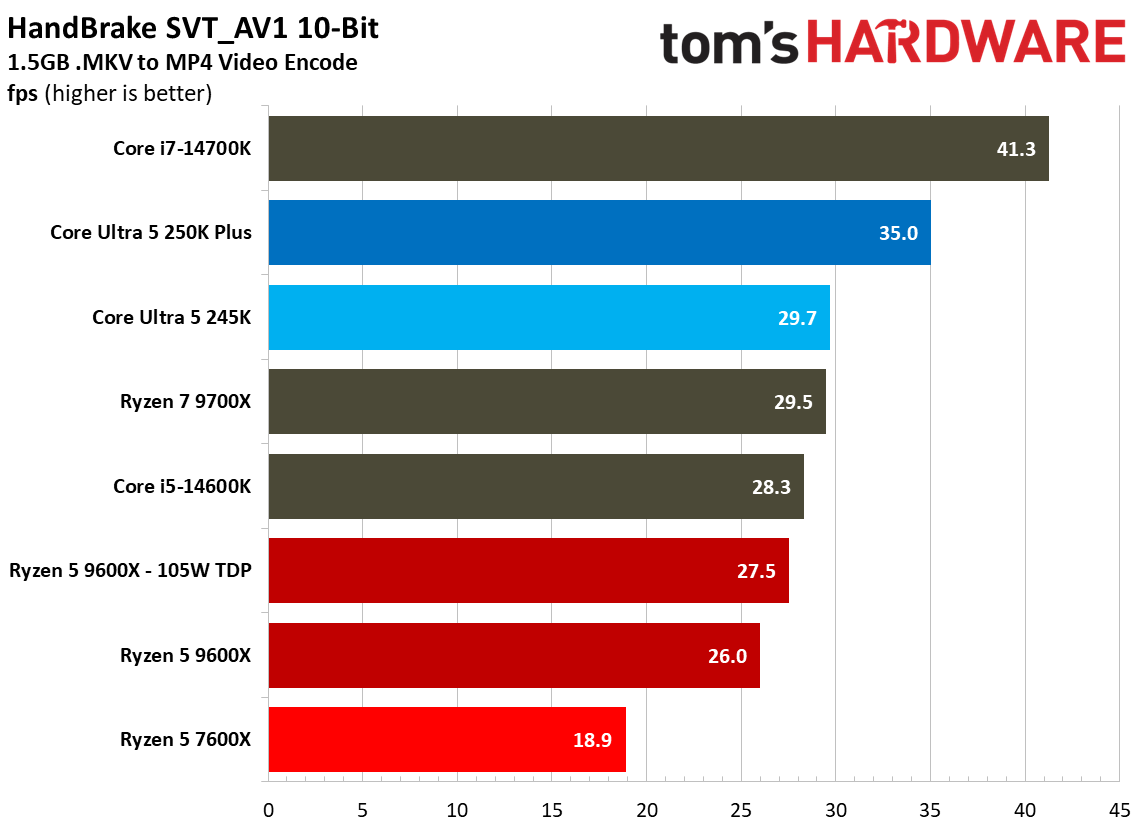
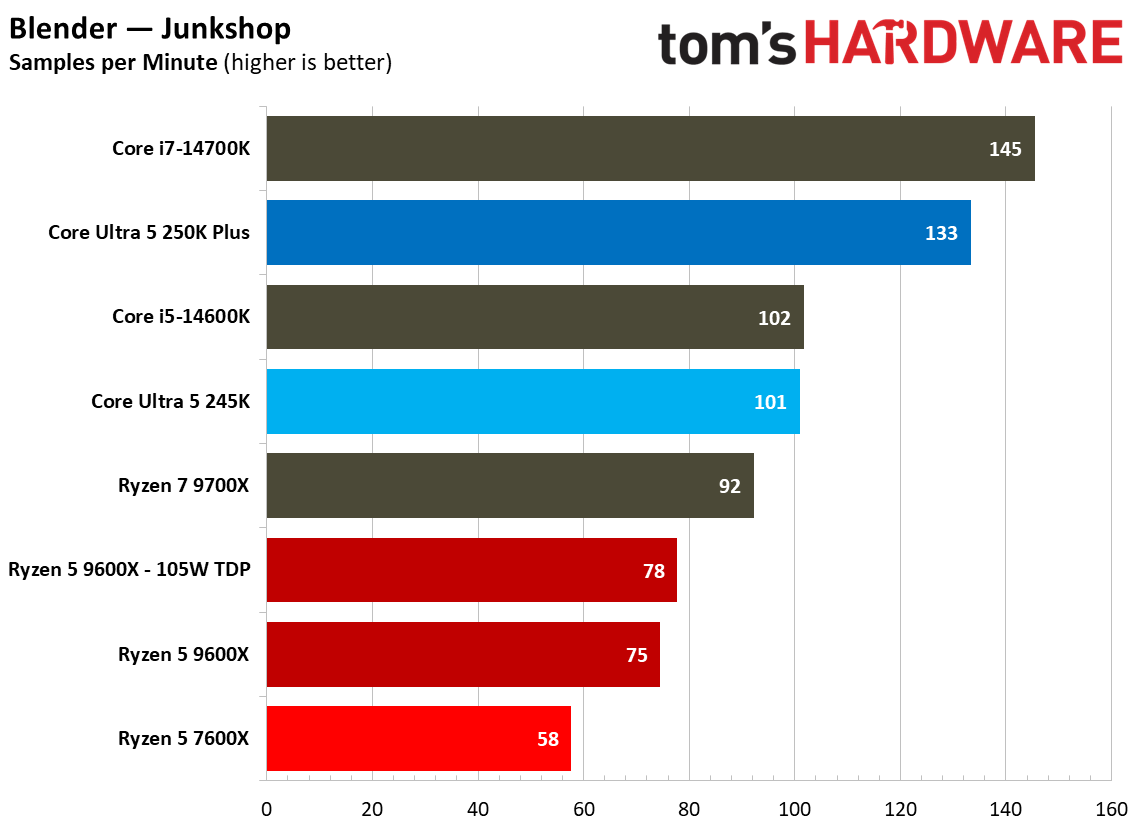
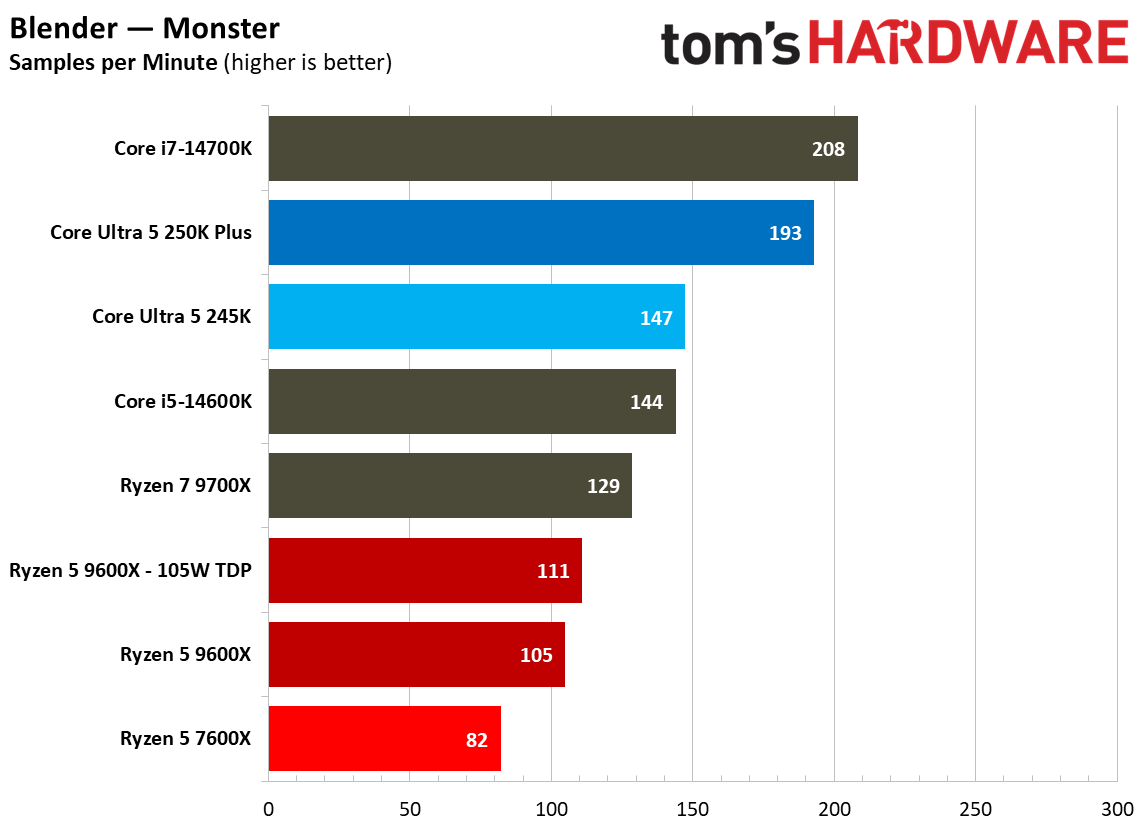
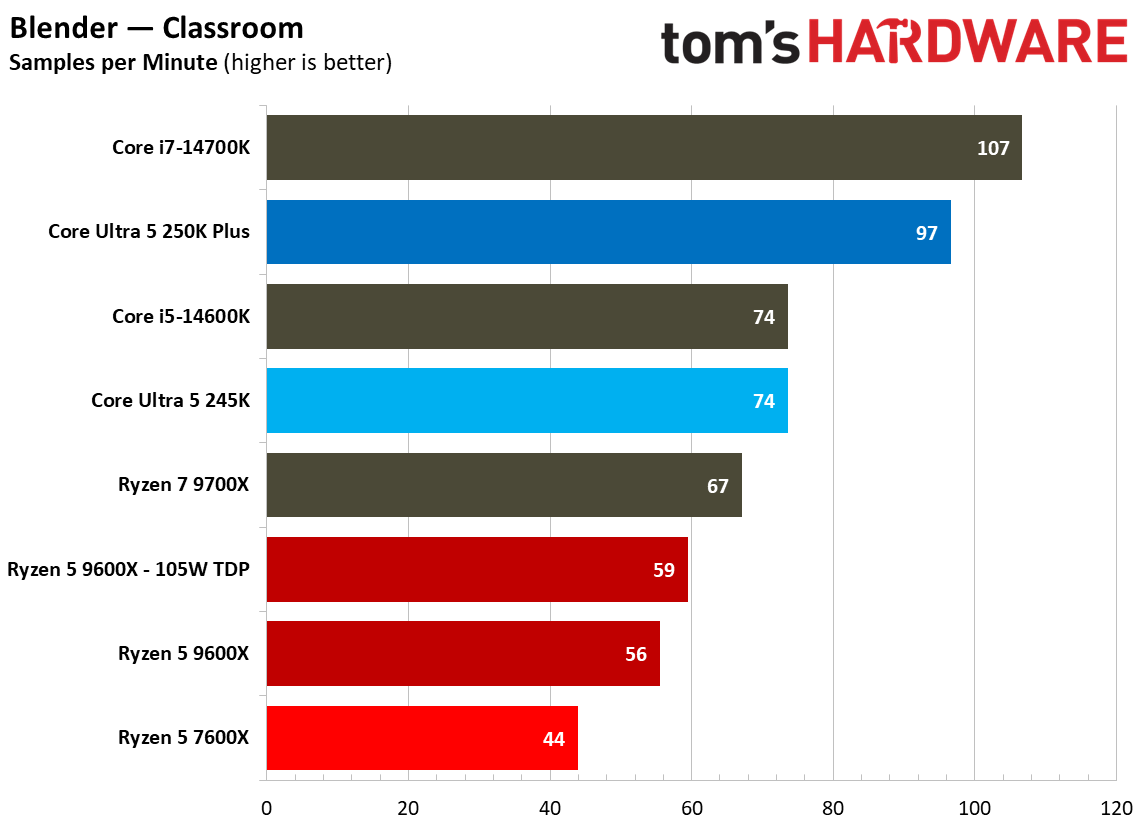
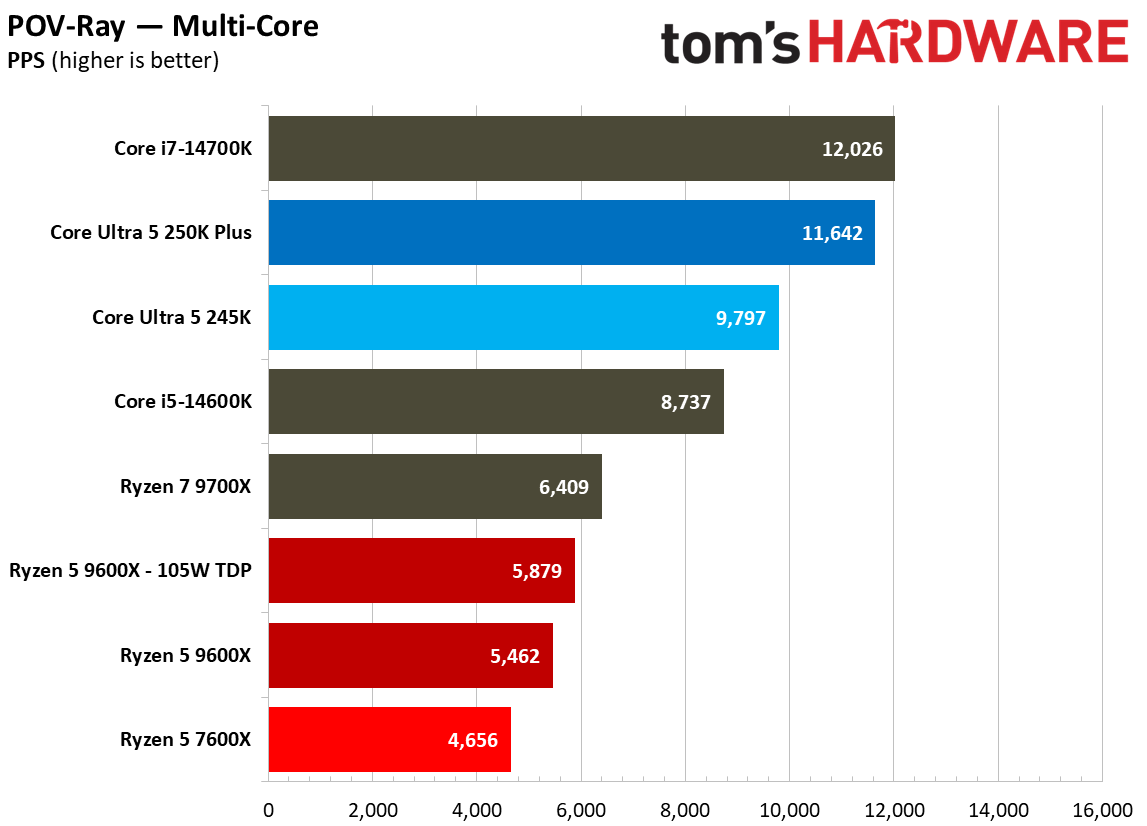
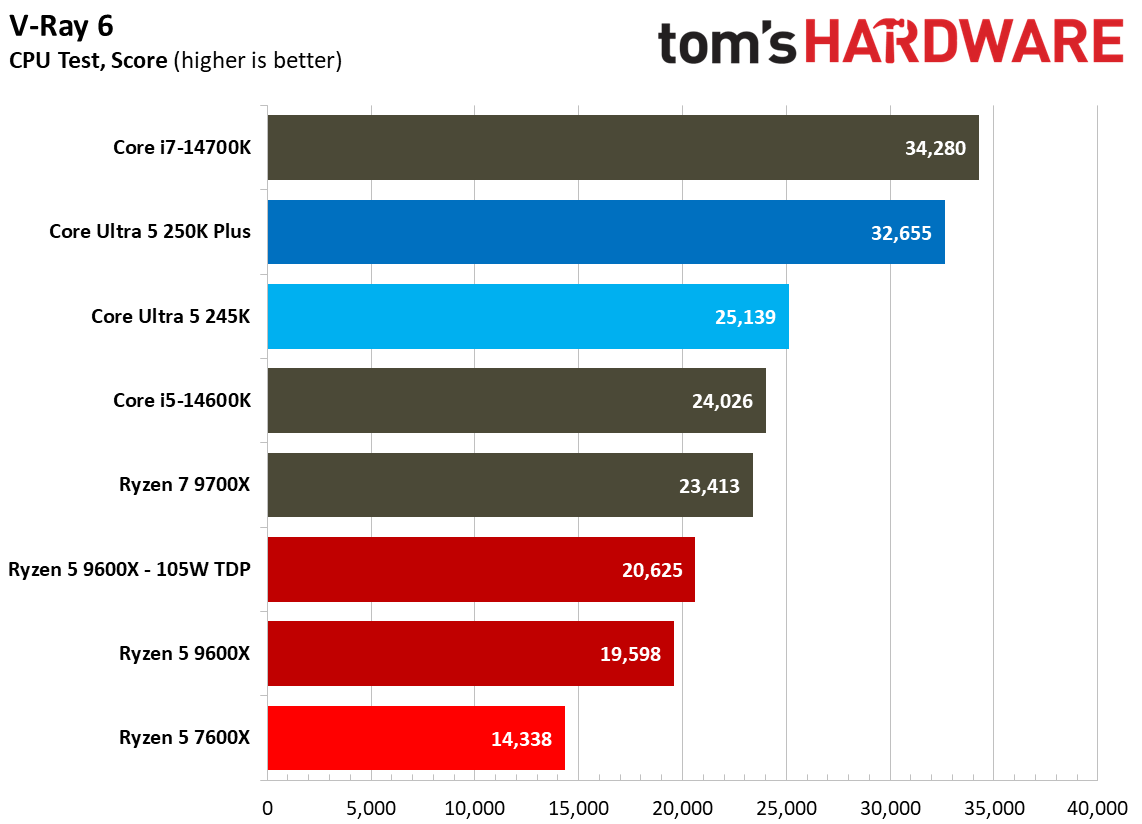
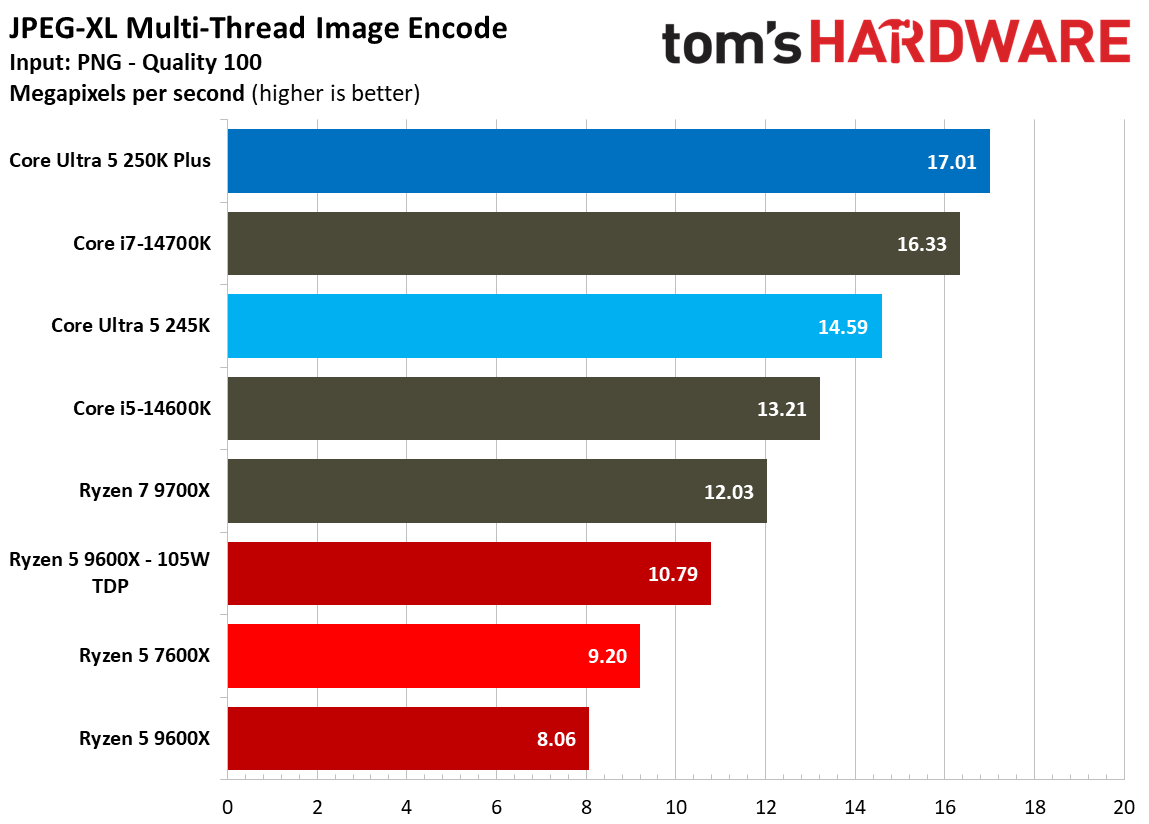
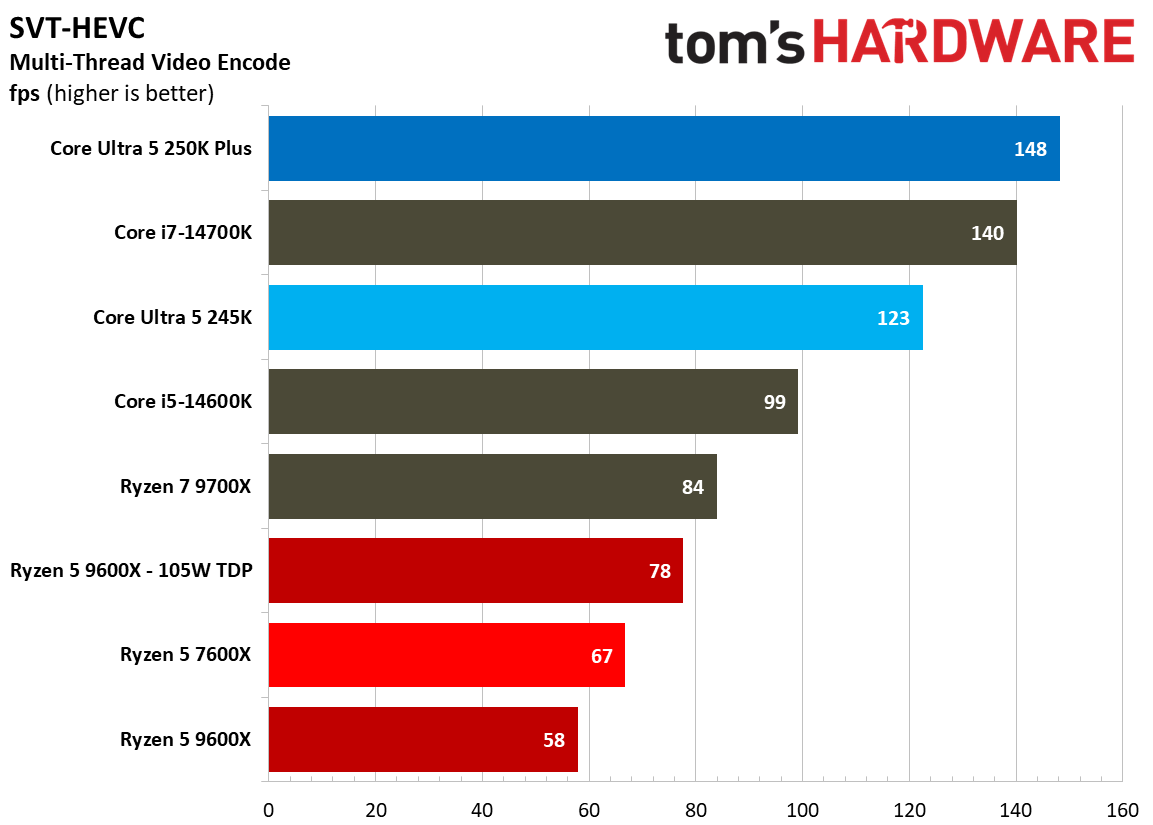
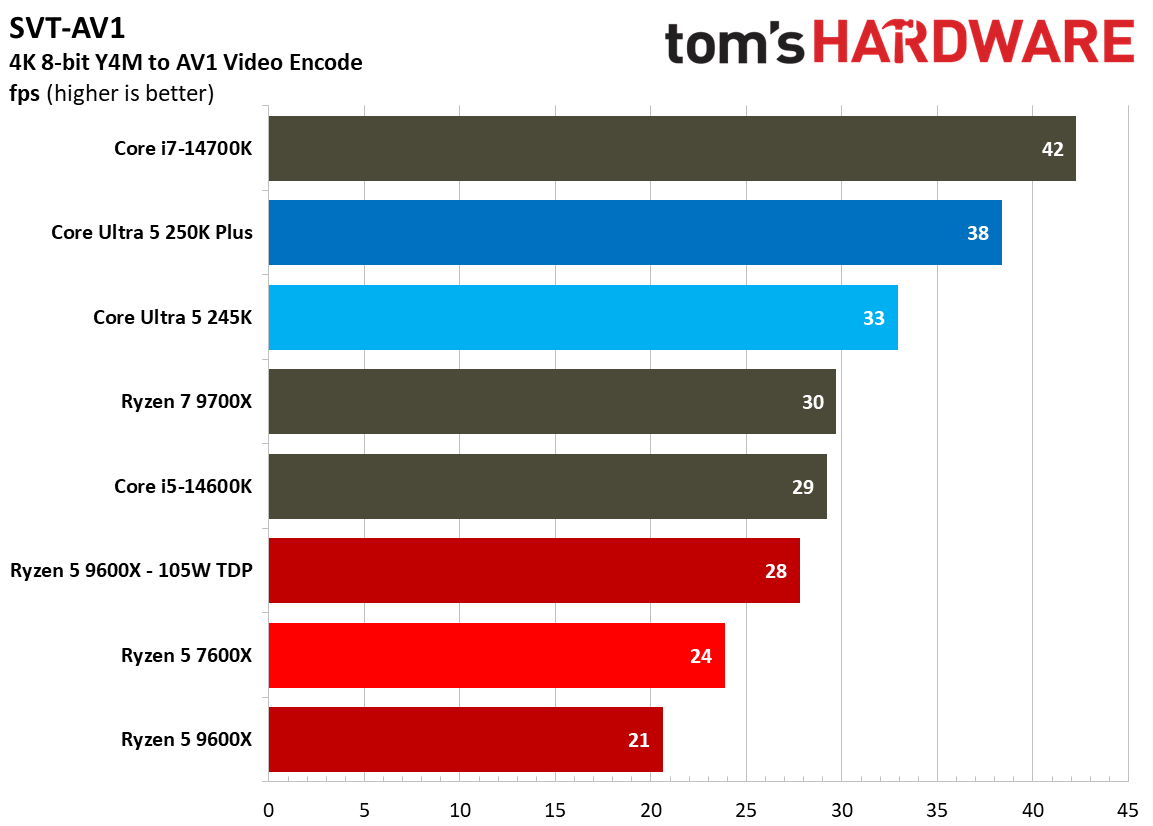
If we look at the range of multithreaded benchmark tests, the 250K Plus consistently outpaces the 9600X by a wide margin. In rendering workloads like Cinebench 2024, the 250K Plus scored 1,860 compared to 971 on the 9600X, delivering roughly 91% higher performance. The gap remains prominent in Cinebench 2026, where Intel posts 7,523 versus AMD’s 4,043 gaining a lead of 86%.
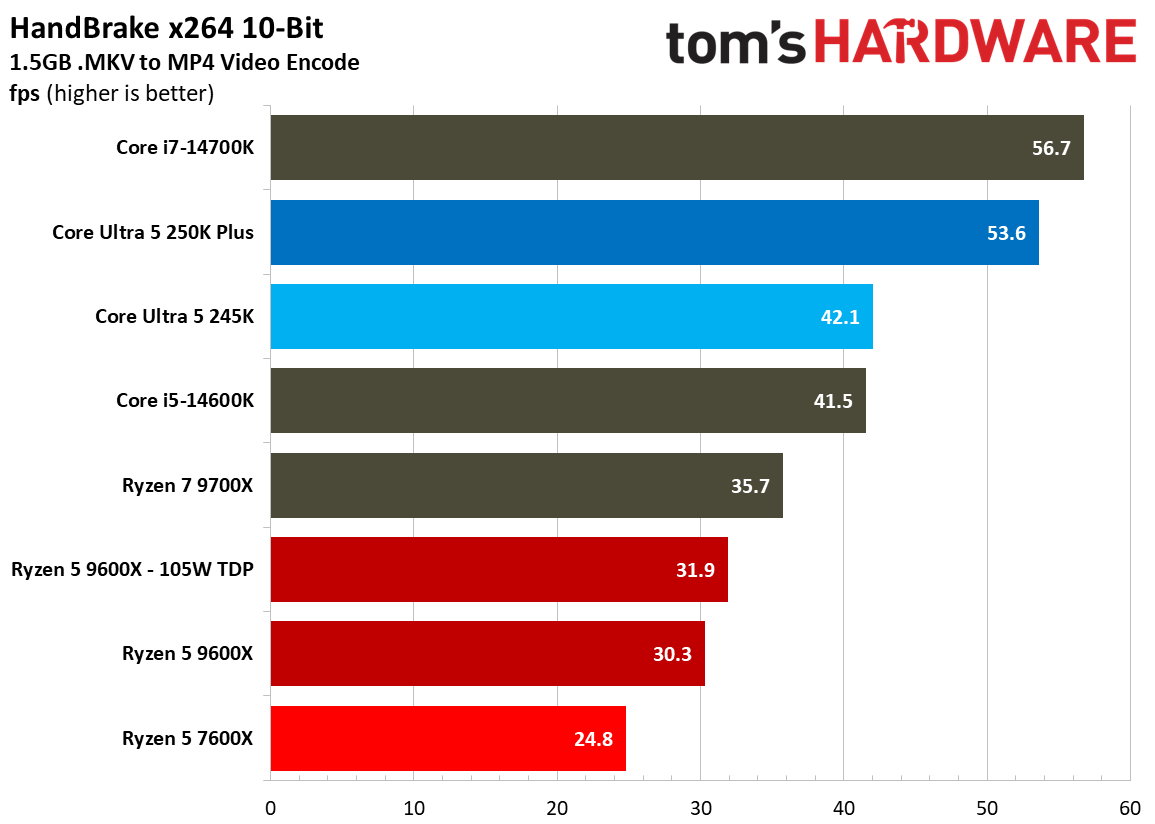
Video encoding workloads further reinforce Intel’s dominance where it achieves 24.1 FPS (frames per second) in HandBrake x265 MP4 video encoding compared 15.6 FPS, while x264 encoding jumps to 53.6 FPS compared to 30.3 FPS, which is an uplift of nearly 77%. In image processing, the difference remains stark with JPEG-XL multi-threaded encoding seeing the 250K Plus push 17.01 megapixels per second, more than double the 8.06 achieved by the 9600X.
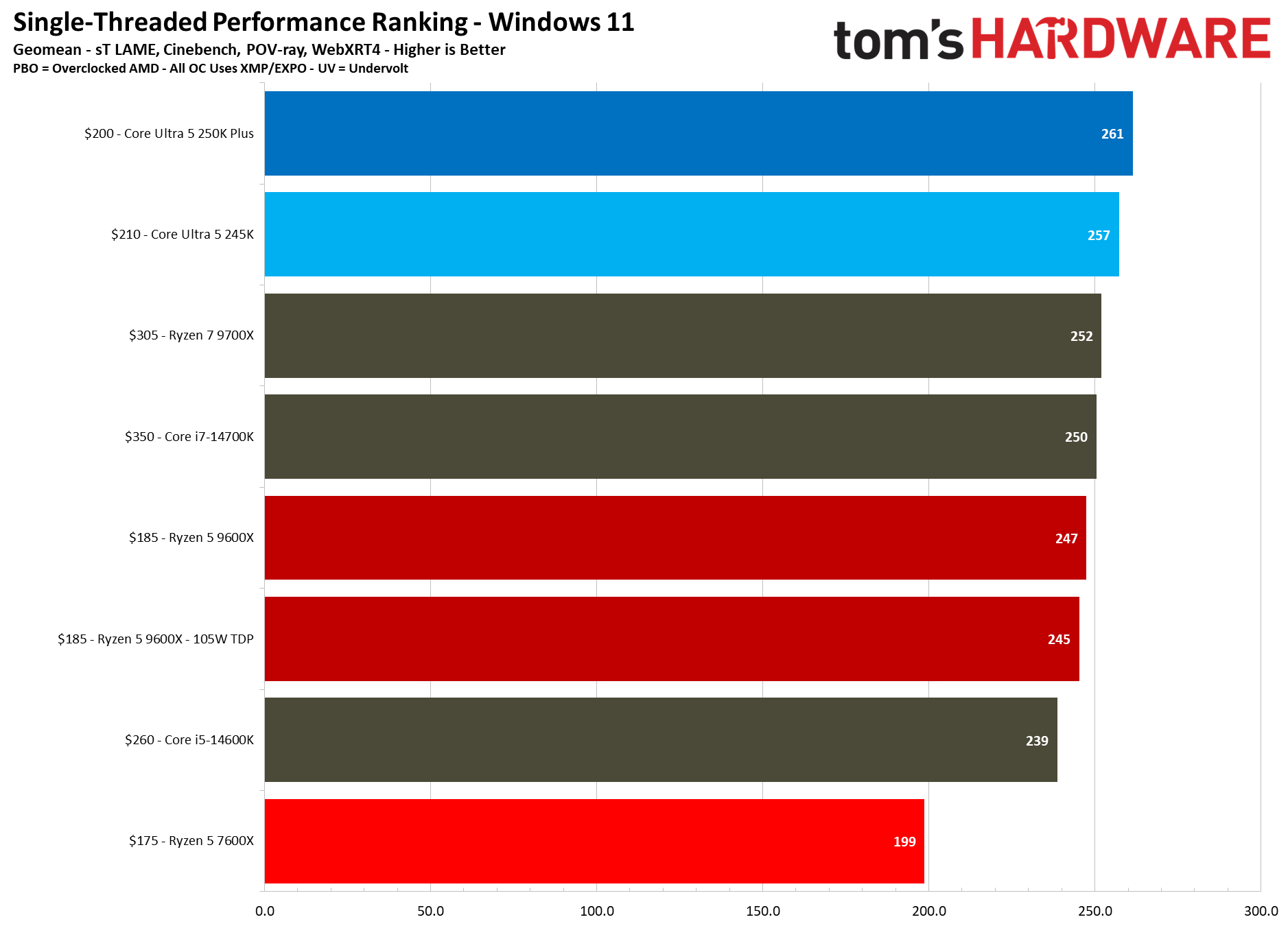
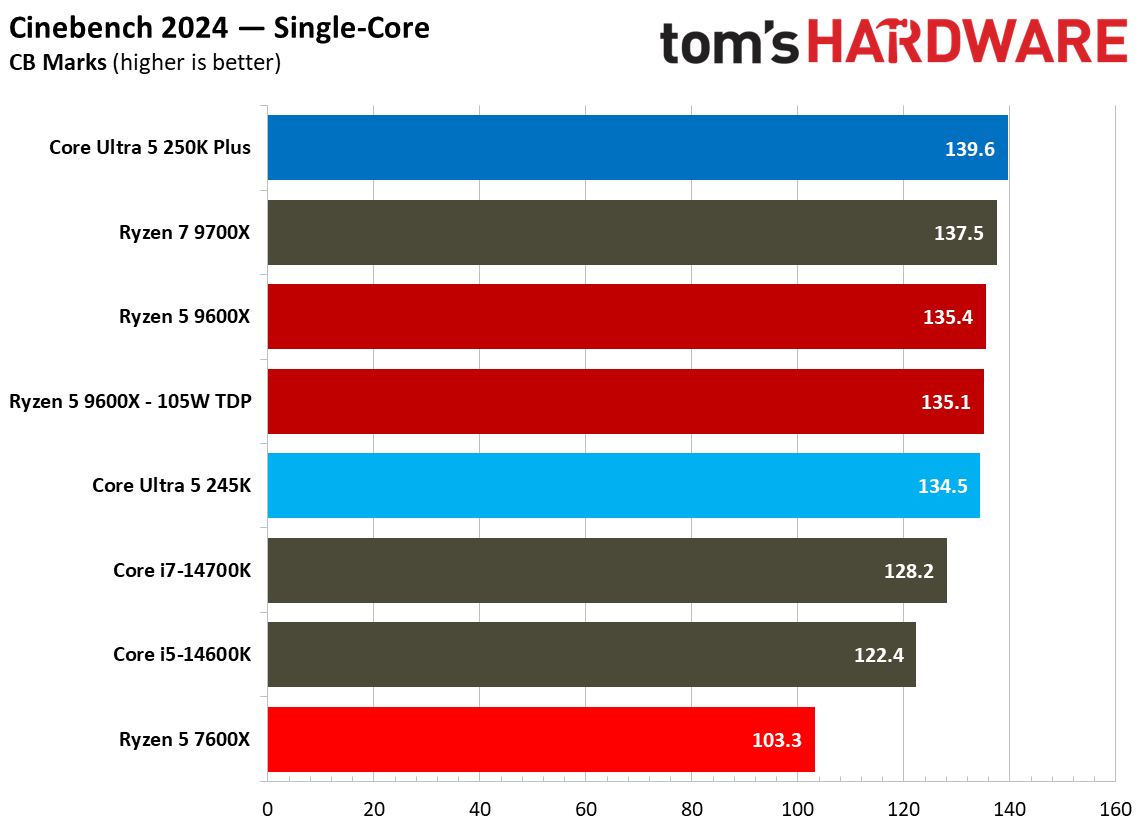
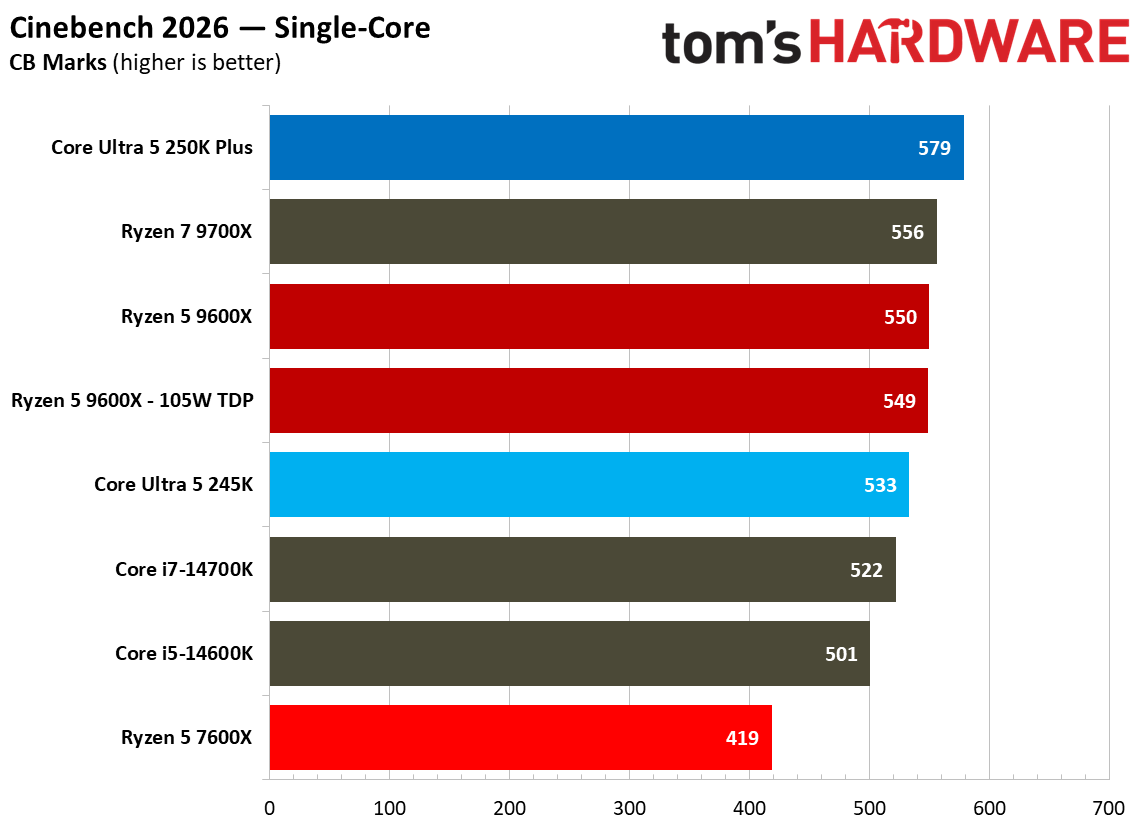
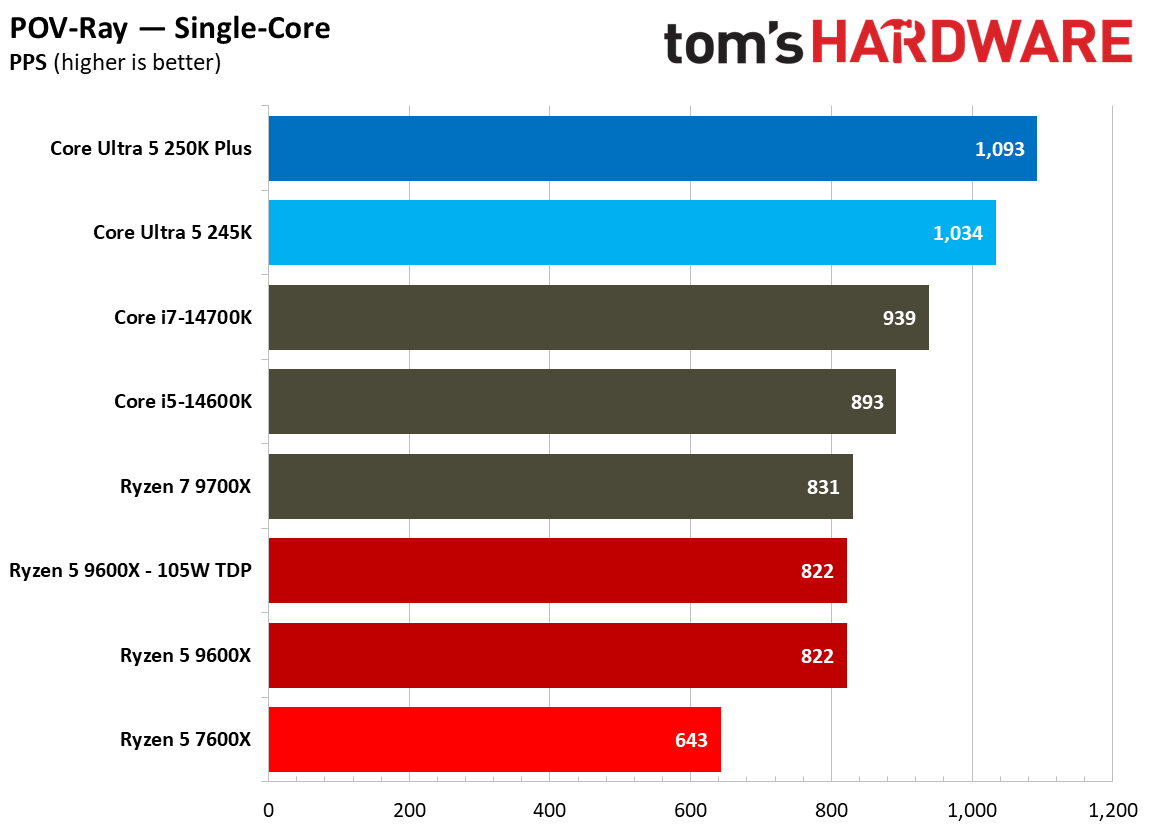
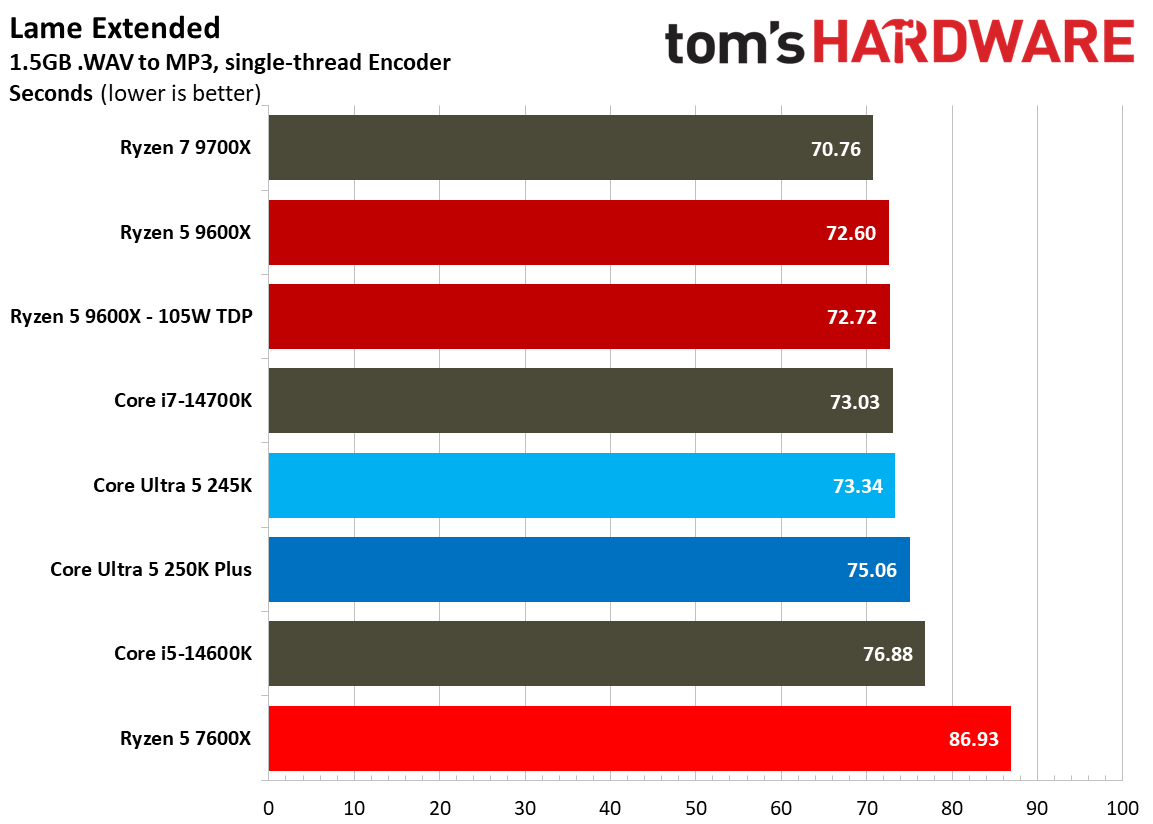
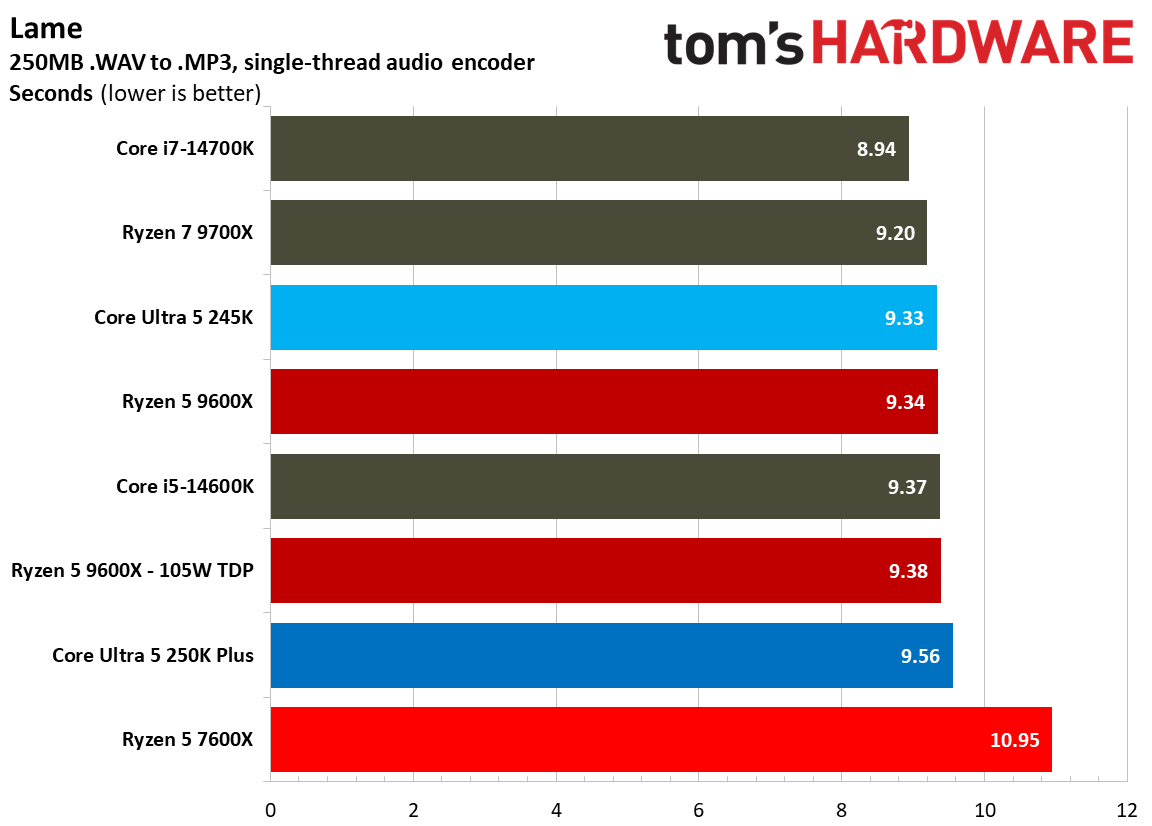
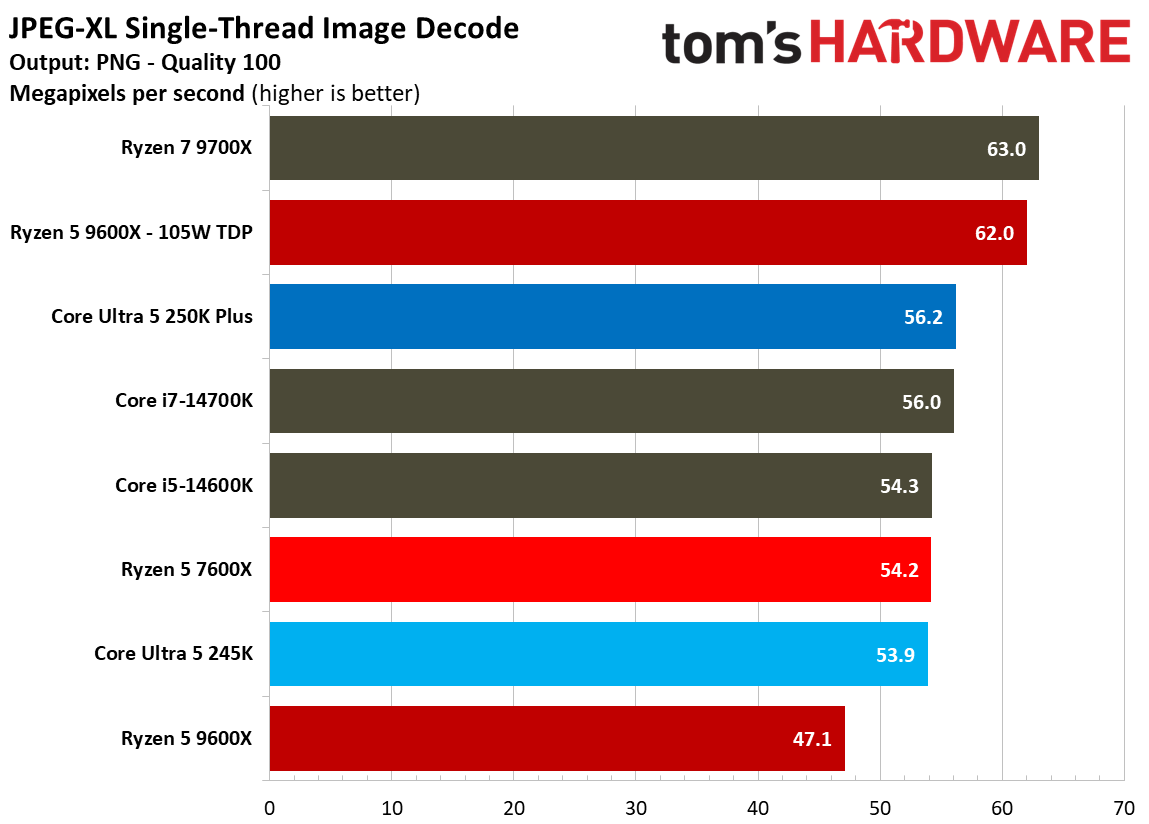
Looking at individual single-threaded performance tests, AMD gains some ground, although it still lags behind Intel. In Cinebench 2024 single-core, Intel posts 139.6 versus AMD’s 135.4, while Cinebench 2026 shows a similar trend with 579 against 550.
POV-Ray is where the difference becomes more noticeable, with the 250K Plus reaching 1,093 compared to 822 on the 9600X, indicating a stronger lead in certain single-threaded rendering tasks. However, not all tests are in favor of Intel. When it comes to audio encoding, the Ryzen chip is actually slightly faster, finishing the 250MB workload in 9.34 seconds and 1.5GB workload in 72.6 seconds, compared to 9.56 and 75.06 seconds on the 250K Plus. JPEG-XL single-threaded encoding once again swings back in Intel’s favor, with the 250K Plus achieving 56.2 megapixels per second versus 47.1 on the 9600X.
⭐Winner: Intel Core Ultra 5 250K Plus
The 250K Plus is a clear winner when it comes to productivity benchmarks. Its dominant multithreaded performance, paired with a small lead in single-threaded workloads, makes it a strong choice for productivity-focused users. The 9600X manages to stay competitive in lighter tasks but it simply cannot match Intel’s performance in heavily threaded applications.
Overclocking: Intel Core Ultra 5 250K Plus vs AMD Ryzen 5 9600X
Considering the price point for these two CPUs, overclocking isn't of the utmost concern. However, that does not mean there’s no scope for it. Intel has historically offered excellent overclocking features and the 250K Plus is no exception. It comes with an unlocked multiplier with granular overclocking supported on Z-series motherboards. Users can manually adjust core ratios, voltages, and power limits by heading to the BIOS or using Intel’s Extreme Tuning Utility (XTU). The CPU also supports Intel’s 200S Boost feature which is a one-click BIOS overclocking profile, however, the 250K Plus has many of the improvements from this profile out of the box.
The Ryzen 5 9600X also supports overclocking, but in practice behaves differently. AMD’s modern Zen 5 chips are already pushed close to their limits out of the box, leaving very little manual overclocking headroom. Instead of traditional overclocking, AMD promotes tools like Precision Boost Overdrive (PBO) and Curve Optimizer, which dynamically increase boost clocks based on thermal and power conditions. These can be configured by heading to the BIOS or through the Ryzen Master software. However, manual all-core overclocking often results in lower single-core boost performance, making it less appealing for real-world use.
As such, the preferred method to gain more performance out of the 9600X is undervolting using Curve Optimizer, which reduces voltage per core and allows the CPU to boost higher within its existing limits. This approach improves efficiency and can result in small performance gains without sacrificing boost behavior.
⭐Winner: Intel Core Ultra 5 250K Plus
The 250K Plus offers better overclocking capabilities and flexibility, making it the preferred choice for enthusiasts who like to tinker around. On the other hand, the 9600X can technically be overclocked, but it is better suited to smart tuning via PBO and undervolting, rather than manual overclocking. In addition, Intel supports far higher memory speeds out of the box.
Power Consumption and Efficiency: Intel Core Ultra 250K Plus vs AMD Ryzen 5 9600X
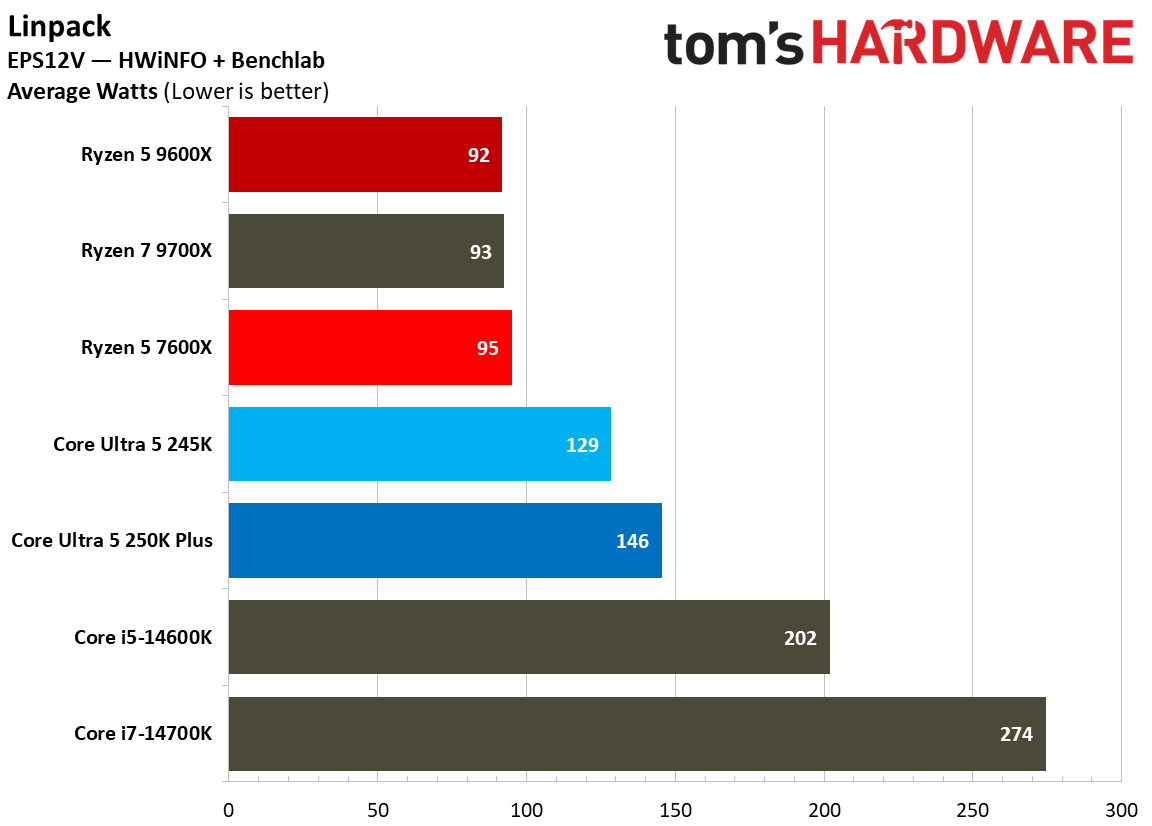
Although the Core Ultra 5 250K Plus is more efficient in games than the Ryzen 5 9600X, productivity workloads are a different beast. We see peak power consumption in all-out, multi-core tests like rendering and encoding, and in those situations, Intel's chip sucks down much more power. We're using the default 65W TDP for the Ryzen 5 9600X here. If you opt for the 105W TDP, power consumption will naturally increase.
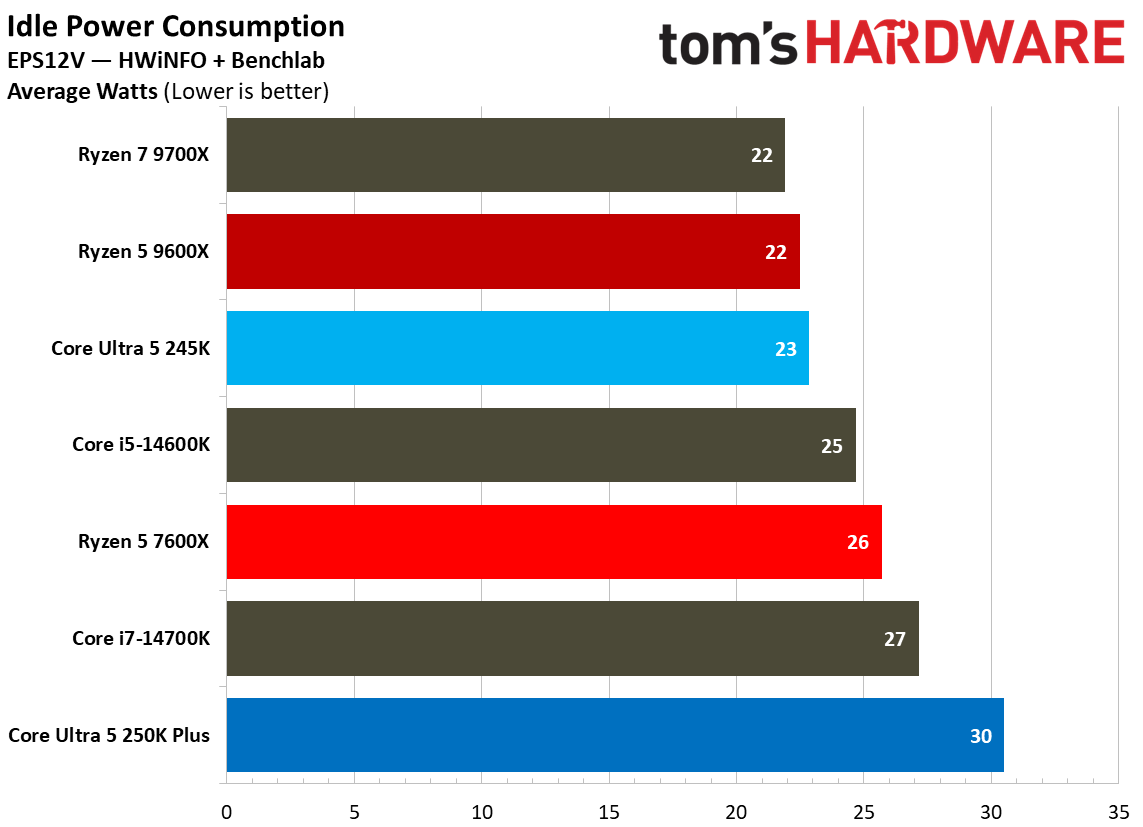
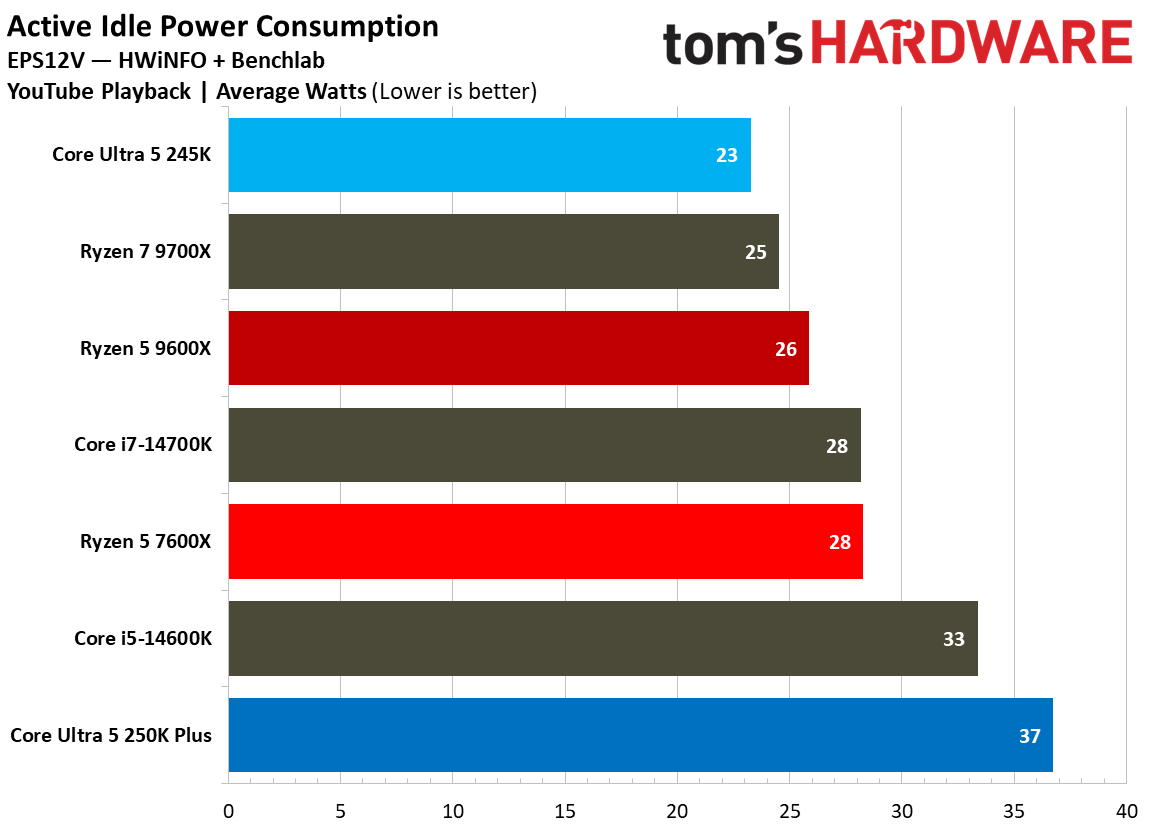
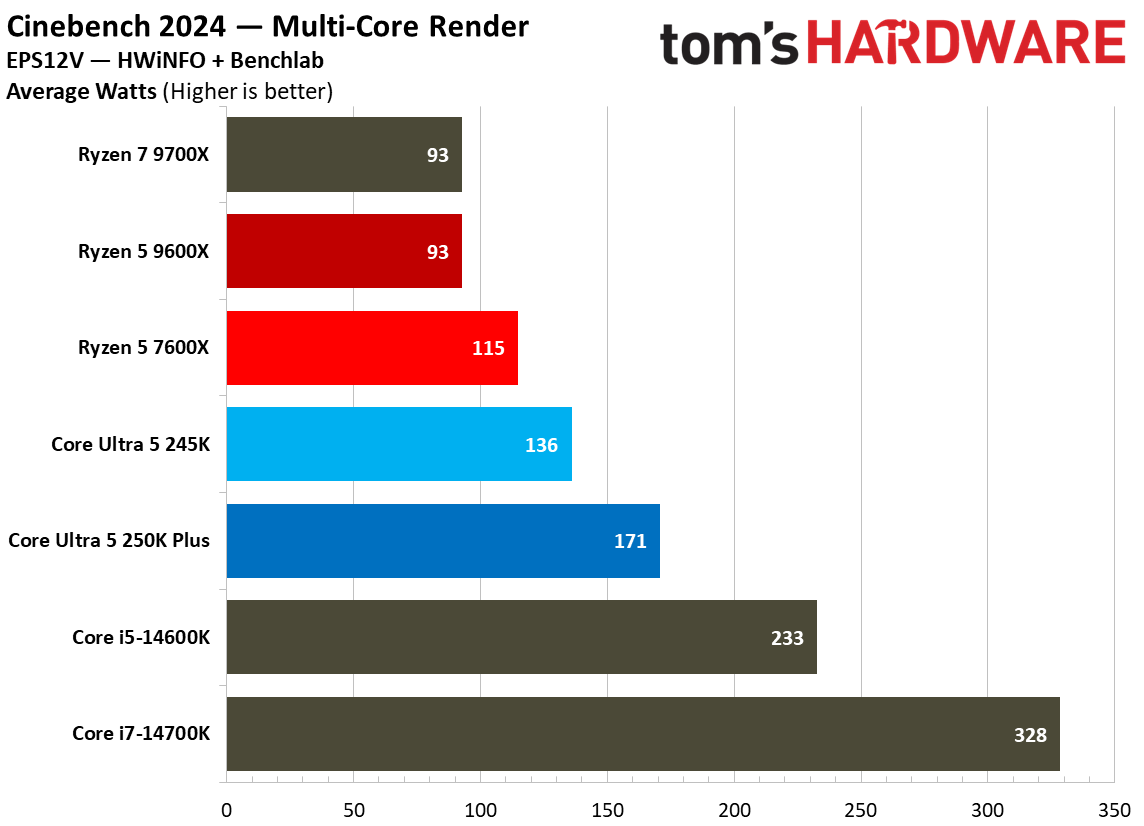
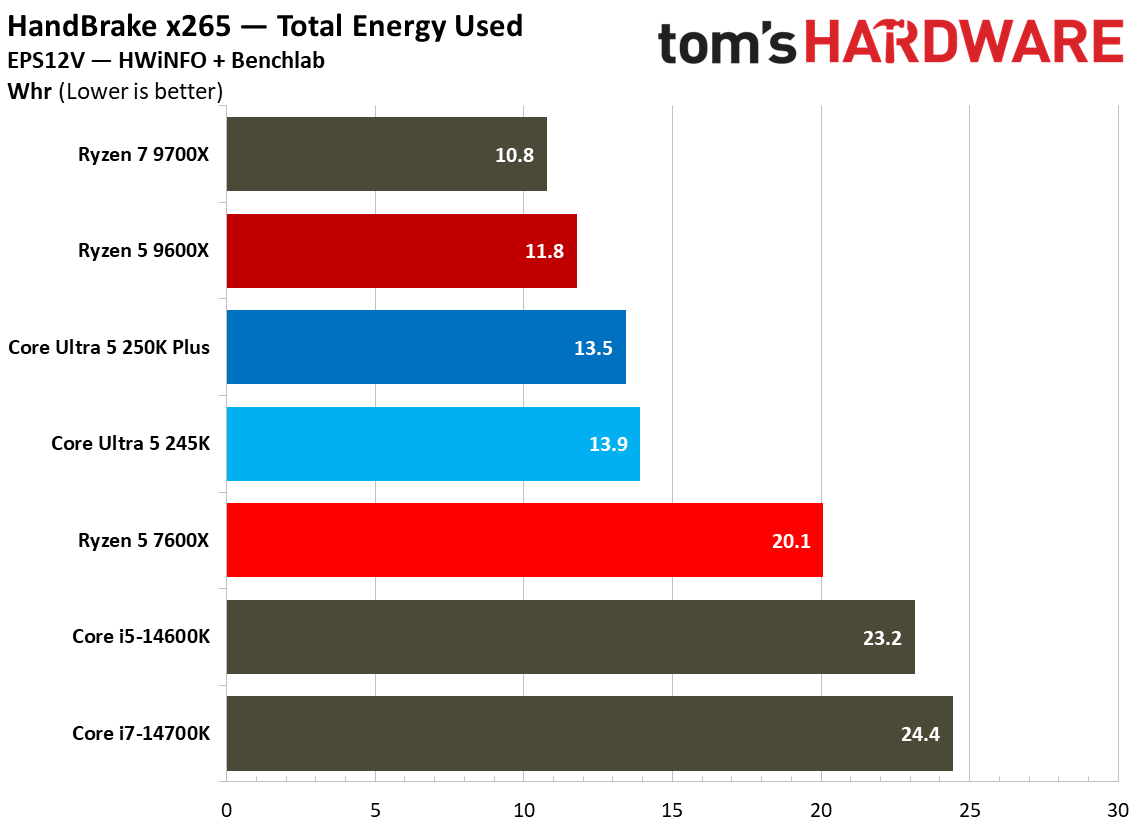
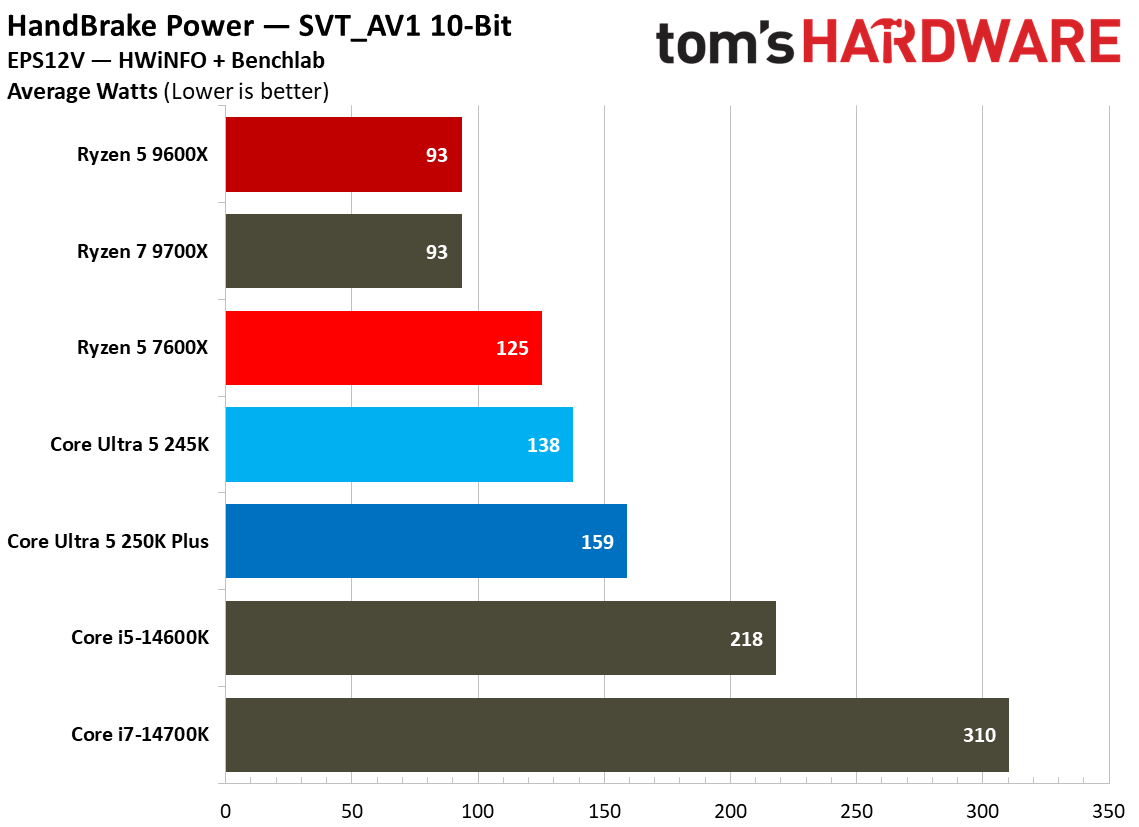
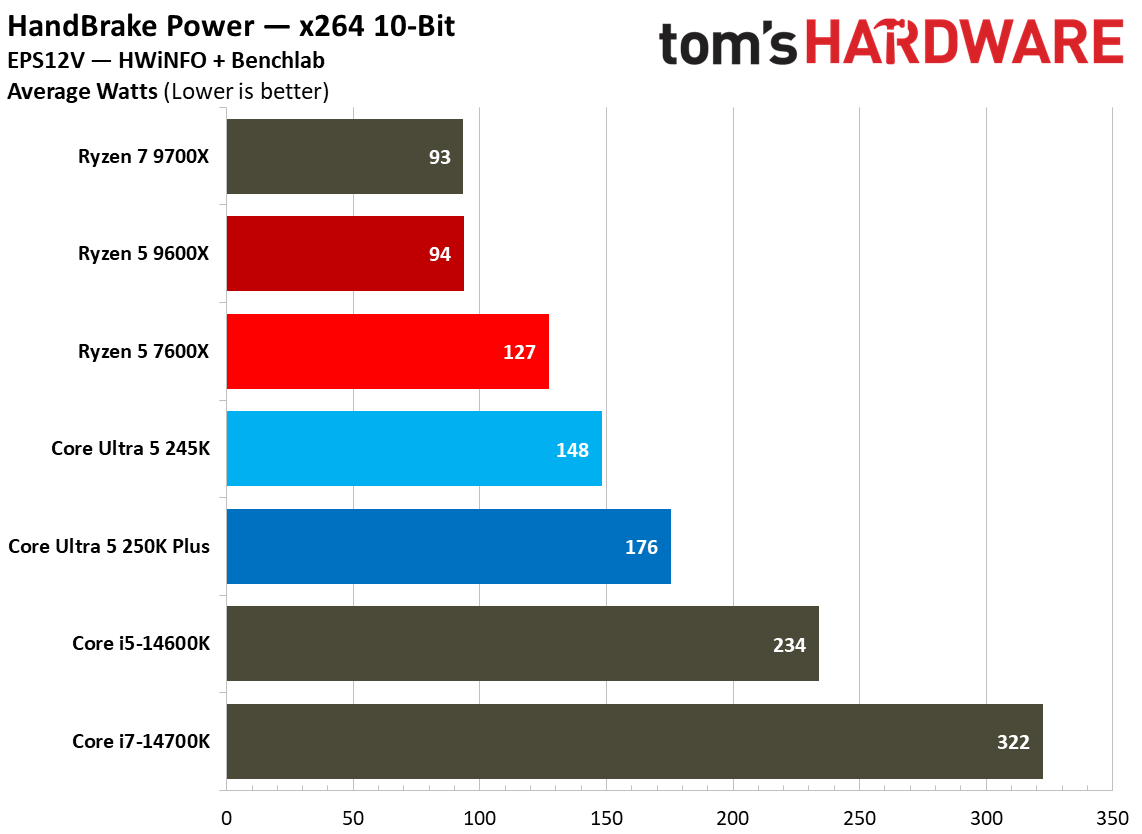
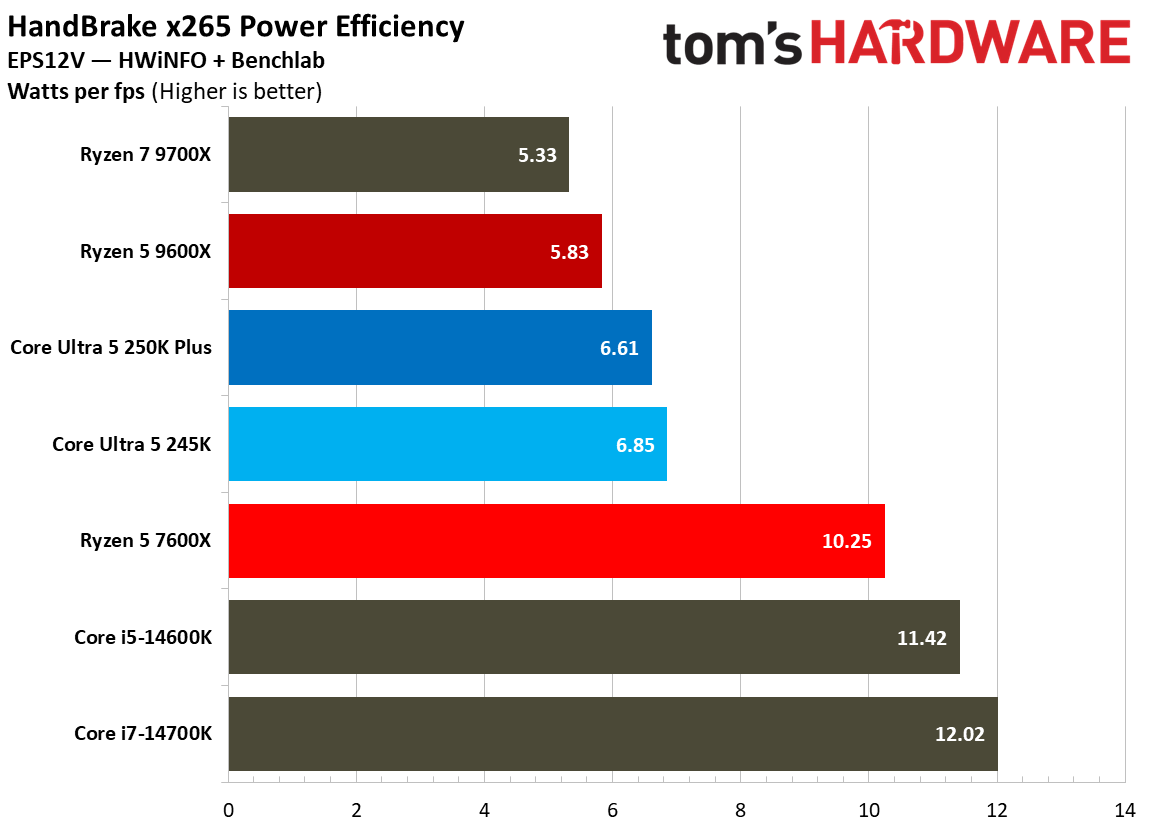
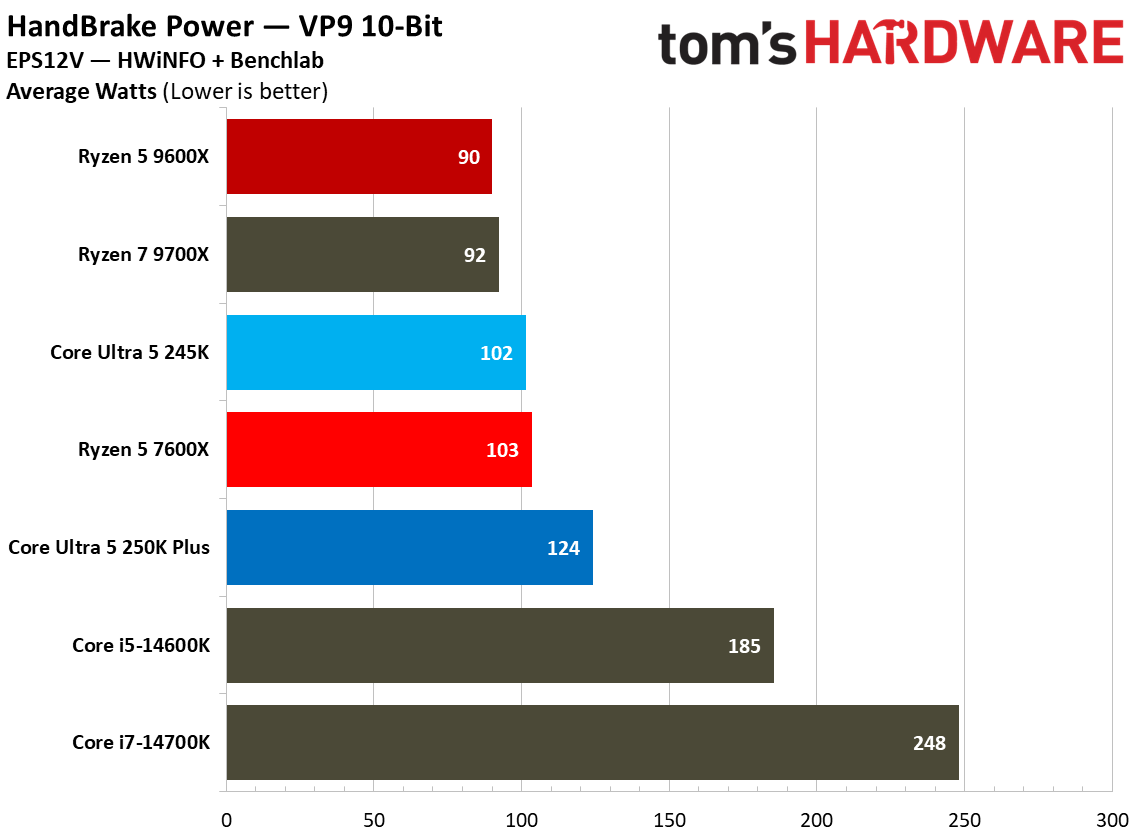
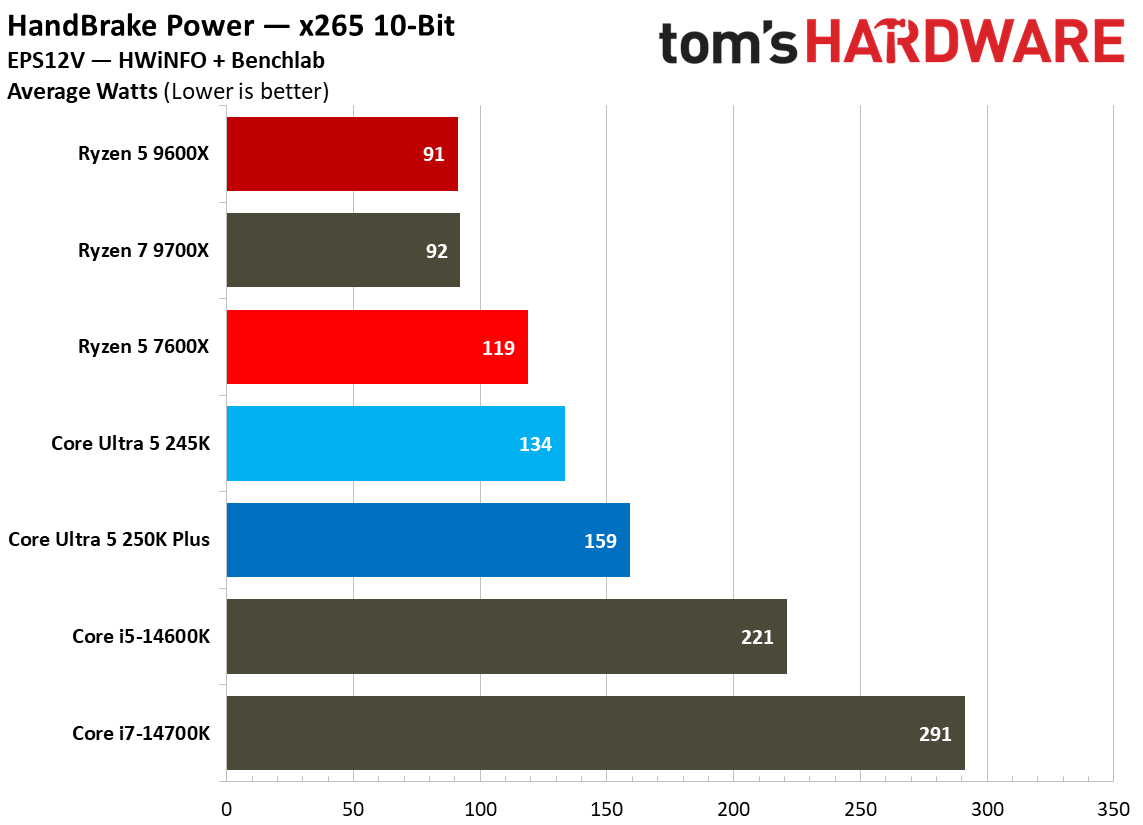
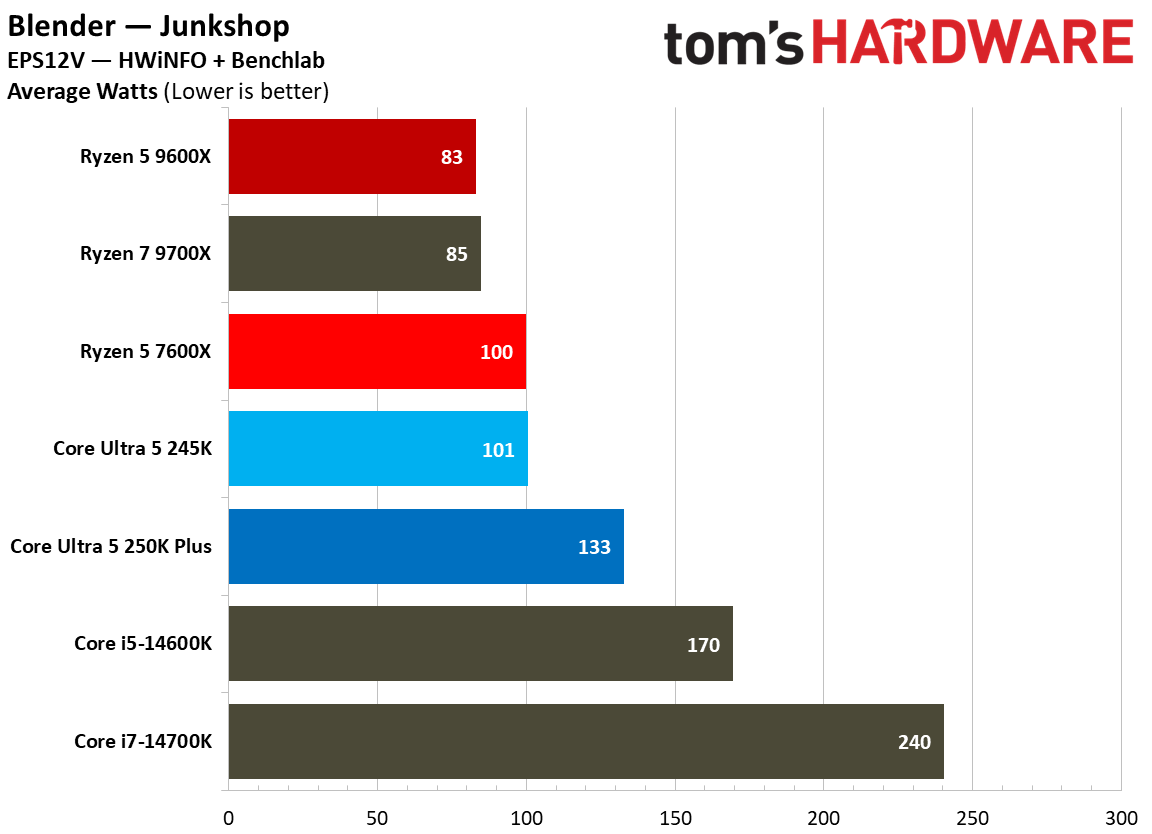
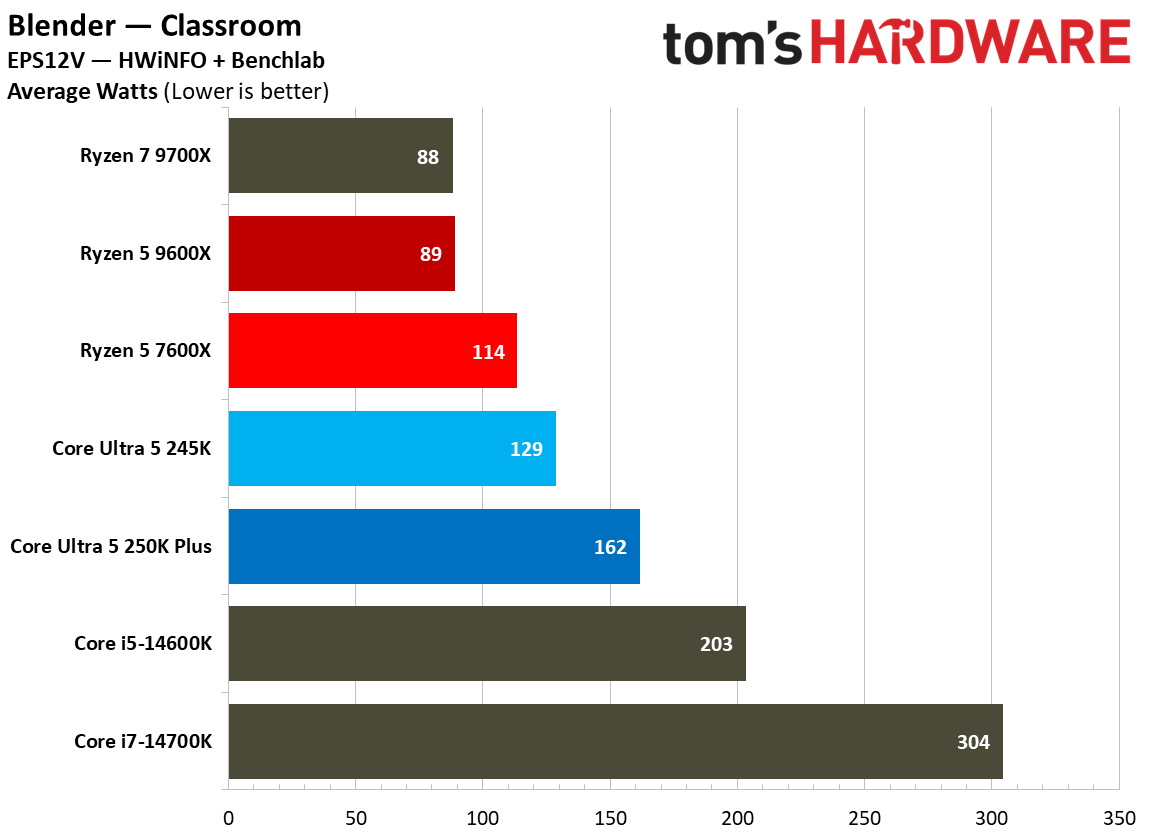
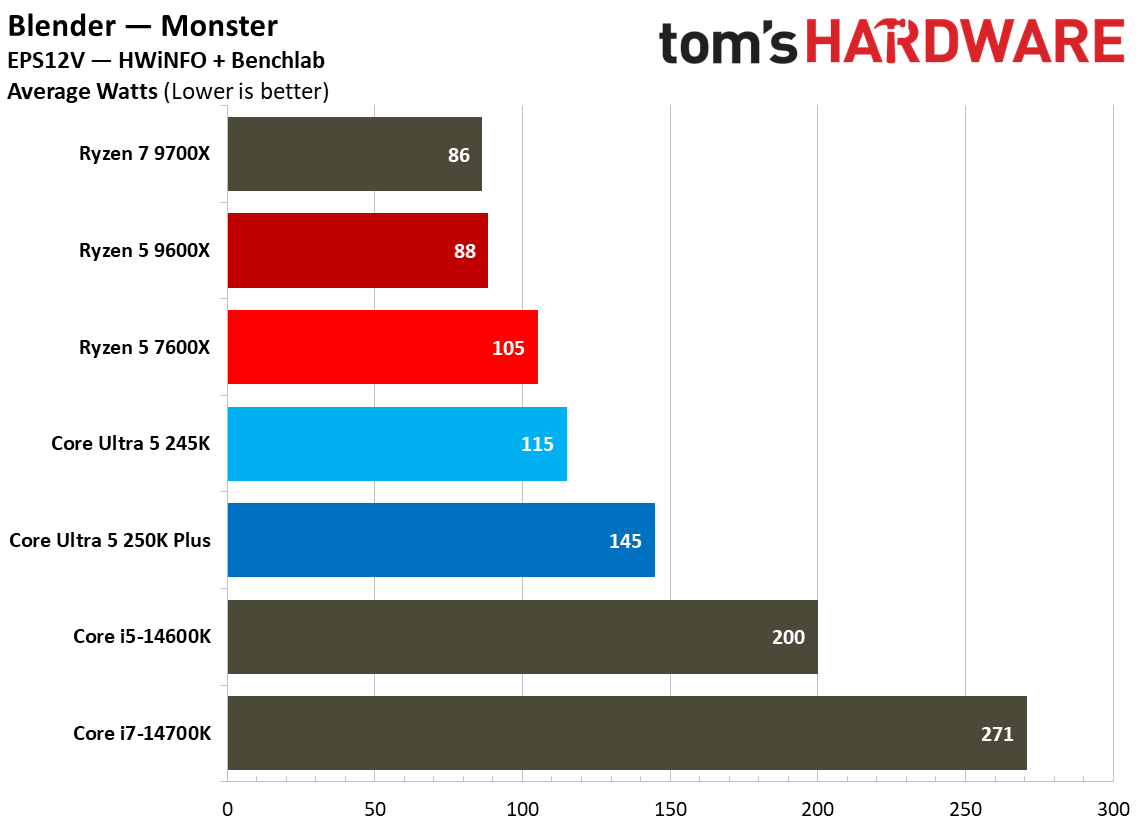
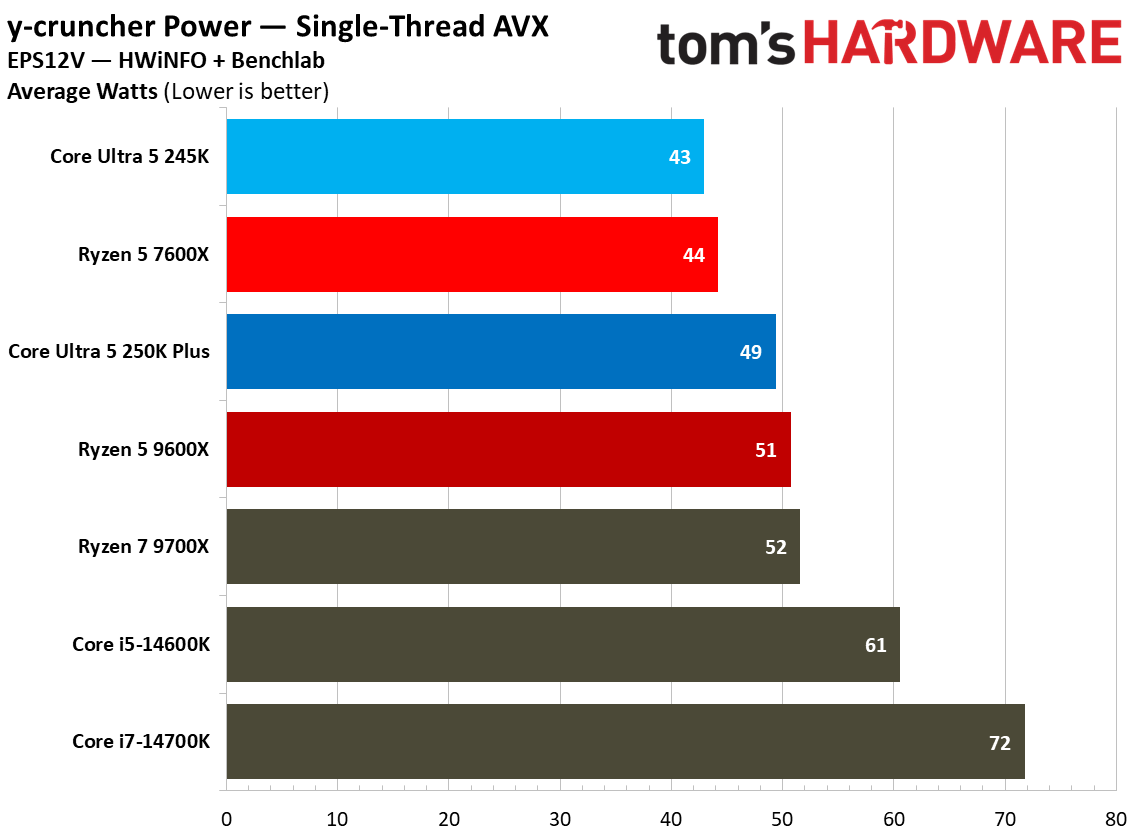
Starting with low-activity states, the 9600X draws around 22W while idling as opposed to 30W on the 250K Plus, which is roughly a difference of 36%. Under active idle conditions (YouTube playback) the AMD chip jumps to 26W while the Intel chip draws 37W, an increased delta of 42%. Although the percentages are drastic here, the actual wattage is important to keep in mind. This is a relatively minor difference in idle power consumption in practice.
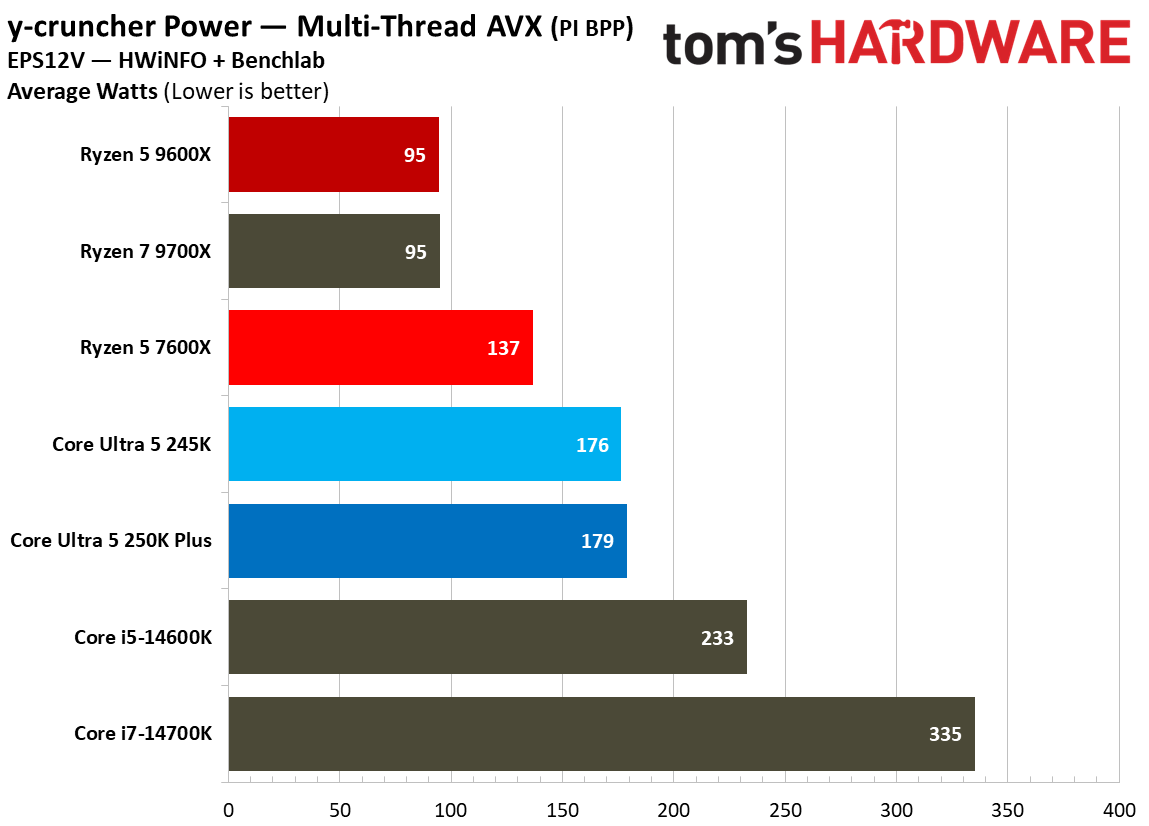
In sustained AVX workloads, the 9600X consumes 95W compared to 179W on the 250K Plus which is a massive 88% lower power draw. This makes sense given the 9600X's access to efficient AVX-512 instructions, which aren't available on the 250K Plus.
In x265 video encoding workloads, the Ryzen chip drew 91W compared to 159W on the 250K Plus, which is approximately 75% less, while x264 encoding shows 94W vs 176W, about 87% less power on the 9600X. Even with newer codecs like AV1, AMD maintains a strong lead at 93W versus 159W, a 71% lower power draw.
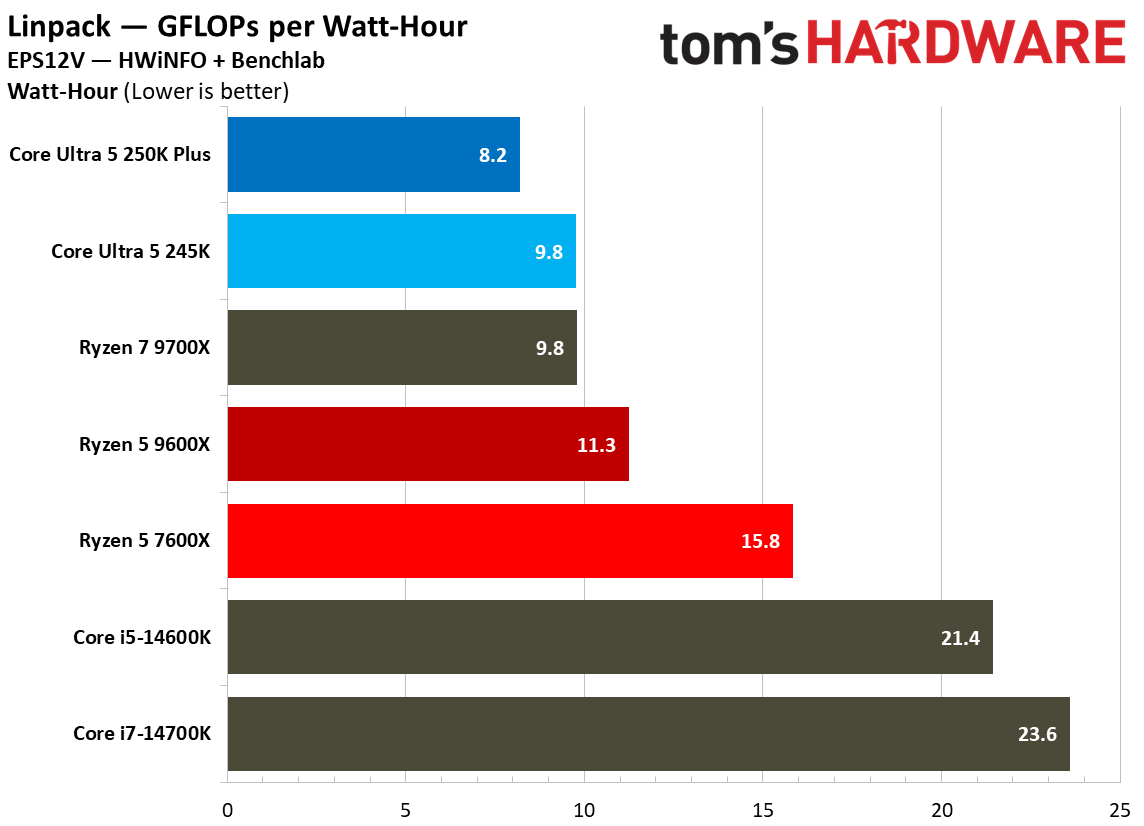
The 250K Plus earns back some points in efficiency. Although it consumes more power than the Ryzen 5 9600X, it also offers far higher performance in these demanding multithreaded workloads.
A good way to visualize that is with a scatterplot. The following charts plot performance against total energy consumed, meaning points closer to the bottom-right indicate better efficiency.
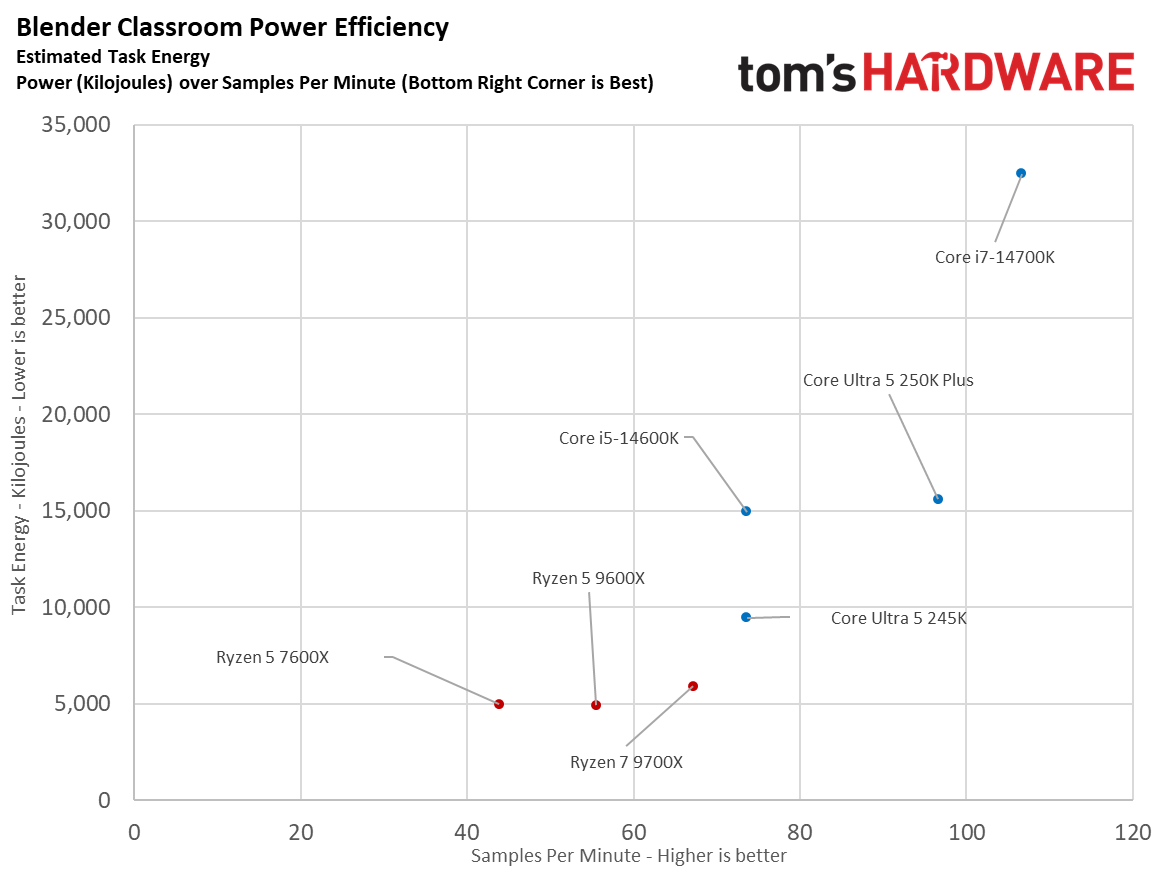
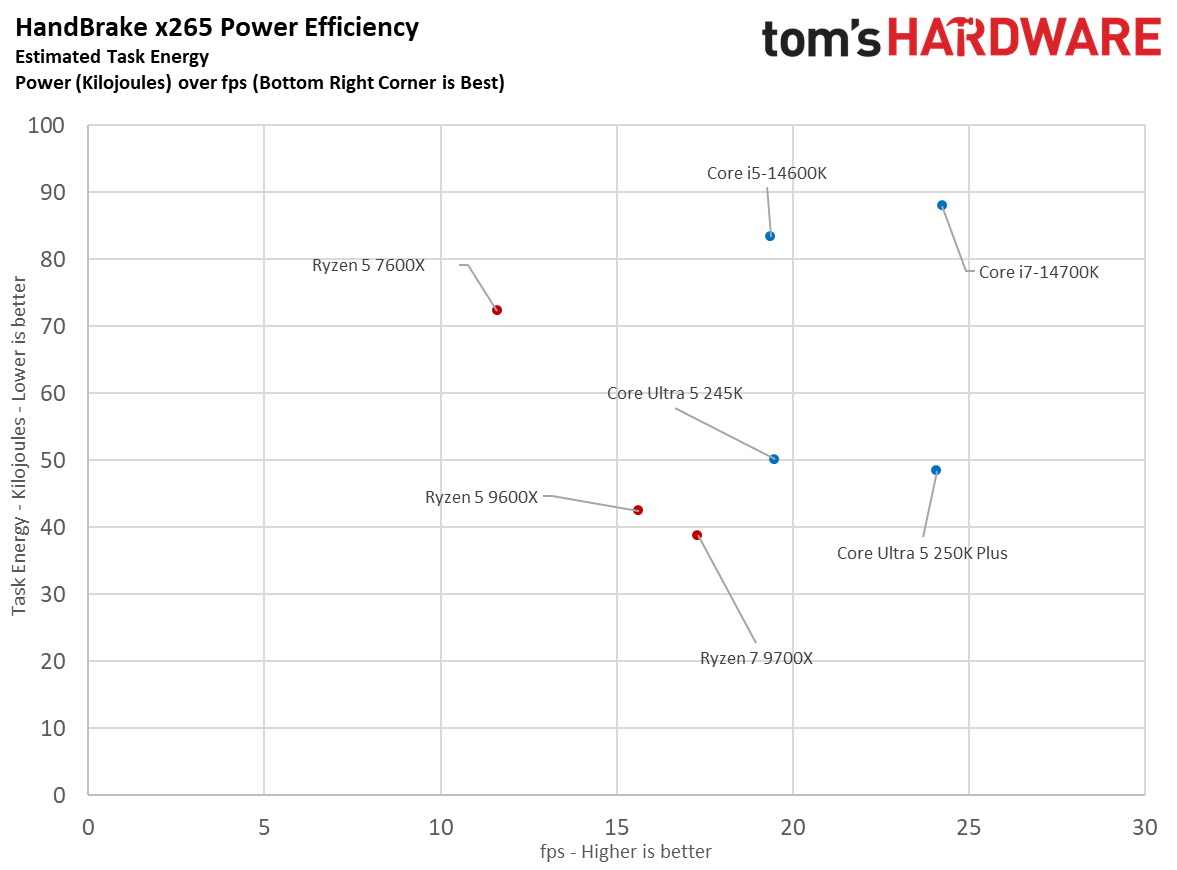
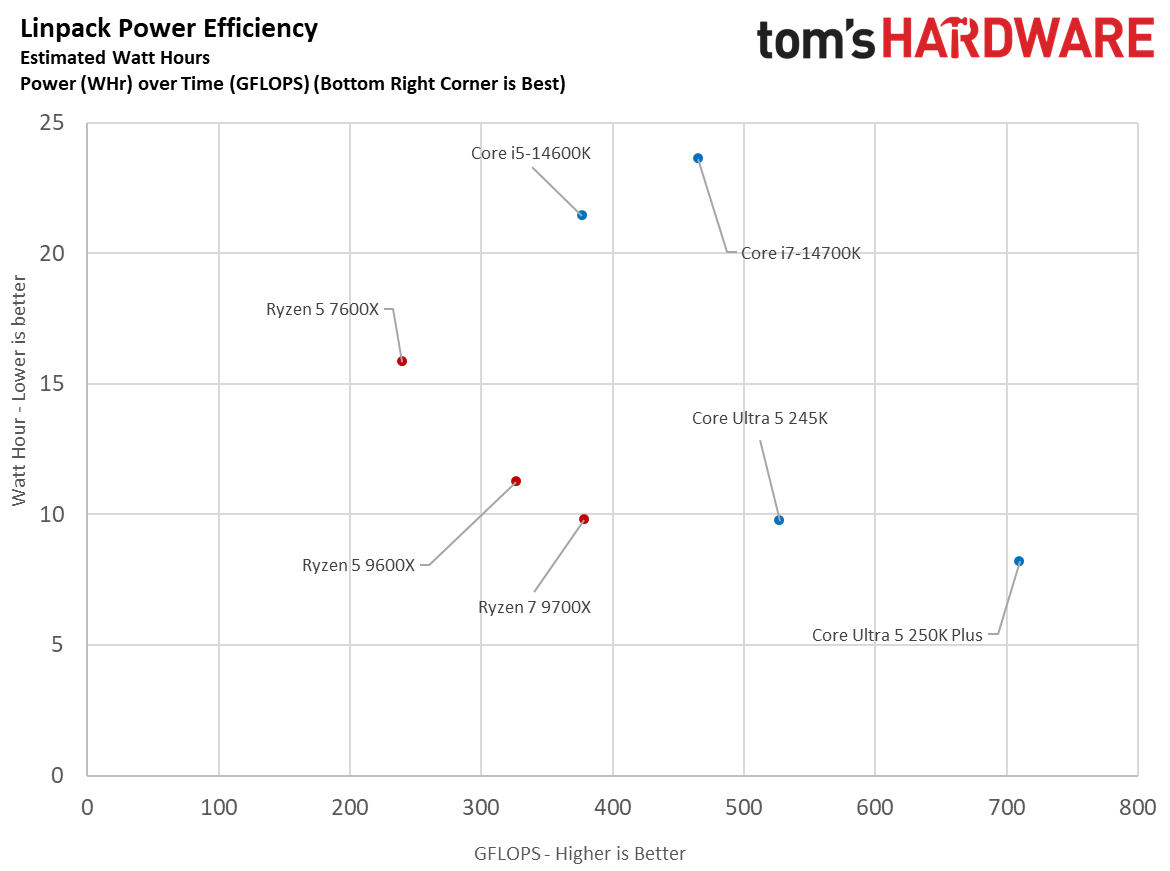
The 9600X consistently runs at much lower energy levels across all three workloads, while the Core Ultra 5 250K Plus achieves higher raw performance at a significant power cost. In Blender, Intel completes renders faster but consumes more energy, placing it higher on the chart, whereas AMD sits much lower with better energy efficiency. In Linpack, the 250K Plus pushes higher GFLOPS, but the 9600X delivers better performance per watt, indicating a more efficient use of power. A similar trend is seen in HandBrake x265, where Intel leads in FPS but requires more energy per task, while AMD maintains lower energy consumption, highlighting its overall efficiency advantage.
⭐Winner: AMD Ryzen 5 9600X
The 9600X delivers better power efficiency across idle, active, and heavy workloads, while also maintaining a strong advantage in total energy consumed in real-world scenarios. The 250K Plus does show occasional gains in specific efficiency metrics and delivers overall higher raw performance but not enough to outweigh AMD’s significantly lower power draw and consistent efficiency profile.
Pricing: Intel Core Ultra 5 250K Plus vs AMD Ryzen 5 9600X
These two chips are pretty close when it comes to pricing. The 9600X currently retails around $200 falling as low as $185 during sales. In comparison, the 250K Plus sits at $199 making both processors nearly identical in upfront cost. As a result, the real difference in value comes down to the total cost that one needs to invest in the platform.
Since the 9600X is compatible with AMD’s existing AM5 platform, one can easily find budget-friendly B650 motherboards starting at roughly $150. Higher-end X-series boards can exceed $250 depending on the specifications and features available. A key advantage here is that AMD allows CPU overclocking even on B-series chipsets, giving users more flexibility without having to invest in a premium motherboard.
The 250K Plus relies on Intel’s LGA 1851 socket, with relatively affordable entry-level B860 boards starting at around $120. Higher-end Z890 motherboards, which offer additional features and overclocking capabilities, begin at approximately $150. Unlike AMD, the B-series boards for Intel do not support overclocking and are limited only to memory overclocking capabilities. Another important consideration is platform longevity. The LGA 1851 socket is expected to be replaced soon with the arrival of Intel’s next-gen Nova Lake processors, restricting future upgrade path compared to AMD’s AM5 platform which is expected to see longer-term support through 2027 at least.
As for memory support, it is similar across both platforms, as both CPUs rely exclusively on DDR5 RAM. Unlike older Intel generations, there’s no DDR4 compatibility here, meaning users will need to factor in the cost of DDR5 memory regardless of platform choice. With memory prices still in a limbo, the overall system costs are going to remain higher than previous generations which removes any potential cost advantage between the two platforms.
Cooling requirements for both chips are quite manageable. Thanks to its efficient design, the 9600X can be tamed effectively with a decent air cooler or an entry-level 240mm AIO. Despite its higher power envelope, the 250K Plus runs relatively cool, especially during gaming. This means you should be able to get away with a reliable budget air cooler.
⭐Winner: AMD Ryzen 5 9600X
The 9600X is the more sensible choice here based purely on pricing and total platform cost. While both CPUs are nearly identical in upfront cost, AMD’s AM5 platform offers cheaper entry-level motherboards with overclocking support and a longer upgrade path. The 250K Plus requires more investment for comparable motherboard features and sits on a platform with limited future compatibility.
Bottom Line: Intel Core Ultra 5 250K Plus vs AMD Ryzen 5 9600X
Swipe to scroll horizontally
| Row 0 - Cell 0 | Intel Core Ultra 5 250K Plus | AMD Ryzen 5 9600X |
Features and Specifications | ❌ | Row 1 - Cell 2 |
Gaming | ❌ | Row 2 - Cell 2 |
Productivity Applications | ❌ | Row 3 - Cell 2 |
Overclocking | ❌ | Row 4 - Cell 2 |
Power Consumption, Efficiency, and Cooling | Row 5 - Cell 1 | ❌ |
Pricing | Row 6 - Cell 1 | ❌ |
Total | 4 | 2 |
The Intel Core Ultra 5 250K Plus ultimately wins this faceoff with a dominating 4-2 lead. The CPU offers excellent gaming performance with better frame pacing and delivers a noticeable advantage in multithreaded workloads, making it a far more capable chip for content creation and heavy tasks. However, this performance comes at the cost of higher power consumption in productivity workloads. On top of that, the LGA 1851 platform holds it back when it comes to long-term upgradeability, especially with a new socket on the horizon for Nova Lake.
The AMD Ryzen 5 9600X still makes a strong case for itself, especially for users who prioritize efficiency and platform value. It consumes significantly less power, runs cooler under sustained workloads, and benefits from AMD’s AM5 platform, which offers better longevity and broader upgrade support. Combined with more affordable motherboard options, it becomes a more practical choice for users planning to keep their system for longer.
If you are after the best overall performance at this price point, the Core Ultra 5 250K Plus is the clear winner. But if lower power draw, better efficiency, and a longer upgrade path matter more, the Ryzen 5 9600X stands out as a more balanced and future-proof option.







 English (US) ·