
 1 hour ago
4
1 hour ago
4
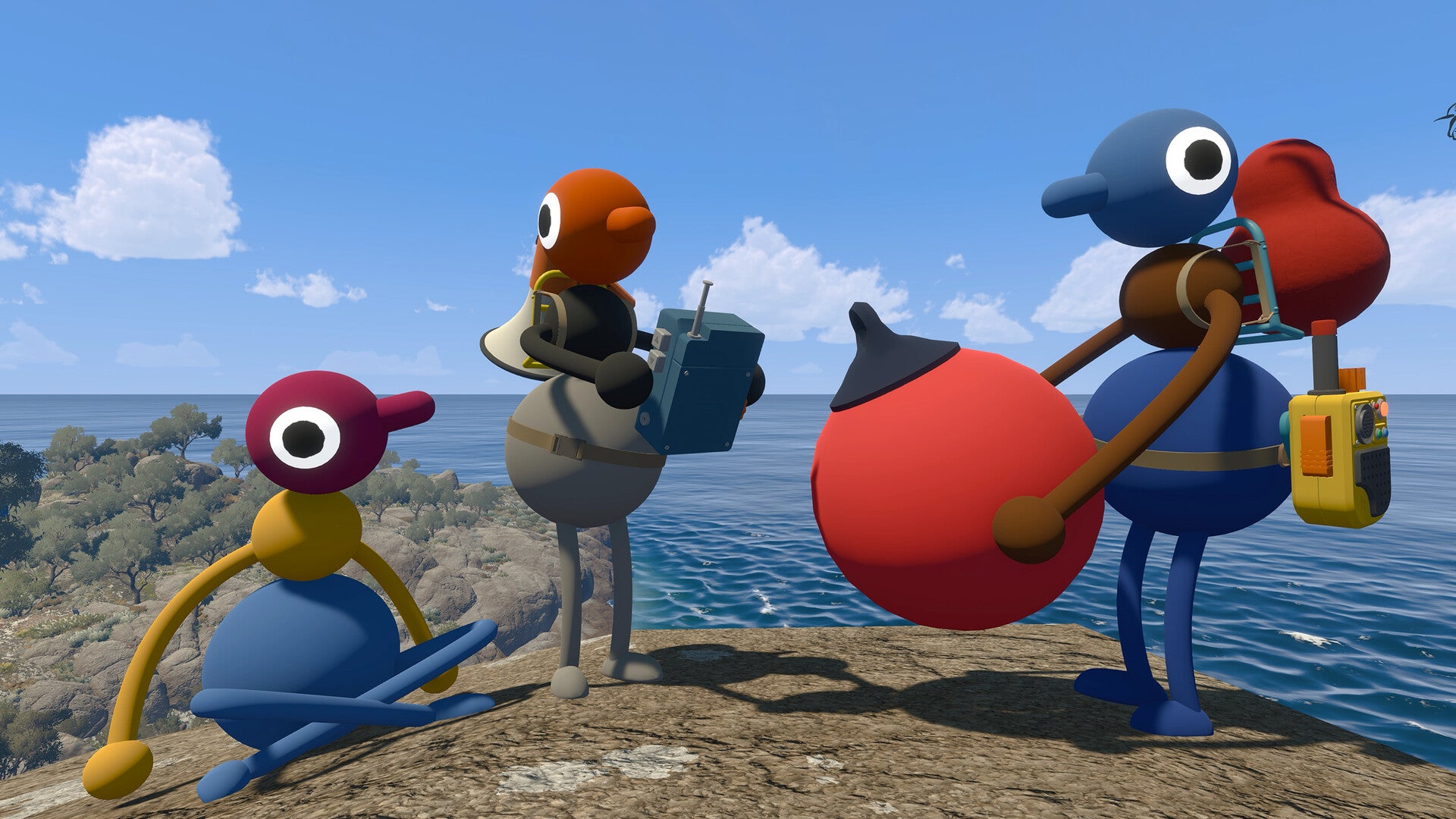
House House were kind enough to keep a video of my hands-on session with Big Walk, filmed by one of the participating PRs. Generally, a full video of a preview event including player audio is a lifesaver for a journalist, struggling to keep notes while pushing buttons. But in this case, I don't want to watch the Big Walk video, because then I would hear what the other players were saying when I wasn't there.
You see, I fell down a cliff midway through Big Walk, and spent the night floundering about in the ocean. Eventually, a developer armed with a big, ball-shaped lamp tracked me down and ushered me back up, hoisting me onto his shoulders so that I could leap to a rock. Nights in Big Walk last moments. I was gone for the length of a luxurious toilet break. But still, those were moments in which the others were gathered, waiting for me. Perhaps they were making fun of me. I don't want to know.
Big Walk is easily dismissed as "friendslop", specifically laconic Aussie friendslop, but the presence of an open world and the total absence of danger sets it apart from the likes of Lethal Company or Peak. It unleashes a group of boggle-eyed, string-limbed, big-arsed birdpeople upon a potted approximation of the Wilsons Promontory National Park. This is a realm of spiky, swaying grasses and coarse yellow boulders that has been partly overtaken by a series of bright, plastic, Crystal Maze-style co-op puzzles. One puzzle might see a player reading out symbols inside a sealed room, while those outside rummage through a heap of tiles. Another might involve the whole team standing on each others' shoulders to push a button.
You'll probably know House House as the creators of Untitled Goose Game, a viral hit dedicated to the fierce avian joy of trolling hapless humans. There's trolling to be done in Big Walk – you can run around clattering a handbell until somebody kicks it into the ocean. But the mood is, overall, gentle.
Some of the fixtures are just there to relax you, like the humming sound shrine on the coast where you can walk around a curved ramp to hear a different blend of notes. Players are free to vanish into the undergrowth at any point; when you need to reconvene, there are flaregun launchers and the like to summon the wayward home. The character animations are immediately amusing – you can stick your arms out to do an aeroplane impression or shake them imperiously at the sky.
The chat function sees your character's head vibrating in time to the inputs, like a speedbag. There's also a paintbrush you can use to give your friends a makeover. And then there are those ball-shaped lamps, which you can send rolling down a hillside, illuminating individual clumps of ferns as they tumble.
Still, my dominant emotion looking back on Big Walk isn't amicability or serenity, but awkwardness. In a good way, though. An interesting way, maybe? In a portrait of Charles Dickens that is itself rather Dickensian, G.K. Chesterton describes the enduring power of a faux pas, commenting that "there are ways of getting absolved for murder; there are no ways of getting absolved for upsetting the soup." I read those lines 20 years ago and the idea that teeny embarrassments stick in the craw and swell up like a permanently stifled chestburster has bothered me ever since. Big Walk reveals that I am as capable of feeling like this in a videogame, as anywhere else.
Here is my Big Walk equivalent for spilling the soup: I couldn't get my microphone to work in the preview session, and so had to communicate using chat and in-game whiteboards. I thus immediately defined myself as a liability. I couldn't have an organic conversation. I couldn't participate in Bantz, the grease that separates the bigshot interviewers from the no-hopers. My smart replies were always 30 seconds too late. Worse, the wobbling of my head made it very obvious when I was having trouble formulating a question. Like my question about the indigenous heritage of Wilsons Promontory, which I couldn't fit into the character count.
I was the Joey of the cast. I was Iron Fist in the Defenders. And throughout our playthrough, I could smell the collective suspicion that my microphone was working fine, actually, and that I really just didn't want to talk. Perhaps I didn't. Other people are scary! I compensated for my unease by channelling a little Untitled Goosiness, pranking around with puzzle props, but there's only so often you can kick a jigsaw piece into the sea before the comedy wears thin.
You may know this agony from co-op shooters with small headcounts, like the recent Marathon, but at least in a game like Marathon, you can cover your nerves by hurrying brusquely towards the waypoint. No time for pleasantries, samurai! I haven't played a game before that kindles such anxiety whilst notionally being a sort of sleepy, post-apocalyptic Center Parcs resort.
Big Walk makes use of proximity and direction-based voice audio, which requires you to approach and face towards the person speaking. If you're further away, you'll need an in-game Fisher Pricey walkie-talkie. One side effect of this is that the game sort of encourages polite body language. In a lot of multiplayer games, you can look away without it being a faux pas; in this one, it makes it obvious that you're not listening.
Another side effect is that when, say, another journalist asks a developer a good question, it's screamingly apparent when you, the weird micless git, are eavesdropping. I hurried ahead during one conversation because I was starting to feel like a creep.
And then there was the part where I fell in the sea. Ugh! No, I won't watch the video. I will delete the email containing it – there! I should have gone totally AWOL, in hindsight. I should have stalked the group from the shadows, a menacing shade with a handbell, echoing from the deep places while my erstwhile brethren cower inside whatever silly Jungle Run bullshit they're trying to solve right now.
If I sound like I'm making mountains from molehills, 1) yes, 2) it's actually rather lovely to consider how multiplayer games might serve as platforms for emotions that are simultaneously this delicate and this stupid. It's lovely in part because games don't tend to market themselves on the strength of their ability to provoke, say, qualms about eye contact, or the relief of having dropped a pun and heard people laugh.
Videogame discourse tends to emphasise the Big Emotions, in both laudatory and accusatory ways: whether a game can make you cry, whether a game can become an addiction, or inspire the urge to kill, whether a game can be Satisfying - the queen of emotions, often found in the company of Gunfeel and Immersive. Some of that is due to Videogaming's on-going insecurity before the Grown-Up mediums, the need to demonstrate that "we" can yank upon the heartstrings as vigorously as a Citizen Kane. Well, Citizen Kane never made me wince because I misspelled a swearword while making a joke about the malfunctioning swear filter. Ball's in your court, rogerebert.com! Read more about Big Walk on Steam.





 English (US) ·