
GMKtec NucBox K13: 30-second review
Looking back, the GMKtec NucBox K13 is the first mini PC that I’ve covered that uses the Intel Core Ultra 7 256V I’ve tested. It’s a Lunar Lake-era processor built on TSMC's 3nm process, not on Intel fabs that can’t handle such small track sizes. But it also represents GMKtec's first foray into the new generation of AI-capable, efficiency-first processors, and it makes a rather decent fist of it.
By replacing the 512GB or 1TB M.2 NVMe drive supplied with the K13 and utilising the second slot, it is possible to add 16TB of storage to this mini PC. However, while the storage can be enhanced, the memory is fixed at 16GB of LPDDR5X 8533 MT, as this is soldered to the mainboard.
That’s one weakness, and the lack of an OCuLink port is another. Though you can attach an external GPU using USB4, the 40 Gbps bandwidth of that technology is less than the 64 Gbps of an OCuLink configuration.
Overall, this is a powerful, small system with plenty of potential for power users. The only issue for any potential buyer is how much memory you might want, as AI tasks generally need lots, and how this system's price compares with others that might offer 32GB or more.
The lack of upgradability and OCuLink stop the K13 from entering our hallowed best mini PC collection. But it could be perfect for users who don’t need discrete graphics or more than 16GB of RAM.
GMKtec NucBox K13: Price and availability
- How much does it cost? From $670/£540/€610
- When is it out? Available now
- Where can you get it? Direct from GMKtec and via online retailers
The NucBox K13 is available direct from the GMKtec website, as well as online retailers like Amazon.com and Amazon.co.uk.
Two configurations are available, both with 16 GB of soldered LPDDR5X RAM. The base model has a 512 GB SSD for $669.99, and the 1 TB variant is $719.99. Both are currently offered below their stated MSRPs of $899.99 and $949.99, respectively.
UK pricing is £536 and £580, and the Euro price is €609.99 and €659.99.
Based on the current exchange rates, US prices are about 7% higher on average. Not sure why that would be, but those are the prices GMKtec decides.
Those expecting a bargain on Amazon are likely to be disappointed, since the price on Amazon.com via the GMKtec Store is the MSRP of $949.99 for the 1TB option.
The price on the UK Amazon.co.uk is equally inflated at £788.96, and that’s just for the 512GB option.
Resist the temptation to buy through Amazon unless a significant coupon brings the price in line with the direct store. At MSRP, it represents poor value compared to gmktec.com.
In terms of alternatives to the K13 that use the same platform, there are only two that I’m aware of, and both are made by Acer. The Acer Veriton NUC (VN1502G) and Acer Veriton NUC AI, but both of these options are north of $1000, if you can find them.
In that context, a GMKtec NucBox K13 direct from the maker looks like a bargain. However, other platforms are available at this price point, and some offer more processing power and features that the K13 doesn’t match.
- Value: 4 / 5
GMKtec NucBox K13: Specs
Swipe to scroll horizontally
Item | Spec |
CPU | Intel Core Ultra 7 256V (8C/8T, up to 4.8 GHz, Lunar Lake, TSMC 3nm) |
GPU | Intel Arc 140V (8 Xe2 cores, up to 64 TOPS GPU compute) |
NPU | Intel AI Boost, 47 TOPS; Total system AI: 115 TOPS (INT8) |
RAM | 16 GB LPDDR5X 8533 MT/s (soldered, on-package, non-upgradeable) |
Storage | 512 GB or 1 TB M.2 2280 PCIe 4.0 (pre-installed) |
M.2 Expansion | 1x additional M.2 2280 PCIe 4.0 slot (up to 8 TB per slot; 16 TB total) |
Display Outputs | 1x HDMI 2.1 (4K@120Hz), 2x USB4 (DP 1.4 Alt Mode) — triple 4K support |
Front Ports | 2x USB 3.2 Gen 2 Type-A, 3.5mm audio jack, power button |
Rear Ports | 1x HDMI 2.1, 2x USB4 40Gbps (PD 3.0 100W), 1x USB 2.0, 5 GbE RJ-45, 3.5mm audio, DC-in, reset button |
Networking | Wi-Fi 6E (up to 2.4 Gbps), Bluetooth 5.2, 1x 5 GbE LAN |
Power (TDP) | 17W–37W configurable |
OS | Windows 11 Pro (pre-installed); Linux supported |
Dimensions | 186 x 88 x 33.2 mm |
Weight | 523 g |
Included Accessories | 30W USB-C PD adaptor, 120W DC power brick, VESA mount bracket, HDMI cable, manual |
GMKtec NucBox K13: Design
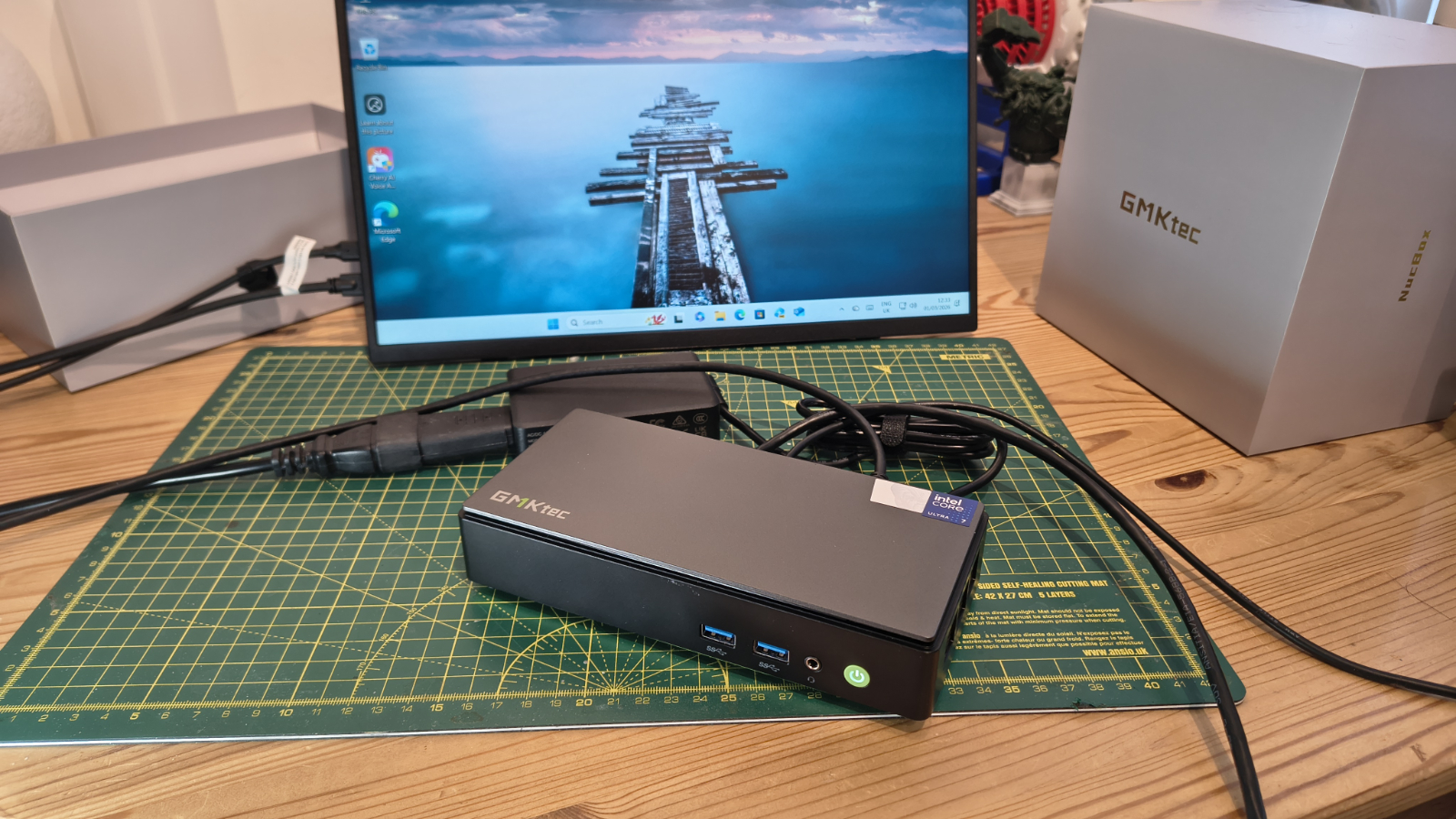
- Docking station-inspired chassis
- Sophisticated cooling
- Easy access
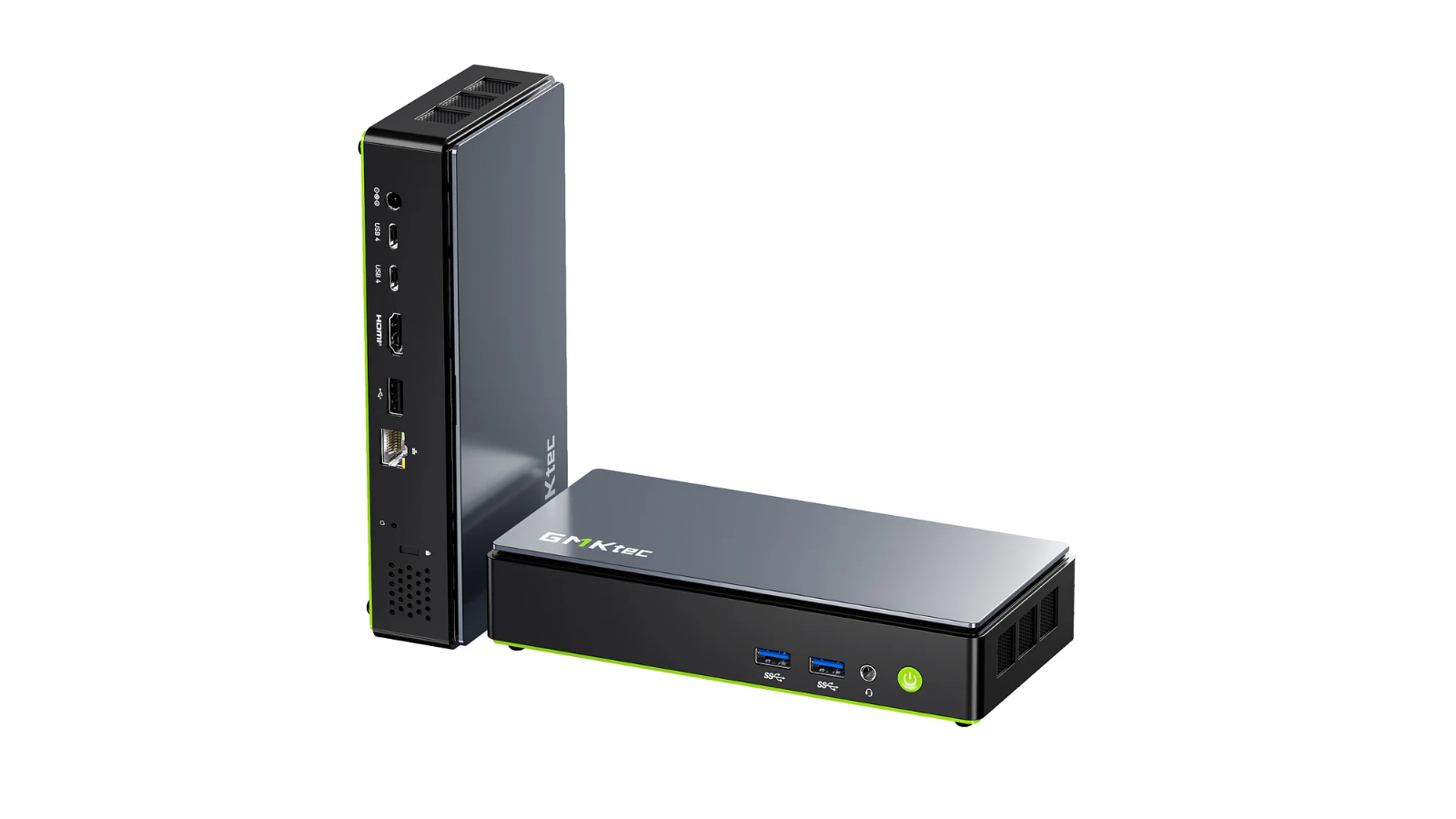
The NucBox K13 makes, in physical terms, quite the statement. At 33.2 mm tall, it is the slimmest mini PC in GMKtec's current catalogue, and it achieves this thinness without resorting to the sort of brutalist cost-cutting that usually accompanies such design ambitions. The chassis is clean and purposeful, with a form factor that would not look out of place mounted behind a monitor or tucked beside a display on a reception desk.
Since Intel declined the opportunity to lead by example in the NUC market, we’ve seen more diversity, and the K13 is a prime example.
With a 186 x 88 mm footprint, the K13 is actually slightly wider than most of GMKtec's cube-format mini PCs, which is a reasonable compromise for the reduced height. The overall volume is modest, and the 523g weight makes it light enough to easily carry.
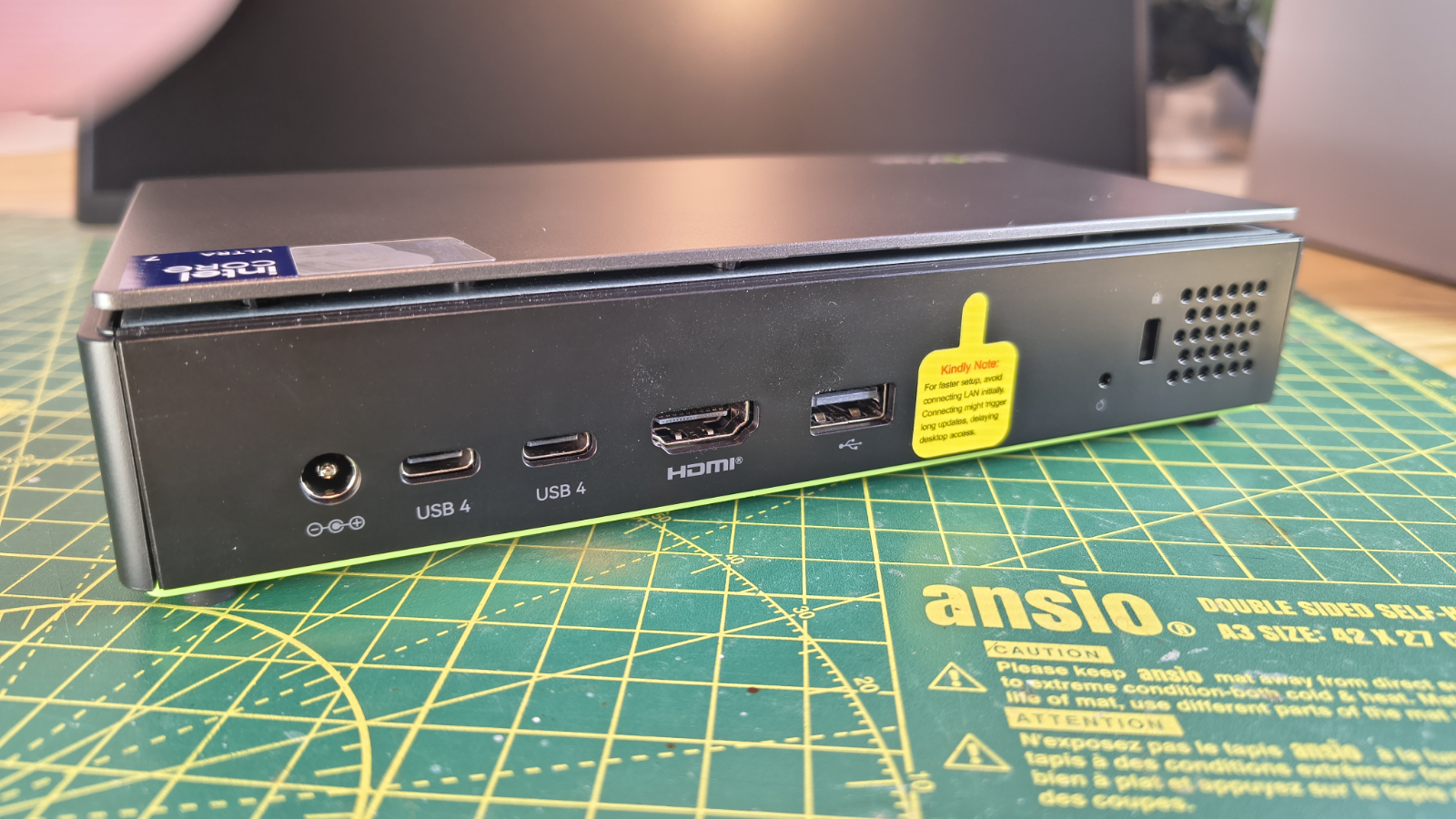
The front panel is fairly restrained: two USB 3.2 Gen 2 Type-A ports and a 3.5mm audio jack sit alongside the power button. Including a USB4 port on the front might have been a useful option, but these are both on the back. They aren’t cut-down USB4 variants, as they both support PD 3.0 (100W) and DisplayPort Alt Mode, which, when combined with an HDMI 2.1 port, enables up to three monitors to be connected to the K13.
Also on the back are a 5GbE LAN port, a USB 2.0 port, and a second 3.5mm audio jack. The choice of a single 5GbE port over dual 2.5GbE will delight some customers and horrify others, especially those who might want to segment a LAN. Given that you can add inexpensive 2.5GbE LAN ports to the USB 3.2 Gen 2 or USB4 ports using adapters, that’s something of a non-issue.
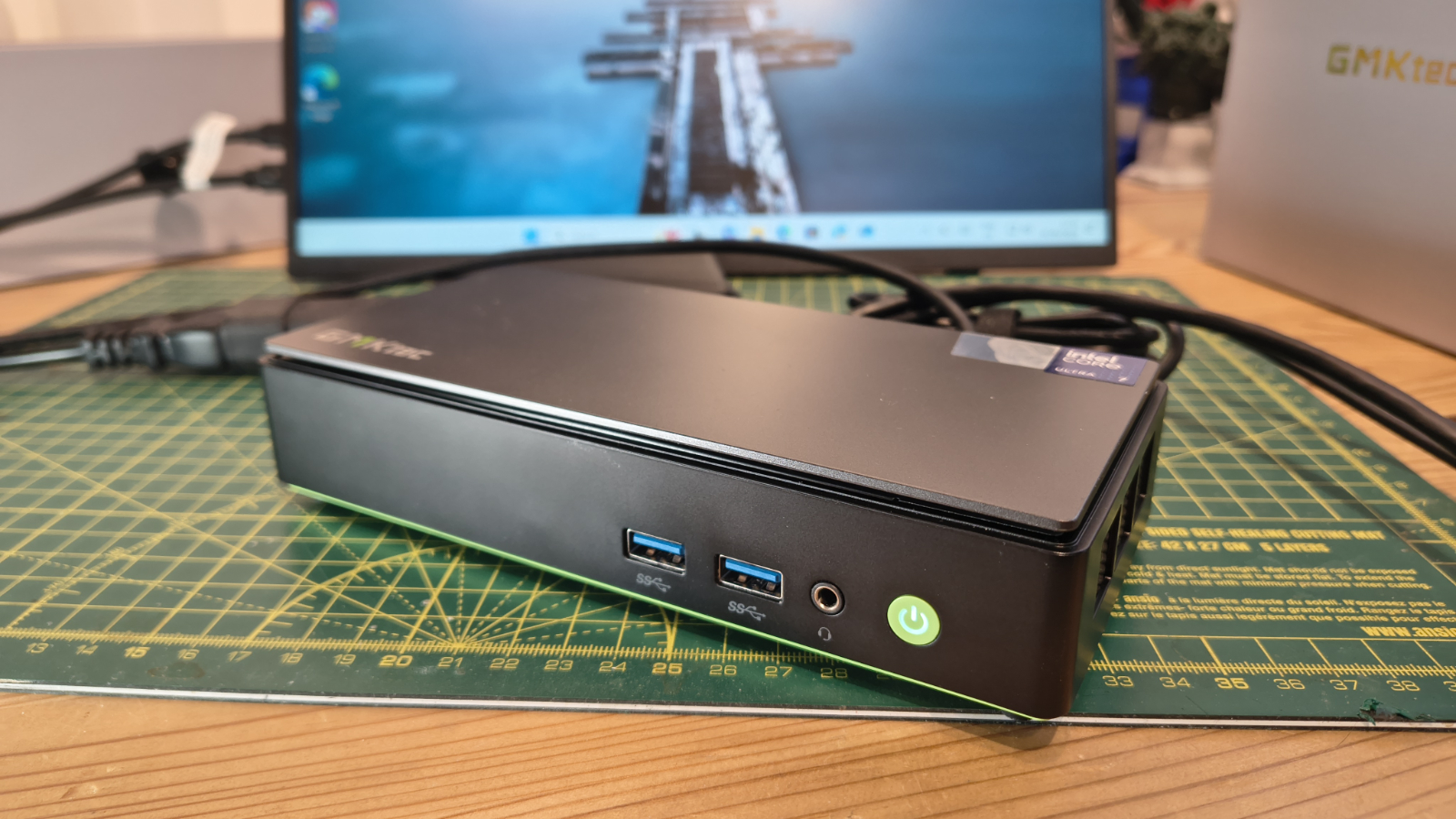
Cooling is managed by dual copper heat pipes and a single turbine fan. This configuration has proven effective in the slim NUC form factor, and Intel's own power budget helps considerably.
With a TDP ceiling of 37W, the K13 is not a machine that will heat a room, and in practice, the fan is rarely audible under normal desktop workloads. GMKtec claims the design incorporates a dust-resistant architecture, though the specifics of it aren’t obvious from my internal inspection.
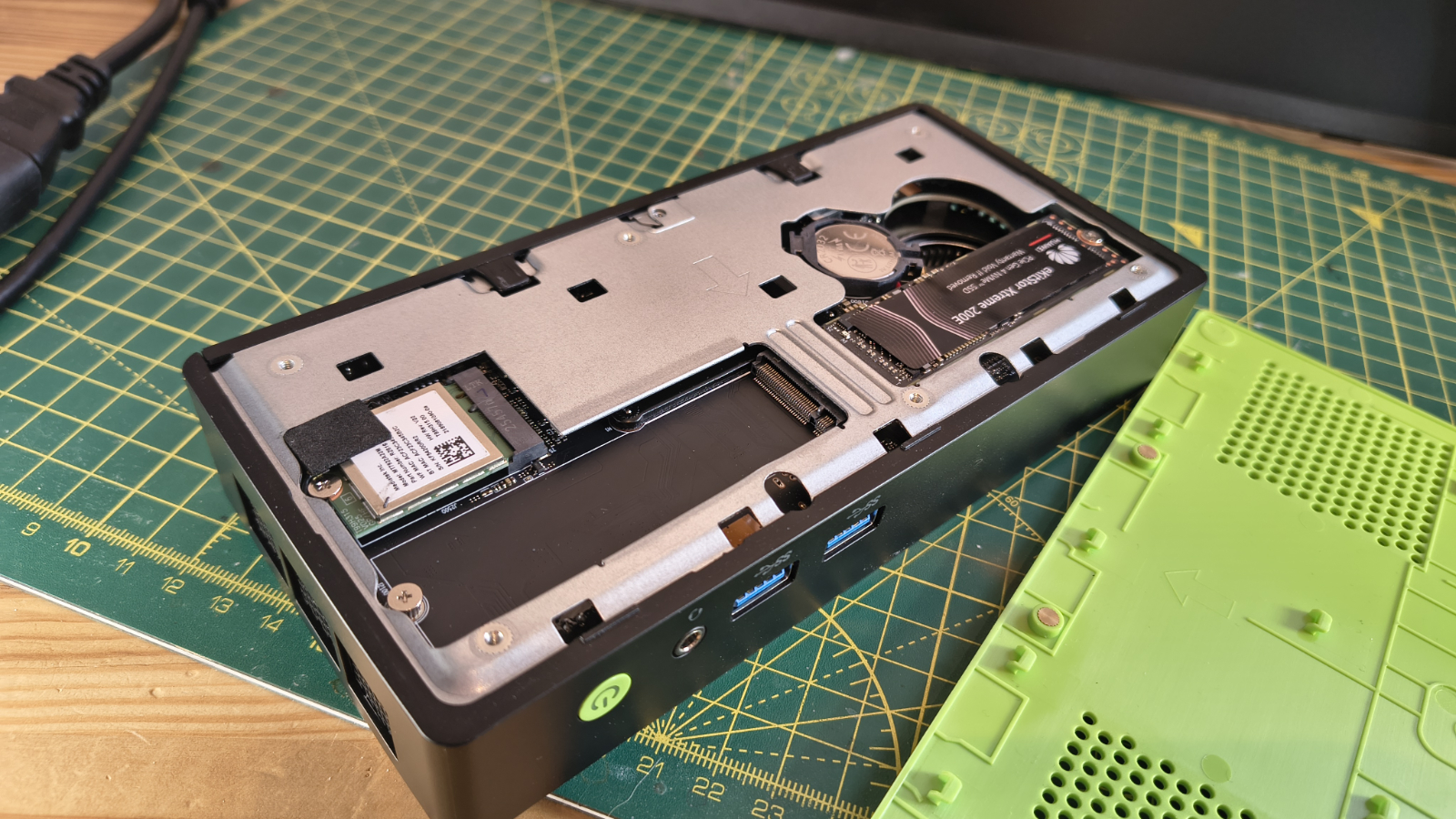
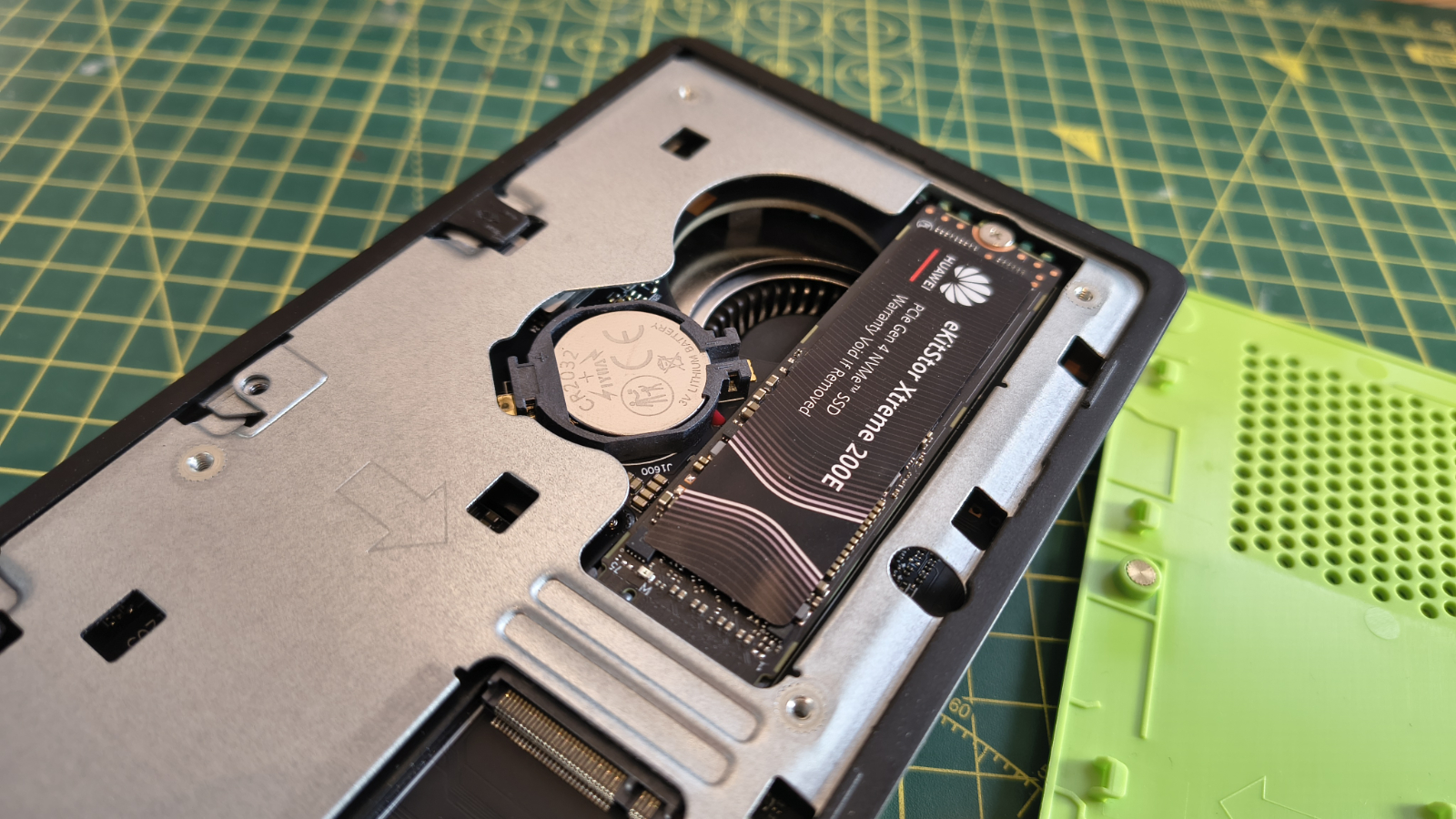
Access inside is probably the easiest I’ve experienced this year, with a single tiny screw holding the entire underside in place with the help of some magnets. With this removed, the two M.2 PCIe 4.0 2280 slots are accessible, along with a 2230 slot for the Wi-Fi adapter and the motherboard clock battery. There is no memory access, because that’s not removable from the mainboard.
The VESA mounting bracket is included as standard, and the K13's slim profile makes it an excellent candidate for monitor mounting. Deployment in this way adds minimal depth to the back of a display and keeps desk surfaces uncluttered.
In some promotional pictures, GMKtec placed the K13 on its end, but I’d strongly advise against doing so. There are no feet on either end, so either way you cut it, you will cut off airflow through the vents on those surfaces, which could lead to overheating.
Overall, this dock-style system seems a successful alternative to the common squashed-cube form factor beloved by many makers.
- Design: 4 / 5
GMKtec NucBox K13: Hardware
- Intel Core Ultra 7 256V (Lunar Lake)
- Arc 140V iGPU
- 47 TOPS NPU
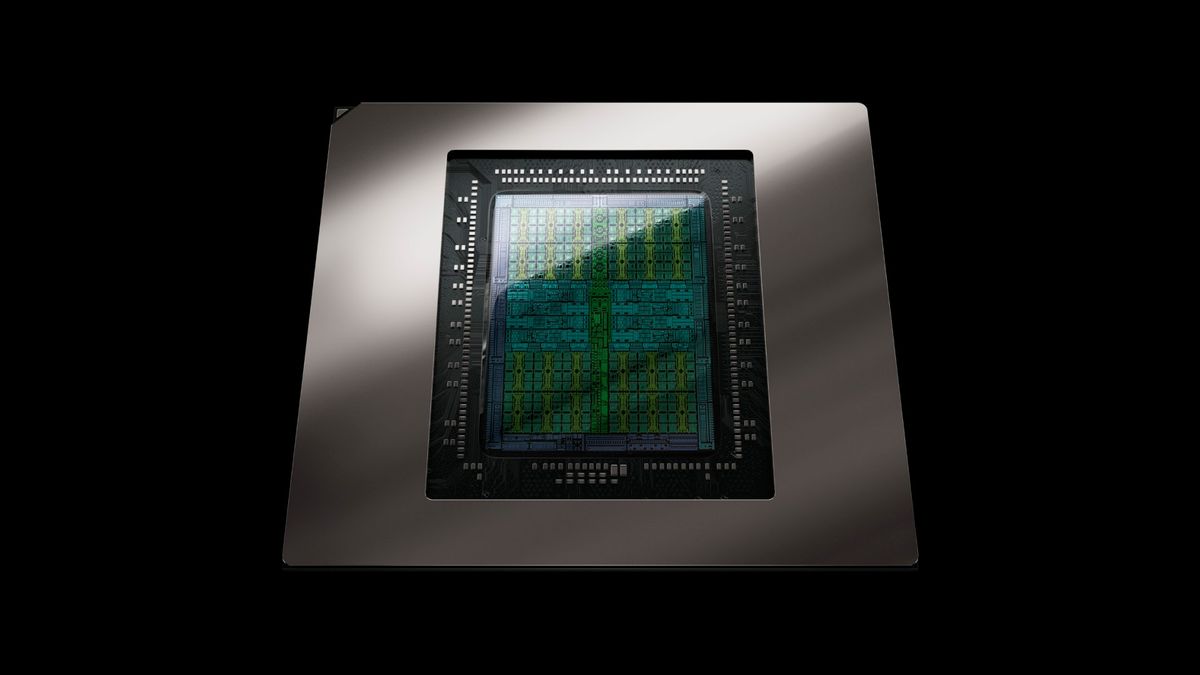
Luna Lake is a notable departure for Intel, as previous Core Ultra generations were straightforward evolutions, whereas Luna Lake is a complete rethink. The on-package memory architecture, borrowed conceptually from Apple's playbook, places LPDDR5X directly alongside the compute die, slashing memory latency and dramatically improving bandwidth efficiency.
The result is a processor that punches well above its 17W–37W power envelope, particularly in graphics and AI workloads.
The Arc 140V iGPU is notably better than the Iris Xe graphics that preceded it, and the 47 TOPS NPU combined with the 64 TOPS GPU compute, the total is 115 TOPS. That is a useful amount of AI processing, and not just a marketing exercise.
The CPU features eight cores arranged in a hybrid layout comprising four Lion Cove performance cores and four Skymont efficiency cores, and none of these cores has hyperthreading.
What I find truly odd about the Luna Lake chips is that prior to this, on both AMD and Intel silicon, it wasn’t uncommon to see cores with hyperthreading performing like those that didn’t have that feature. This was often due to code that tried to weave two parts of a process across different threads, where passing data from one thread to another on the same core caused delays that negated the duality.
That doesn’t happen on this chip, because each core can only handle one thread. But as I’ll talk about in the benchmarks, this processor can, in certain circumstances, appear to operate as if it were only a four-core processor, since some tasks won’t use the efficiency cores.
What I can’t deny is that single-threaded performance is strong, and the 3nm fabrication allows for excellent thermal distribution, enabling the turbo mode to be liberally utilised.
The real story, however, is the memory architecture. Rather than connecting to system RAM across a relatively slow off-package bus, Lunar Lake integrates LPDDR5X memory directly into the package using Intel's Foveros packaging technology.
The K13's 16 GB of LPDDR5X runs at 8533 MT/s, delivering a theoretical peak bandwidth of around 137 GB/s. To put that in context, the Ryzen 7 7735HS (as used in the NucBox K16) achieves approximately 100 GB/s with its LPDDR5X 6400 MT/s configuration. The K13 is approximately 37% faster in raw memory bandwidth, and the Arc 140V iGPU uses every bit of it.
The Arc 140V integrated graphics are built on Intel's Xe2 (Battlemage) architecture, representing a generational leap over the Xe-LP graphics found in 12th- and 13th-generation Core processors. With eight Xe2 Execution Unit clusters, the Arc 140V delivers performance broadly comparable to a GTX 1650 in rasterised gaming.
That’s a significant step up from the Radeon 680M, and a rather humbling improvement over Intel's own previous integrated efforts. Hardware ray tracing is supported, as are XeSS upscaling, AV1 hardware encoding, and the full suite of Intel's media pipeline. Quick Sync, in particular, remains one of the strongest hardware video encode/decode implementations available in integrated silicon.
To be clear, it's not the AMD Radeon 8060S great, but for an integrated GPU, this is as good as it gets for Intel these days.
Another strength of this silicon is its integrated NPU, which can work alongside the CPU and GPU for AI processing. The NPU is 47 TOPS, meeting Microsoft's Copilot+ PC requirement and enabling local inference for AI features, including live captions, Cocreator in Paint, and the suite of Recall-adjacent productivity tools that Microsoft is gradually rolling out for Windows 11.
When the CPU, GPU and NPU are all working in conjunction through AI compute, throughput reaches 115 TOPS. That’s a meaningful figure for anyone running local large language models, AI-assisted code completion or automation workflows. It’s ideal for the Clawdbot agent if you’re feeling confident using that notorious tool.
Another factor in its AI usefulness is the second M.2 slot, making the K13 a credible candidate for a local AI inference workstation where fast NVMe access to model weights is useful.
This platform has seen duty on some expensive laptops, but it's almost unknown in the mini-PC space. Its appearance here hints that Intel is trying to clear existing Luna Lake chip stock before something new is released (Panther Lake), so this might not be the only small system we see it used on.
- Hardware: 4.5 / 5
GMKtec NucBox K13: Performance
Swipe to scroll horizontally
CPU | Row 0 - Cell 1 | Intel Core Ultra 7 256V | Intel Core Ultra 7 255H |
Cores/Threads | Row 1 - Cell 1 | 8C 8T | 14C 14T |
RAM | Row 2 - Cell 1 | 16GB LPDDR5 | 32GB DDR5 (2x16GB) |
Storage | Row 3 - Cell 1 | 1TB Huawei eKitStor Xtreme 200E | 256 GB Phison M8256GCB5ECS-E192 |
Graphics | Row 4 - Cell 1 | Intel Arc Graphics 140V | Intel Arc Graphics 140T |
3DMark | WildLife | 22653 | 21370 |
| Row 6 - Cell 0 | FireStrike | 7364 | 7185 |
| Row 7 - Cell 0 | TimeSpy | 3413 | 3879 |
| Row 8 - Cell 0 | Steel Nom Lt. | 1914 | 3160 |
CineBench24 | Single | 116 | 127 |
| Row 10 - Cell 0 | Multi | 508 | 872 |
| Row 11 - Cell 0 | Ratio | 4.39 | 6.87 |
GeekBench 6 | Single | 2731 | 2879 |
| Row 13 - Cell 0 | Multi | 9429 | 14465 |
| Row 14 - Cell 0 | OpenCL | 25982 | 38919 |
| Row 15 - Cell 0 | Vulkan | 26274 | 35463 |
CrystalDisk | Read MB/s | 7132 | 3526 |
| Row 17 - Cell 0 | Write MB/s | 6338 | 1843 |
PCMark 10 | Office | 7781 | 7404 |
WEI | Score | 8.6 | 8.3 |
As no other machine I’ve seen uses the Intel Core Ultra 7 256V from September 2024, I thought another NUC that utilises a Core Ultra 200-series silicon might provide some interesting insights into the K13 and what makes it different from most small PCs.
The ECS LIVA Z11 Plus uses the Intel Core Ultra 7 255H, an Arrow Lake-H chip from early 2025. On paper, the chip in the Z11 has a significant edge on cores, but its memory bandwidth is less, and the base clock speed of the 256V is 2.2GHz, over 2GHz on the 255H.
What the comparison boils down to is that the Arc 140V GPU, with the extra bandwidth of LPDDR5 8533 MT/s, delivers more graphics performance for those tasks.
However, the single-core speed of the 255H is better, and with the extra cores, it wins all the multi-threaded tasks. And, as the graphics tests become tougher, as in Time Spy and Steel Nomad Lite, the 255H has a significant advantage.
One curious diversion is that the ECS LIVA Z11 Plus only had one 2280 M.2 slot, though it was rated for PCIe Gen 4x4 bandwidth like those on the K13. However, ECS only used a Gen 3 drive on that system, which couldn’t hit half the read or a third of the write speed of the one used on the K13.
That choice in the K13 was a major factor in the better PCMark and WEI scores, since SSD speed was what dragged down those results on the Z11.
What I haven’t included results for is AI, since while I have them for the K13, they weren’t collected for the Z11.
What’s worth noting is that the NPU on the 255H is only rated for 13 TOPS, whereas the one in the 256V is 47 TOPS. For those using AI Compute, that’s a big difference, and the 256V is definitely the processor you will want.
- Performance: 4 / 5
GMKtec NucBox K13: Final verdict
The GMKtec NucBox K13 is, in the bluntest possible terms, the mini PC that Intel's Lunar Lake deserved from the outset. GMKtec has done due diligence by pairing the chip with the fastest possible memory configuration, designing a chassis that leverages Lunar Lake's efficiency, and adding 5GbE connectivity.
The weaknesses are real but hardly fatal. Sixteen gigabytes of soldered RAM will give some buyers pause, particularly in a machine otherwise configured for demanding workloads. The absence of OcuLink limits eGPU flexibility, but it’s not a port commonly found on cheap NUC models.
The LAN configuration supports 550 MB/s file transfers with the right infrastructure. And with USB adapters, it is still possible to make the K13 useful as a dual-homed firewall.
But if your use case is modern, efficiency-focused desktop computing, perhaps content creation, AI experimentation, clean-desk professional work, or a powerful behind-monitor media machine, then K13 makes a compelling argument.
Its iGPU is the best Intel integrated graphics available in a mini PC at this price, its AI credentials are genuine rather than marketing-department aspirational, and it achieves all of this whilst remaining practically silent under most workloads.
There is plenty to like here, and relatively few reasons to avoid this machine, not least the price.
Should I buy a GMKtec NucBox K13?
Swipe to scroll horizontally
Value | Competitive but needs monitoring vs Zen 4/5 rivals | 4/5 |
Design | Strikingly slim; with well-considered rear I/O | 4/5 |
Hardware | Arc 140V, 115 TOPS AI, 5 GbE LAN | 4.5/5 |
Performance | Strong iGPU and AI, but modest multi-core vs AMD rivals | 4/5 |
Overall | A modern, efficient mini PC for the right buyer | 4/5 |
Buy it if...
You want practical AI features
With 115 TOPS of total AI compute and full Copilot+ PC compliance, the K13 is one of very few mini PCs that can run local LLM inference, AI-assisted productivity tools, and NPU-accelerated Windows features without compromise.
You need a slim, quiet machine for a professional environment
At 33.2mm tall and practically silent under normal loads, the K13 is purpose-built for desk-constrained, noise-sensitive settings. Mounted behind a monitor, it essentially ceases to exist as a physical presence.
Don't buy it if...
If 16 gigabytes of non-upgradeable RAM concerns you
The on-package memory is fast but fixed in size. If you foresee needing more than 16GB for large VM stacks, memory-hungry AI models, or future-proofing against increasingly bloated software, then a machine with socketed SODIMM slots offers more flexibility.
You need maximum multi-threaded CPU performance Lunar Lake trades Hyper-Threading for efficiency, and the eight-core/eight-thread configuration trails the AMD Ryzen 9 8945HS and similar high-TDP mobile parts in sustained, heavily threaded workloads. If rendering, compilation, or simulation defines your workflow, consider the GMKtec K11 or the EVO-X2 instead.






 English (US) ·