
Bosgame BeyondMax M6: 30-second review
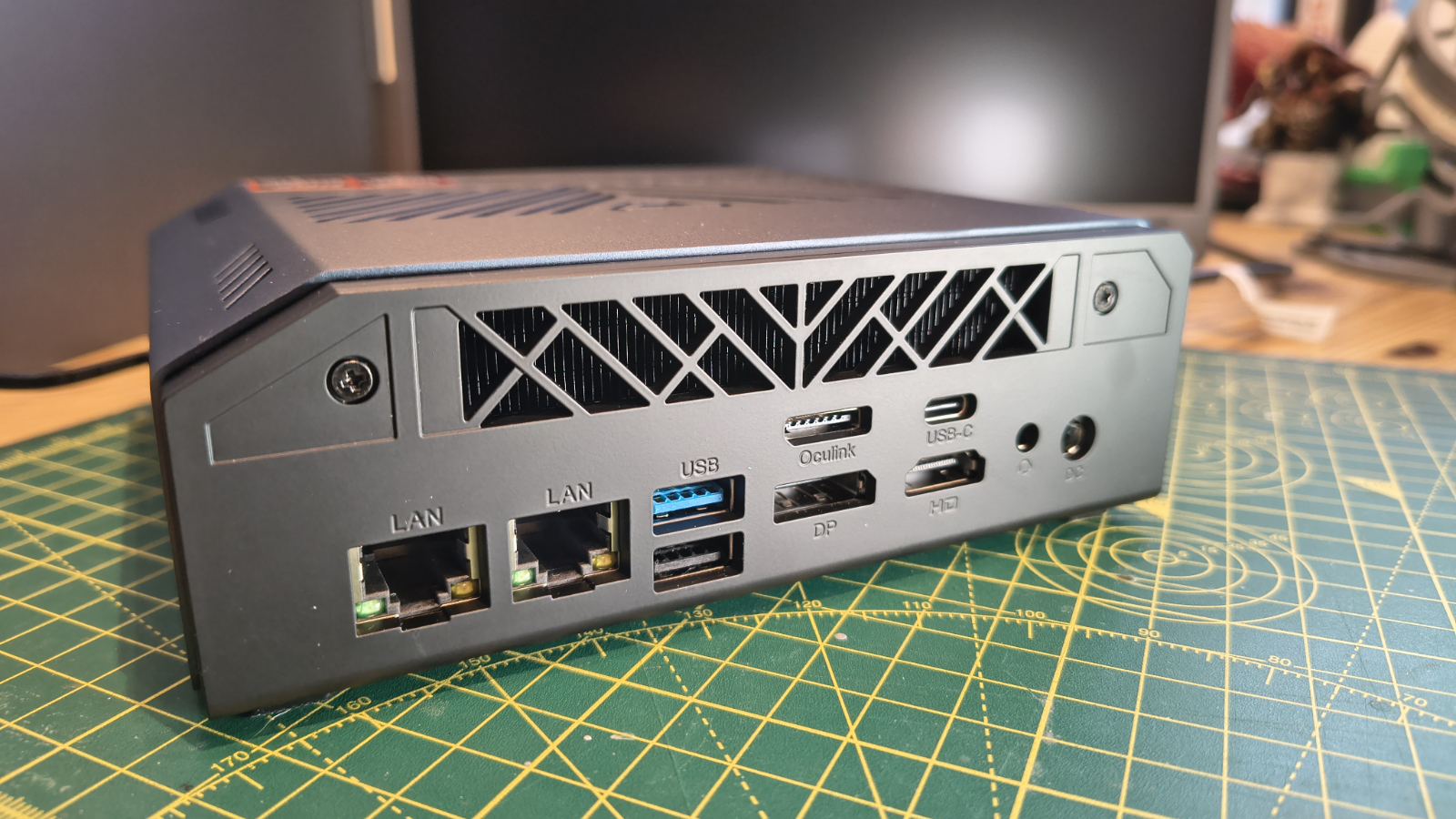
At less than $900, the M6 uses the AMD Ryzen AI 9 HX 370 processor, a veritable mobile monster with 12 cores and 24 threads, with a baseline clock of 2GHz that can boost to 5.1GHz on limited cores.
While it doesn’t quite hit the top of the performance curve that the M5 managed, the fact that you can buy two of these for less than one of those does widen its potential appeal.
Built into a small but larger than a typical NUC enclosure, the M6 can address 256GB of RAM when 128GB DDR6 modules become available, but it comes with 32GB from the factory.
It also has 1TB of NVMe storage pre-installed into one of three 2280 M.2 slots, and additional storage can be attached using USB4. But for those wanting to beef up what is already a powerful rig further, this system sports an OCuLink port, enabling it to connect to an externally mounted video card with a suitable OCuLink bay.
This ultra-high-performance platform and extensive upgrade potential make the M6 suitable for almost any use, ranging from software development to video editing and AI LLM creation.
It might not be able to beat the Bosgame M5 in a straight fight, but it beats it on value for money, and it’s a system that's up there with the best mini PCs I've tested.
Bosgame BeyondMax M6: Price and availability
- How much does it cost? From $888
- When is it out? Available now
- Where can you get it? Direct from Bosgame
At the time of writing, the M6 hasn't been officially launched, but it can still be found on the Bosgame website here.
The only price given is $888, and for most countries, that cost includes free shipping.
Based on the exchange rate in January 2026, that dollar price converts to approximately £670 or €764.
Considering the technology in the M6, that sounds like an incredible deal. However, with RAM and storage prices going up, how long Bosgame will be able to sell these at this price is debatable.
However, Bossgame isn’t the only system builder making AMD Ryzen AI 9 HX 370-powered PCs, with Minisforum, Beelink, GMKtec, and Acemagc among those with available products.
Minisforum has the AI X1 Pro-370, which sells for $1,151.90 for the same 32GB+1TB spec. The Beelink offering is the SER9 Pro, listed for $929. From GMKtec, its EVO-A1 AI is $889, for a remarkably similar system. And finally, Acemagic has the F5A, which can be purchased for $999, populated like the M6, or barebones for only $729.
Given these alternatives, the M6 seems competitively priced, being only undermined by the Acemagic F5A when sold without any memory or storage.
Its closest competitor is the GMKtec EVO-A1, but that system only has two M.2 slots inside, not the three that the M6 has.
Overall, the pricing of the M6 looks too good to be true, or more accurately, too good to last.
- Value: 4 / 5
Bosgame BeyondMax M6: Specs
Swipe to scroll horizontally
CPU: | AMD Ryzen AI 9 HX 370 ( 12C/24T, up to 5.1GHz) |
GPU: | AMD Radeon 890M, 16 Cores, up to 2.9 GHz |
NPU: | AMD Ryzen AI, 50 TOPS, Overall 80 TOPS |
RAM: | 32GB DDR5-3200 (16GB x 2) expandable to 64GB |
Storage: | 1TB M.2 2280 PCIe Gen 4 |
Expansion: | 2x M.2 2280 PCIe Gen 4 |
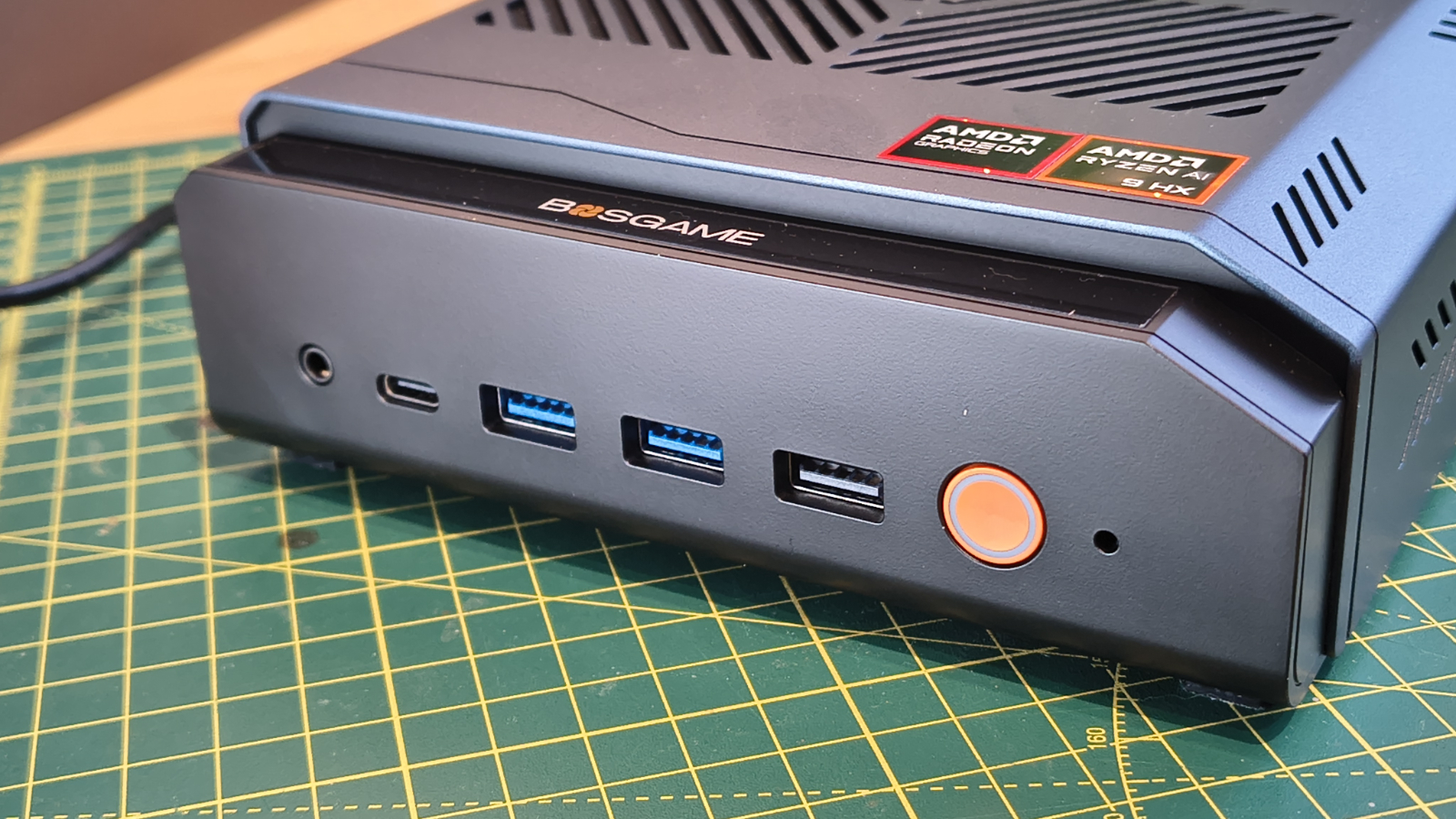
Ports: | 1x USB4, 2x USB 3.2 Gen 2 Type-C, 4x USB 3.2 Gen 2 Type-A, 1x USB 2.0, 1x HDMI 2.1, 1x DisplayPort 1.4, 1x 3.5mm Audio, 1x Oculink |
Networking: | 2x 2.5GbE Realtek RTL8125, WiFi 6E, Bluetooth 5.2 |
OS: | Windows 11 Pro (pre-installed) |
Base Power: | 45-65W |
PSU: | 19V 6.3A 119.7W |
Dimensions: | 154 x 152 x 50 mm |
Bosgame BeyondMax M6: Design
- Metal enclosure
- Easy internal access
- Triple M.2 and Oculink
I still haven't formed a definitive opinion on the M6 enclosure. It’s well made, and the metal skin makes it look durable, but the part of my brain that was once used for designing dislikes the one corner that is bevelled for no obvious good reason.
One graphic on the Bosgame website shows the system balanced on the narrow side, but there are no feet, and this would block vents, but then placing it any way but flat would also hinder airflow.
Another aspect that I have mixed feelings about is the power supply, because a machine this powerful typically uses a supply designed for a large laptop or mobile workstation. Instead, Bosgame used a wall socket PSU with a relatively short cable. As this PSU isn’t USB-C, if anything happens to that supply, then this system is probably done.
I should also mention that this system comes without any means to mount it to a monitor, and is exclusively desktop sitting, from what I can determine.
These are small issues in the greater scheme of things, and where the M6 started to impress me was when I went to get inside, looking for upgrade opportunities.
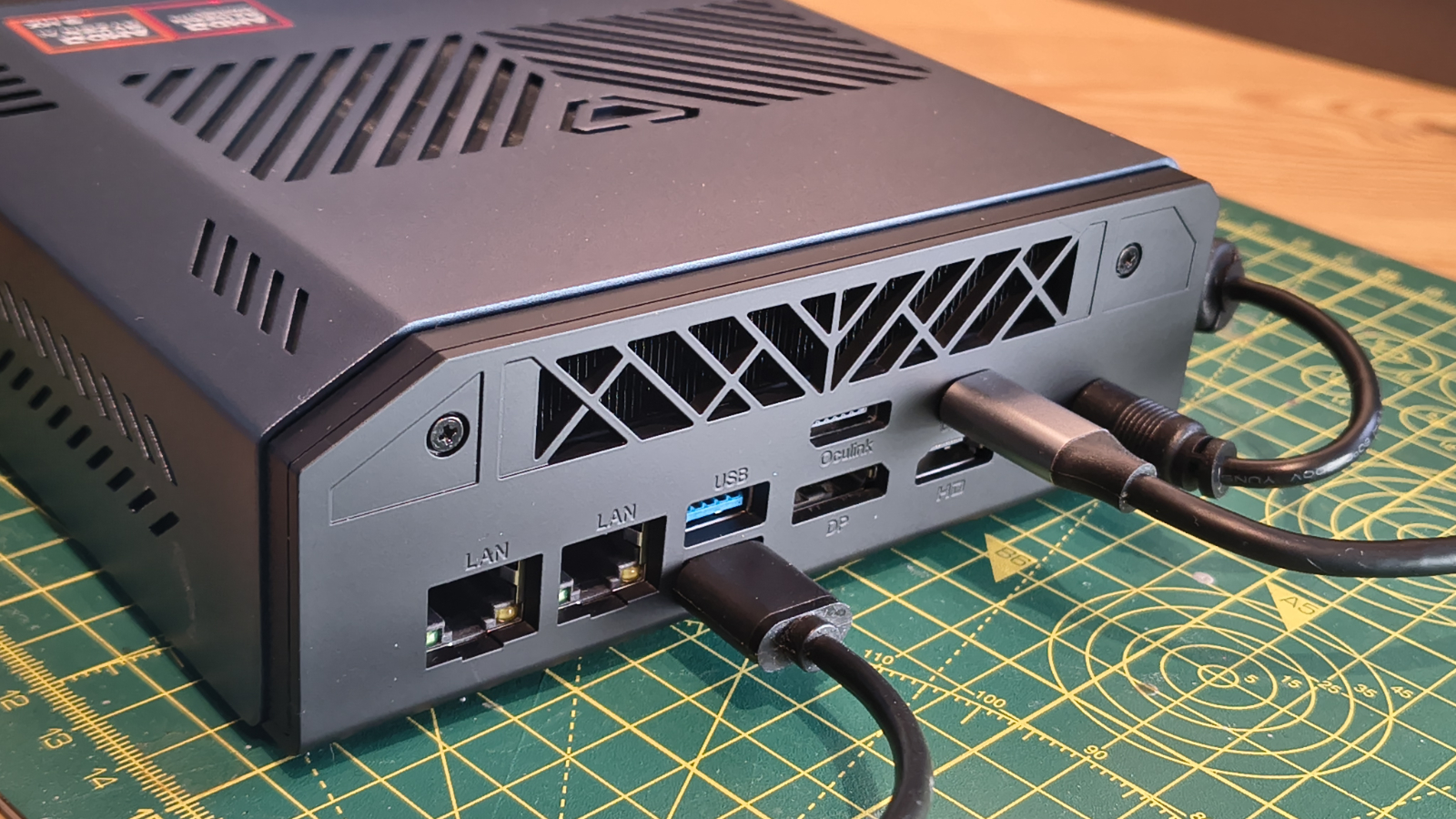
A single screw allows you inside, although you need to detach a tiny fan header cable to release the underside of the M6 and have unfettered access. I was expecting dual DDR5 SODIMM slots, and these were already occupied with a pair of 16GB modules.
In theory, the M6 processor can address up to 256GB of RAM, but at this time, 64GB modules are hard to get, let alone 128GB sticks. Thankfully, 48GB DDR5 SODIMM can be found, although they’re not cheap, if you fancy expanding an M6 to have 96GB of memory.
Unless you are doing something truly intensive, that much RAM should be sufficient, but where mini PCs generally fall down compared to desktop solutions is with storage.
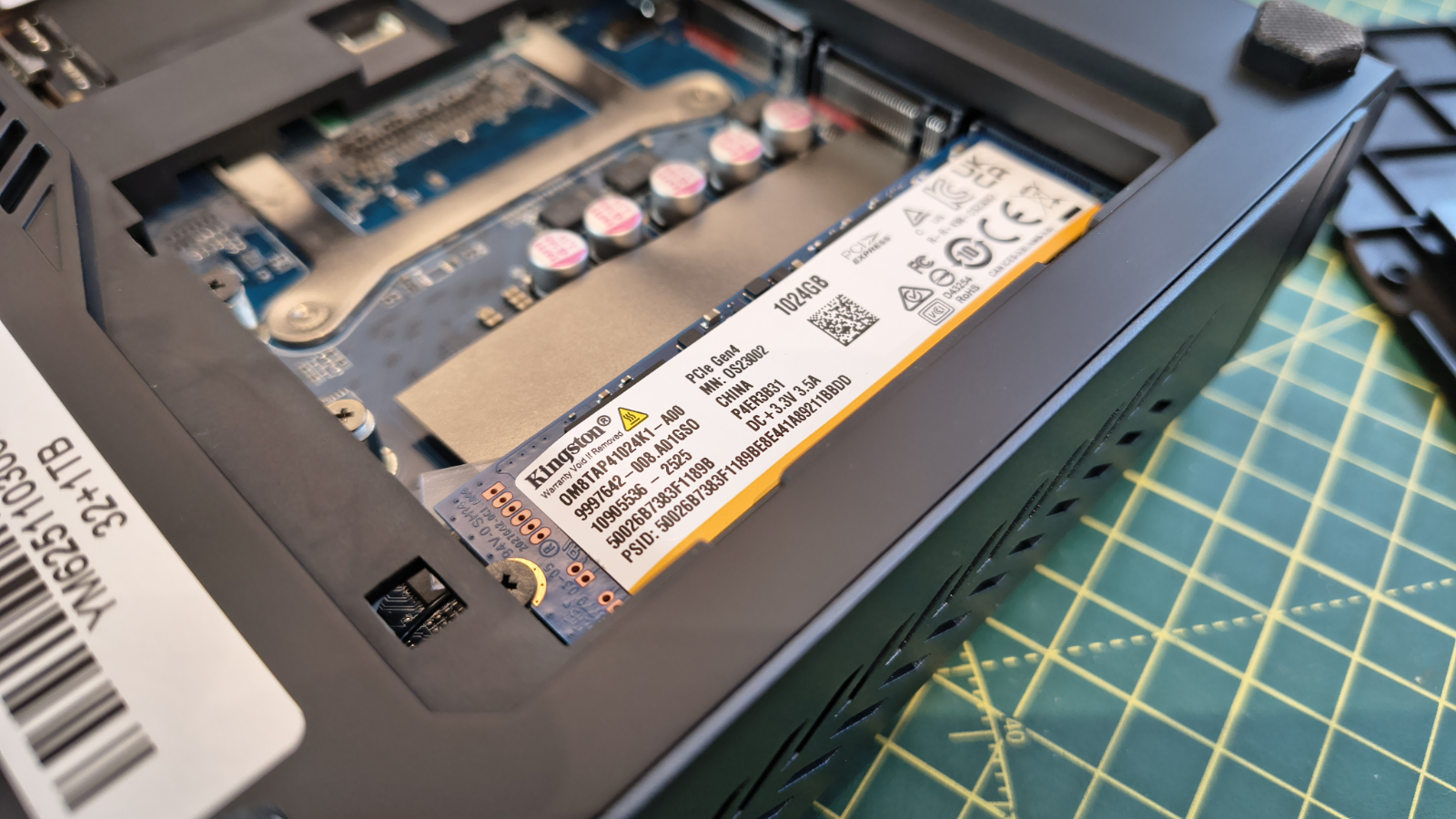
As the M6 is slightly larger than a basic NUC, there was room in here for three 2280 M.2 slots, and all of these are PCIe 4.0, and the underside has a thermal pad that enables them to be cooled. If you used 8TB modules, that would be 24TB of storage, which is enough for server duties unless you have crazy amounts of data.
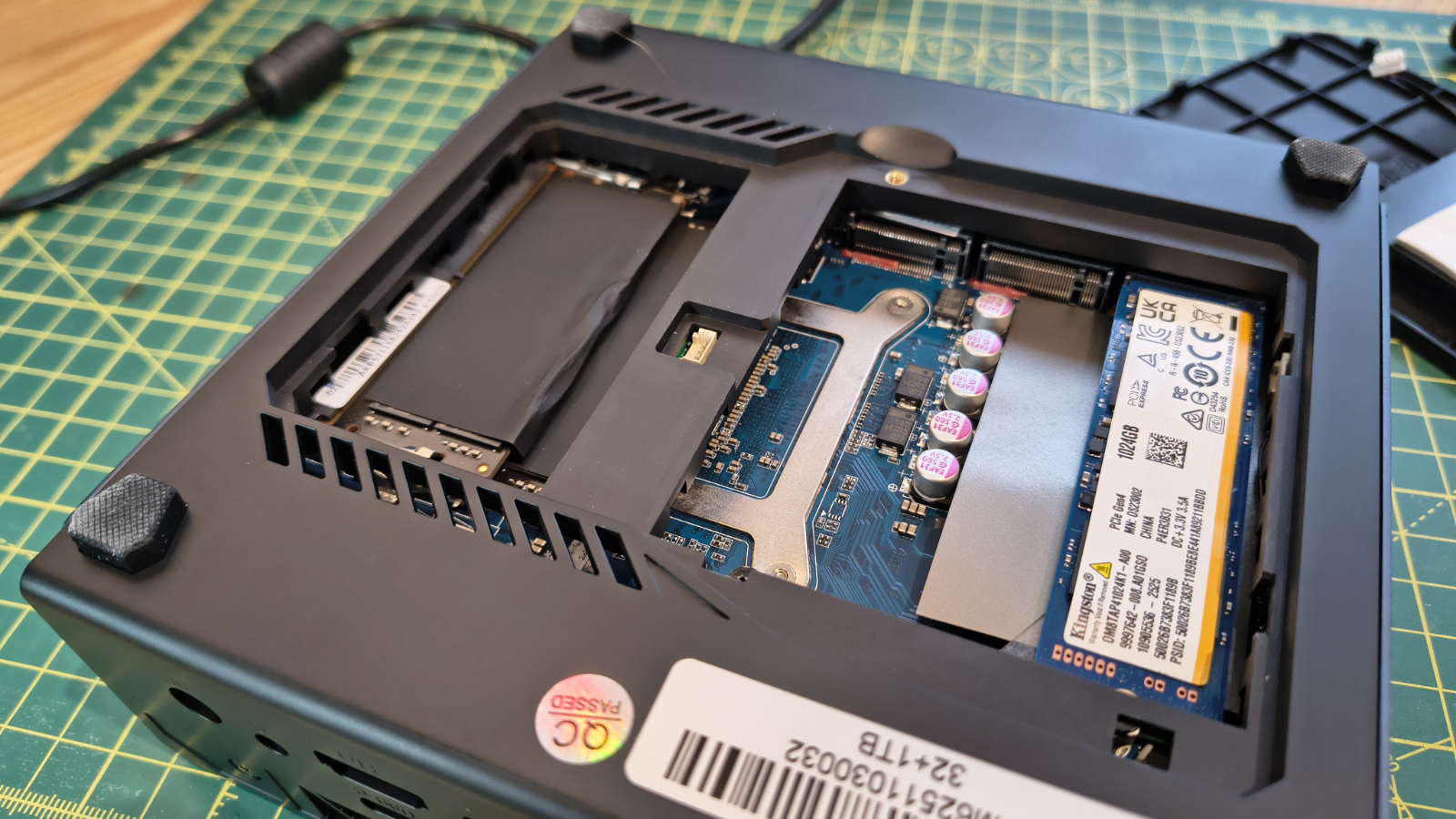
But the expansion possibilities don’t end with M.2 slots, because the external port selection is comprehensive. Lots of USB 3.2 Gen 2, a single port of USB4 and a means to connect external GPUs via Oculink.
Maybe the third M.2 slot and the Oculink negated the second USB4 port, but other than wanting more USB4, this is a great layout for external storage, adding a dock or even a discrete external GPU.
Overall, this is a genuine powerhouse of a mini system, which is only one rung beneath the AMD Ryzen AI Max+ 395 systems that can easily cost double or triple the amount.
Some users might want to see more USB4 and pass on Oculink, but for those looking for an affordable, small system for power users, there are plenty of boxes ticked by the M6.
- Design: 4 / 5
Bosgame BeyondMax M6: Hardware
- AMD Ryzen AI 9 HX 370
- Radeon 890M GPU
- 16 Gen 4 PCIe lanes
In its latest Zen 5 mobile processor releases, AMD has a number of codenames under the Ryzen AI 400 series, and the AMD Ryzen AI 9 HX 370 comes from the ones in the Strix Point bucket.
These all use Zen 5 and Zen 5c cores, support DDR5 or LPDDR5 memory, have integrated USB4 and offer sixteen lanes of PCIe 4.0.
Technically, the AMD Ryzen AI 9 HX 370 isn’t quite the top of the Strix Point series, with the HX 375 chip being above it. But it matches that top CPU with the same 12 cores that can hyperthread 24 threads, uses 4 Zen 5 and 8 Zen 5c cores, has a total of 24MB of L3 cache, and has the Radeon 890M GPU with 16 CUs.
Above these chips are Strix Halo designs like the Ryzen AI MAX+ PRO 395, which has 16 cores, a Radeon 8060S GPU with 40 CUs, and 64MB of L3 cache.
The best way to view all these options is that the Strix Halo is the cutting edge of AMD's mobile computing technology, but the Strix Point chips aren’t far behind. And for most users, they might not notice the difference.
Where I noticed the downgrade from the M5 with Strix Halo to the M6 with Strix Point was mostly to do with the graphics performance, since the Radeon 890M GPU has significantly fewer GPU cores than the Radeon 890M, and also the M5 used LPDDR5X RAM at 8000MHz, providing the CPU and the GPU with substantially more memory bandwidth.
I’ll explain this impact in the performance section, but the short version is that the M5 performed on graphics tests like it had a discrete GPU, where the M6 offers good integrated video performance.
Both platforms have sixteen PCIe 4.0 lanes, which seems plenty until you realise that each of the M.2 slots could take four of those lanes. That would leave only four lanes for the LAN ports, WiFi and Oculink port. Thankfully, these AMD chips have the USB integrated, but the Oculink alone uses four PCIe lanes.
It might be that this system uses a PCIe switch, but it might be able to avoid that with dynamic adjustments. However, the AMD Ryzen AI Max+ 395 gets the same number of lanes, so while you might get more cores and a better GPU moving up to that technology, there isn’t any more bandwidth to be had.
- Features: 4 / 5
Bosgame BeyondMax M6: Performance
Swipe to scroll horizontally
CPU | Row 0 - Cell 1 | AMD Ryzen AI 9 HX 370 | AMD Ryzen AI 395 Max |
Cores/Threads | Row 1 - Cell 1 | 12C 24T | 16C 32T |
RAM | Row 2 - Cell 1 | 32GB DDR5 (2x16GB) | 128GB DDR5 |
Storage | Row 3 - Cell 1 | 1TB Kingston OM8TAP41024K1 | 2TB Kingston OM8PGP42048N |
Graphics | Row 4 - Cell 1 | Radeon 890M | Radeon 8060S |
3DMark | WildLife | 23107 | 70014 |
| Row 6 - Cell 0 | FireStrike | 8853 | 26917 |
| Row 7 - Cell 0 | TimeSpy | 3825 | 11317 |
| Row 8 - Cell 0 | Steel Nom Lt. | 3432 | 11201 |
CineBench24 | Single | 120 | 115 |
| Row 10 - Cell 0 | Multi | 1179 | 1879 |
| Row 11 - Cell 0 | Ratio | 9.8 | 16.32 |
GeekBench 6 | Single | 2964 | 2981 |
| Row 13 - Cell 0 | Multi | 15750 | 17882 |
| Row 14 - Cell 0 | OpenCL | 41478 | 101915 |
| Row 15 - Cell 0 | Vulkan | 49643 | 90384 |
CrystalDisk | Read MB/s | 6147 | 4083 |
| Row 17 - Cell 0 | Write MB/s | 5350 | 3639 |
PCMark 10 | Office | 7421 | 9056 |
WEI | Row 19 - Cell 1 | 8.2 | 9.6 |
This is an unfair comparison, since the processor and the memory used on the Bosgame M5 are on an entirely different level from those used in the M6.
However, what I was most interested in presenting was what the investment in the M5 gains you, and conversely, where the M6 holds its own.
One obvious place is single-core operations, where there is relatively little difference in the CineBench24 and the GeekBench results. If you have an app that runs a single process, then the difference wouldn’t be noticeable.
However, once software starts multi-threading, then having 25% more cores and threads enables the M5 to create a healthy gap.
But where the M5 really sticks it to the M6 is when the challenge is graphics, since the Radeon 890M only has sixteen compute units, whereas the 8060S has both forty units and the additional bandwidth of LPDDR5 at 8000MHz. In some tests, this converts to being 250% faster, and there are discrete video cards that couldn’t compete with the Radeon 8060S.
One interesting win for the M6 is the drive performance, which is purely down to the choice of module in each case. Both Kingston M.2 drives are Gen 4, but the 2TB one in the M5 isn’t a great performer.
Looking at these results its easy to conclude that the M6 is slow, at least when put up against the M5, but that’s a narrow viewpoint.
To put all these numbers into a better perspective, the Wildlife score of 23107 is better than any other AMD-based mini PC that I’ve reviewed, ever. And, the only Intel machine that has beaten that result is the GMKtec EVO-T1, a top-of-the-line Intel Core Ultra 9 285H system, which managed 24893.
Therefore, the M6 might be overshadowed by the M5, but it isn’t by much else.
The only slight annoyance with this mini PC is that when you push it hard, as these tests do, the fan noise can become a little intrusive. Perhaps a bigger, slower-rotating fan might have been a better plan for the M6, if they ever reengineer it.
But with that one caveat, the M6 is still a sterling performer, and more than sufficiently powerful for the majority of business tasks.
- Performance: 4.5 / 5
Bosgame BeyondMax M6: Final verdict
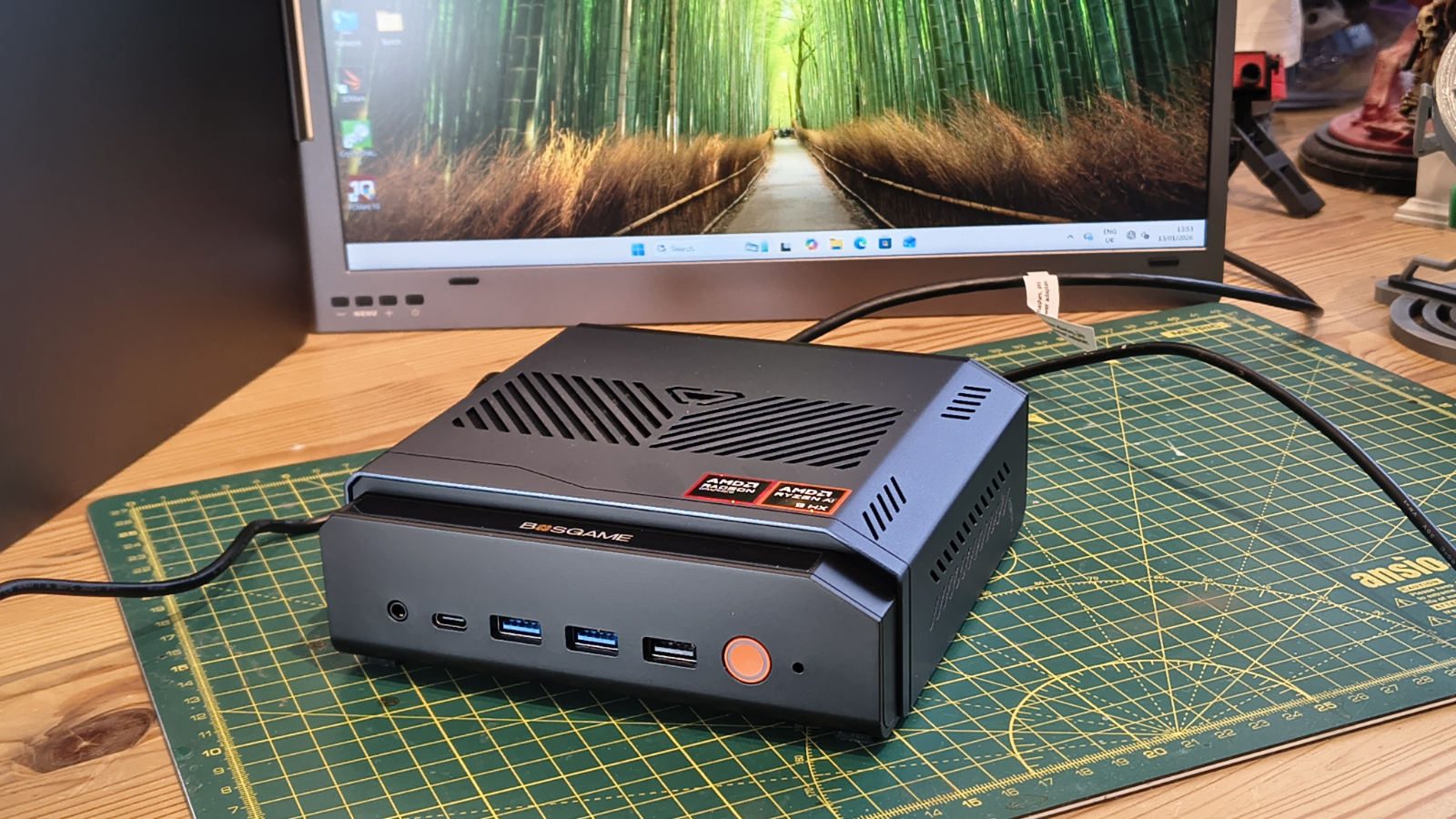
Despite the curious aesthetic of its case and an occasionally noisy fan, the Bosgame M6 provides a near-perfect argument for why you might want this on your desk: Bags of power, lots of memory, great expansion options and even the capability to have an external GPU, it doesn’t get much better than this.
The only rung above this on the AMD ladder is M5 specification systems with the AMD Ryzen AI 395 Max, and those are at least double the price of this system.
While making the justification for one of those might be more of a challenge, this system is only a $200 more than a middle-order system, but it delivers more than twice the power.
The only blot on this landscape is that it indicates, like the AMD Ryzen AI 395 Max above it, that in a future version of the AMD Ryzen AI 9 HX 370 either more PCIe lanes are needed, or they get an upgrade to PCIe 5.0. Because it's only the availability of bandwidth that is holding back these systems from having Thunderbolt 5, or more USB 4, and more M.2 slots.
But even with the PCIe lanes it has, the M6 is probably better overall than any Intel-based mini PC I’ve tested, and better than some machines that are sold as workstations.
Should you buy the Bosgame BeyondMax M6?
Swipe to scroll horizontally
Value | Affordable for the power in this system | 4/5 |
Design | Odd case, but easy access and lots of ports | 4.5/5 |
Features | AMD AI CPU, 890M GPU and Oculink port for an external GPU | 4/5 |
Performance | Only bettered by the M5 and other expensive choices | 4.5/5 |
Overalls | Focused power with tons of upgrade options | 4.5/5 |
Buy it if...
You need extra power
By mini PC standards, the asking price of this system isn’t cheap, although more expensive options exist. But what you get for that investment is a system with a wide range of uses and enough power to satisfy even power users. If they want more power than this system can offer, then maybe they need a desktop workstation-class PC.
You want a flexible mini PC
Compared to some NUC designs, this one offers ultimate flexibility. With two 2.5GbE LAN ports, it could be used as a hardware firewall, a media server, or in a dozen other contexts. The power and performance of this platform can be extended using OCuLink to attach discrete GPU technology. If you want more flexibility, then you need a desktop system.
Don't buy it if...
You want ultimate performance
While it's a very powerful mini PC, the Ryzen 9 AI HX 370 chip isn't the most powerful out there. For that, you'll want a system running the Ryzen AI Max+ 395, with 16 cores and 32 threads. But frankly, most users will be happy with what the M6 delivers.
Also consider
GMKtec EVO-T1
A recent Intel-based NUC that has a similar spec to the M6, with triple M.2 slots, Oculink and USB4. However, the Core Ultra 9 285H processor doesn’t deliver the multi-core performance that the AMD Ryzen AI 9 HX 370 can, even though it has better single-core performance.
The other issue here is price, since GMKtec don’t offer this system with 32GB+1TB, although you can get it barebones for less than the M6. A populated model with 64GB+1TB is $950, but you can get some discounts for bulk purchases.
AMD has the upper hand on mobile performance, but if you insist on Intel, then this is the logical choice.
Check out my GMKtec EVO-T1 review








 English (US) ·