
 2 hours ago
8
2 hours ago
8

Published Jun 23, 2026, 9:00 AM EDT
Director Frank Coraci and production designer Perry Andelin Blake recall designing the most iconic prop from any Sandler film
 Image: Sony/Everett Collection
When Click was released 20 years ago, Adam Sandler fans were shocked by just how dark it got. While 2002’s Punch Drunk Love had previously proven the depths of Sandler’s acting chops, that was a Paul Thomas Anderson movie that had cast Sandler. Click, on the other hand, was a bona fide Sandler comedy from Happy Madison productions and with a lot of the same people that had previously brought about Billy Madison, Happy Gilmore, and The Waterboy. Click appeared to be a return to form for Sandler.
To an extent, it was. The premise of a guy who obtains a magical remote control which allows him to control his universe by pausing, muting, and fast-forwarding the world around him as he pleases offered plenty of hilarious, often low-brow moments (like Sandler speeding through foreplay and accidentally skipping sex with his wife entirely). Yet it also contained some surprisingly poignant messages about the fragility of life and being grateful for what you have.
“We were really proud of Click because we were pushing the envelope with tone,” director Frank Coraci tells Polygon. “I always tell people, it's amazing that, in a movie where Sandler literally farts and shits in Hasselhoff's face, 40 minutes later you're in the same office and you're bawling.”
The blend of styles made Click an instant classic among a certain subset of Sandler fans, and a good chunk of the credit goes to an iconic prop, without which the film’s entire premise wouldn't have worked. That’s why, for the film’s 20th anniversary, we spoke with Coraci and the film’s production designer Perry Andelin Blake to break down the making of the essential object.
Click began as a screenplay for Sandler, penned by Bruce Almighty screenwriters Steve Koren and Mark O'Keefe, but the look of the remote wasn’t determined until Blake and Coraci got involved.
“The visual wasn't in the script at all,” says Coraci. “Those guys wrote a really funny script, but nothing was really in there as far as what the remote looked like. Perry had the vision of making the remote look really ergonomic.”
“I wanted it to feel like it was going to be part of him,” adds Blake. “I got a piece of clay, took it in my hand, and I just kind of squished it until it had the shape of almost like shaking someone's hand. I looked at it and said, ‘This is how it should feel in somebody's hands, so then this is how it should look.’”
Coraci was instantly on board.
“When it came to the shape, I loved it immediately,” he says. “I loved it because it didn't look like any other remote. It looked like something that was organic. It looked like something a little bit spacey. It didn’t look like something Sanyo or Sony or anybody made.”
There was just one catch.
“Sony wanted us to put their name on it," Coraci laughs.
As for the blue, metallic-looking color of the remote, Coraci says, “I'm obsessed with the color blue.”
That color choice for the remote actually ended up affecting the overall look of the film.
“The movie goes through a transition of being really warm, with earthy colors in the beginning — there's lots of reds and greens and browns — but then once he gets the remote, his whole world starts going blue," Blake says. "That's the technology taking him to these places.”
While the remote in Click is intended as a “universal remote,” it does not have the rows and rows of buttons that real-life universal remotes have. Part of that choice was to preserve the sleek look of the remote, but it was also to point out that the device was intuitive. “The remote knew his will,” Coraci says.
Besides the buttons, the remote has a little display screen on it, something that wasn't commonplace on remotes at the time.
“It was important to me that it had a screen,” Coraci says. “Normally, when you lower the volume, there's a volume thing on the TV. For this, with the screen, you can always tell exactly what the remote was doing.”
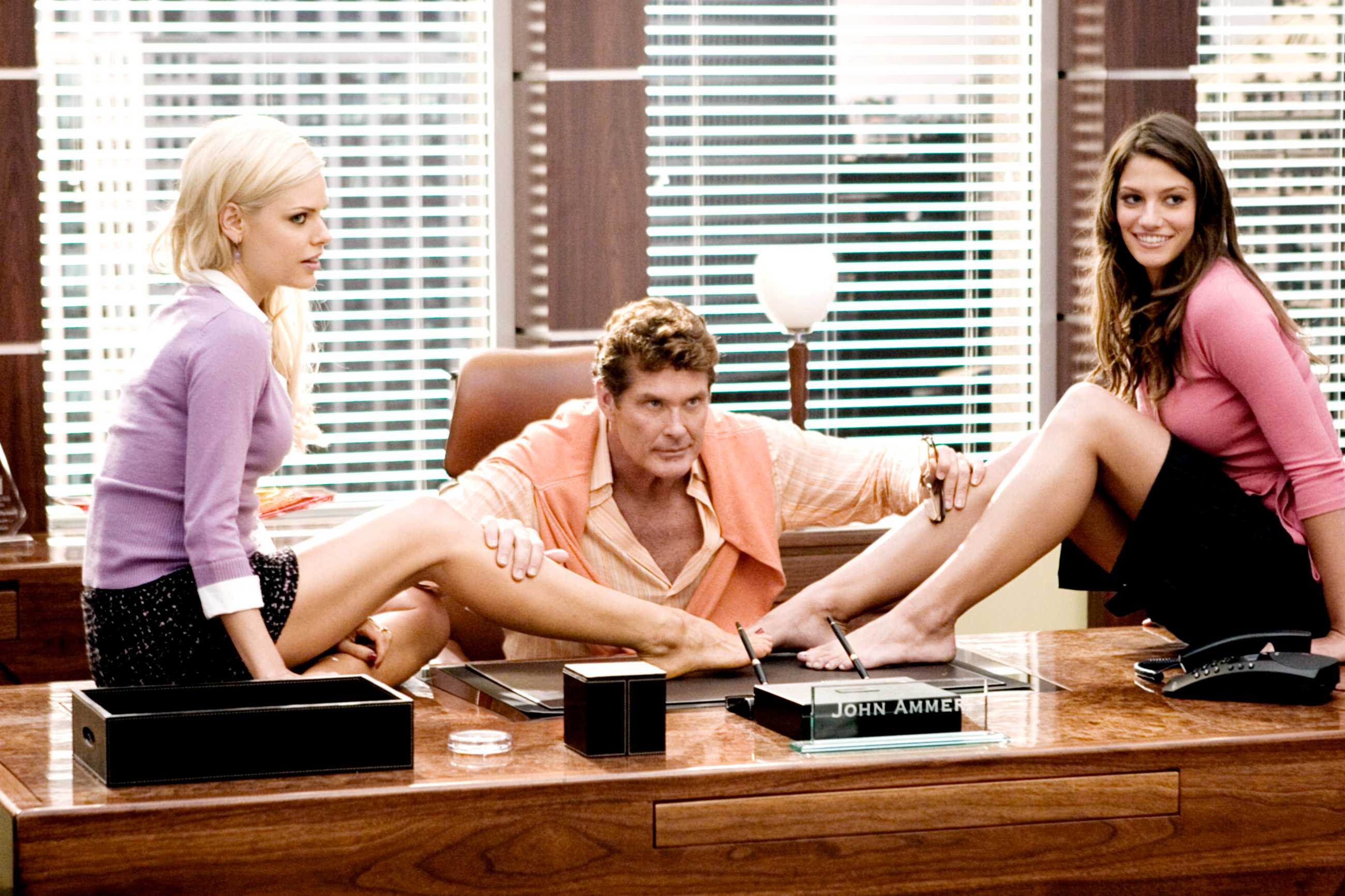 "It's amazing that, in a movie where Sandler literally farts and shits in Hasselhoff's face, 40 minutes later you're in the same office and you're bawling.”Image: Sony/Everett Collection
Beyond the look of the prop itself, the way it was shot was also important, with the remote often being very large in the frame.
“The first time he goes to get it in the cabinet, I did a very old-fashioned film trick called a split diopter, where you can have two things in focus,” Coraci says. In the foreground, the remote is in focus along with Christopher Walken (as Morty, the mysterious inventor), and in the background, Sandler is also in focus. “I wanted to make the remote bigger than life.”
When Sandler pushes the buttons on the remote, Coraci wanted it to “feel like a dopamine hit.” So he and sound designer Elmo Weber layered a series of about eight different sounds to achieve the effect.
For visual transitions when Sandler pushed a button, Coraci employed a variety of approaches. Sometimes he’d swing around Sandler, and for other shots the film almost looked like it was being fast-forwarded.
“I would do these weird things where I would dolly as he hit the remote and I would dolly on the other shot," Coraci says. "So it looked like he warped through like a dimension warp or something.”
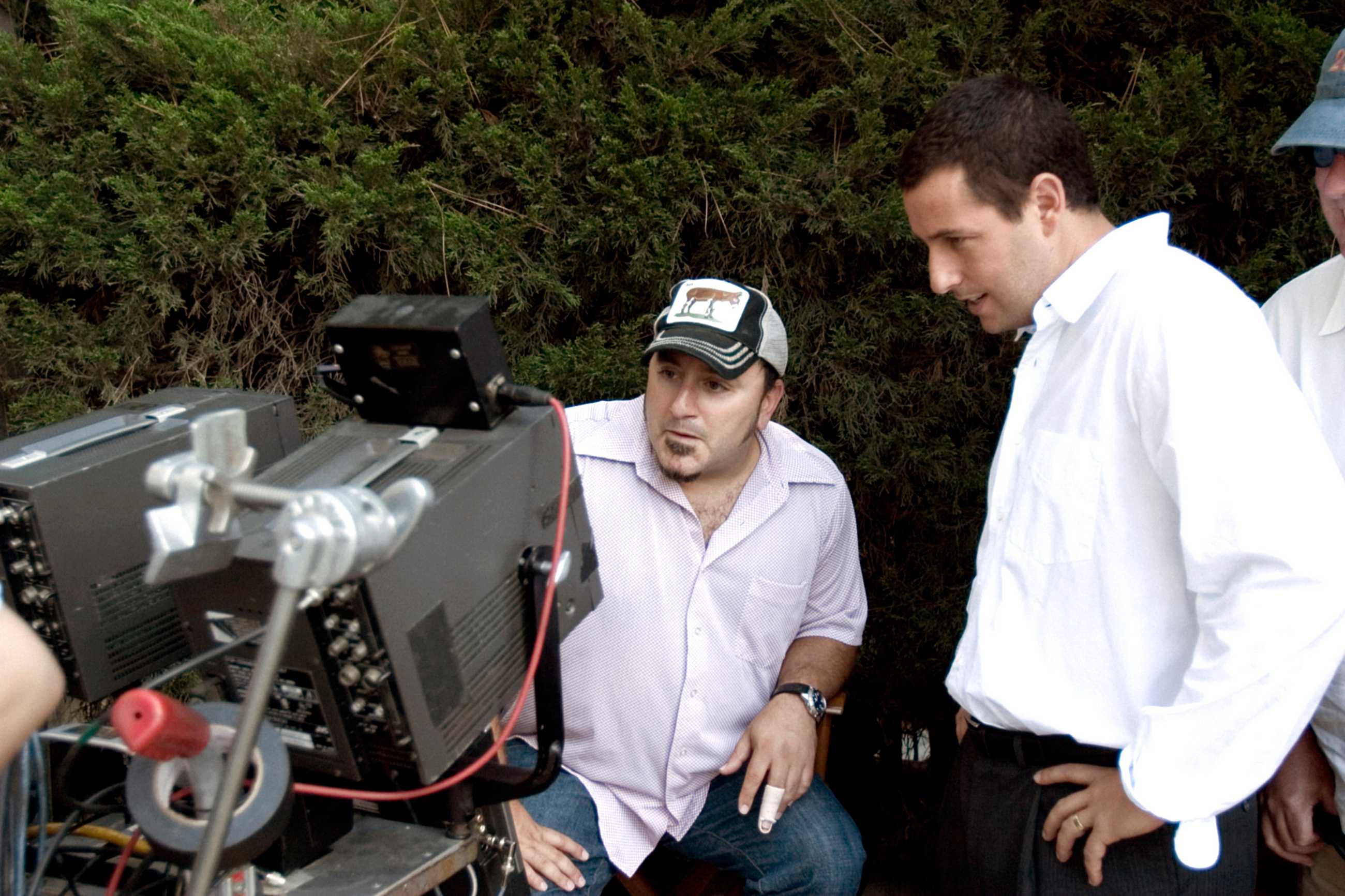 Coraci with Sandler on the set of ClickImage: Sony/Everett Collection
The cumulative effect of all of this is that the remote in Click wasn’t just a remote.
“The remote got to be like a character,” says Blake. “It was like it had a mind of its own and it was doing stuff that he didn't want to do.”
At the time, Click was meant to be a genie-like, “be careful what you wish for story,” but having rewatched it recently, Blake sensed something far more timely about the device at the center of the film.
“Looking back, it's almost like it was AI," he says. "It's kind of like it was just sitting there, listening and waiting, then it'll do something you don't want or expect, kind of like your Alexa. The remote really is AI. It's doing exactly what AI is doing by just taking over.”


 English (US) ·