
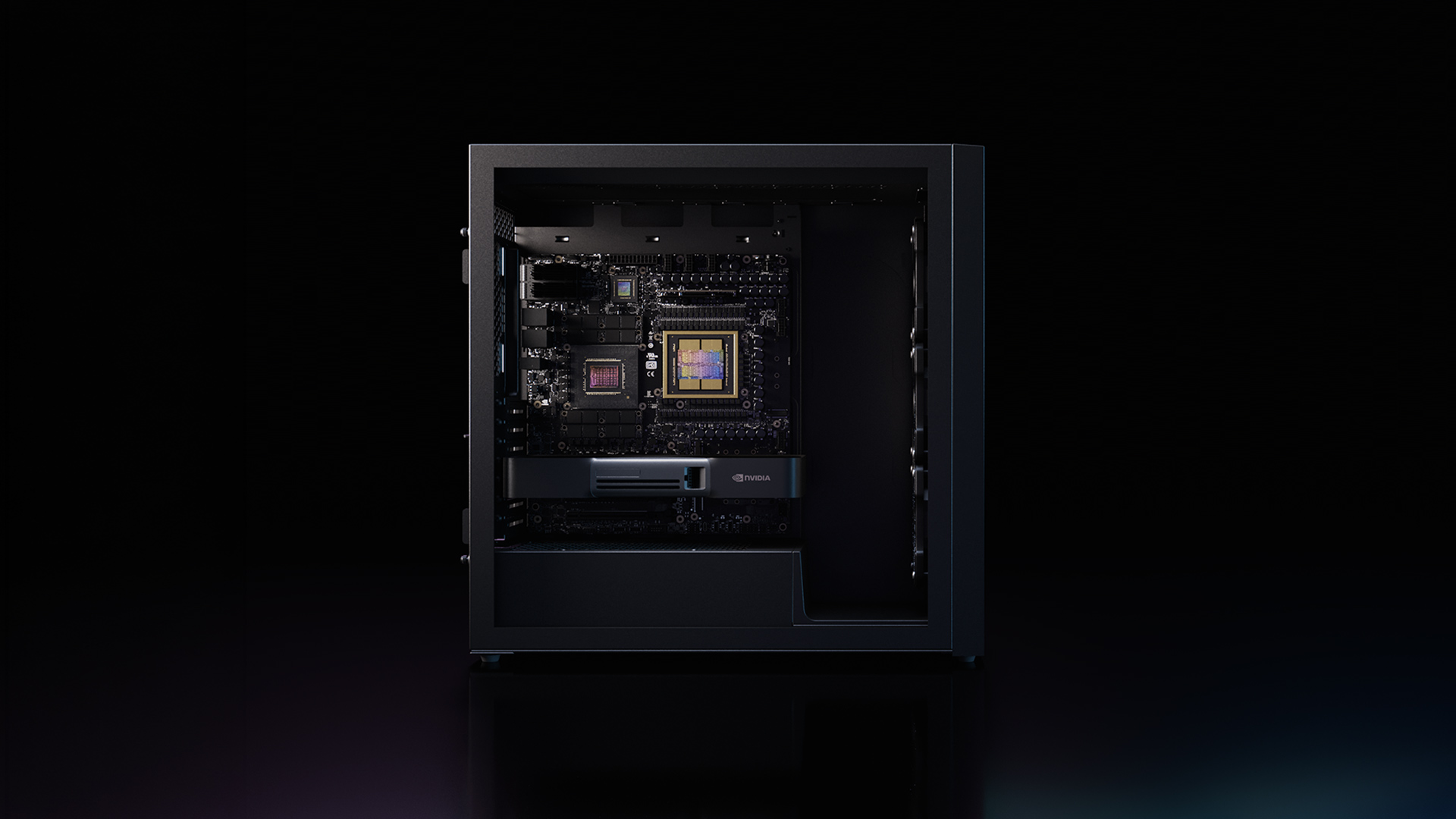
- HP recently debuted multiple devices that cater to AI developers at Computex, which are powered by Nvidia's GPUs, including the DGX Spark and the GB300 Grace Blackwell Ultra Desktop Superchip
- HP's high-end deskside solution, the ZGX Fury GB300, leverages Nvidia's top-end GPU, offering up to trillion-parameter inference with up to 784GB of memory
- The ZGX Fury GB300 is expected to be available to power users and AI enthusiasts later in 2026
Computex 2026 ends today, and the obvious elephant in the room was AI, or how far it has come since ChatGPT was released in November 2022.
The expo featured the "AI Together" theme and included keynotes from multiple industry leaders, even as Nvidia's GTC 2026 announcements ran parallel to the event.
Nvidia's announcements most notably included its DGX Station, a powerful supercomputer one can deploy deskside that offers compute comparable to small datacenters, thanks to its large GB300 superchip and swathes of memory it comes configured with.
A powerful, but costly option for AI
Nvidia announced the DGX Station for Windows on the 31st of May 2026 at GTC Taipei to an audience of over 30,000 attendees from over 190 countries.
The DGX Station is marketed by Nvidia as a desk-side AI supercomputer that can handle up to 1 trillion parameters locally, a feat previously only capable on dedicated datacenter-class hardware, including Nvidia's DGX GB300 and its rack-scale GB300 NVL72 offerings.
“As enterprises scale AI agents across their organizations, they need AI infrastructure that can connect directly to the applications and workflows that power their business,” said Chris Marriott, vice president of enterprise platforms at NVIDIA.
Unlike some of its more affordable (in AI terms) solutions, such as the DGX Spark, the DGX station, and solutions based on it like HP's ZGX Fury GB300 and Dell's Pro Max GB300, are expected to cost hundreds of thousands of dollars, which is far from a surprise for most of their intended targets: enterprise consumers.
These clients may require the trillion-parameter inference that these configurations can offer, or the ability to fine-tune multi-billion-parameter models to suit their needs, often by localizing data to reduce reliance on the cloud.
Solutions such as HP's enterprise-focused DGX station, ZGX Fury GB300, come with up to 784GB of coherent memory and up to 20 petaflops FP4 compute for these tasks, in addition to customized enterprise networking solutions.
SVP and Division President, Advanced Compute and Solutions, HP Inc., Jim Nottingham, chimed in on the matter, saying: “Over 70% of enterprise PCs run Windows, and our customers have asked for AI supercomputing power that can seamlessly integrate into their existing environments," while confirming support for Windows down the line.
HP remains mum on the price tag, but one can infer that its pricing will closely follow the DGX station itself, which has seen some resellers offering mid-range configurations for $94,000 or more, with higher-end SKUs capping out at sub-$200,000.
It has also not disclosed a final release date for the product, but it is expected to launch alongside Nvidia DGX Station sometime during Q4 2026, in conjunction with other partners, including Dell, MSI, ASUS, and Supermicro.

Follow TechRadar on Google News and add us as a preferred source to get our expert news, reviews, and opinion in your feeds.





 English (US) ·