
Amazon Studios
Spoilers ahead for the book and movie versions of "Project Hail Mary."
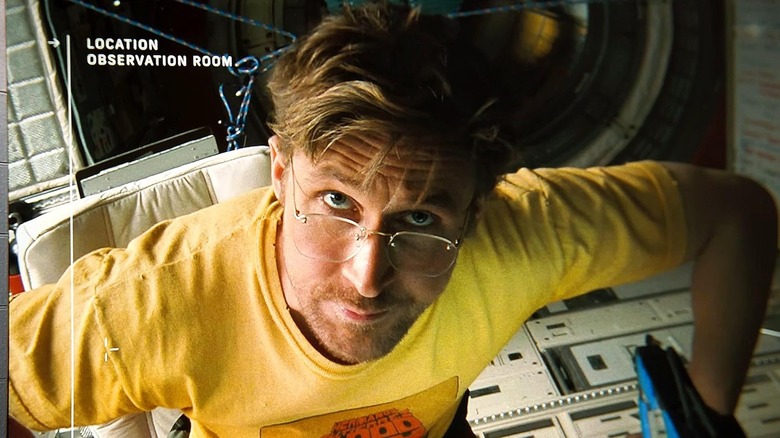
One of the things I really enjoy about "Project Hail Mary" is the way the story is built on the premise of a time crunch, even though time is one of the things that Ryland Grace (Ryan Gosling) and Rocky (James Ortiz) have in abundant supply. The total demise of their home planets, Earth and Erid, is still years away, which gives them weeks and even months to work on solutions.
It also gives them plenty of time to learn about each other when they initially meet, and in the books, a significant portion of that time is spent figuring out how to communicate. Directors Phil Lord and Chris Miller's on-screen adaptation follows the book pretty closely: Grace uses a computer to record Rocky's sounds and then translate them using an ever-growing bank of vocabulary.
While this is pretty straightforward in the books, where exposition is easy, the movie version eases into it more slowly. Initially, we get the fun first-contact moments of waving, jazz hands, striking pantomime poses, and using tape measures and clocks (Rocky's people use base six instead of base 10, so the math is tricky there — I get why they left that part out, even though Lord and Miller are aware that audiences are smarter than you think.) After those initial moments, though, there are a couple of tweaks to the story, as is always the case when you go from book to screen.
The subtle communication shift in the movie

Amazon Studios
The language profression in the book takes a while as the clock bros build a vocabulary of thousands of words (not hundreds, like we see in the movie). Grace narrates:
The next several days are repetitive, but far from boring. We greatly increase our shared vocabulary and a decent amount of grammar. Tenses, plurals, conditionals ... language is tricky. But we're getting it piece by piece.
Here's where things get interesting in the adaptation. Grace and Rocky spend a while deciding who the audio translation will sound like, including considering the voice of one of the best actors ever, Meryl Streep. Eventually, they settle on James Ortiz (the puppeteer who is also behind Rocky's physical performance in the film). We then continue to hear Ortiz's voice throughout the film. It's technically attached to the computer for a while, but eventually the computer becomes irrelevant and often isn't even in the scene.
In the book, however, Grace quickly starts to understand Rocky's musical voice without the need for interpretation. In the sequence when they're learning to talk, the book version of Grace says:
Sow though the process is, I'm memorizing more of his language. I don't need the computer as often. Though I still can't go without it completely — that'll take a long time.
So, in effect, we end up getting a Han Solo and Chewbacca situation. Remember, Chewy's lines aren't random. They're often written out and deliberate. The same goes here, where Grace directly understands Rocky's dulcet tones. In the movie, though? The audience doesn't have the chance to learn Eridian on the spot, so they keep Ortiz talking. That is, until the last scene.
Project Hail Mary's interstellar communication gets a fun twist at the end

Amazon Studios
At the end of the movie, Grace and Rocky are together on Erid in the sealed, climate-controlled habitat the Eridians have built for their saving Grace to live in. In that scene, the two talk, but something's different. Up until then, as a viewer, you pretty much take it for granted that Rocky's voice is James Ortiz. But then we get a twist that reminds us that it really was the computer translating all along, whether we saw it or not.
In that final scene, Rocky speaks only in his musical voice. No James Ortiz translation. Instead, we get subtitles at the bottom of the screen. Translation? Grace has clearly gone from AI-spoken support to a Han Solo-esque skill of straight-up understanding Rocky. It's a fun little reminder that, while a computer is supporting their communication throughout the film, eventually Grace's skill and familiarity give him the ability to learn what Eridians are saying directly through their musical notes.
All things considered, the movie follows the book pretty closely. Lord and Miller make minor tweaks where necessary to make sure they don't leave the audience behind, but they spend plenty of time showcasing the communication process that features so heavily in the book.
"Project Hail Mary" is in theaters now.






 English (US) ·