
 2 weeks ago
15
2 weeks ago
15
The Game & Watch set Nintendo up for massive success, with the original idea coming from an unexpected place.
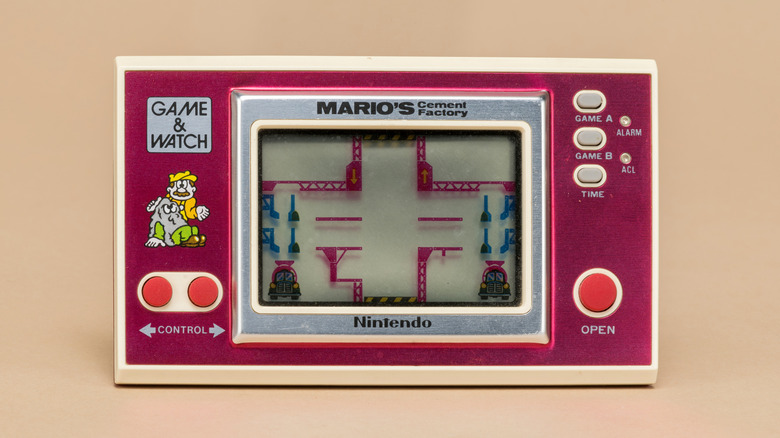
Photology1971/Shutterstock
Nintendo is now a company synonymous with video games, but that wasn't always the case. Much of Nintendo's current-day legacy comes down to one man, Gunpei Yokoi, who spearheaded the creation of the Game & Watch. When Yokoi joined the company in 1965, it was floundering. The stock had recently fallen from 900 yen to just 60, but that would be almost single-handedly turned around by the new hire's innovation.
When it was founded in 1889, Nintendo was a manufacturer of hanafuda playing cards based out of a small operation in Kyoto. Over the years, the company tried several ventures to stay relevant as the cards fell out of favor, from a taxi service to instant noodles. But it truly began to find its footing in the modern-day market with toy production. In 1966, Yokoi created the Ultra Hand, a reach extender toy, which would go on to sell 1.4 million units worldwide. After several more toy ventures — the success of which varied — he would set his sights on the digital market, with inspiration coming from an unexpected place.
The history of the Game & Watch
By the late '70s, Nintendo had almost entirely shifted its focus to the video game market, releasing the home consoles TV-Game 6 and TV-Game 15 in 1977, and opening a coin-operated games division in 1979. The same year that division launched, Yokoi was riding the train when he noticed a salaryman idly playing with a calculator to pass the time. That's when inspiration struck: games shouldn't be limited to the arcade and at home, but should be available on the go as well. Thus, the idea for the Game & Watch was born, though bringing it to fruition required a lot of ingenuity.
In a fortuitous coincidence, Yokoi wound up pitching the Game & Watch idea to Nintendo's then-president Hiroshi Yamauchi right before Yamauchi was meeting with the president of Sharp. At the time, Sharp was the world's biggest manufacturer of calculators, and the two discussed a collaboration. The tech behind the Game & Watch is similar to the calculators of the time: both utilized LCD screens and button cell batteries, and achieved their visuals using a system of segments. In a calculator, each number is made up of seven segments, and the number of digits one can calculate depends on the segment capability of its chip. 1980's Game & Watch: Ball was the first in the lineup, and utilized a chip that could display 72 segments.
Game prototyping was done physically first, with a combination of painstakingly-cut acrylic plastic and tiny wheat bulbs placed onto a circuit board matching the size of the Game & Watch. Soon, the team was putting out one Game & Watch title almost every month, releasing 59 total between its inception and 1991. As time went on, the tech improved, first going widescreen before introducing the iconic clamshell dual-screen format seen across other Nintendo handhelds. In total, the Game & Watch series sold over 43 million units worldwide.
The impact of the Game & Watch
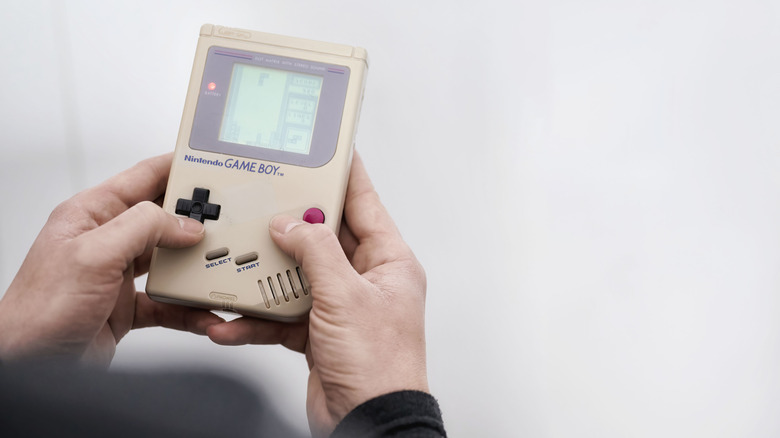
Dudbrain/Getty Images
In his time working on the Game and Watch, Yokoi coined a philosophy that still remains relevant at Nintendo: lateral thinking with withered technology. In other words, finding new applications for older, proven hardware — repurposing calculator technology for gaming being a perfect example. Yokoi applied this idea to his next project after the Game & Watch, the Game Boy, opting for simpler, more affordable hardware than leading competitors. This made for a more portable device with better battery life, and in turn it became one of the most popular handhelds of all time. Even now, devices like the Nintendo Switch 2 might not have the most powerful hardware, but excel in portability and price.
Yokoi's lasting impact on the gaming landscape can't be overstated. His pioneering of playing on the go led to the introduction of two extremely important concepts: the aforementioned portable-but-protected clamshell design and the D-pad, both of which are utilized to this day. In an internal interview, the late long-time Nintendo producer and president Satoru Iwata said, "If it weren't for Game & Watch, today's handheld game systems would probably be different. I doubt the Game Boy and Nintendo DS systems would have made it out into the world."
While those devices perhaps would've never seen the light of day due to lack of innovation, it's also possible they wouldn't have existed because of Nintendo going under due to massive debts. With the success of both the Ultra Hand and Game & Watch, Yokoi managed to pull the company out of a financial hole on two separate occasions. If Yokoi hadn't joined the company, it might never have gotten time to flourish in the video game realm. Even though the iconic handheld line that started it all is only occasionally celebrated today with themed Game & Watch releases and in-game references, Yokoi's influence is obvious in everything Nintendo does.






 English (US) ·