
 3 weeks ago
30
3 weeks ago
30
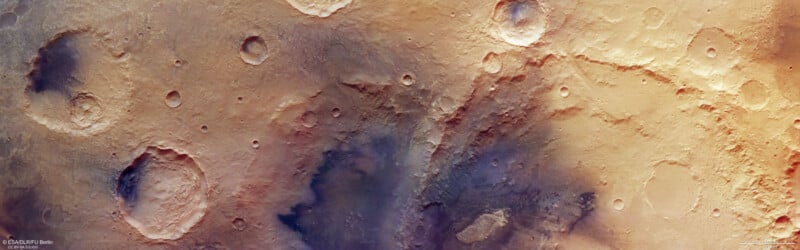
Newly published high-resolution photos of Mars show some of the red planet’s many craters in exceptional, colorful detail.
Mars is a regular source of interesting new photos. From detailed shots of the planet captured from orbit to rare night photos and everything in between, no alien planet is as photographed as Mars.
The exciting new shots of Mars were captured by the European Space Agency’s (ESA) High Resolution Stereo Camera (HRSC) aboard ESA’s orbital Mars Express mission. The HRSC is tasked with capturing full-color, 3D images of the entire Martian surface at 10-meter resolution. However, the camera can pinpoint specific parts of the surface and capture images with even better two-meter resolution.
“One of the camera’s greatest strengths is the unprecedented pointing accuracy achieved by combining images at the two different resolutions,” ESA explains. “Another will be the 3D imaging which will reveal the topography of Mars in full color.”
The HRSC features multiple CCD image sensors mounted in parallel. They capture images simultaneously from slightly different perspectives, enabling stereoscopic data capture that helps scientists map Mars’ topography.
“The strength of HRSC is to perform high resolution digital terrain models of the martian surface in order to provide topographic context for the geoscientific evaluation of surface processes in space and time,” explains Ralf Jaumann, from the Institute of Planetary Research, DLR, Berlin, who was previously the HRSC Principal Investigator.
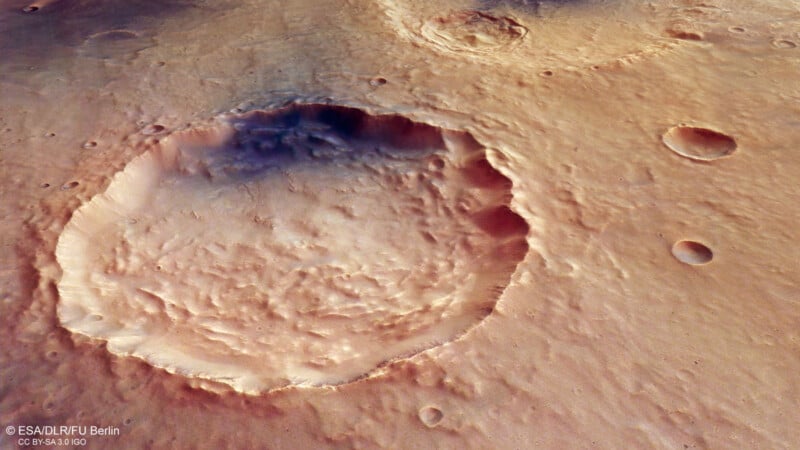
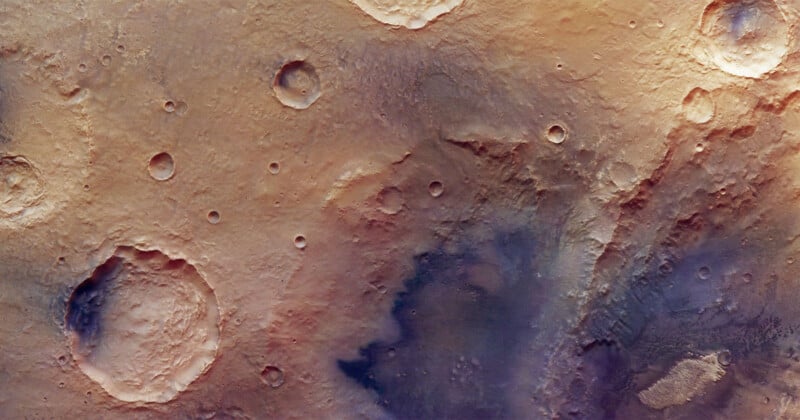
This high-resolution prowess is on full display in the new photos, which capture part of Arabia Terra, a plain in Mars’ “ancient highlands” known for its high crater density, each formed when space rocks struck the planet’s surface. As ESA notes, Arabia Terra has had between 3.7 and 4.1 billion years to amass its “impressive crater collection.”
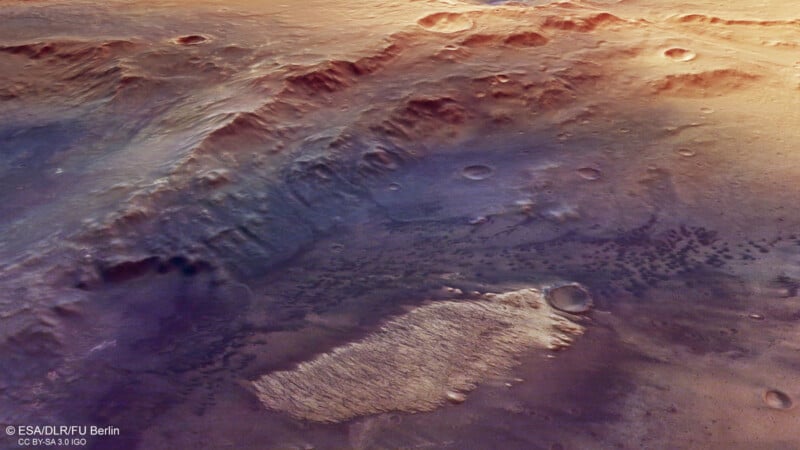
These craters are of great interest to scientists, as they offer clearer views of Mars’ geology and help explain the planet’s rich, often mysterious history. Some of these craters are as wide as 130 kilometers (nearly 81 miles).
Since the Mars Express mission launched in 2003, the HRSC has diligently mapped the planet’s surface, “returning insights that have drastically changed our understanding of our planetary neighbor.”
Image credits: ESA/DLR/FU Berlin





![New 100% RT Cyber Thriller Unleashes 10-Minute Sneak Peek [Exclusive]](https://static0.colliderimages.com/wordpress/wp-content/uploads/2026/01/wardriver-sasha-calle-dane-dehaan.jpg?w=1600&h=900&fit=crop)

 English (US) ·