
 Image via HBO
Published Oct 1, 2026, 2:58 PM EDT
Liam Gaughan is a film and TV writer at Collider. He has been writing film reviews and news coverage for ten years. Between relentlessly adding new titles to his watchlist and attending as many screenings as he can, Liam is always watching new movies and television shows.
In addition to reviewing, writing, and commentating on both new and old releases, Liam has interviewed talent such as Mark Wahlberg, Jesse Plemons, Sam Mendes, Billy Eichner, Dylan O'Brien, Luke Wilson, and B.J. Novak. Liam aims to get his spec scripts produced and currently writes short films and stage plays. He lives in Allentown, PA.
HBO raised the bar for blockbuster television with Game of Thrones, but Westworld made its biggest impression by turning the audience’s trust against them. The series expanded on Michael Crichton’s original film with lavish production values and questions about consciousness, cruelty, and the limits of human freedom. Its greatest trick, however, was a non-linear structure that disguised how its characters were connected.
Scenes that appeared to unfold alongside one another took on a different meaning once the timelines fell into place. While this occasionally led to some confusion for the viewer, it often sparked moments of revelation that had a tremendous impact on the story. Westworld completely subverted expectations by showing the backstory to the Man in Black, a character who had been depicted very differently in the original 1973 film.
HBO's 'Westworld' Redefined One of Its Greatest Villains
The Westworld film cast Yul Brynner as a ruthless android designed to look like a gunslinging cowboy, who tracked down and executed many of the unlucky guests that had come to the park. While Ed Harris was introduced as a similar character early on in the show’s pilot, it soon became clear that he was actually a human who had spent years in the park trying to crack a mystery initiated by its founder, Dr. Robert Ford (Anthony Hopkins). It wasn’t initially clear what drove the Man in Black to become such a sadistic villain, but Westworld took a wild turn by revealing that the viewers had been watching the bad guy the whole time. William (Jimmi Simpson), a young guest who falls in love with the host Dolores (Evan Rachel Wood), is eventually shaped by heartbreak and tragedy to become one of the most sinister characters in the Westworld universe.
Westworld crafted an aura of ethical ambiguity because of the double-nature of many of its performances. Since the hosts are revitalized many times, and are often based on existing humans, it’s never exactly clear at what point in the timeline something is taking place. Westworld makes William into one of the most instantly likable characters because he does not share the same aggressive qualities as many of the other human characters. A majority of the guests at Westworld are wealthy, pretentious investors and bureaucrats who want to use their freedom to act on their darkest violent and sexual desires; by comparison, William is forced to attend a trip to the park with his soon-to-be brother-in-law, Logan (Ben Barnes), whose father James (Peter Mullan) is one of the board’s most important investors. Even though the series ultimately serves as a warning about putting too much faith in artificial intelligence, the kindness that William shows to Dolores indicates that he has a sense of moral decency that Logan and the other guests lack.
The genius of the first season’s construction is that Westworld examines how William’s experiences in the park unlock part of his nature that he has kept under the surface. While in real life he is forced to be subservient to Logan and struggles to express his confidence, the park is the rare place in which he feels powerful and free. Initially, William’s self-actualization is seen as a positive character development because he goes out of his way to save Dolores. However, his protective attitudes slowly transform into possessive toxicity when he realizes that she can be reincarnated, and has no memory of him. Simpson impressively shows how William’s heartbreak eventually leads him to begin brewing in his own anger; while initially the series is somewhat sympathetic to him because he genuinely seemed to care about Dolores, it subsequently builds the idea that William believes that nothing matters, and that he is therefore excused to do whatever he wants in the park.
HBO's Sci-Fi Hit 'Westworld' Establishes a Brilliant Labyrinthian Structure
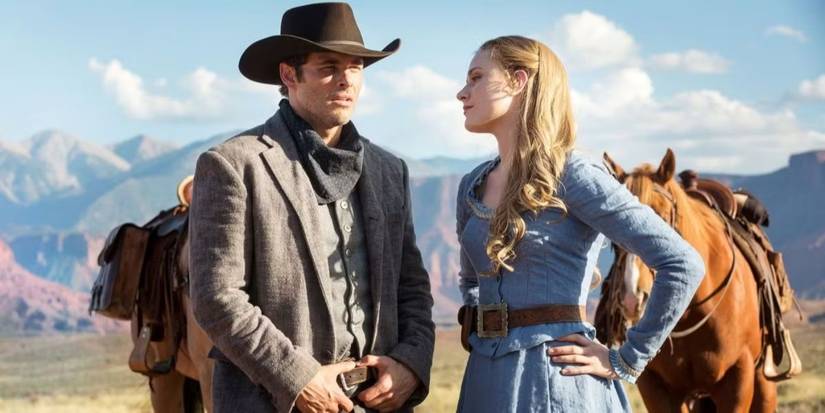 Image via HBO
Westworld's Season 1 finale, “The Bicameral Mind,” finds a clever way to stage the reveal about William’s identity because it is framed through Dolores’ perspective. Dolores is just as clueless about the mechanics of the timeline as the audience is, and therefore is not able to differentiate between her memories of William and the terror she feels when facing off with the Man in Black. Even though William is never seen interacting with the Man in Black, the show doesn’t call attention to the disparity, particularly when viewers are tracking other twists, such as the reveal that Bernard (Jeffrey Wright) is a host modeled on Ford’s former partner, Arnold.
Wood gives an impressive performance that mirrors the shock and horror that the audience may have felt upon realizing they’d been duped into being emotionally engaged with such a violent character. The subsequent montage that examines William’s transformation is masterfully done, and there’s also a complexity to the emotions within Harris’ performance that makes the scene even more painful. Harris is one of the best living actors and is able to show that there is still part of William that hasn’t stopped being in love with Dolores.
It is often the case that shows with innumerable plot twists aren’t able to adequately follow through with the ramifications. However, Westworld’s revelation about William made the rest of the show more interesting. William’s negative experiences with his own family were cast in a new light when he’s forced to team up with his daughter, Emily (Katja Herbers), who seeks to rekindle their relationship. In order to make the transition between the two actors more believable, Westworld Season 2 was able to explore more with Simpson’s version of the character as he oversaw attempts to recreate his father-in-law’s consciousness in a host body.
Despite the horrific actions he was capable of, William served as a bit of an audience avatar through his desperation to solve all the riddles in the park. The premature nature of Westworld ending with Season 4 means that there was much squandered potential and unanswered questions, but the incredible development of the character of William is one of the show’s most impressive achievements.
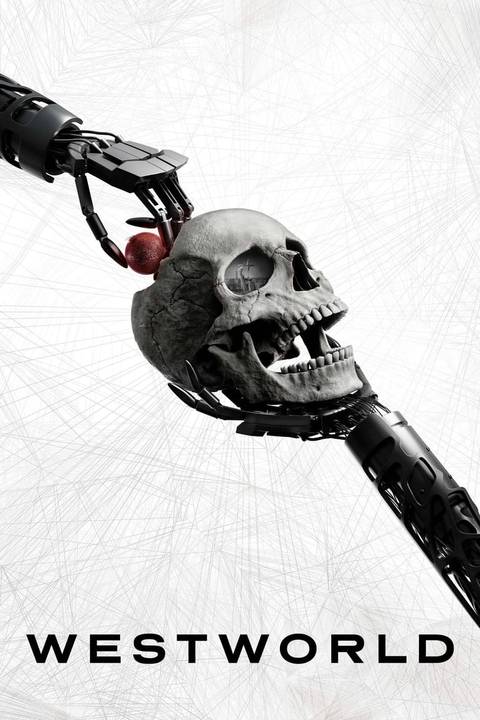
Release Date 2016 - 2022-00-00
Network HBO
Showrunner Jonathan Nolan, Lisa Joy
Writers Roberto Patino, Carly Wray, Ron Fitzgerald, Daniel T. Thomsen, Karrie Crouse, Wes Humphrey
-

-

Thandiwe Newton
Maeve Millay




 English (US) ·