
 4 hours ago
5
4 hours ago
5
Android laptops are here, but Google has a lot of work ahead to make them good.
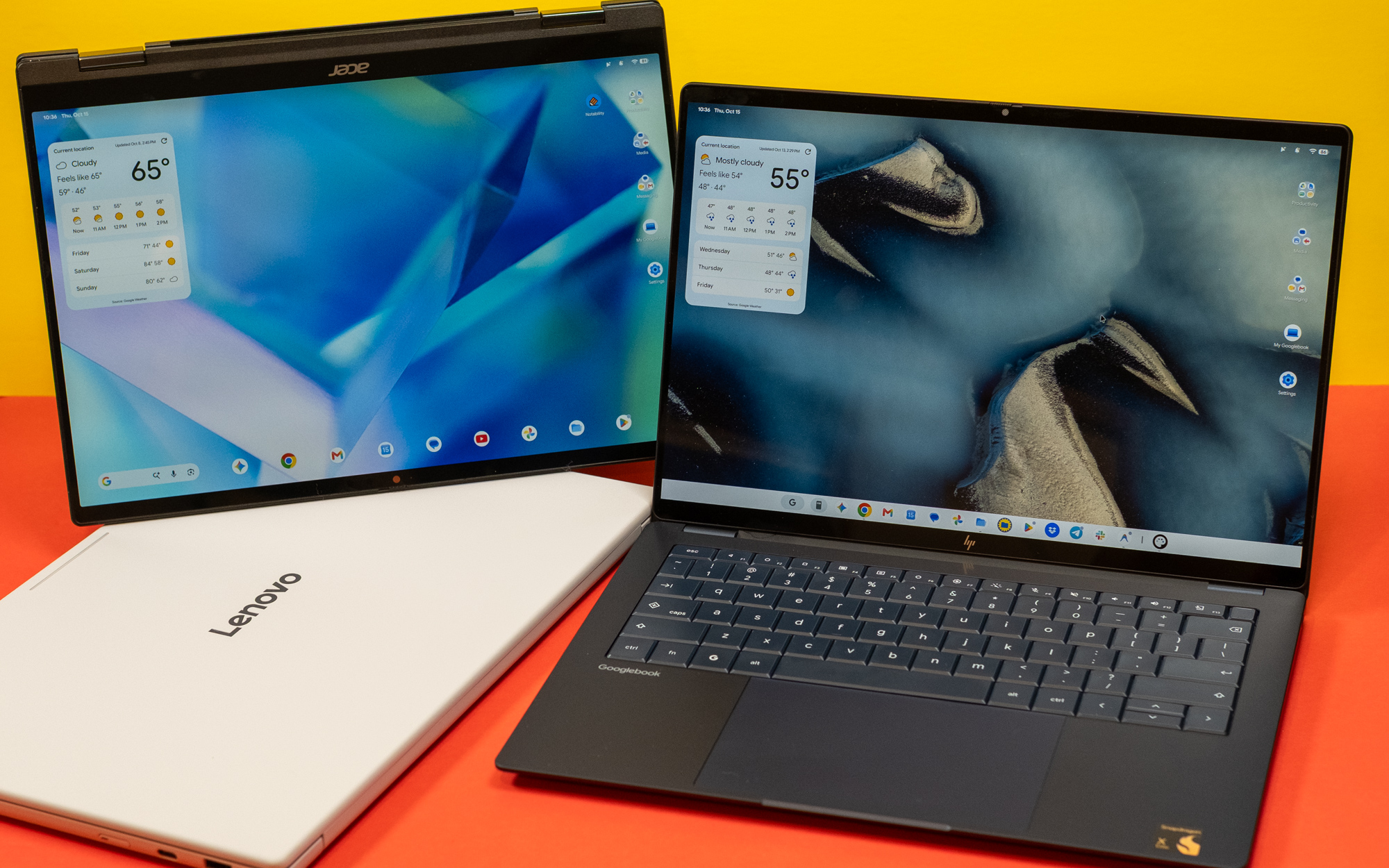
Googlebooks take a big swing with the hardware. Credit: Ryan Whitwam
Googlebooks take a big swing with the hardware. Credit: Ryan Whitwam
Android was designed for phones, but that hasn’t stopped Google from trying to adapt the OS and its apps to larger machines over the years. Googlebooks are just the latest attempt after tablets, Chromebooks, and foldables induced little change in how people interact with Android software. These new Android-powered laptops are designed to pick up where the web-focused ChromeOS left off, offering premium hardware and native support for Android apps.
Google sees Googlebooks as an alternative to Windows and macOS, but these platforms are entrenched with decades of software and UI conventions that keep users locked in. Googlebooks have to offer something very special to steal users away from either of the dominant operating systems.
For devoted Android phone users, there are some cool things in Googlebook OS, but the Android roots of these machines are impossible to miss. Sometimes it feels like using a Chromebook, and sometimes it feels like using a giant phone. It almost never feels like using a premium laptop, and that’s the problem.
OEMs pulling their weight
While there were a few premium Chromebooks, the platform was really only successful in the budget segment. With Googlebooks, the company is almost conspicuously ignoring lower-cost options. And as most of the lineup clocks in at well over a thousand dollars, Googlebooks are not just a new take on budget-oriented Chromebooks.
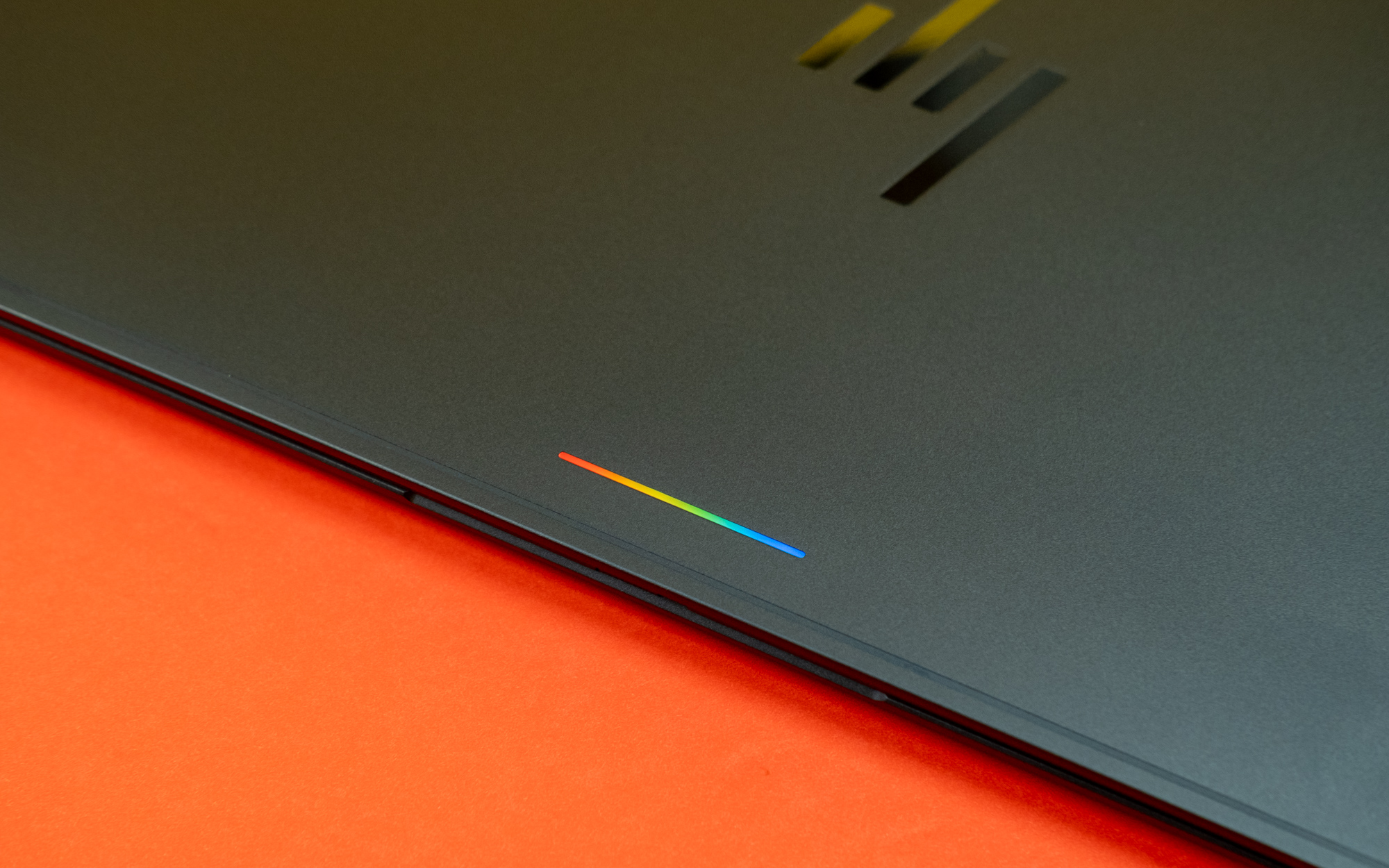
The Glowbar doesn’t do a whole lot, but it’s kind of pretty.
Credit: Ryan Whitwam
The Glowbar doesn’t do a whole lot, but it’s kind of pretty. Credit: Ryan Whitwam
All of the launch Googlebooks have excellent touchscreen displays, aluminum and magnesium bodies, biometric unlock (fingerprint or face), and big trackpads. There’s also the Glowbar, which doesn’t do very much right now. It lights up in Google colors when Gemini is activated with the wake word and during boot-up. It also shows the battery level when you plug in a Googlebook. The latter is modestly useful, but it’s not really a selling point.
There’s something in the lineup for most premium laptop buyers. If you want a convertible, there’s the Acer machine. Sleek and spendy? Asus and HP have you covered. Want something a little bigger? Lenovo has a 15.3-inch model with an HDMI port and USB-A.
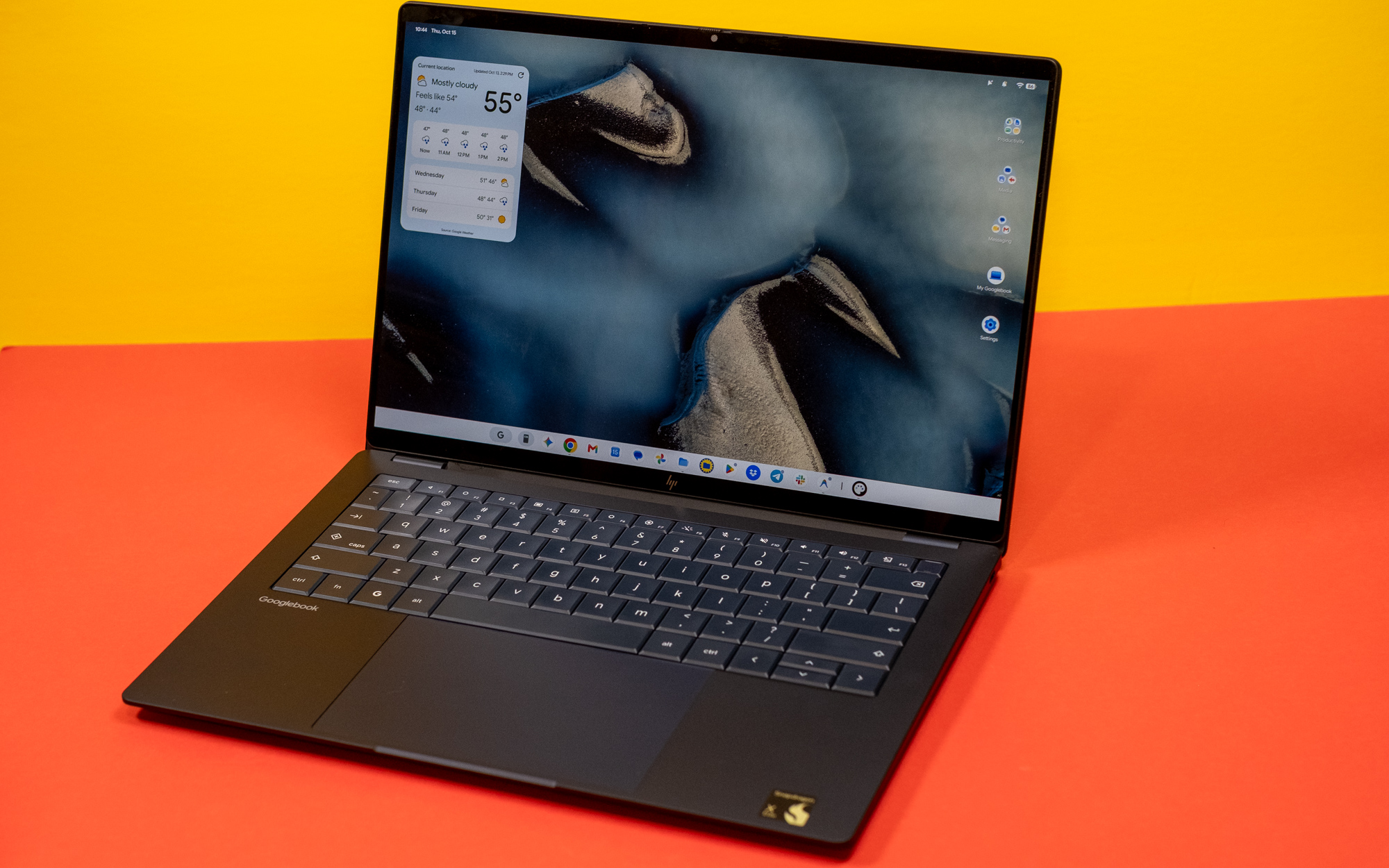
The $1,300 Snapdragon-powered HP Googlebook 14 could pass for an even more expensive Windows laptop.
Credit: Ryan Whitwam
The $1,300 Snapdragon-powered HP Googlebook 14 could pass for an even more expensive Windows laptop. Credit: Ryan Whitwam
The least-spendy model, the Acer Googlebook 14, starts at $899, and that’s a limited-time deal. Even this one gets a lot of the hardware right. It has a vibrant OLED screen, a metal chassis, and three USB-C ports (all of which can charge the laptop). However, you won’t get a haptic trackpad, just the old-fashioned kind that physically clicks. The supposedly DTS-tuned speakers also don’t sound great. Still, the hardware is at least as nice as any $900 Windows laptop. Acer hasn’t decided when the price will change or what it will be, but it’s at $899 for the rest of the year at least.
The next step up from that is the Dell XPS Googlebook at $999, but this model has an LCD instead of OLED. If you want the most capable Google laptops with OLED and haptic trackpads, you’re looking at spending at least $1,100 for the Lenovo version. This machine is solid, and the larger footprint allows for vents in the hinge instead of on the bottom. But I don’t love the slightly wobbly feel of the keys or the flex in the middle of the keyboard. The HP Googlebook 14 has a much nicer keyboard, a better overall look, and a Snapdragon X Elite chip inside. However, it’s also $1,300.
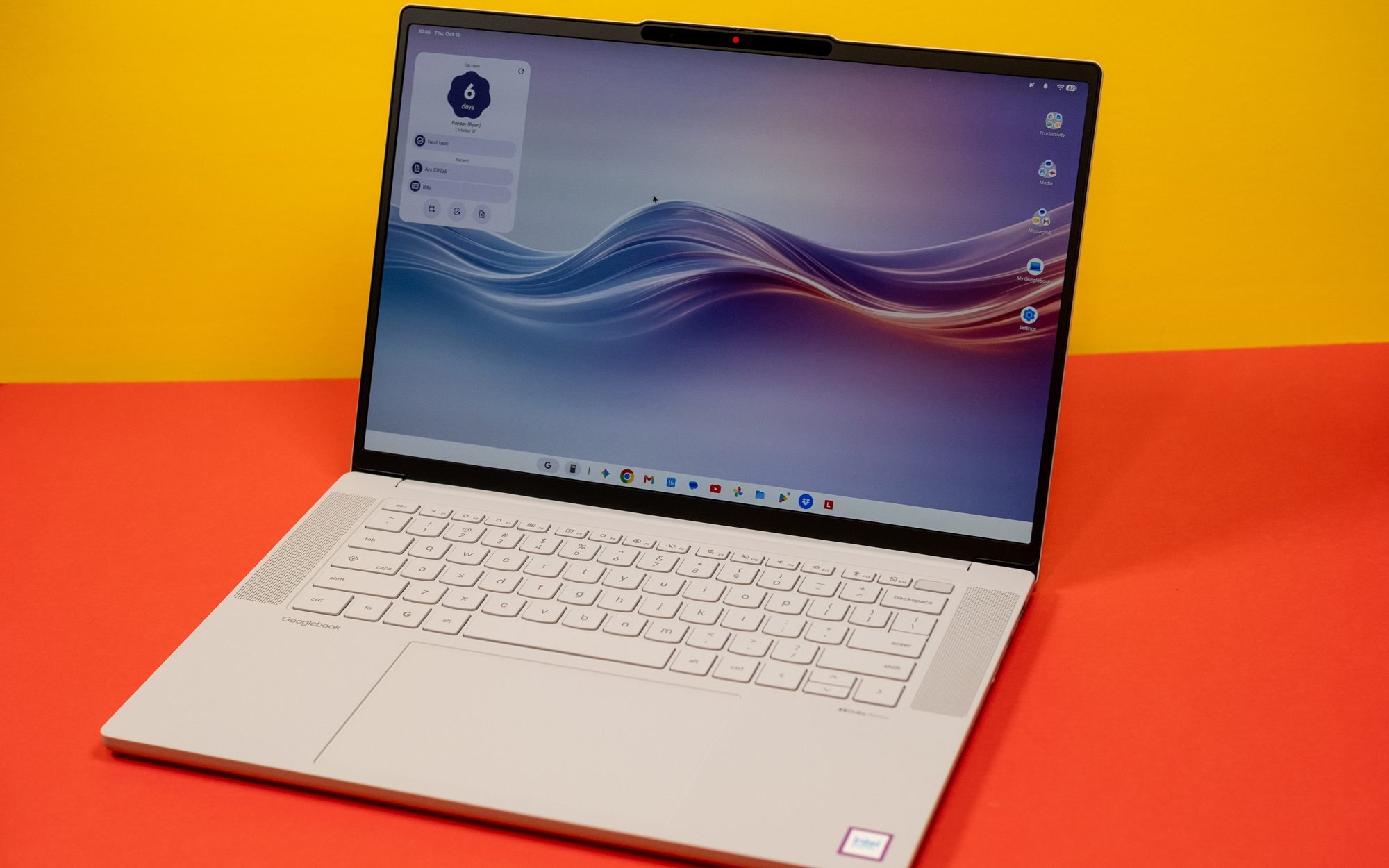
The Lenovo Googlebook 15 is a little bigger, offering an HDMI port and a legacy USB-A.
Credit: Ryan Whitwam
The Lenovo Googlebook 15 is a little bigger, offering an HDMI port and a legacy USB-A. Credit: Ryan Whitwam
I appreciate that Google is pushing for things like haptic trackpads and high-resolution OLED screens, but the more expensive Googlebooks suffer from the same issue as premium Windows laptops—they don’t exist in a vacuum. If you’re spending $1,300 on a laptop, the entry-level MacBook Air is probably a better overall option for most people.
All of the launch Googlebooks have the same keyboard layout, which is a bit different from what you get on other laptops. There’s a G button that works similarly to the Windows button, and the top F-row has been revamped. You get the usual Windows staples like brightness and volume control, but there are also Android navigation buttons and a voice input key that activates the AI-powered Rambler.
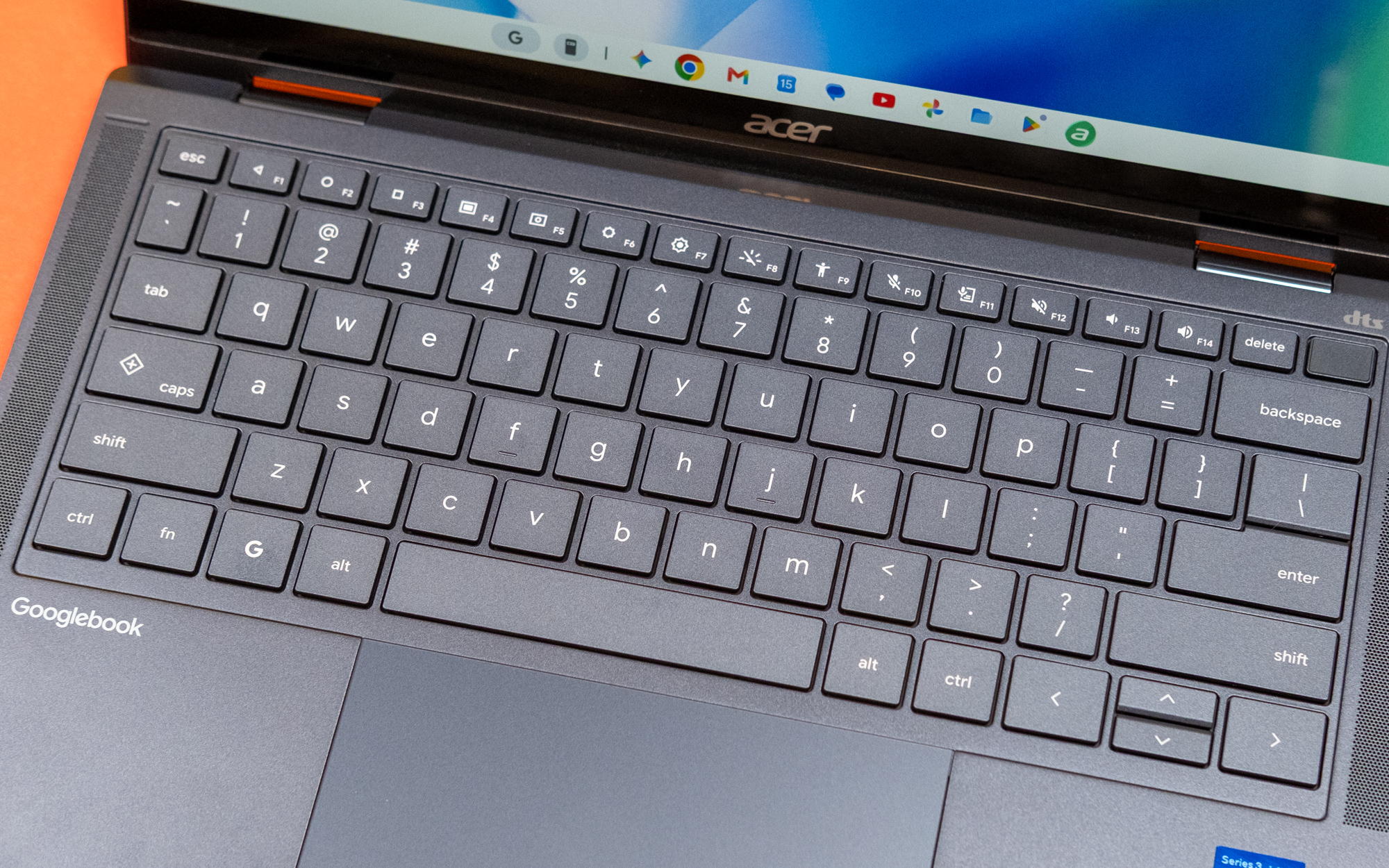
The Googlebook keyboard (seen on the Acer Googlebook 14) might take a little getting used to.
Credit: Ryan Whitwam
The Googlebook keyboard (seen on the Acer Googlebook 14) might take a little getting used to. Credit: Ryan Whitwam
Probably the best change to the Googlebook keyboard is ‘quick insert’ in place of ‘caps lock’ (you can still get caps lock with the Fn toggle). Just press this key to add emoji, recent screenshots, clipboard contents, recently visited URLs, and more. Admittedly, I don’t mind using function layers on a keyboard, so the extra step to access caps isn’t a concern. You may feel differently, and that’s okay.
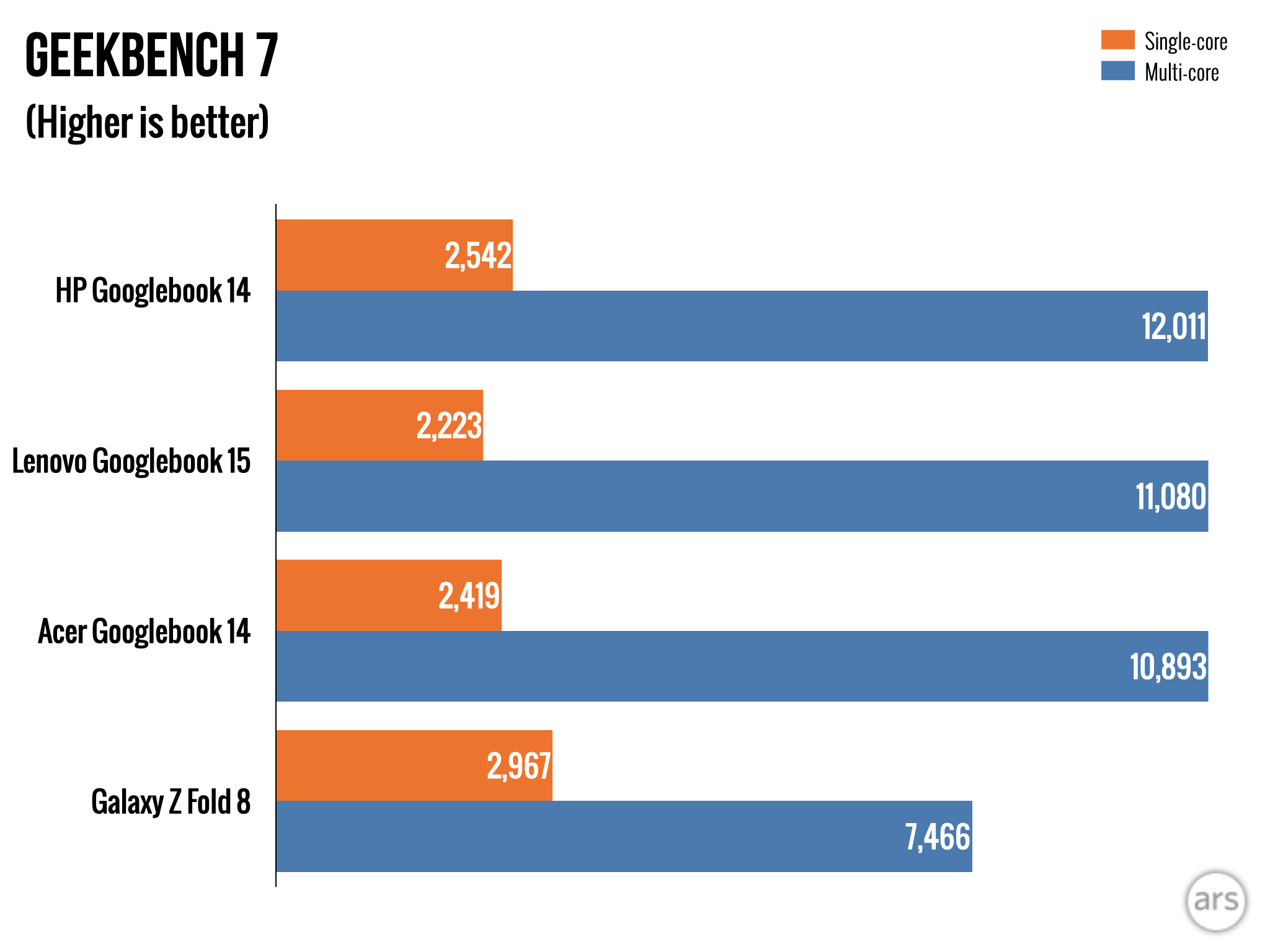
Googlebooks all perform similarly in CPU tests.
Credit: Ryan Whitwam
Googlebooks all perform similarly in CPU tests. Credit: Ryan Whitwam
Googlebooks come in both Intel and Snapdragon variants. I’ve been using both, and general performance feels about the same. There have been some reports of app issues with Intel-powered Googlebooks, but I haven’t run into any apps that will only run on Snapdragon.
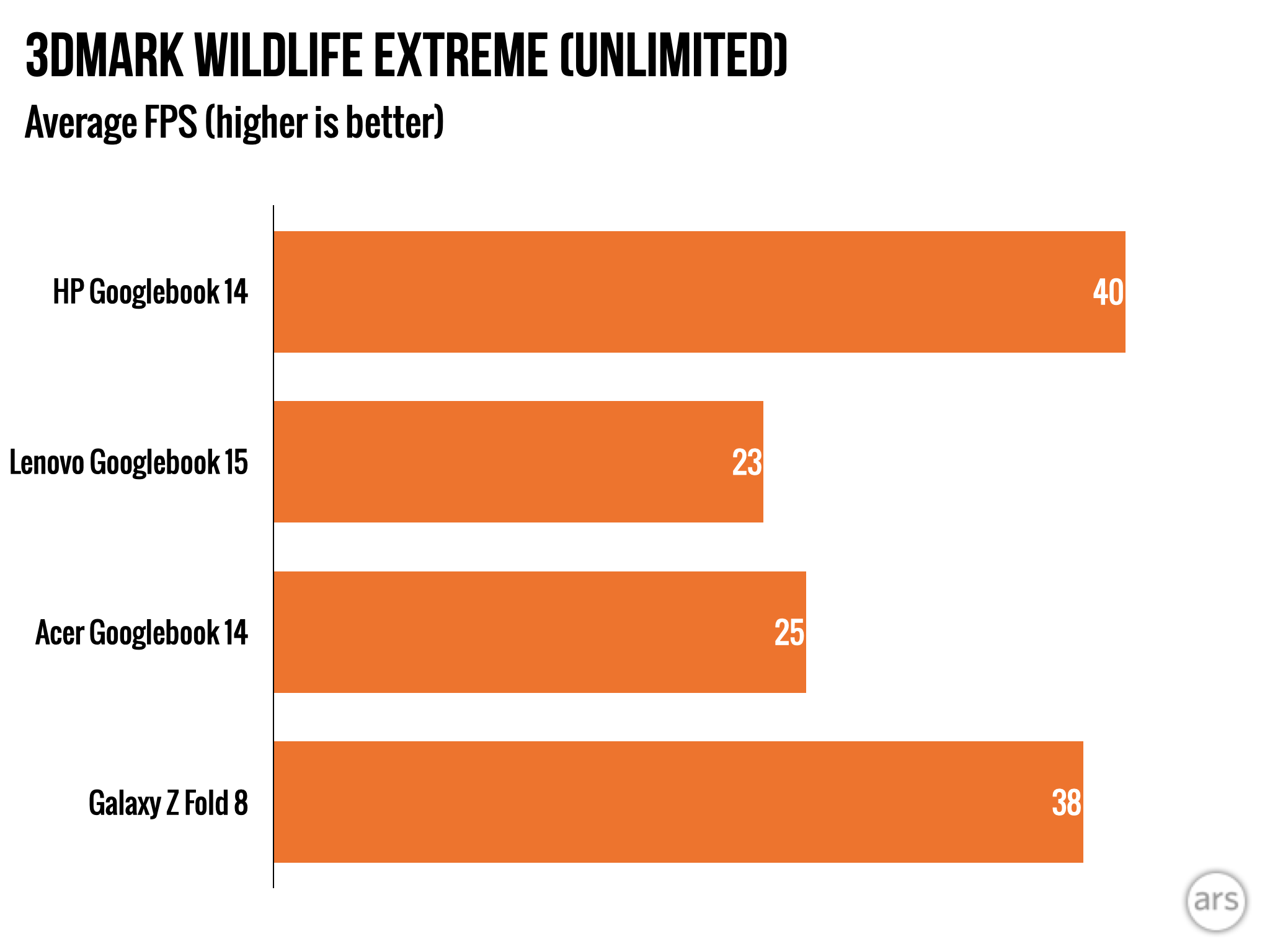
Snapdragon’s GPU performance is better on Android.
Credit: Ryan Whitwam
Snapdragon’s GPU performance is better on Android. Credit: Ryan Whitwam
The Snapdragon model (HP) seems to have a higher performance ceiling, if you can find a way to reach it. Gaming performance also appears better on Snapdragon, but even the heaviest Android games seem fine on the Intel models (Lenovo and Acer). It can be hard to push these machines when you’re relying on software that was originally designed to run on phones. Unsurprisingly, software proves to be the biggest hurdle for Googlebooks.
Using Android—err, Googlebook OS
Google has flirted with Android on larger screens on a few occasions, mostly with tablets and tablets that impersonate laptops. This is the first time it has totally revamped the OS for a laptop, but it’s still Android under the hood. Sometimes that’s good, and other times not so much.
Setting up a Googlebook is a snap for Android users. Just like configuring a new phone, you can scan a QR code with your current phone to copy your accounts, data, and apps over automatically. You can be up and running in minutes, and your phone will integrate deeply with the OS. Well, provided it runs Android 17. That’s going to be a sticking point, since most phones don’t have that update yet.
With Google’s “Better Together” services, a Googlebook can access files on your Android 17 phone, sync notifications, remember where you left off in apps, and even mirror apps from your phone. This all sounds great, and when it works, the experience can be good. However, there are various limitations and bugs that get in the way.
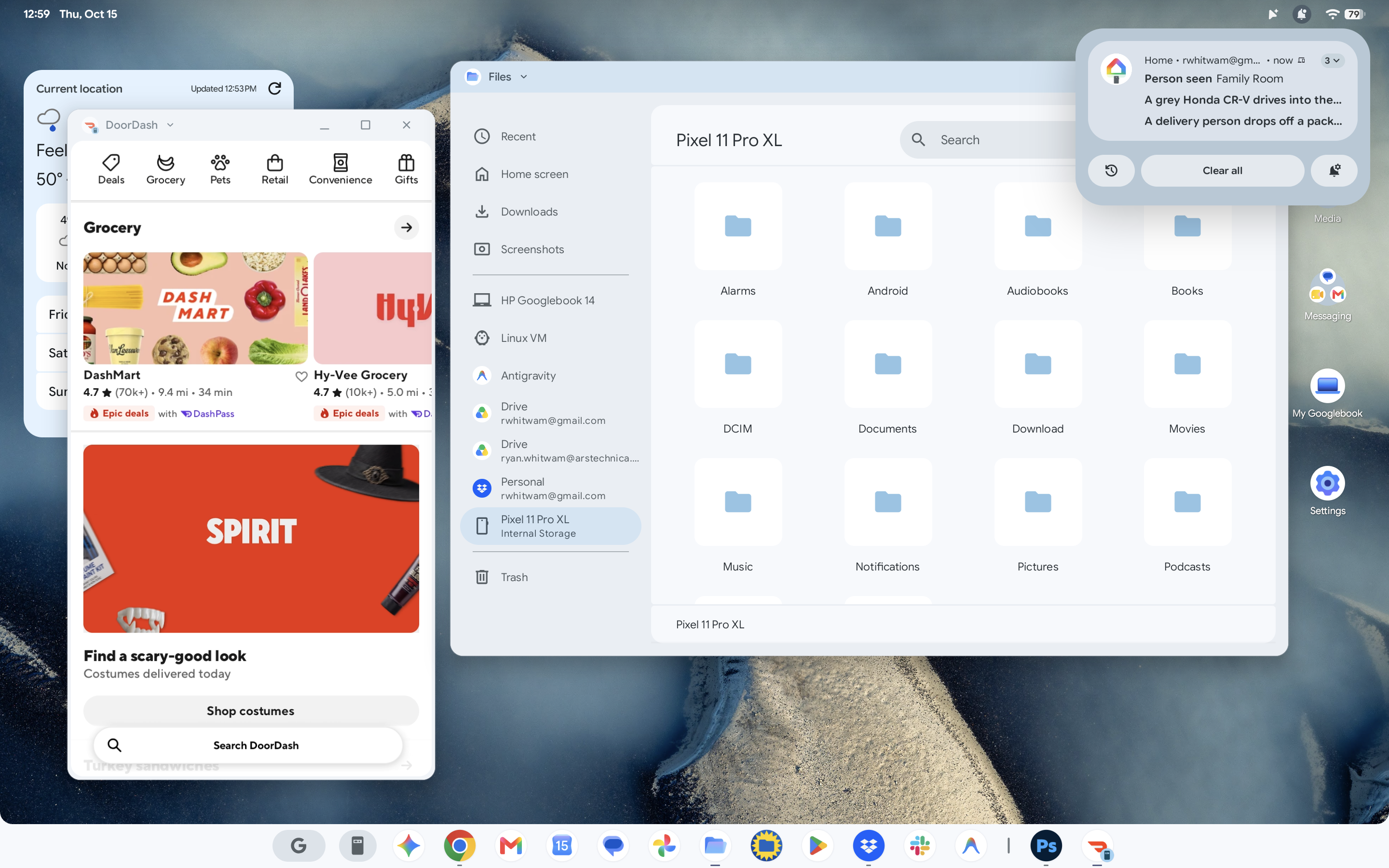
Googlebooks can stream apps, mirror notifications, and access storage from your Android phone.
Credit: Ryan Whitwam
Googlebooks can stream apps, mirror notifications, and access storage from your Android phone. Credit: Ryan Whitwam
To remain in contact, the phone and Googlebook need to be on the same Wi-Fi network, and switching to other networks can break the connection in annoying ways. Even when the devices appear to have a solid connection, I have rarely seen any hint of Google’s Continue On feature, which is supposed to let you pick up where you left off in a phone app. Mirroring phone apps on your laptop can also be handy, but the performance is varying degrees of bad, and apps with system-level security features won’t work at all. You are also limited to one app at a time, and they won’t stay open in the background.
Accessing the files on your phone from the laptop is a good idea, but the transfer speed is often sluggish. More annoyingly, the connection only goes one way—the Files app on the Googlebook can see your phone, but the Google Files app on a phone can’t see the Googlebook. Speaking of the Files app, this is emblematic of how far behind Google is with desktop software. The app lacks basic things like tabs and support for network shares. It’s nice that it can access my phone, but it feels very restrictive if you’re used to Finder or Windows Explorer.
Google has at least done a good job of making Android look like a desktop OS. There’s a proper desktop that you can fill with app shortcuts, folders, widgets, and files. There’s a folder in the storage tree where you can manage that content, or you can simply drag things onto it from a file manager. You also get ChromeOS-style split-screen support and multiple desktops. These features work, but they’re not as intuitive or capable as what you get on either macOS or Windows.
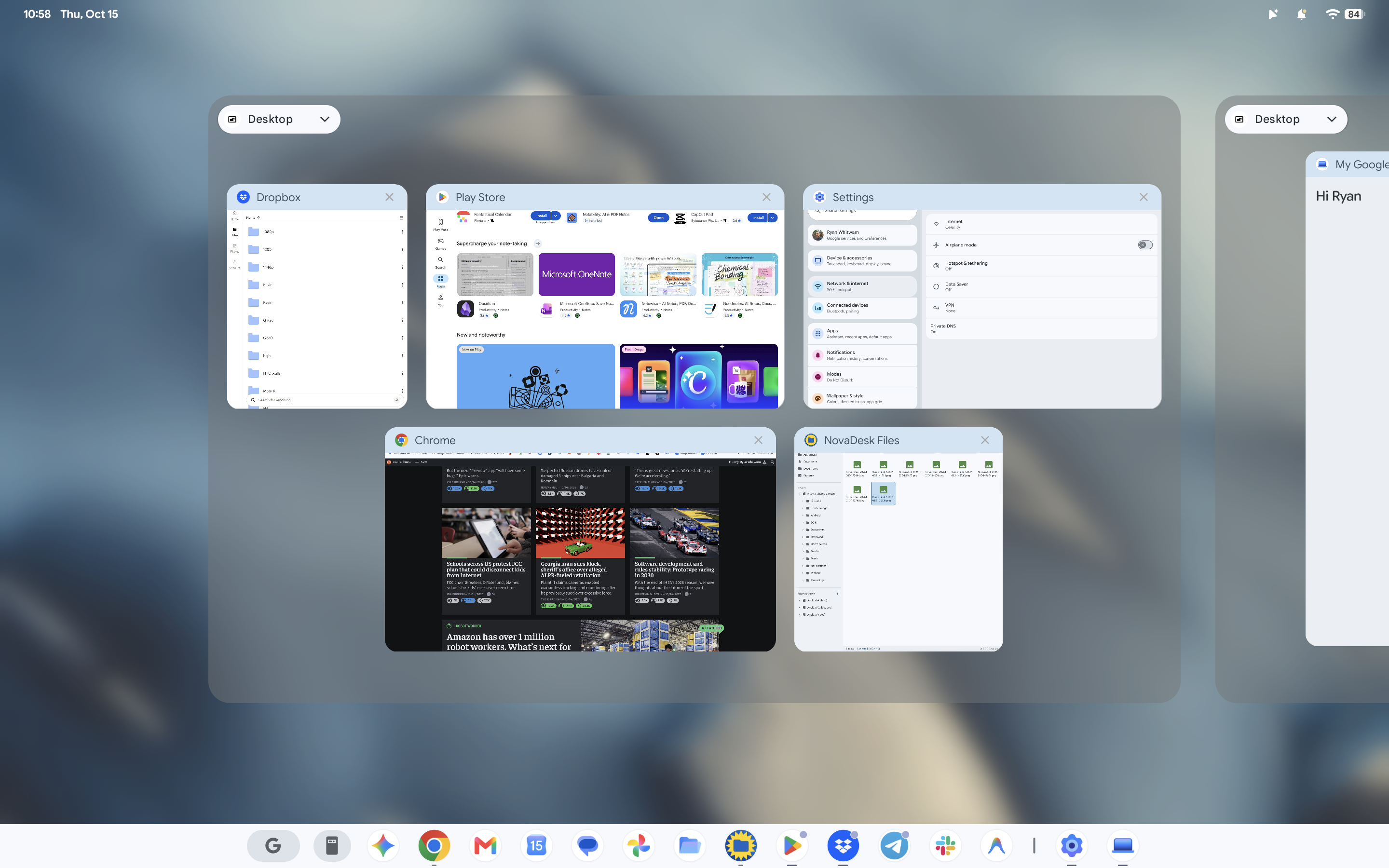
Managing multiple desktops on Googlebook OS.
Credit: Ryan Whitwam
Managing multiple desktops on Googlebook OS. Credit: Ryan Whitwam
AI is a big part of the Googlebook experience. Google talks a lot about Magic Pointer, which you can activate by wiggling the cursor. This allows you to hand any content on your screen over to Gemini, but calling it magic is a little silly. You can have it translate text, make images, create calendar appointments, and so on. You’re basically feeding Gemini screenshots and asking it to do things.
Magic Pointer can be useful sometimes, but it’s hardly revolutionary to streamline the process of feeding screen content into an AI by attaching it to the mouse. You still have to contend with the inaccuracy of Gemini. Even adding calendar appointments can fail, which means you have to double-check almost everything the AI does.
Magic Pointer is an optional feature, and you can adjust the sensitivity of the gesture. However, I never found a level that I was entirely happy to use. Too much sensitivity, and the gesture triggers when you don’t intend it. Too little, and you have to shake the mouse so hard that the cursor is probably going to be nowhere near what you wanted to highlight.
Rambler, which debuted on the Pixel 11 lineup, is included with all Googlebooks. This AI-powered voice input feature works in any text field on the laptop, which is handy if you want to add a lot of text without typing and don’t mind sounding like a robot. This has been popular on phones, and most people using it on a Googlebook will probably be impressed.
Create My Widget is another head-scratcher, though. The pitch is that you can simply describe the widget you want, and the AI will place it on your desktop. It sounds cool, but in reality, the content you can rope in is so limited as to make the feature largely useless. If you want calendar countdowns and sports scores, great. If you want system info or app content, you’re out of luck.
All the mobile apps
Googlebooks come with the Play Store, which is crammed full of all the Android apps you could ever want. But desktop apps? Google says it has worked with devs to optimize apps for Googlebooks, and some software has been newly built from the ground up for a desktop experience. For example, Chrome on Googlebooks is a mostly desktop-class experience. It’s missing a few niche features like split windows, tab groups, and multiple profiles, but it will work with all of your extensions.
On other platforms, I’ve routinely used desktop clients for Dropbox and Drive to sync files. I had hoped something similar would be possible on these Android laptops, but no such luck. Dropbox runs on a Googlebook, but it’s not optimized. The UI is clunky, and even if you save a folder offline, it only updates when you refresh the app manually (just like a phone running the app).
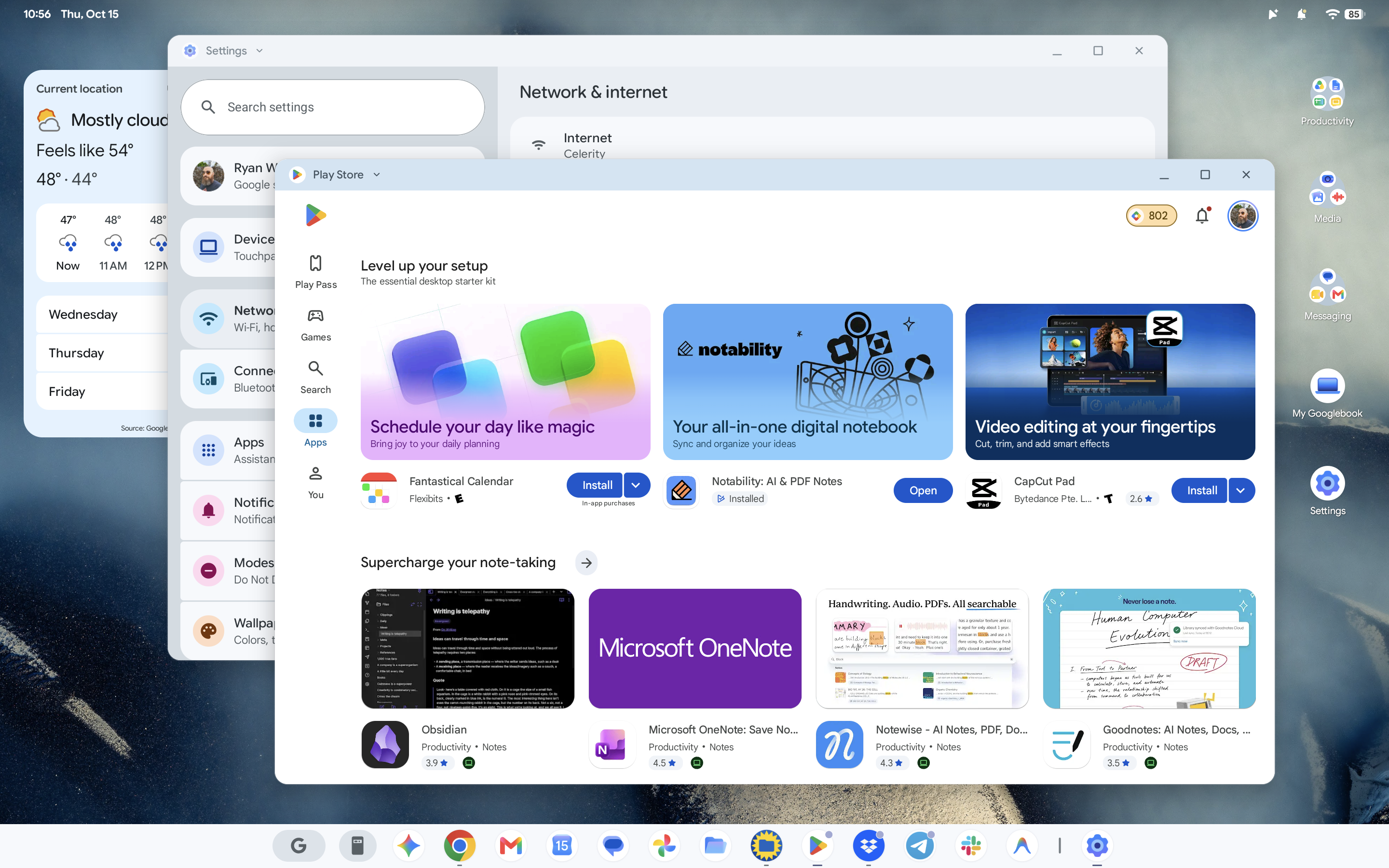
The Play Store highlights the handful of desktop-caliber apps currently available.
Credit: Ryan Whitwam
The Play Store highlights the handful of desktop-caliber apps currently available. Credit: Ryan Whitwam
Meanwhile, the Drive app isn’t even an Android app—it’s a progressive web app (PWA). So you can’t set it up to sync a folder to the device. All you have is the option to make individual files in Drive available offline. Without a real desktop app experience here, you actually get a lot more functionality out of Google’s cloud storage system on Windows and macOS.
Drive isn’t the only Google web app masquerading as a native app. Gmail and Calendar are also PWAs on the Googlebook, offering the same experience you’d get opening them in a browser tab. Gmail exists as an Android app with a large screen format. Why not adapt that for Googlebooks? Real operating systems have email apps. If you’re just going to end up in a web app, why not buy a Chromebook for a third of the price?
The Play Store uses labels to let you know which apps are best on a laptop, but most apps in the Play Store are very obviously built around a phone experience. Google is in a tough spot here. Developers only build for what people use, and so far, no one has been demanding desktop-style Android apps. As you peruse the Play Store, you’ll see a few of those “optimized” labels, but there are many more “Compatible with desktop” tags, which means you can expect only nominal support for a keyboard and mouse.
The most problematic apps are flagged in the Play Store as “Built for mobile” or even “Better on the website.” Some popular apps fall into these categories. For example, team chat app Slack is an abysmal experience on anything other than a phone. The app runs on Googlebooks, but the web UI is much more desktop-friendly. You are supposed to be able to install Slack as a progressive web app, essentially what Google is doing with Gmail, Drive, and other apps. However, this doesn’t work currently for unknown reasons. Again, you could just use a Chromebook if you wanted everything in a browser tab.
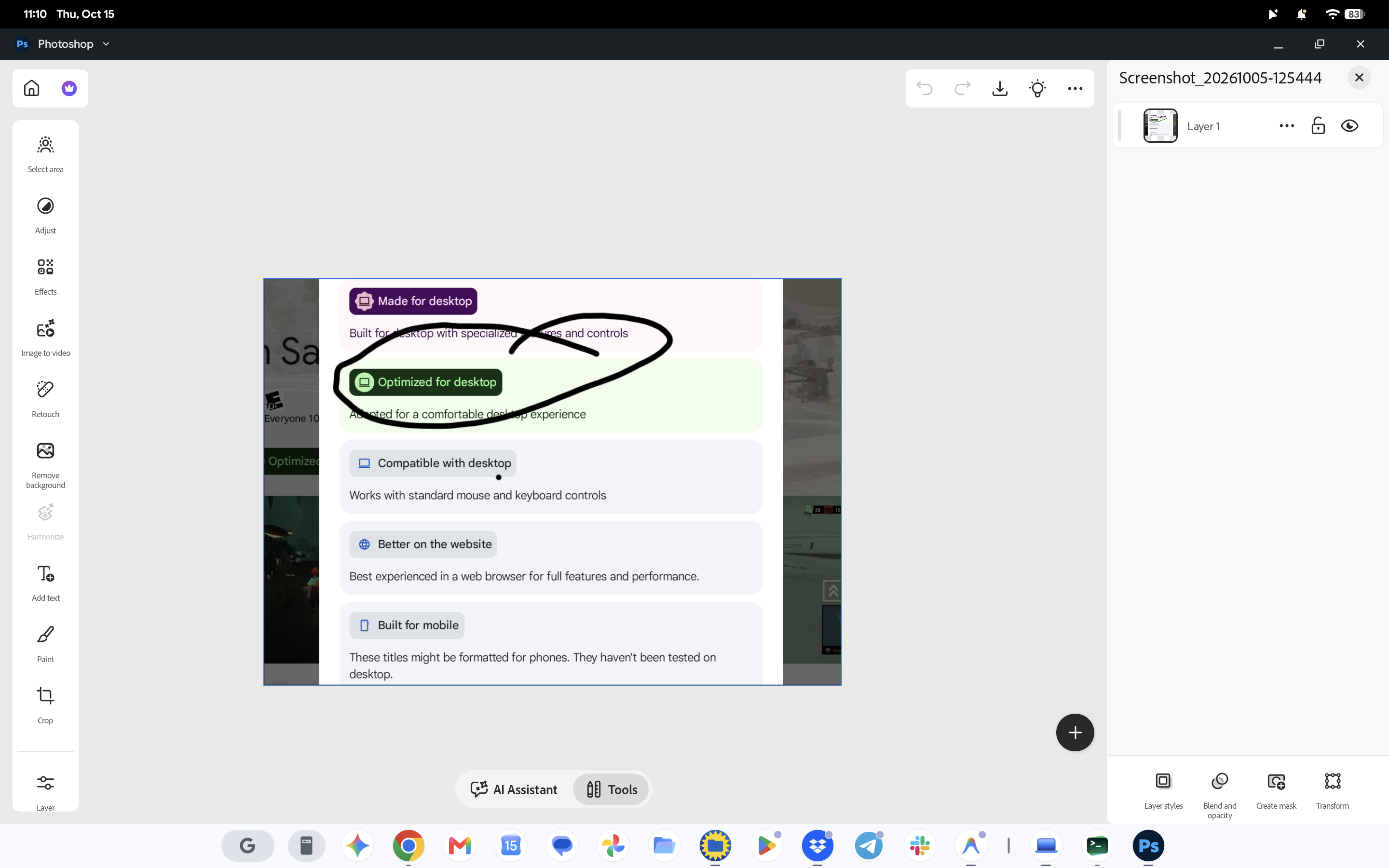
Adobe’s optimized version of Photoshop is still very limited on Googlebooks.
Credit: Ryan Whitwam
Adobe’s optimized version of Photoshop is still very limited on Googlebooks. Credit: Ryan Whitwam
Even apps that have been optimized for desktop can be frustrating on a Googlebook. These apps are aware you have a keyboard, but they can respond to button presses in ways you don’t expect. Photoshop is a major offender here. The app has a poorly scaled mobile UI shifted into landscape, and there are only a few keyboard shortcuts. Sometimes, you’ll see a UI element that looks like it should be controllable with the arrows or enter key, but you just end up moving the cursor around and selecting the wrong thing. In fairness, Android’s Photoshop app is free, whereas the real Adobe suite on other platforms costs money. But calling this a desktop app is a stretch.
You’ll find lots of pbone-first apps that don’t fully understand that you have a trackpad, ignoring hover interactions and right-clicks. Many apps also expect you to frequently trigger the Android back gesture to navigate the UI. On that last count, Google has a solution. Googlebooks have Back, Home, and Multitasking buttons on F1-F3. So you can make phone apps work, but reaching up to mash F1 constantly is annoying.
The Android lineage of Googlebook OS also means that even apps built for desktop may not operate the way you’d expect on a desktop PC. Android was designed for a memory-constrained environment, so the system closes apps in the background whenever it needs to free up RAM. It’s common to come back to an app you left in the background to find that it has lost your place and has to reload. This is a phone-like experience that doesn’t really fit with a real computer.
Can vibes save it?
Google is aware that Googlebook apps may not fulfill all needs. One possible solution to that, say reps, is to simply make what you need with Antigravity. The new Android version of Google’s AI-centric development app is included on every Googlebook, giving you the option to vibe code apps for your laptop. The AI can generate plans, mockups, and line after line of code to bring your idea to life.
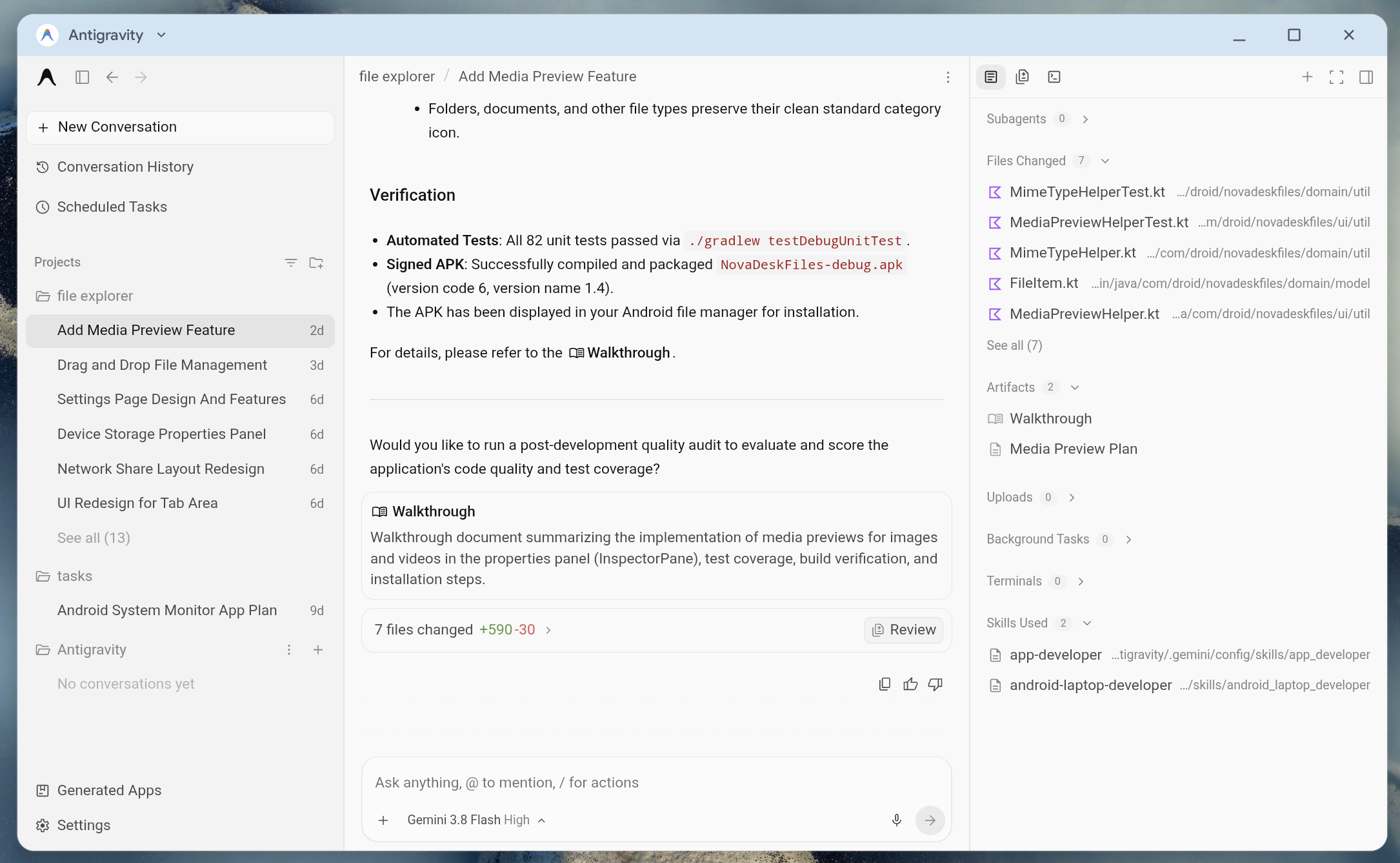
Antigravity on Googlebook OS.
Credit: Ryan Whitwam
Antigravity on Googlebook OS. Credit: Ryan Whitwam
Antigravity can autonomously download all the Android developer tools it needs and builds APKs ready for installation on your device. Installing your apps is technically sideloading, as they’re not hosted in the Play Store, but Google gives these special treatment. They get scanned by Play Protect, but you don’t have to enable unknown sources in the settings. Google also confirms these apps won’t be affected by developer verification when that rolls out on Googlebooks next year.
After struggling with the Files app for a few days, I decided the lack of network shares was a deal-breaker. I keep most of my files on a NAS so I can access them from any device, and Googlebooks were cramping my style. I first tried to find an alternative in the Play Store, but the apps with sufficient features were totally unoptimized for a laptop, so I decided to test Antigravity on Googlebooks by making one.
Using Google’s default Gemini Flash model, I was able to get a functional but very buggy file manager installed in a few minutes. Making it work reliably and support all the features I needed took several hours of prompting over a few days, but the result is something I like using more than Google’s default Files app.
My custom file manager is essentially Windows Explorer on Android. While I did not set out with that intent, that’s where I ended up. The app has a desktop-friendly UI, tabs, network share support, expandable file trees, file previews, and more buttons. It has more features than Google’s default app, although it lacks the deep phone and system integration of the default file manager.
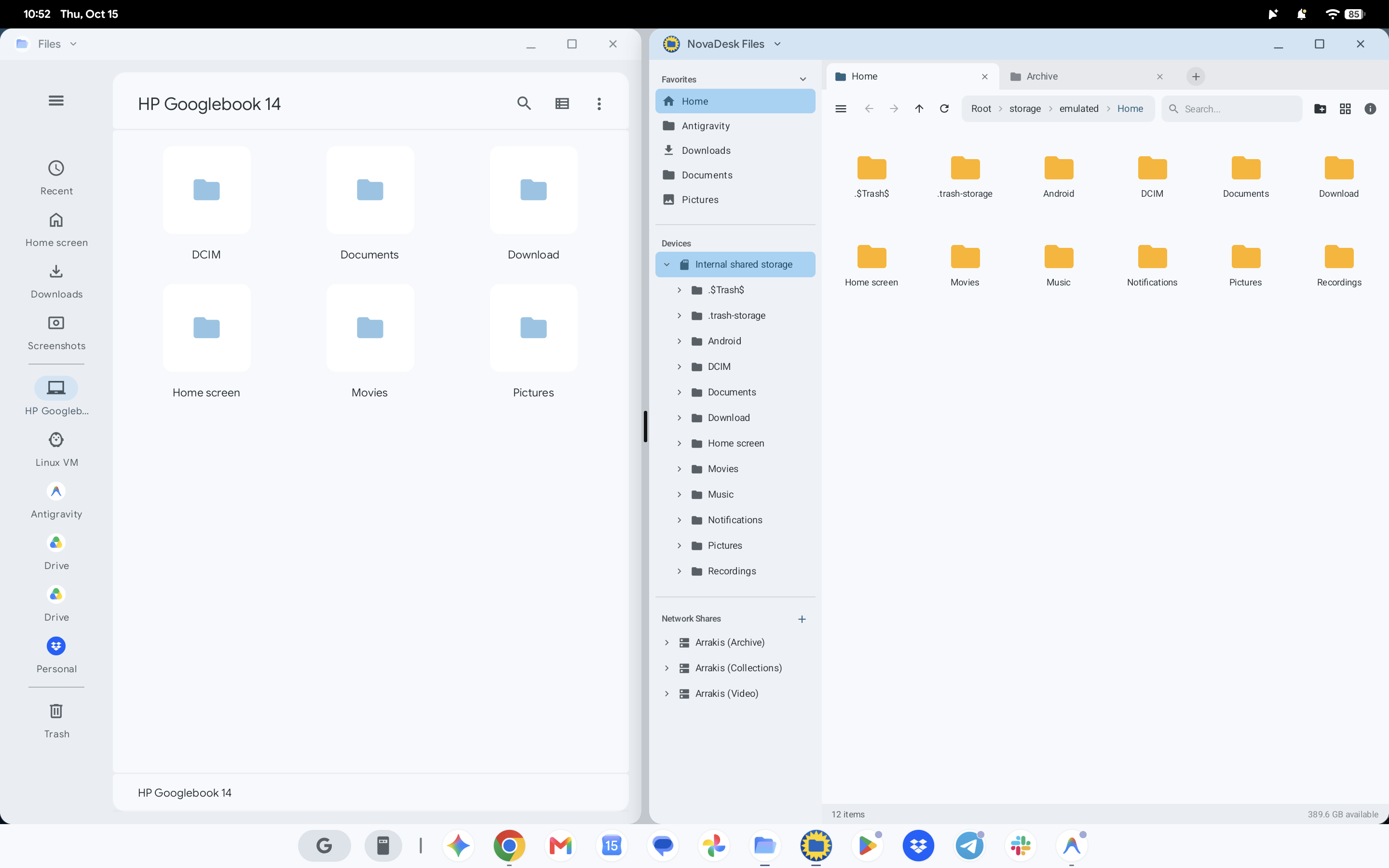
Left: Default Files app, Right: My vibe-coded replacement
Credit: Ryan Whitwam
Left: Default Files app, Right: My vibe-coded replacement Credit: Ryan Whitwam
On one hand, it’s cool that you can create your own apps with the included Antigravity software. However, you’ll need to pay someone (probably Google) for enough AI compute to get the job done. It took a lot of iterations and bug hunting with Gemini 3.8 Flash to get my app where I needed it to be, and lighter models will struggle to produce something functional. It’s also not ideal to expect people buying a laptop to spend hours chatting with a robot to make it do basic laptop things. It should do those things out of the box.
The first step on a long road
I keep coming back to one inescapable question that hangs over everything Google is doing with these new laptops: Do Googlebooks need to exist? This seems like a lot of effort just to deliver deeper Android phone integration and more AI features when Chromebooks are already established in the market. True, that’s not a premium part of the market, but going after premium laptops means you need a premium experience, and currently, Googlebooks don’t offer that.
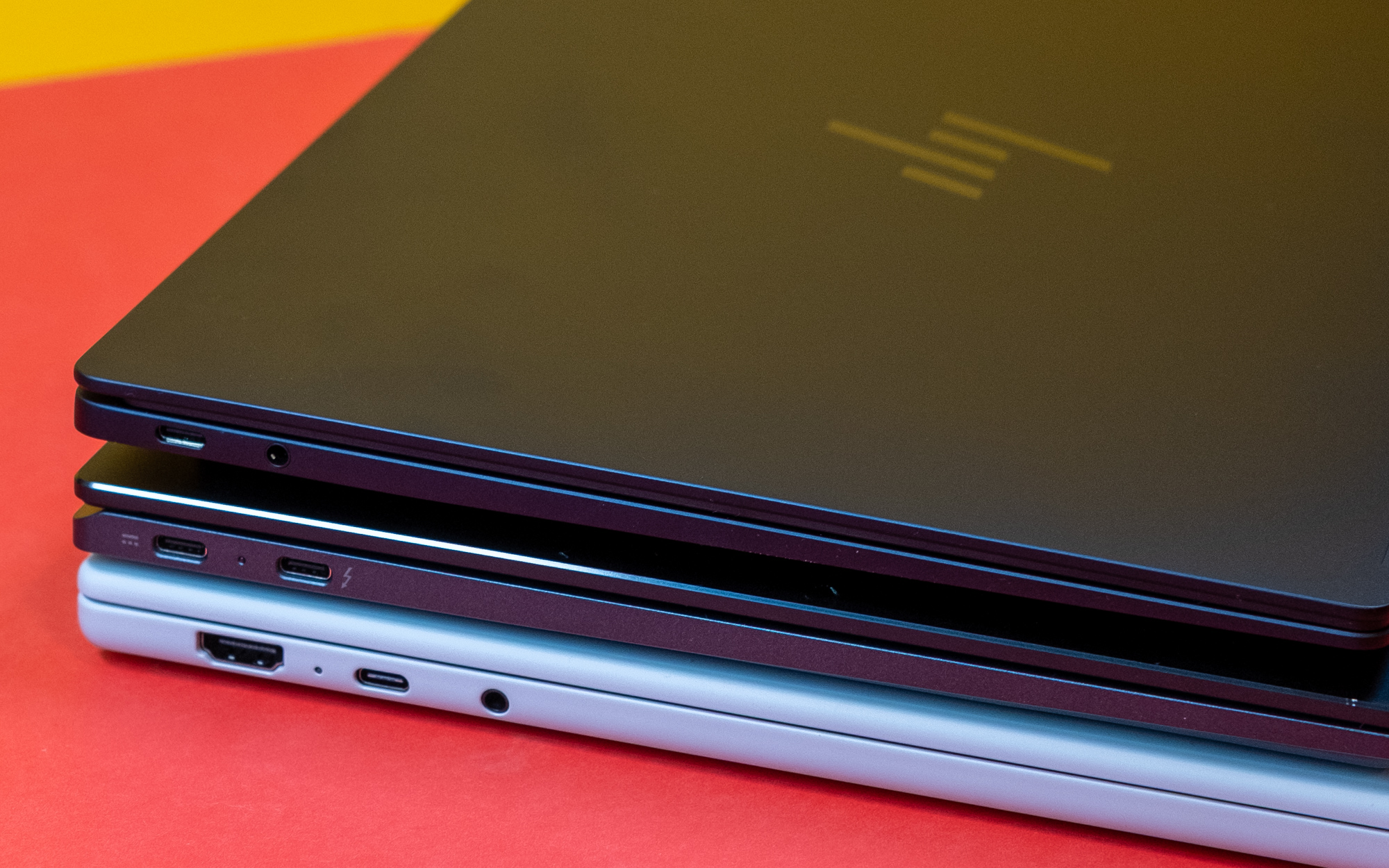
Port location and selection vary across the lineup.
Credit: Ryan Whitwam
Port location and selection vary across the lineup. Credit: Ryan Whitwam
The hardware is solid—it’s smart that Google is pushing for things like OLED and haptic trackpads on Googlebooks. Its OEM partners have made some very nice-feeling laptops for Google’s software, but the OS isn’t doing its part. I just don’t feel more productive on a Googlebook than I do on a Chromebook.
I’ve been using Android since the beginning—this should be a good laptop for someone like me. However, the rough edges of the Googlebook experience are still wearing me down. It’s great that it talks to my phone, but that conversation is too often one-sided and buggy. It’s good, in theory, that Googlebooks have a deep software library with the Play Store, but too few apps are actually good on a laptop. And it’s cool that Googlebooks have such nice hardware, but they’re too expensive for what you get.
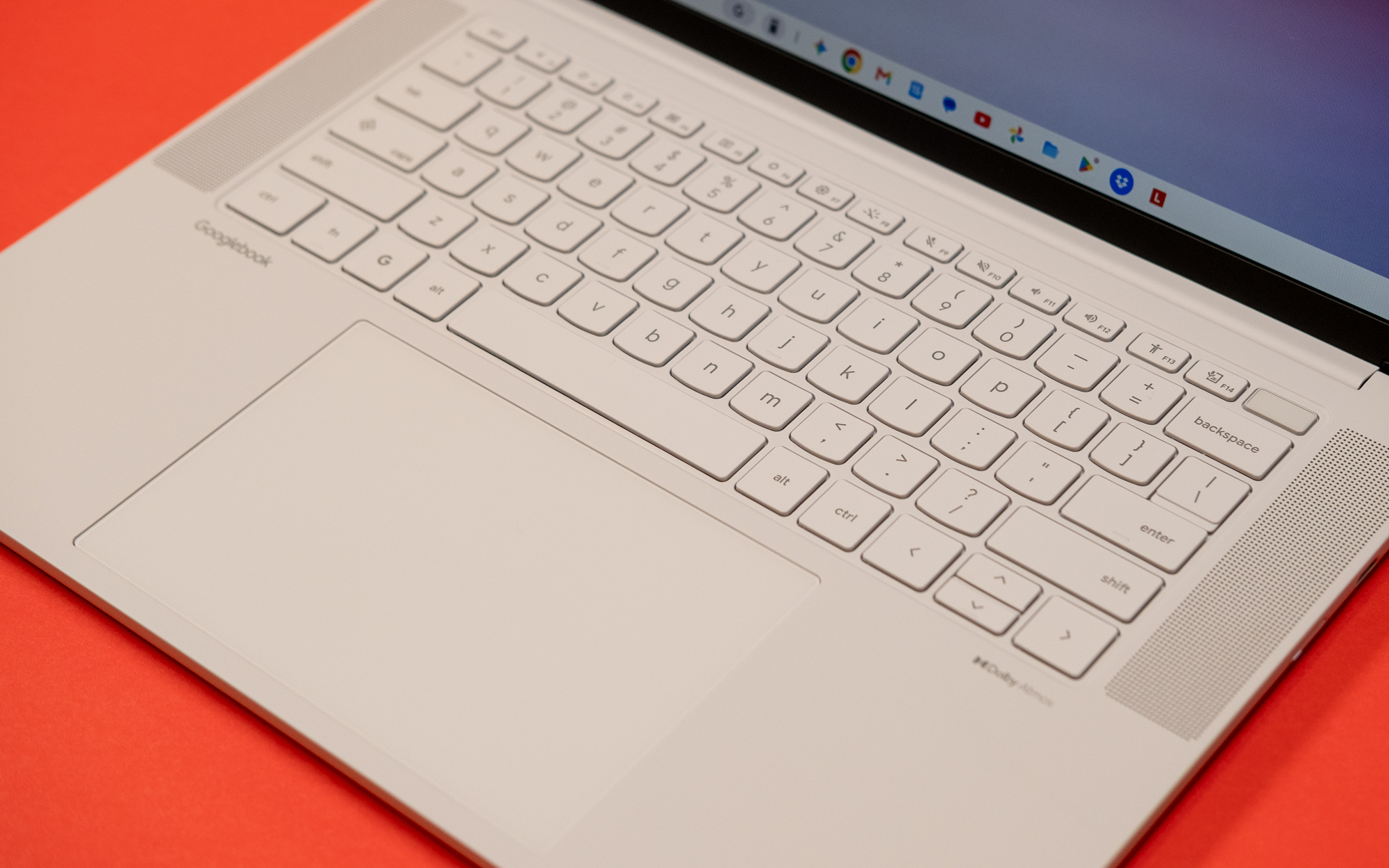
Googlebooks have generously sized touchpads, and most of them are haptic.
Credit: Ryan Whitwam
Googlebooks have generously sized touchpads, and most of them are haptic. Credit: Ryan Whitwam
Maybe Google can fix this—ChromeOS looked a lot different a year or two after its consumer launch, after all. But Google has a lot of work ahead to make the Googlebook experience what it needs to be, and in the meantime, it’s not a viable alternative to macOS and Windows. Does Google have the patience to spend years doing this work? The company’s recent history leaves me feeling skeptical, and that makes it difficult to recommend a Googlebook to even the most ardent Google customers.
The good
- Laptop hardware looks and feels great
- Extremely quick setup
- Deep Android phone integration
- Access to millions of Android apps running natively
The bad
- High price tags and no budget options
- Very few Android apps work well on laptops
- Missing features of more mature desktop operating systems
- Bugs with phone connectivity
- Tentpole AI features are not very useful

Ryan Whitwam is a senior technology reporter at Ars Technica, covering the ways Google, AI, and mobile technology continue to change the world. Over his 20-year career, he's written for Android Police, ExtremeTech, Wirecutter, NY Times, and more. He has reviewed more phones than most people will ever own. You can follow him on Bluesky, where you will see photos of his dozens of mechanical keyboards.







 English (US) ·