
Serving tech enthusiasts for over 25 years.
TechSpot means tech analysis and advice you can trust.
Facepalm: For a short while, Google's AI Overviews handed the internet a financial case for vandalizing Flock's AI-powered license plate cameras, and it wasn't based on anything real. Google has since walked the answer back, but the incident is a clean example of how quickly a widely used AI tool can turn a joke into something that looks like fact.
The story starts with a meme: privacy advocates joking online that Flock's surveillance cameras are secretly loaded with valuable metals, worth cracking open for scrap. AI Overviews took the joke literally, and for a while, told anyone who asked exactly that.
Until recently, anyone searching "how much gold does a Flock camera have" saw a confident answer: a "Flock safety camera contains about 1 to 5 grams of gold used in its internal circuit boards and wiring," plus between two and 23 pounds of copper.
Taken literally, that put roughly $650 worth of gold, and an implausible amount of copper, inside a device that weighs just three pounds. The figures didn't match what engineers would expect from this kind of compact electronics, and of course weren't backed by teardown data or materials analysis.
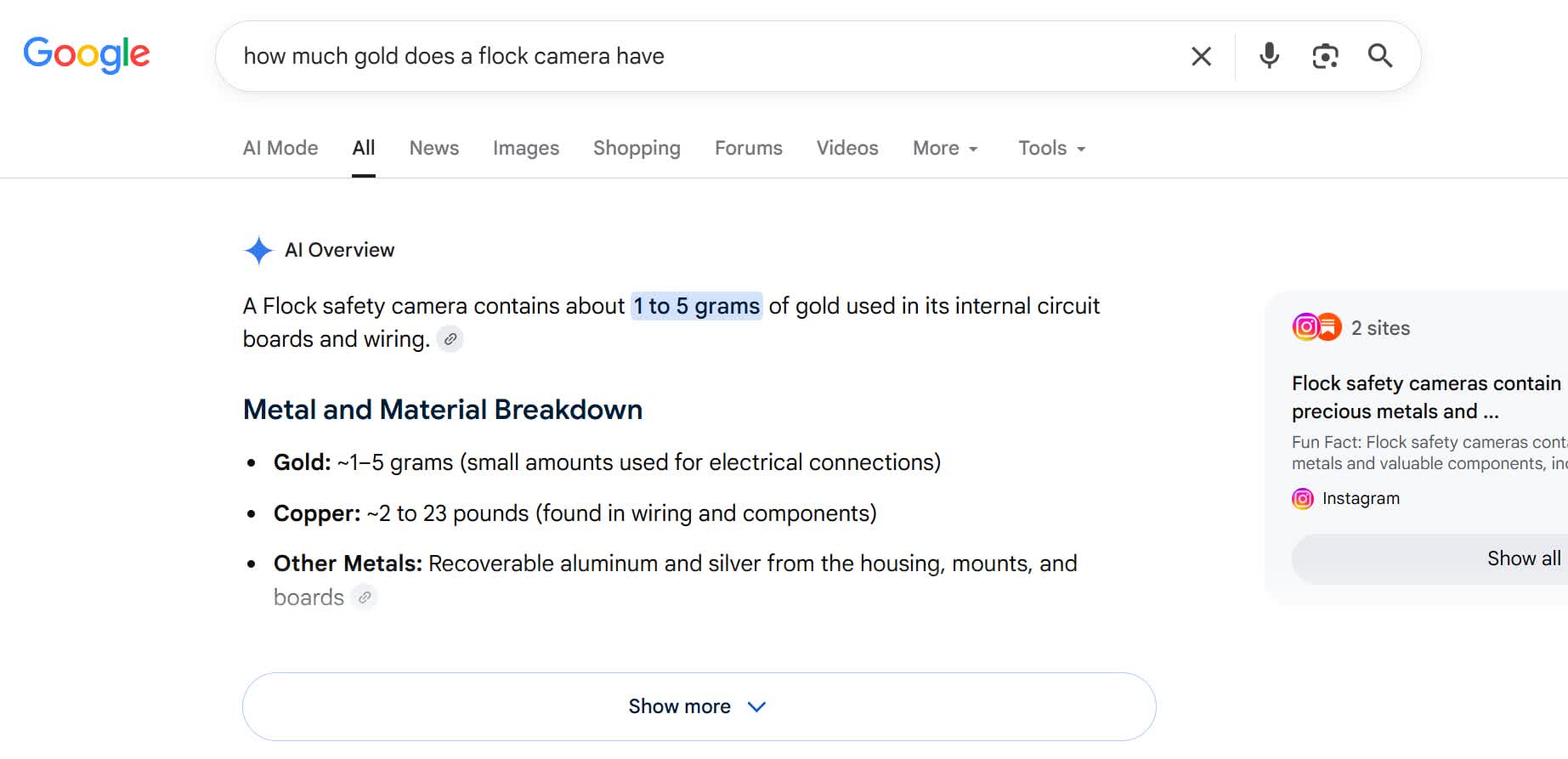
Image credit: Futurism
After the discrepancy was reported, Google appears to have updated the answer. The AI answer now pushes back directly, telling searchers that claims of a single unit holding pounds of recoverable copper are false since the whole housing weighs about three pounds, and that any gold present is only in trace amounts typical of small consumer electronics.
Some users saw this new language, too: "A Flock safety camera only contains trace amounts of gold in its standard electronic circuit boards, similar to most common small electronics. Rumors claiming the cameras are packed with large amounts of valuable precious metals – like ounces or grams of recoverable gold – come from internet memes and AI hallucinations, not facts."
Flock's cameras sit at the center of a growing AI surveillance network. The units use cameras and machine learning models to capture license plate images, translate them into machine-readable text, and feed that data into searchable databases used by police and private customers.
The process is automated end to end: the system scans passing vehicles, runs the plates through recognition software, and surfaces hits in seconds. Those capabilities – continuous data capture, AI-based identification, and fast search across large datasets – have made Flock a focal point in debates over how far automated monitoring should go, especially as reports emerge of officers using the system for unauthorized checks on romantic partners.
The technology has also become a lightning rod because it reflects where modern security tools are headed: networked cameras, automated recognition, and large, queryable datasets about everyday movement.
Online, the backlash has spawned an ecosystem of memes and videos celebrating the destruction or sabotage of the cameras. One recurring joke casts Flock's units as high-tech piñatas, packed with gold, copper, and other metals rich enough to make vandalism pay. The premise is simple: cut down the hardware, crack it open, strip out the "valuable" components, and cash in at the scrapyard.
The underlying economics don't hold up. Like most electronics, the cameras contain small amounts of precious and base metals in their boards, connectors, and wiring, but the quantities are tiny, and extracting them takes time, tools, and know-how.
Without experience breaking down circuit boards, the realistic payoff is closer to pocket change than a serious cash haul. The meme glosses over that reality.
Google's earlier AI Overview answer lent the meme a veneer of credibility, repeating it almost verbatim and backing it with two weak sources. The first was an anonymous Substack post from an account called do.not.obey.do.not.comply, claiming the "rough scrap value of these metals per camera is estimated to be $150 to $500."
The post itself admitted the figures came from "estimates based on scrap-value discussions," not testing, teardown documentation, or formal analysis.
The second was an AI-generated Instagram post urging people to rip apart Flock cameras for scrap. The account mostly posts about growing weed, plant cloning, and hydroponics, with no apparent expertise in hardware engineering.
For people using AI systems, the episode is a reminder of how easily a summarization tool can turn casual speculation into what looks like a technical statement. The model scans available content, finds material that fits the question, and stitches it into a clean, confident-sounding answer.
In this case, nothing suggests it checked whether the numbers made sense for a three-pound device, or weighed the credibility of anonymous and AI-generated sources. The output sounded certain even though the underlying data was flimsy.
The episode also exposes how prone AI models still are at missing context. The scrap-value narrative around Flock is part humor, part protest against AI-driven surveillance, exaggerating the hardware's value to make a point about the cameras themselves. Google's system didn't get the joke. It treated the posts as straightforward claims and repeated them as facts.






 English (US) ·