
 1 hour ago
23
The star of To Hold a Mountain is having trouble with her goats, which keep escaping. So my interview with Mileva “Gara” Jovanović is rescheduled to a moment where the animals are under control and Gara can descend from the peaks to her small winter residence in a small village near the capital of Podorica, for a video call.
“You have to take care of them because they are always searching for their paths,” says Gara, whose Montenegrin is translated into English by Biljana Tutorov, the joint writer-director of the stunning film about Gara’s life in the mountains of Sinjajevina. “But the goats are good, especially when they know the shepherdess. I’m a good shepherdess. They listen to me.”
People listen to Gara too, as Tutorov and her partner and co-writer/director Petar Glomazić discovered eight years ago. Their epic commitment to filming this pastoralist community, whose way of life is threatened, has been rewarded: To Hold a Mountain has swept up prizes on the festival circuit after winning the grand jury prize for world cinema documentary at Sundance earlier this year.
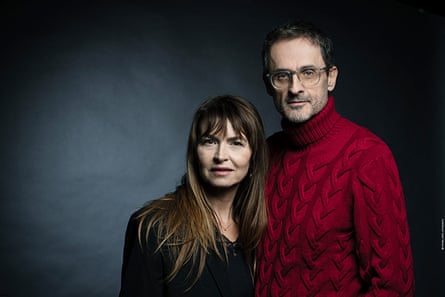
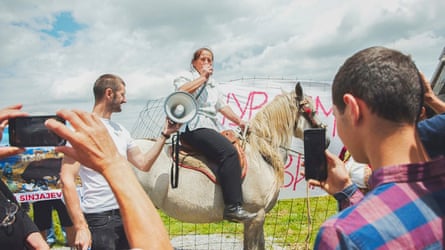
The film-makers first met Gara when she spoke at a rally against the government’s plans to turn a swath of the mountains into a Nato military training and weapons testing facility. “Somebody had to say something, and all men were reluctant,” says Glomazić. “And then one woman jumped on the white horse, took the megaphone, and made an incredible speech. And that was Gara.”
Glomazić hails from a family of herders, and understood the ancient transhumance culture, whereby graziers move their livestock to the high peaks for summer grazing and live alongside them before ushering them back to the lowlands when the winter snows arrive. Tutorov fell in love with the vivid light of Sinjajevina (“It felt like a big stage for a big story,” she says) and was also moved by the way she saw Gara embracing Nada, her 12-year-old daughter. There was some unfathomable meaning in it – the fierce protection of a shepherdess defending her flock, perhaps – and Tutorov knew they would become friends. They all wanted to make a film that would help the pastoralists resist the military takeover of their mountain. Gara recognised that the film-makers possessed “the power to actually move this mountain and to walk it around the world”.
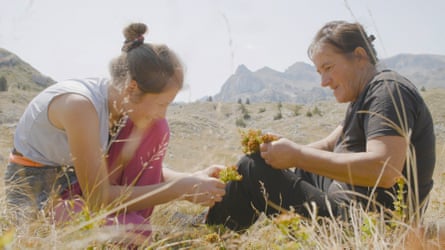
To do so, Tutorov, Glomazić and their small crew devoted years to immersing themselves in Gara’s physically brutal working life. Her small summer cabin is off-grid: water must be hauled from a well; washing is by bucket; food is cooked on a wood-fired stove. Low cloud, violent storms and early snows sweep through as the shepherds keep their sheep safe from wolves, and rescue errant cows on vast hillsides. Gara knows each cow, sheep, pony and sheepdog as an individual, and usually by name. No part of her livestock is wasted: skins of sheep are used as vessels for cheese-making; manure is gathered and sold to gardeners.
Alongside a life whose basics have barely changed in centuries, we see Nada growing up, on the brink of womanhood and caught between two worlds – painting her nails, singing along to pop songs, heading down the mountain for school and sometimes still sharing a bed with her mum in their tiny cabin.
The film contains small revelations of such intimacy and knowledge that can only be won by patient observational film-making. At one point, Gara says she can smell herbs when cows return from the highest pastures and burp. Given the freedom to roam, the animals, she says, always choose the most nutritious grazing.
We realise that Gara endures this life so devoid of contemporary comforts because it gives her freedom, too. “We don’t want to work in a private store for €300 a month,” Gara tells her fellow herders as they fight for their right to exist. “When I was young, I read about the world, where there are cities, where it looks beautiful,” she says. She moved to the city, and worked in a factory but found she couldn’t support her children on her salary and felt oppressed by her managers. “I decided that nobody’s going to be my boss. For the kids also, it was much nicer to grow up in nature. God gave us everything but often we just don’t know how to use it.”
On the mountain, she has no boss. She can choose to pause in a meadow and close her eyes, with the sun on her face. “No one determines the way I will walk through life,” she says. “Freedom does not have a price.”
The mountain gives Gara a livelihood but her defence of it is rooted in a spiritual relationship. “I feel the mountain as a living being. The mountain gives me strength and healing for my soul. Even if I didn’t extract my livelihood from the mountain, I would still defend it. If someone challenged me to choose between my life and saving this mountain for future generations, I wouldn’t have any doubt: I would give my life and say, ‘Let the mountain stand.’”
The film captures this attachment with such visceral power that we the audience feel a shocking sense of loss when the scene suddenly shifts to a claustrophobic office corridor beside a TV studio where Gara must confront military officers about their plans. The officer’s arguments appear even more ridiculous because he is the only person in the room wearing a Covid face mask.
At times like this, the film appears to be an elegy for a disappearing way of life. If the military doesn’t destroy the pastoralists’ relationship with the mountain, then economics will. Rural upland populations are shrinking across Europe and land is abandoned as traditional farming systems no longer deliver economic ease. Gara is worried that ancient skills will disappear as the number of graziers dwindles. But she is also proud that her labours have sent her children to university. Nada, her youngest, is now 20, studying biology at university; she hopes to become a microbiologist.
But Gara may not be the last in a long line of pastoralists. Tutorov says it is quite usual for today’s pastoralists to study at university and then return to their family’s traditional way of life, or combine grazing with another career.
“I think it’s possible to do both,” says Nada. “I want to finish studying and work as a microbiologist, but if life decides that I am dedicated to that job [of grazing], it will give me that.” She shares her mother’s deep connection to the mountain. “When I have a hard time, I usually talk to the mountain because it will listen without judgment,” she says.
The film was finished in the summer of 2025 when the government abruptly cancelled its plans for the military area. “We had the film done and invitations to two big festivals, and then we decided to reopen the edit and skip the planned premieres,” says Tutorov. “They were so generous in sharing their most intimate moments, and we thought: we have to put in this moment of victory.”
Gara treasures the moment. “I suddenly felt like a queen in my castle; the mountain is my castle and I’m free,” she says. Instead of being a film tour to fight the plans, the festival circuit has been a victory lap for Gara, who has travelled to Sundance, Switzerland, Sarajevo, London and Copenhagen for screenings and interviews. “It’s unforgettable, and so beautiful – I met a lot of beautiful people from different cultures.”
The struggle for the mountain, and to retain the knowledge and freedoms of an ancient way of life, is a rich story, but To Hold a Mountain contains an even more powerful personal story of abuse, grief and survival. It would be a spoiler to reveal it here but it emerged organically from the time, and the trust the film-makers shared with Gara. “I always felt the duty – I had to do everything and by all means to save the mountain,” says Gara. “The crew became like our family very quickly. And with family and friends, you are open and you want to share everything.”
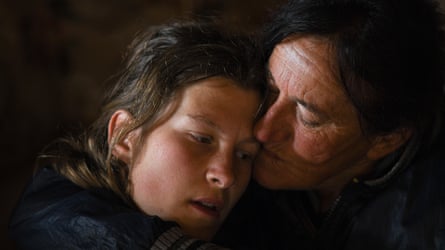
For Tutorov, it was empowering to see how Gara and her family “celebrate their wounds” as the film-makers sought to bring into the light “something that is maybe dark in our culture”.
“We also recognise that their story has a mythological depth,” she adds. “And Gara was so smart always to say when we were filming, ‘It’s not just my story. It’s the story of all women.’”
And so the film celebrates one woman’s strength across dimensions – political, physical, personal, social and cultural. Is Gara proud of what she’s achieved? “Yes, I am proud of myself, and I wanted to show all generations that women, and mothers, need to find all the strength to protect their children.”
One final question: can I try your delicious-looking cheese? Gara, Nada and the film-makers laugh. “When we come back to Britain, we will try to smuggle one in,” says Tutorov.





 English (US) ·