
 3 weeks ago
38
3 weeks ago
38
“We achieved within a few years what had taken the European space industry decades before.”
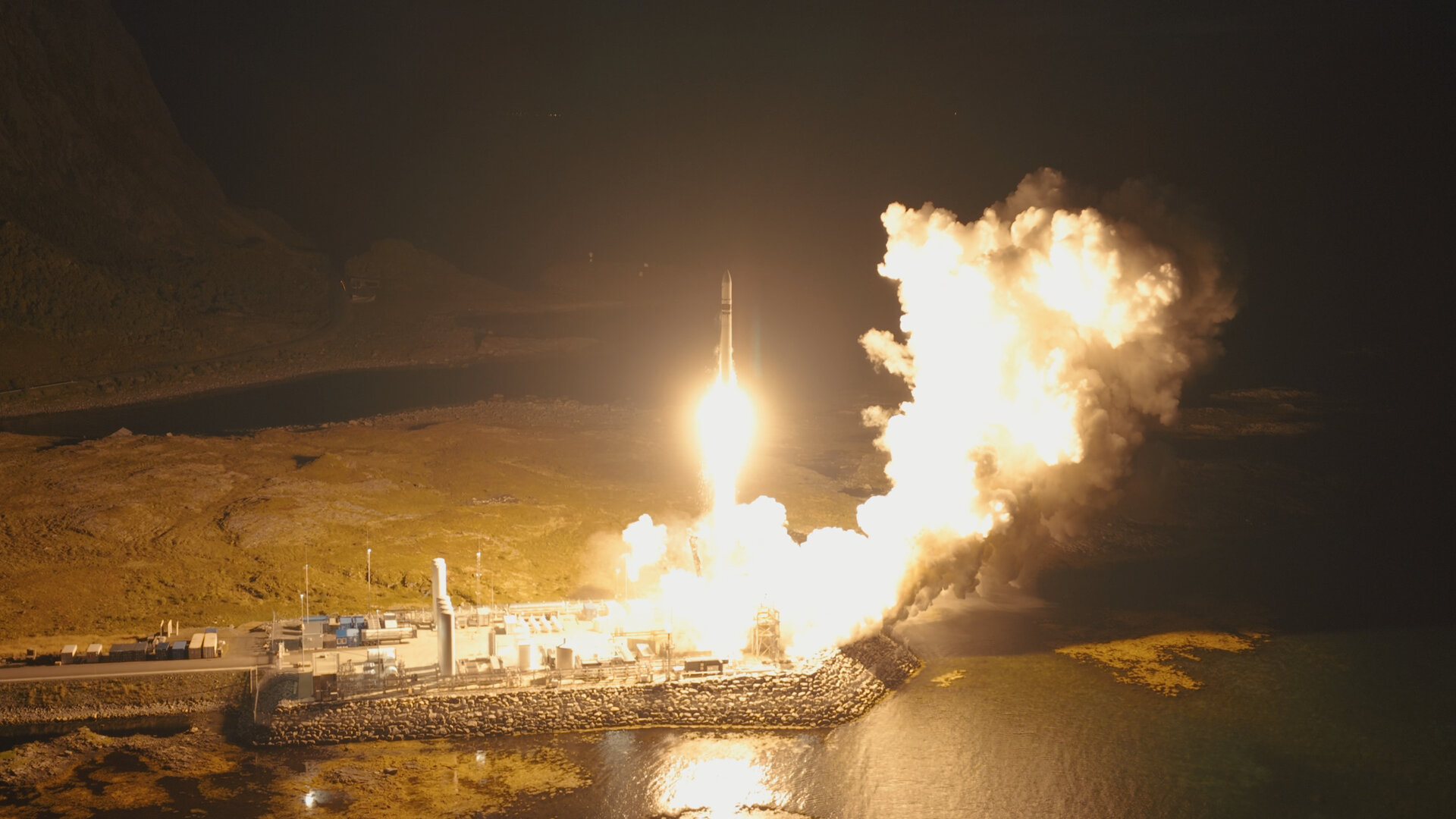
Isar Aerospace's Spectrum rocket climbs away from Andøya Spaceport in northern Norway. Credit: Isar Aerospace
Isar Aerospace's Spectrum rocket climbs away from Andøya Spaceport in northern Norway. Credit: Isar Aerospace
Isar Aerospace, founded in 2018 by three students at a German university, successfully launched a privately-developed rocket into low-Earth orbit Saturday from a Norwegian spaceport inside the Arctic Circle.
The two-stage rocket, named Spectrum, became the first fully commercial launch vehicle in Europe to reach orbit. With Saturday’s success, Isar is the clear leader among a pack of several European launch startups vying to inject some competition into Europe’s stagnant launch market.
Isar’s 92-foot-tall (28-meter) Spectrum rocket lifted off at 4:12 pm EST (20:12 UTC) Saturday from Andøya Spaceport in northern Norway, where it was 10:12 pm local time as the final bluish hues of daylight faded from the late summer sky. Seven minutes later, the rocket was in orbit.
“Today, Isar Aerospace opened space from continental Europe,” said Daniel Metzler, the company’s co-founder and CEO, in a press release. “Launch continues to be the largest bottleneck for the global space industry and from today on, there is a true alternative for commercial and institutional customers.
“We achieved within a few years what had taken the European space industry decades before,” Metzler continued. “Europe now has sovereign access to space. We have entered into a new chapter for European spaceflight. I am incredibly proud of our team, that has made this success story from Europe possible. We will now focus on rapidly scaling launch vehicle production, deliver on our order pipeline, and meet surging global demand.”
Metzler joined two classmates at the Technical University of Munich in 2018 to establish Isar, named for the river that runs through the Bavarian capital. Metzler, Josef Fleischmann, and Markus Brandl enjoyed tinkering with rocket parts in a campus workshop before deciding they might be able to make some money with their hobby.
It wasn’t easy. Europe boasts a robust space sector with an impressive pedigree, but the industry is not known for its dynamism.
“Especially early on, back in 2018, when, frankly, there was no ‘New Space’ industry, especially on this side of the Atlantic, people said it will never work,” Metzler told reporters in a press briefing Sunday. “People will continue to always say this will not work, and that will not work, until we just prove them wrong. Giving up is not in our DNA.”
It took eight years for Isar to get to orbit, a timetable similar to other successful commercial rocket startups in the West. In that time, the company raised roughly $1 billion through several private financing rounds, and now has a workforce of nearly 500 employees. This makes Isar, by far, the most well-capitalized private launch company in Europe.
“Generally, I think you very much overestimate what you can do in the short term, but I think you underestimate what you can do in the long term,” Metzler said. “Don’t forget the human element behind all of this. There are engineers, technicians, operators, a strong support team, who just dare to dream, and against all odds, that team delivered.”
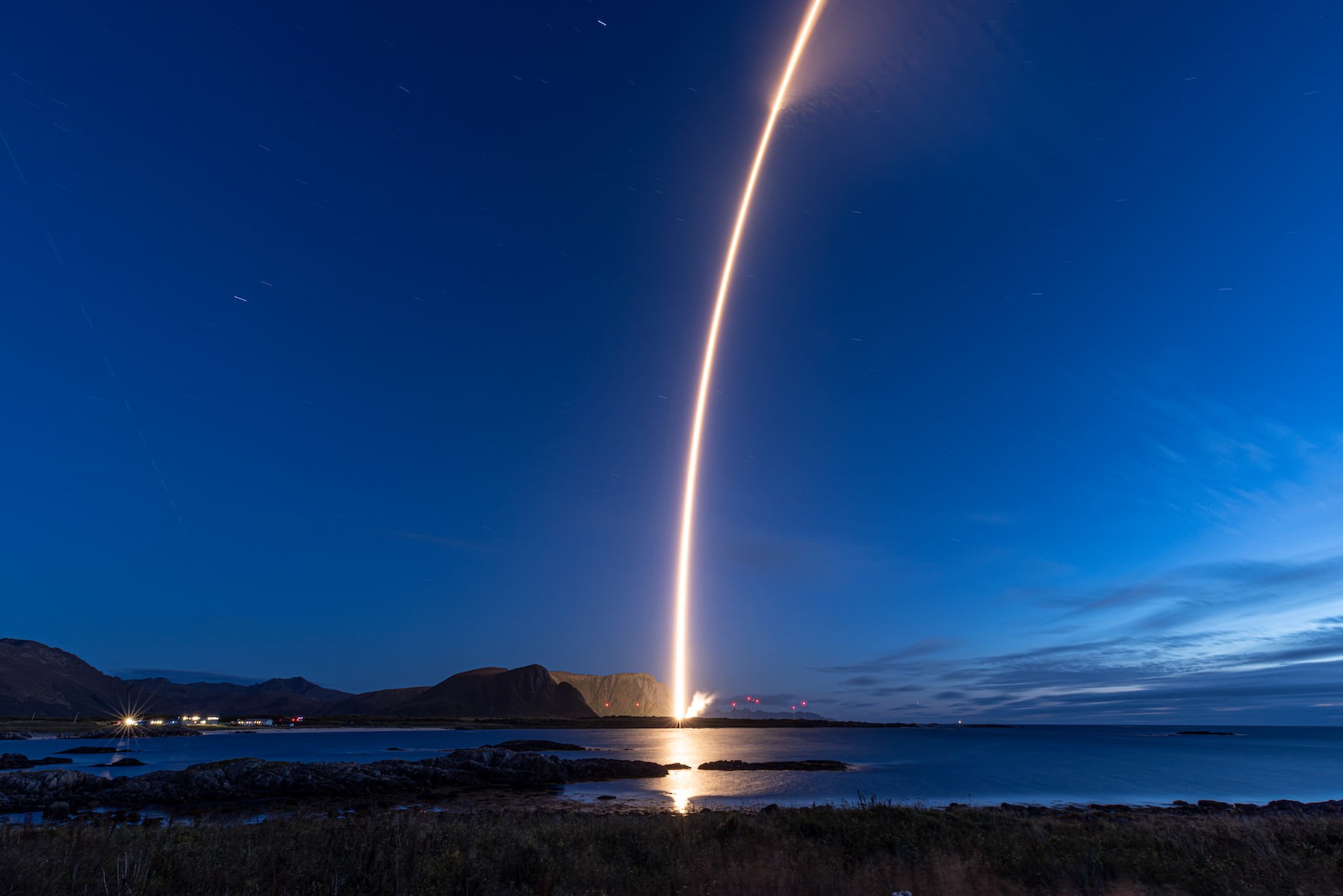
The Spectrum rocket streaks into the sky over Andøya Spaceport, Norway, on Saturday evening.
Credit: Isar Aerospace
The Spectrum rocket streaks into the sky over Andøya Spaceport, Norway, on Saturday evening. Credit: Isar Aerospace
Launch autonomy
Isar’s success is welcome news for the European Space Agency and Europe’s space industry as they seek lower-cost rockets to put their satellites into orbit. Europe’s incumbent launch providers, Arianespace and Avio, have relied upon billions of euros in funding from European governments to get their rockets off the ground. Those companies currently operate the Ariane 6 and Vega-C rockets, which have proven reliable but are only marginally competitive, even with the assistance of government subsidies.
European space officials hope a jolt of competition will light a fire under the continent’s rocket industry. European governments are accustomed to footing the bill and having a say in where rockets are built, a procurement model known as geographical return, or geo-return. The paradigm is different with companies like Isar, which established themselves on a privately-funded basis, with ambitions to eventually attract commercial and government business.
There is an important geopolitical angle to Isar Aerospace’s success Saturday, too. European startups have a harder time attracting venture capital investment than US companies, and the top-down architecture of Europe’s legacy space industry is often incompatible with the entrepreneurial culture of Silicon Valley. These headwinds are hitting Europe’s space industry as officials seek to bolster the continent’s strategic autonomy amid rocky relations with the United States and the Trump White House.
Today, Europe’s governments have to a pay a premium to launch their satellites on a European rocket. It is less expensive, but not politically palatable, to sign a contract with SpaceX to launch those payloads from the United States.
“I think that it is important to realize that Europe can also move fast and deliver,” Metzler said. “Everybody across Europe, I think, realizes what this actually means because strategic access to space and not being dependent on a monopoly … is extremely important for our own security, for our own economy, for strategic autonomy. Everything [is] there for Europe to drive those things.”
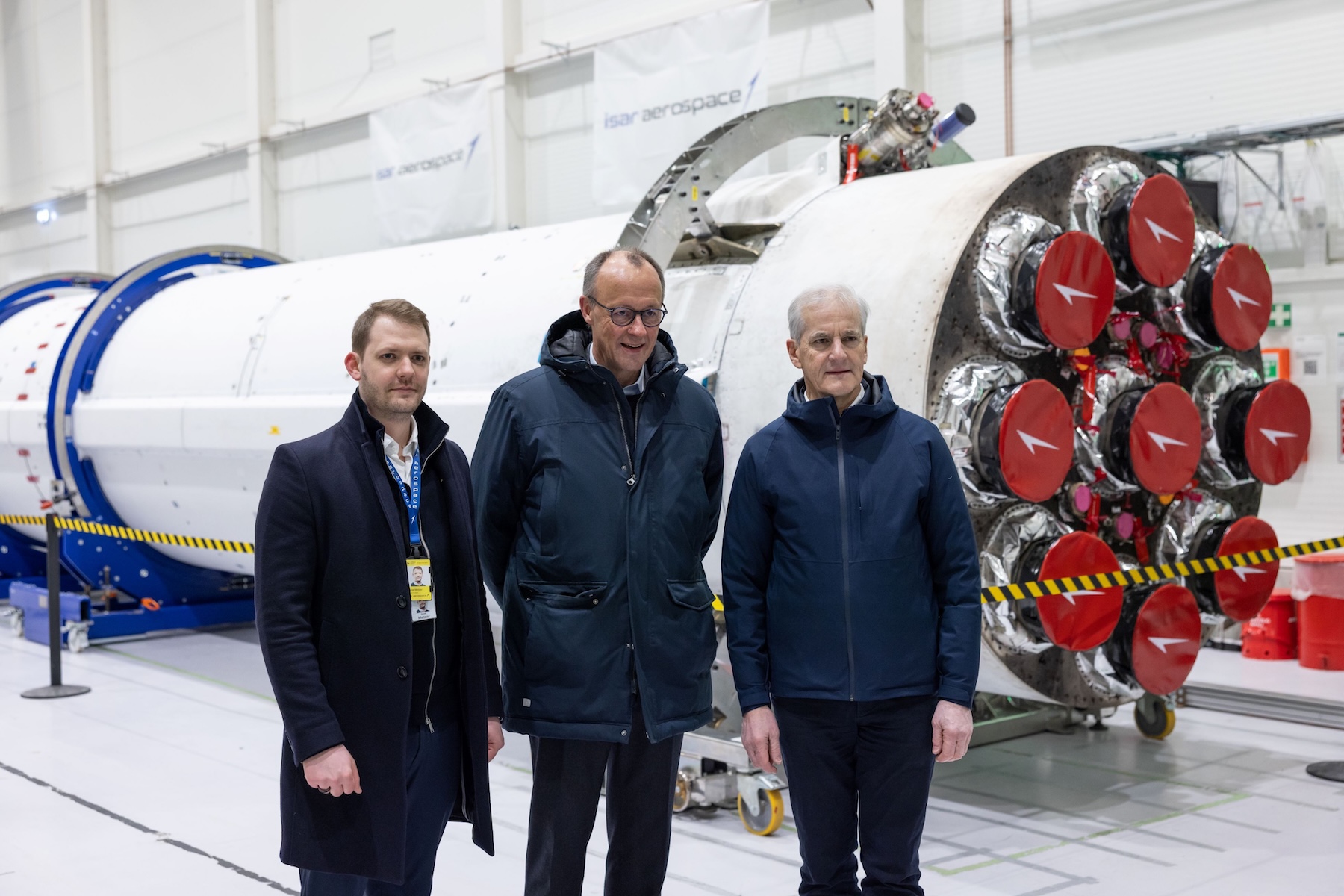
Daniel Metzler, CEO of Isar Aerospace, joined German Chancellor Friedrich Merz and Norwegian Prime Minister Jonas Gahr Støre on a visit to see Isar’s Spectrum rocket at Andøya Spaceport in March.
Credit: Isar Aerospace
Daniel Metzler, CEO of Isar Aerospace, joined German Chancellor Friedrich Merz and Norwegian Prime Minister Jonas Gahr Støre on a visit to see Isar’s Spectrum rocket at Andøya Spaceport in March. Credit: Isar Aerospace
Isar’s Spectrum made history in another way Saturday. It is the first rocket built predominately in Germany to reach orbit. Spectrum also supplants the V-2, the World War II weapon of terror, as the largest German rocket in history. Many of the V-2’s engineers, led by Wernher von Braun, emigrated to the United States after World War II to work on rockets for the US military and NASA. Germany’s domestic space industry developed a handful of small suborbital sounding rockets and manufactured upper stages for Ariane rockets. Since the 1970s, France has provided the bulk of the funding for the development of Europe’s Ariane program, taking charge of building engines and booster stages.
Germany, meanwhile, has historically preferred to spend money on satellites, scientific missions, and payloads. For example, the service modules for NASA’s Orion spacecraft are manufactured in Germany. Isar didn’t obtain a substantial up-front investment from the German government to get off the ground, but German leaders are keen to frame the company’s successful launch as key to European sovereignty.
German Chancellor Friedrich Merz visited Andøya Spaceport and toured Isar Aerospace’s launch pad in March. He congratulated the company Saturday in a post on X, heralding the launch as the “beginning of a new era.”
Walther Pelzer, director general of the German Space Agency, DLR, said Isar’s successful test flight “redefined the path to independent European access to space, a clear sign of the innovative strength of a young ambitious company.” DLR awarded the company $13 million (11 million euros) in 2021 to support development of the Spectrum rocket and arrange for the launch of the CubeSats on Saturday’s flight.
“The Spectrum rocket was not developed under a government contract,” Pelzer said in a statement. “It was developed to serve a global market.”
Worth the wait
The Spectrum rocket fits in an underserved segment of the launch market, with the ability to place up to a metric ton (2,200 pounds) of payload into low-Earth orbit. Spectrum’s lift capacity is comparable to that of Firefly Aerospace’s Alpha rocket in the United States. Alpha has achieved several successful launches, but setbacks and failures have kept Firefly from establishing a routine launch cadence.
Isar’s rocket can lift heavier payloads than Rocket Lab’s Electron launch vehicle, the market’s workhorse for dedicated launches of small satellites. Isar’s Spectrum slides in below the performance envelope of the Vega-C rocket from Italy’s Avio.
The Spectrum rocket faltered on its first test flight in March 2025, when the launcher spun out of control less than 20 seconds after liftoff and crashed near the launch pad. Engineers identified the unintentional opening of a vent valve and a loss of attitude control as the cause of the failure.
There were no customer payloads onboard the test flight last year. That changed with the second flight of Spectrum, christened “Onward and Upward” by Isar. There were five small CubeSats and a non-separating technology experiment packed inside the Spectrum rocket’s payload fairing during Saturday’s launch.
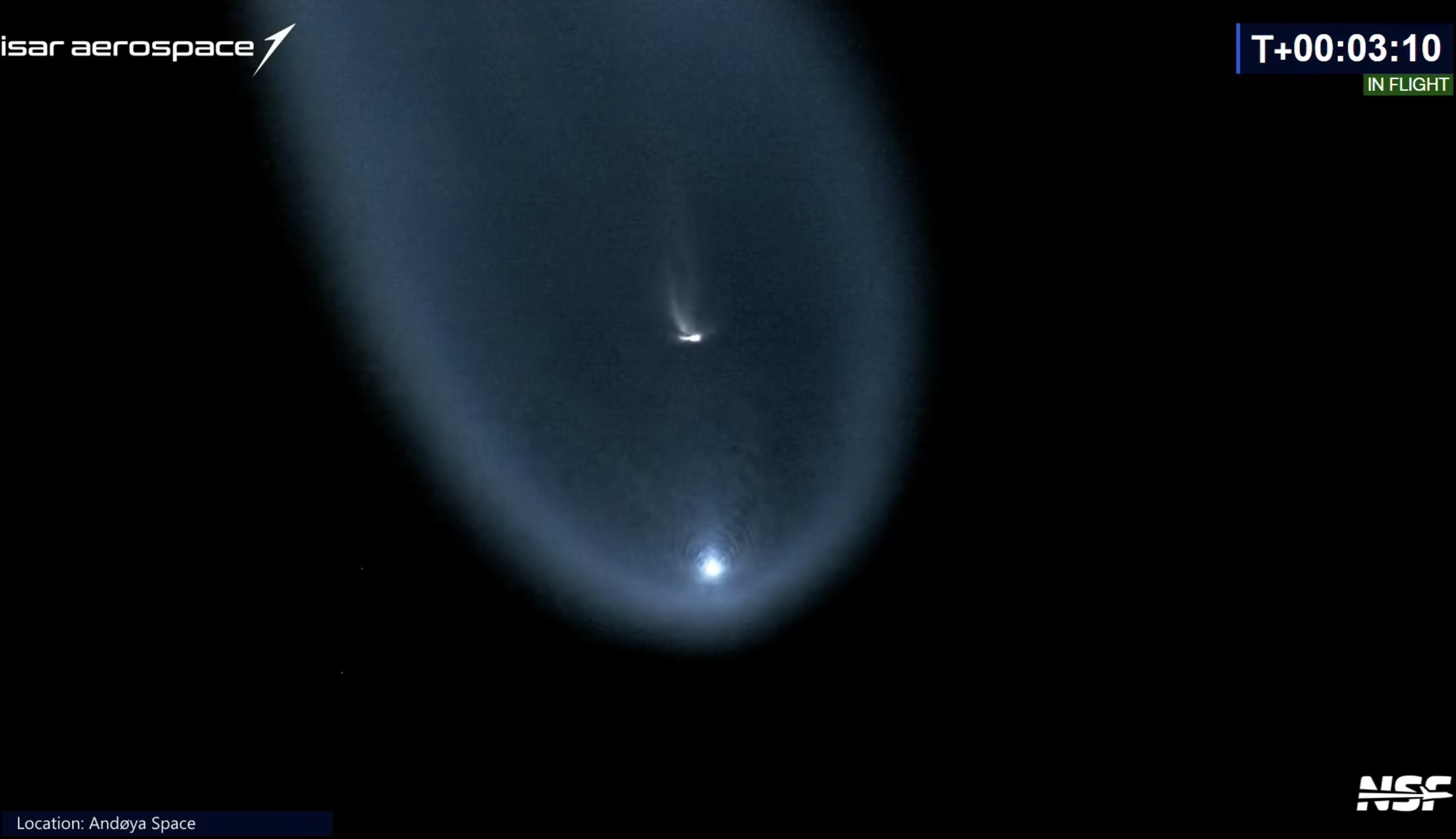
The exhaust plume from the Spectrum rocket’s second stage was illuminated by sunlight, creating a “jellyfish effect” as the vehicle climbed into space from Andøya Spaceport, Norway.
Credit: Isar Aerospace/NSF
The exhaust plume from the Spectrum rocket’s second stage was illuminated by sunlight, creating a “jellyfish effect” as the vehicle climbed into space from Andøya Spaceport, Norway. Credit: Isar Aerospace/NSF
Spectrum’s second flight began with ignition of the rocket’s nine Aquila main engines, burning a mixture of propane and liquid oxygen propellants to generate more than 150,000 pounds (675 kilonewtons) of thrust. The rocket climbed away from the launch site at Andøya, then turned north over the Norwegian Sea. Spectrum’s first stage booster fired for two-and-a-half minutes, then separated to fall into a predetermined downrange drop zone.
The rocket’s second stage ignited a single Aquila engine and accelerated to orbital velocity—some 5 miles per second—about seven minutes into the flight. The second stage was expected to coast halfway around the world before reigniting to circularize its orbit at an altitude of about 300 miles (500 kilometers).
Isar officials did not immediately specify the exact altitude and inclination of the Spectrum rocket’s final orbit. At least one of the CubeSats deployed by the Spectrum’s upper stage made contact with ground teams, an apparent confirmation that the rocket hit its target.
“I can tell you the atmosphere here in Norway was a bit crazy because orbit has a lot of meaning for a rocket company,” said Alexandre Dalloneau, Isar Aerospace’s vice president of mission and launch operations.
A series of technical problems, poor weather, and scheduling constraints on the launch range at Andøya forced repeated delays since Isar first attempted to launch the second Spectrum test flight in January. The long wait paid off Saturday.
“We knew the system could perform, but you only find out if the system actually performs when you actually hit that launch button and you see the rocket fly because you cannot simulate your way into orbit,” Metzler said.
Funding secured
The European Space Agency added $230 million (197.8 million euros) to Isar’s coffers last month with a contract through the European Launcher Challenge, which aims to support commercial launch vehicle development in Europe. Isar’s contract was the most valuable of the three awarded through the launcher challenge.
Saturday evening’s flight confirmed Isar’s pole position among European launcher startups. The other two awardees in ESA’s European Launcher Challenge—Germany’s Rocket Factory Augsburg and Spain’s PLD Space—claim to be targeting their first orbital launch attempts by the end of the year. MaiaSpace, a subsidiary of Ariane rocket-builder ArianeGroup, is in negotiations with ESA to become the fourth company participating in the European Launcher Challenge.
The challenge imposes several requirements for the participants, including a stipulation that they accomplish an orbital launch no later than 2027. Isar has now cleared this milestone just days after receiving its European Launcher Challenge contract.
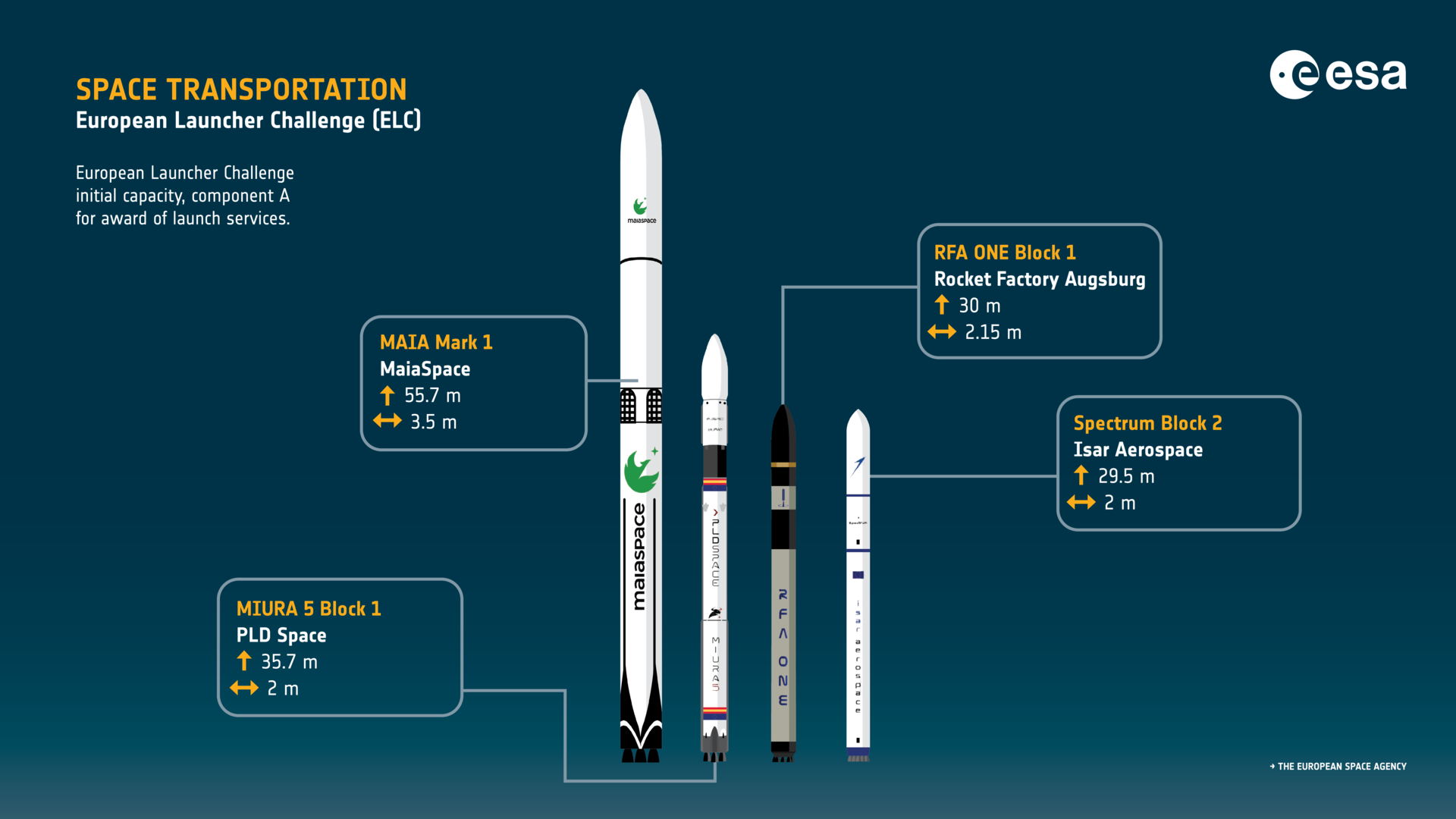
European launch providers chosen for funds to ramp up their activities.
Credit: ESA
European launch providers chosen for funds to ramp up their activities. Credit: ESA
“Spectrum quite literally rose to the challenge and delivered its payloads in low-Earth orbit,” said Josef Aschbacher, ESA’s director general.
Isar’s next task is to repeat Saturday’s feat over and over again. It often takes several years for new rockets to scale to a consistent launch rate. Isar has customers lined up to launch on Spectrum, including the European Space Agency and several commercial satellite companies, like Astroscale, an enterprise focused on in-orbit servicing and space debris mitigation.
Isar has five more Spectrum rockets in production, according to Metzler. A new 10-acre factory near Munich will have the capacity to manufacture up to 40 launch vehicles per year. “Realistically, it’s going to take a few years until we will actually be there,” Metzler said. “We’ll try to push it as hard as we can, while making sure that the quality we put out of the factory is also actually good quality.”
Isar is in the early stages of developing a second launch site in Canada, and the company may eventually base launches from Kourou, French Guiana, home to Europe’s primary spaceport on the northeastern coast of South America.
But the factory in southern Germany has to churn a lot of rockets for Isar to fully take advantage of additional launch sites. The funding from ESA’s European Launcher Challenge will help Isar simplify and standardize its design to improve manufacturability.
“Ramping production is probably one of the hardest and most underrated challenges out there,” Metzler said. “Our margins of error are so small when you compare it to other industries. Sometimes, even a tolerance of a few micrometers on a single part out of 100,000 parts can make the difference between a payload that gets separated in orbit versus the rocket exploding somewhere during the flight.”
Metzler hinted that Isar has a “much bigger” launch vehicle in its roadmap, and the company has a “dedicated team” working on technologies for a reusable rocket. He declined to offer more details.
The Spectrum rocket will also grow slightly larger to carry heavier payloads. Isar aims to sell Spectrum launches somewhere between $10 million and $15 million.
“We’ve got to basically take the design and further streamline it, almost in a bit of an IKEA approach, where you can really build a lot of units,” Metzler said. “And you’ve got to make sure that every one of those units is actually good quality.”

Stephen Clark is a space reporter at Ars Technica, covering private space companies and the world’s space agencies. Stephen writes about the nexus of technology, science, policy, and business on and off the planet.






 English (US) ·