
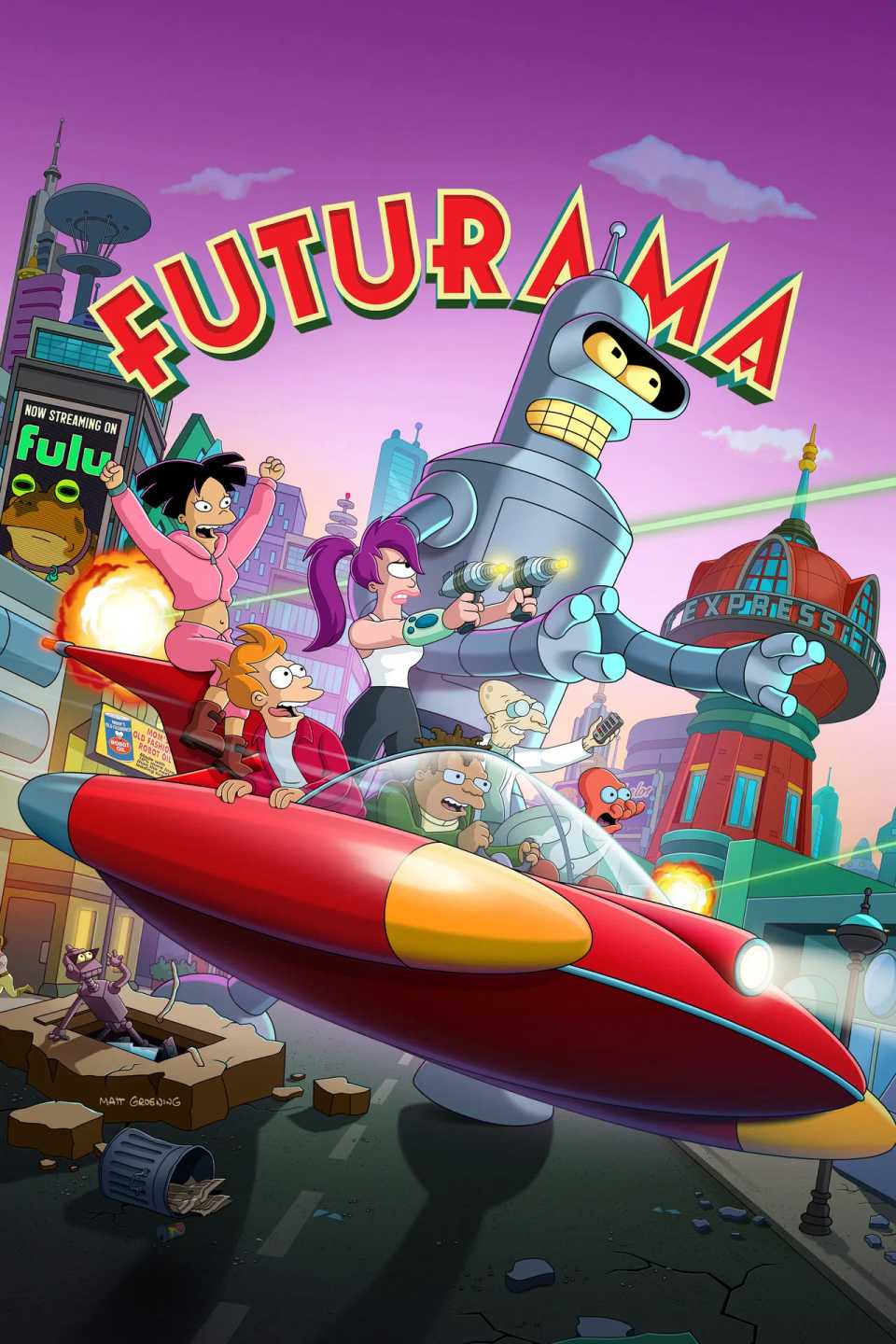
Matt Groening and David X. Cohen’s Emmy Award-winning animated series, Futurama, is a rare television phenomenon that’s stood the test of time. Its run spans nearly 30 years, surviving cancellations and the streaming era, making its new home on Hulu and Disney+. With Season 14, Episodes 1 and 2, available to stream now, Collider is proud to offer fans a peek behind the scenes. Our own Steven Weintraub had the opportunity to celebrate the debut with the creatives and cast members who bring the sharp wit and heart to life on screen in a packed theater on the Walt Disney lot in Burbank.
Last Friday, Collider invited fans to join us for an early theatrical screening of Futurama Season 14. For everyone who has since caught them on Hulu and Disney+, and everyone who wasn’t able to join us, don’t miss the full Q&A with creator Groening, showrunner and head writer Cohen, plus producer and EP Claudia Katz, supervising director Peter Avanzino, and stars Billy West (Fry, Professor Farnsworth), Maurice LaMarche (Morbo, Kif Kroker), Phil LaMarr (Hermes Conrad, Dwight Conrad), Lauren Tom (Amy Wong, Inez Wong), and David Herman (Scruff, Larry).
The team behind the hit series chats with us about new generations discovering Futurama, their nerdiest Easter eggs, the most challenging episodes to figure out, and what it’s really like behind the scenes in the booth with voiceover masters like West, LaMarche, and John DiMaggio (Bender, Sal). They also discuss the recently announced extended holiday specials, how they handled the cancellations over the years, and Groening teases his crossover episode with Disenchantment. For all this and so many great behind-the-scenes stories, check out the full conversation in the video above, with a transcript provided below.
The 'Futurama' Team Reveal Their Favorite Easter Eggs and References
"How come every time someone says the word “nerd,” everyone looks at me?"
 Image via Hulu
DAVID X. COHEN: You know, whenever we see the show on a big screen, I always think the same thing: Futurama movie. That looks so good up there.
MATT GROENING: By the way, it's so much fun because we watched the show, like everybody else, at home, and to see it with a crowd, laughing, when you do laugh, is very nice.
COLLIDER: I say this for myself, but I think I speak for everyone in the audience, and millions of people around the world when I say, thank you so much for making us laugh. Jumping in, what is the funniest or strangest way you learned that a new generation had discovered the series?
BILLY WEST: Reddit. That's how you find out. You go online, and there are all these people, “I wasn't born then.”
COHEN: A friend of mine gave me a drawing that his daughter did, who was not born when the show started. Then, she was about six, maybe. It was Bender and Fry. She had never seen the show, but she heard Bender was a robot, so there was a robot, and she drew a French fry next to it. So, that was cute.
Futurama is famous for sneaking real math and science into jokes. What's the proudest nerd Easter egg you got on TV?
COHEN: This might be me again.
GROENING: That's got to be you, David.
CLAUDIA KATZ: That's definitely a David question.
COHEN: How come every time someone says the word “nerd,” everyone looks at me? For me, probably, we did an episode called “The Prisoner of Benda,” which is one where all the characters switched brains, and they talked in each other's voices. It became this complicated math problem of, like, is there any way to switch everyone back so that they can get back to their original bodies? There were certain rules, like the same two people who had already switched couldn't switch again, so your brain had to travel through a series. So the question was, is there any way to get everyone's brain back to their original body?
We were talking about this story in the writers' room, and we didn't know the answer. We’d written ourselves into a corner. We don't know the answer. That was the end of the day. We went home. We came back in the next day, and one of our senior writers, Ken Keeler, who has a PhD in applied math, jumped up on the couch, and he said, “I proved a theorem!” This is true. He then went through it on the board.
He proved that if you can get two strangers added to the mix, then you could always get everyone's brain back to their original body, including the strangers. So, we used that to solve the conundrum on the show. But also, at the key moment on the show, at the climax, and this is probably the only time in cartoon history, for about one quarter of a second, we cut to a chalkboard that showed the entire mathematical proof. It is the correct proof.
GROENING: And we have that chalkboard here. Bring it out, David!
COHEN: So that's pretty hardcore nerd. Hardcore nerd right there.
It's one of the things I love about the show. What is the strangest idea ever pitched in the writers' room that somehow became an actual episode?
PETER AVANZINO: I’d put Fry eating Brocky J. up there.
DAVID HERMAN: NO!
GROENING: David Herman, Brocky J.
COHEN: Dave is so loud that he's declining to use his microphone. It would hurt you if he used the microphone.
GROENING: Well, I pitched an idea once that Bender wanted to steal God's treasure, and he wanted to go to heaven, and we never did it because we got canceled. So, I did this other show, Disenchantment, in which Phil LaMarr plays God. The reason I bring it up, because it's unrelated to Futurama — no, it is not! Because we have a crossover episode with Futurama in Disenchantment. Finally, we bring Hulu, Disney, and Netflix together. That's coming up on September 21st.
'Futurama's Most Emotional Episodes Are the Cast and Crew's Favorites
"That always strikes me as the point when we realized that this show can go in directions that people were not expecting."
For each of you guys, which episode best represents what each of you think Futurama is at its core?
KATZ: These are very thoughtful, tough questions. They're great.
WEST: I asked David this question earlier because this is what I think about Futurama: Does the Wheeler-DeWitt equation really matter? Is the future, in a technical sense, already there?
COHEN: Billy, stop wasting your time with these simplistic questions.
WEST: I’d love to tell you, but I signed an NDA.
COHEN: I've heard Billy talk about one of my favorites that is a Fry episode, but how about Fry’s brother, “The Luck of the Fryrish?”
WEST: “Luck of the Fryrish” was making me feel sad.
COHEN: That was the first time we went for a very emotional episode, and so to me, that always strikes me as the point when we realized that this show can go in directions that people were not expecting. So to me, that expanded the horizons that we could go for a very emotional episode about Fry’s brother.
LAURA TOM: And “Jurassic Bark,” as well.
KATZ: Oh, that’s a killer.
TOM: For me, my favorite kind of entertainment is things that make me laugh and cry, so it's pretty cool that our show can do that. That makes it quintessential to me.
GROENING: You know, you kill a dog, and people will cry. I was against it. I just want to say I was against it. However, people apparently have come to love that episode. I've met strangers on the street who tell me how much they love that episode, and then they start crying while they're telling me that.
WEST: I remember reading it, and I said, “This is going to be sad.” I just didn't know how sad. I read it, recorded it, and when I went home and I watched it, finally, I was like, “Aaah!” And I don't have a dog, so I had the cat, “Don’t go anywhere!” Everybody knows what it's like to bond with an animal. We wish they could live as long as us or forever, but they don't. So, that episode got me in the feels.
This is for the cast. Which line in the recording process has a great story behind it, too?
TOM: “Two?!”
MAURICE LAMARCHE: That's the stuff that occurs in between takes. We have this little show we do. We take it to the improv or Dynasty Typewriter about once or twice a year called Outtake-O-Rama. Because while we're recording the show, it's hilarious, but Billy and John [DiMaggio] and I love to recreate celebrity outtakes like the Orson Welles frozen peas outtake, “Get me a jury and show me how you can say ‘in July,’ and I'll go down on you.”
There's a great outtake of Casey Kasem, who was the original voice of Shaggy on Scooby Doo. He was a local DJ, and he had this national show called American Top 40, and at one point we discovered Matt’s a fan of that, so we started each trying to make Matt laugh. It turns out that your favorite moment in that is when Casey goes, “Join us this Saturday morning and every Saturday morning at two… Two?!” because he can't believe his hit show is on at two in the morning at some market. And that's the thing that makes him laugh the most, is the way Casey says “two.”
So in the studio, anytime the word “two” comes up, that includes all the variations — T-O, T-W-O — we are there with, “Two?!” So that's something that's only funny to us as this entire run has proven.
TOM: So now you're in on the inside joke.
GROENING: Wait a minute. Also, a part of that is him talking about a dead dog.
LAMARCHE: Oh, another dead dog moment. Yeah.
GROENING: Do you remember that?
LAMARCHE: Yes. Of course. “And now, we come to our long distance dedication. It's a story each of us can relate to. It's about a little dog named Snuggles. And it's most certainly… You know what? Go back to the end of the record. We’re coming out of the record now. Boy, they do this to me all the time. I don’t know how we can not come out of an up-tempo number into somebody's dog dying. I want somebody to use his fucking brain and not come out of an up-tempo… Is Don on the phone? Well, ask him what happened to the pictures I was supposed to see!” And he just goes off. We love that. We love dead dogs and we love dead DJs. We love dead DJs and we love dead Orson Welles.
I'll admit, this went in a direction I was not expecting. Loved it, though.
GROENING: By the way, he does that all the time.
LAMARCHE: This is what it's like, is us just riffing back and forth with these outtakes.
COHEN: And that’s why it takes a month to record these episodes.
LAMARCHE: By the way, my favorite science line… You gave me an education because there's this whole thing where there’s this race, and then the professor says, “You change the outcome by measuring it!” And I said, “David, I don't get this.” And he gave me an entire physics lesson. Yes. This can only happen on Futurama. And he actually got me to understand quantum physics and how an outcome can be changed by observing it. So, thank you, David. And now David in Hail science. Yeah.
COHEN: Did that answer your question? Never mind. Never mind. Let's move. [Laughs]
What's a fan theory about the show that's either dead-on or wildly off base?
LAMARCHE: We don't get to hear the fan theories that often.
WEST: Anybody got one? We can riff on it, at least.
AVANZINO: The theory that it's just a cartoon has always really bugged me.
COHEN: There was stuff, like we had hidden Nibbler’s shadow in the pilot. I mean, I don't know if this, again, answers your question, but later on that became public knowledge, years later, when we had some backstory about time travel, and then a lot of the fans thought we had gone back and inserted that, and it was only in reruns, but it was always there.
AVANZINO: I will say, you did insert it. I think we had maybe even gotten color back, but we hadn't aired it yet, and it was inserted. It was not originally there, but it was originally there by the time it aired.
COHEN: Yeah, because in between, that's when Nibbler went back in time and changed the picture you were drawing.
GROENING: Wait, wait, wait, for clarity, because you've just confused things, before the pilot aired, it was put in.
AVENZINO: I said that.
GROENING: It was always there.
COHEN: I think we're just fanning the flames of this conspiracy.
This is for the cast. Which character is the most fun to play and which one is the most physically exhausting on your voice?
WEST: The Professor, as time wore on, his voice went from being like, “Well, Fry…” and then it turned into, “Hey!” And David liked it the angrier and angrier that he got, so that one is a tough one on me.
LAMARCHE: He's probably the most fun for all of us to play because when we're in studio recording the show, the other thing we do between takes is do each other's characters. So, John DiMaggio does a pretty great Professor Farnsworth. “Oh my, yes!” We just go a little crazy doing each other's characters.
WEST: Tell me where he lives. Give me his phone number, and I’ll kill him.
LAMARCHE: Morbo for me, or Lrrr. “Lrr, ruler of the planet Omicron Persei 8,” because he lives in the same place in my voice that Yosemite Sam does. “Ohh, I hates rabbits!”
WEST: We got something in common because I always thought rage was a beautiful vehicle for comedy or performing, so the professor was like, “Who needs courage when you have a gun?” He's just angry.
TOM: And I got to play Jrrr once! That was really hard.
LAMARCHE: Yeah, you gotta go to your growl place.
PHIL LAMARR: So many amazing characters all these great people are doing. Actually, I would say the most challenging one to voice for me was the futuristic basketball star, Bubblegum Tate, because then I had to sound taller and more athletic than I am.
GROENING: By the way, how was it to hear your voices on the big screen? Wasn’t that amazing?
TOM: It was awesome. It looks beautiful, too.
GROENING: And how we cut it together.
WEST: The ring was blowing my mind. It was breathtaking. It was so beautiful.
GROENING: Shout out to Rough Draft. Amazing animation.
COHEN: And by the way, let's compliment the directors, Edmond Fong for the first one, and Crystal Chesney Thompson. I just want to also add, I hope I'm not giving away too much information, but Crystal, the director of the second one, used to have pet rats. So I remember when this episode was in the pipeline, I called Claudia, and I was like, “If there's any way to massage the order so Crystal could get it,” and then Claudia said she’s already doing that one.
KATZ: It all worked out perfectly.
LAMARCHE: Dave Herman, which is tougher on your voice, Scruffy or Roberto?
HERMAN: “I was just going to practice my stabbin’.”
KATZ: I don't know that anything bothers Dave's voice. Brocky J. is pretty awesome.
Which cast member is most likely to improvise something that ends up in the final episode?
COHEN: I think it's David Herman.
HERMAN: Steve, in this show, they got a lady, one eye. Steven, just to be clear, she doesn't have the option for two eyes. She's got one eye. One eye. When I saw that, I thought to myself, I said, “Now I've seen everything.” But then, then they got a talking robot! And not just that, this one robot talks and then the next robot, he's talking to him. Steven, I have a toaster oven. My whole life, never does this toaster oven talk to me. And then I was like, “Now I seen everything.” But no! They got a lobster man.
But that, that's for real, because I know a guy who works at Outback Steakhouse, and that stuff they got on the menu, that ain't lobster. That's lobster man. That's lobster man. And they don’t wash the Hooley Dooley Coconut Shrimp there. Just so you know, they don't even take out the poop line on the shrimp. They just bread it. They just bread it and they serve up lobster man. Just so you know. Does that answer your question at all?
WEST: Dave does improve-ization.
What is the hardest line of dialogue any of you have had to say because of the scientific language, alien terminology, or sheer number of syllables?
WEST: I guess it was Diamondium and Diamondillium. That was kind of tough. I mean, it's not tough for me to say it, [in Professor Farnsworth’s voice] “But for me, I went through 50 takes.” You know what we should do? Cutting Room Floor-O-Rama. All the stuff that didn't make it in, we'll throw it together. Somebody’ll animate it. I'm sure you guys can do it. Because AI is the Hamburger Helper of creativity.
COHEN: We do not use AI on our voices. It all comes out of these guys. And by the 38th take, they always get it.
What's a tiny visual joke or background detail that took an absurd amount of work, but most viewers probably never noticed?
KATZ: We have three or four people who literally go through every frame of footage before these guys ever see it, and we really hone it tremendously before we bring it to Matt, David, and the writers. Then it sort of gets improved again. But I think sometimes we adjust things nobody but us notices or sees, but we can't unsee it. We fix a lot of stuff.
AVANZINO: We don't get to verbally ad-lib, but if they give us a robot chop shop, it's packed with Rosie and Bill & Ted robots and everything we can pack in it. Meanwhile, in Times Square, I don't know if I ever told you this, but there's a spider robot frozen. When the whole world is frozen, there's a little spider robot kind of swinging there.
COHEN: I gotta watch this show.
AVANZINO: For me, I know I had to argue in “Parasites Lost” when Lila chopped them all up with the ax, which I really loved. You guys thought it was a little extreme. I go, “Just wait and see. I think it'll be pretty good.” Not really an Easter egg, but…
LAMARR: We don't generally need to ad-lib lines because we've got so many great Harvard grad writers.
TOM: That’s so true.
'Futurama's New Extended Holiday Special Will Be "Closer to Movie Length"
The special will also honor Kwanazabot, played by the late rap icon Coolio.
 Image via Fox
It just came out that you guys are doing three extended-length specials with the first holiday special planned for 2027. What can you tease about these episodes?
LAMARCHE: We've seen it, and you haven't! We've seen it, and you haven’t!
COHEN: It's very exciting, first of all, because I was just saying how great the show looks on a movie screen. So in this case, we get to write them a little bit more like movies because they're closer to movie length. So, I think they're going to be very good. What can I say without tipping too much…?
HERMAN: There's this lady, she's got one eye. One socket — not missing an eye. You know what I'm saying?
COHEN: We're going to deal with a real-life emotional thing, which is the loss of Coolio, who played Kwanzaabot, so we're going to try to give him a proper sendoff for the character. We have a big story about Fry’s childhood fantasies about Santa Claus, and there is a tragic romance involving Bender and a snowman. I think that I have taunted everybody enough with that teaser.
I appreciate you indulging. What can you tease about the rest of the upcoming episodes this season, which start on Hulu on August 3rd?
KATZ: They're great!
GROENING: Well, we decided we've done it where we release them all at the same time, and that's really fun. It's really fun for a weekend. And then the fans who are watching the entire show are saying, “When's the next season coming out?” So this time we're going back to the old-fashioned way of two on the premiere on Monday…
WEST & LAMARCHE: Two?!
TOM: See? Now you all understand.
LAMARCHE: See how much Matt loves it?
GROENING: …and then one week! And you get to talk about it at work in between.
Matt, I do have a question for you. I noticed on the upcoming episodes for the new season that on Episode 9, you're listed as a story-by credit with Josh Weinstein. You don't give a story every season of the show, and I'm just curious, what can you tease about it?
GROENING: That's the one I mentioned. That's the Disenchantment-Futurama crossover. Josh worked on Futurama in the past, and we put together Disenchantment together. During the writing of that episode, I got COVID and dropped out, and so Josh carried on without me.
KATZ: Andrew Han directed the episode.
What's a Futurama episode that looked simple on the page but turned into a very complex thing to actually produce?
GROENING: All of them. I think that ring world must have been.
AVANZINO: I can't think of one that looked simple on the page, actually.
GROENING: Every script… All the animators are going to mute me on this one.
COHEN: Claudia, which one drove you insane?
KATZ: I think that fractal episode because the whole nature of fractals is you cannot control them. So, our head of CGI, Scott Vanzo, basically figured out how to kind of create and automate and sort of corral fractals to get them to do what we needed them to do, and it was quite insane and beautiful. But I think it was so much more complicated than you would think.
COHEN: That's the episode where the ship gets squashed, and then they're in the two-dimensional flatland, if anybody remembers that. But then to get back, they have to go through the intermediate dimension on the way back to the third dimension, which is sort of — I'm going back into Nerdville, but mathematicians talk about fractals as having a fractional dimension, so that's what they were trying to animate, a universe that was between two and three dimensions.
KATZ: That was a thinker. But yeah, it ended up looking beautiful. But I think we, for better or worse, really take the challenges in the scripts as throwing down the gauntlet and really wanting to excel and overdeliver.
We had an episode where you guys just sort of cavalierly wrote “everyone who's ever been in Futurama appears,” and so I said to Pete, “Well, why don't we just go back and ask?” Because generally the writers are very considerate and collaborative. And Pete's like, “No, no, they wrote it. We're going to do it.”
AVANZINO: I wanted to do it.
KATZ: When we brought the color in, David started chuckling as soon as he saw it. He goes, “Oh my God, I didn't know you were going to do it.”
GROENING: I have reminded the animators on Futurama and on The Simpsons, I said, “Look, we have a lot of crowds. Look at Dumbo. They put the crowds in the dark in the circus, okay? And you animators never do.”
AVANZINO: Well, the scripts usually call for the crowds to be doing things, like “everyone in Futurama says ‘Yay!’”
COHEN: No, that's too easy. Everybody in Futurama is each doing their own thing.
AVANZINO: But if you read The Art of Futurama book, I'm the guy who always complained, “How are we supposed to do that?” But when you write a murderlator killing machine, we really enjoy figuring out and making it look good. Road races and rainbow nebulas, it's a really fun challenge to us.
COHEN: Also, sometimes we are vague because we know Pete and the animators at Rough Draft can come up with a better visual idea than we can. So, we try to describe the mood, maybe, and they come up with the means of doing that.
KATZ: Yeah. We'll get scripts that just say “elaborate space battle takes place here,” and then we sort of take it from there. So, I think that the beauty is we've all been working together so long that there's sort of a great shorthand and trust. We're so fortunate to get the scripts that we get, and hopefully, we live up to them and sort of give them a value added when we return them on the screen.
'Futurama's First Cancellation Wasn't Really a Cancellation
"I think they just stopped returning Matt's phone calls."
 Image via Hulu
At this point, Futurama has survived multiple endings and revivals. Which cancellation felt the most final, and when did you realize the show might actually be immortal?
KATZ: Well, the first cancellation wasn't even really a cancellation. I think they just stopped returning Matt's phone calls. So, it was like we kind of got ghosted.
COHEN: This is a true story about that. We were working for the Fox network. We had offices in a building that Fox owned off the lot, but a building Fox owned, so we were in there for, like, four years in this building. We were working on the last season, and waiting, waiting. They haven't picked us up, haven't picked us up. What's going to happen? Then one day, a real estate agent comes through while we're at work, saying, “We got four offices over here, and three over here.” That's probably not a good sign.
KATZ: That might be worse than being ghosted.
GROENING: One of the times we got canceled was on Comedy Central, and the president of Comedy Central called to say that he was sorry to cancel us. Many years went by. Last year, I got on a plane to go to the New Orleans Jazz Fest, and sitting next to me was the guy who canceled us.
LAMARR: Oh, wow.
GROENING: And he said, “You probably want to punch me in the face, don't you?” But you know what? It's all showbiz. He was a very gracious guy. I'm not going to name him. You can look it up.
KATZ: I hope you left him something very special on his seat when he went to the restroom.
COHEN: In fairness, Matt, he also brought us back onto Comedy Central after we had been canceled.
KATZ: That's true.
GROENING: Well then I shouldn't have punched him!
I have some trivia questions. Let's see how it goes. What is Bender’s serial number?
COHEN: I know the first three digits because they were the first three digits of my phone number at that time. I don't remember the last four.
KATZ: You mean the number of his chip?
COHEN: It's 271-something.
AVENZINO: 6057.
WEST: I know the combination of Fry’s safe back in 1999 — Three.
COHEN: Pete, you knew it off the top of your head?
AVENZINO: Nah, I got it right here, written down.
COHEN: It's the sum of two cubes, as I recall.
What’s the name of Fry’s dog from the past?
TOM: Seymour.
In “Roswell That Ends Well,” what was the name of Fry's original grandfather before Fry accidentally caused his death?
LAMARCHE: Enos.
GROENING: By the way, one of the best episodes, “Roswell That Ends Well.”
WEST: Well, Enos was trying to figure out who and what he was. “Hey, Fry, did you ever get the feeling you was going out with girls cuz you’re s’posed ta?”
What rare musical instrument must Fry learn to play to express his feelings for Lila in “The Devil's Hands Are Idle Playthings?”
LAMARCHE: Holophoner.
AVANZINO: Who directed the first holophoner scene? [Raises hand]
What is the name of the robot devil's domain located underneath the abandoned Reckless Wrecks ride at a New Jersey amusement park?
LAMARCHE: Robot Hell.
I am curious, though, what is it like in the editing process of this show? Because with animation, things can change. How has it changed in the editing room, maybe in ways you didn't expect?
COHEN: I mean, we do a lot of work in the editing room, but I think the type of stuff you're thinking about is probably more like the animatic stage. If you guys want to describe what the animatic is.
KATZ: We have several real benchmarks for editing. The first is the radio play, which is when our editing team takes all the wonderful voice performances we get, and out of that embarrassment of riches, creates the ultimate take. Sometimes it's multiple takes stitched together, sometimes it's one run. And then David works really closely with the editor on finalizing that radio play.
COHEN: That's Paul Calder, our long-time editor who’s really great.
KATZ: And then we storyboard really specifically to that track. So, all of that acting is completely inspired by the voice performances, but the filmmaking and the physical acting, it really comes from the director and the supervising directors and our board artists. Then we shoot something called the storyboard animatic, which is really the storyboard exposed to the radio play, and that’s sort of when we bring it back to Matt, David, and the writers. It's actually a really good tool to evaluate what's working or not working, and we sort of take it from there.
COHEN: So at this middle stage, we see it's a black-and-white pencil drawing — I don't think actual pencils are used anymore, but you know what I mean — and it's just jerky poses, but enough to convey all the key emotions and key actions. We hear that with the whole dialogue track going and some temporary music and things. That's really the stage at which everyone can kind of see if it's working, if there's a boring part, if it's too long, we have to cut something. Sometimes things aren’t clear, so we'll even write an entirely new scene or two at that stage. So that's really where it can be fixed up if there are any problems, or made better if it's already perfect.
AVENZINO: And we do that before it goes to animation. That's the stage where we're doing key drawings.
Have you ever reached a point where you're like, “Maybe we really need to redo a bunch of things?” Or when you get to that stage, it's only minor things that have to be adjusted?
KATZ: I think early on. I'll tell a small story out of school, which was the very first Futurama, the pilot. We were running behind, so I think we literally screened that episode on a Saturday of some holiday weekend, I can't remember. We screened it, and Matt, David, and the writers left, and Rich Moore and I, who directed it, were sitting in Matt’s office waiting and waiting and waiting.
GROENING: We thought you had left. We went home.
KATZ: Yeah. Rich had already started to go, “We're getting fired. We're fired.” I go, “No, no, it's fine.” So eventually, I think David or Matt came back and said, “We have some story stuff to figure out. You guys can go, and we'll get back to you. We’ll send you the script.” So, I think pilots are so hard. That one had a larger than normal rewrite.
But for the most part, it's a pretty smoothly-running machine. Matt, David, and the writers are so dialed in to what the show is and how it works and how great these characters are, that pretty much it’s just honing from the first record script on.
GROENING: Well, I loved the pilot, but the executives at Fox did not. They said, “We thought this was going to be The Jetsons. It's so dark. Why is there a suicide booth?”
KATZ: Yeah. They were not pro-suicide booth.
GROENING: The funniest thing about that particular episode for me was that that's where Bender meets Fry, and you have to pay $0.25 for the booth to work, and Bender has a quarter on a thread, and so he gets it back, even though he's going to the booth. And by the way, that was inspired by a Donald Duck cartoon, “Modern Inventions,” from 1938. So, there you go.
By the way, I also want to say that I think that pilot is fantastic, and so does the internet. They rave about how great that pilot is.
HERMAN: Donald Duck commits suicide?
Futurama Season 14 is now streaming on Hulu and Hulu on Disney+ for bundle subscribers. New episodes will stream on Mondays.
Release Date March 28, 1999
Network FOX, Comedy Central, Hulu
Directors Peter Avanzino, Brian Sheesley, Crystal Chesney, Frank Marino, Edmund Fong, Stephen Sandoval, Bret Haaland, Rich Moore, Ron Hughart, Dwayne Carey-Hill, Raymie Muzquiz, Mark Ervin, Susie Dietter, Gregg Vanzo, Swinton O. Scott III, Ira Sherak, James Purdum, Corey Barnes, Lance Kramer, Ray Claffey, Chris Sauve, Jeffrey Lynch, Pat Shinagawa, Wes Archer
Writers Eric Rogers, Dan Vebber, Maiya Williams, David A. Goodman, Ron Weiner, Aaron Ehasz, Kristin Gore, Brian Kelley, Evan Gore, Heather Lombard, Jason Gorbett, Michael Saikin
-

Billy West
Fry / Professor Farnsworth / Zoidberg / Zapp Brannigan (voice)
-




 English (US) ·