
 1 month ago
119
1 month ago
119
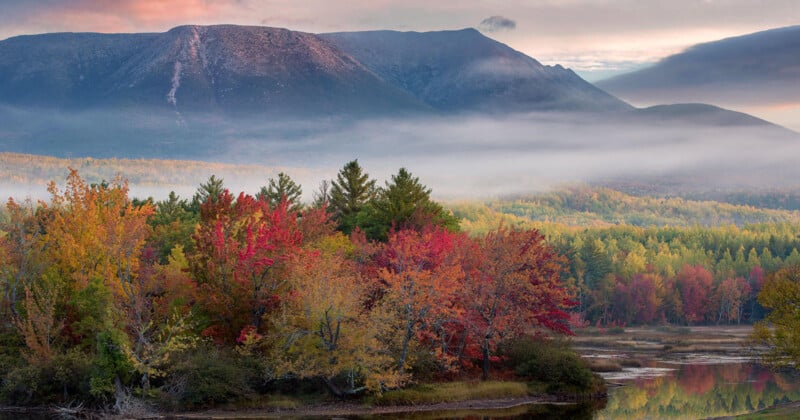
Photographer and university student Megan Tucker created a browser-based photography conditions forecaster, LightCast Suite, to help fellow photographers decide when it’s worth heading out with their camera gear.
Like many photographers, Tucker loves going out and shooting. However, it can be tricky to determine whether the conditions will be good enough to justify packing a camera bag and heading out, especially for photographers who need to drive a long distance to reach their favorite spots.
Tucker’s LightCast Suite scores photographic conditions at a selected location on a 0-100 scale for golden hour (sunrise and sunset), night sky, and aerial photography. As Tucker’s portfolio shows, the Bentley University marketing student (class of ’26) is a passionate drone photographer.
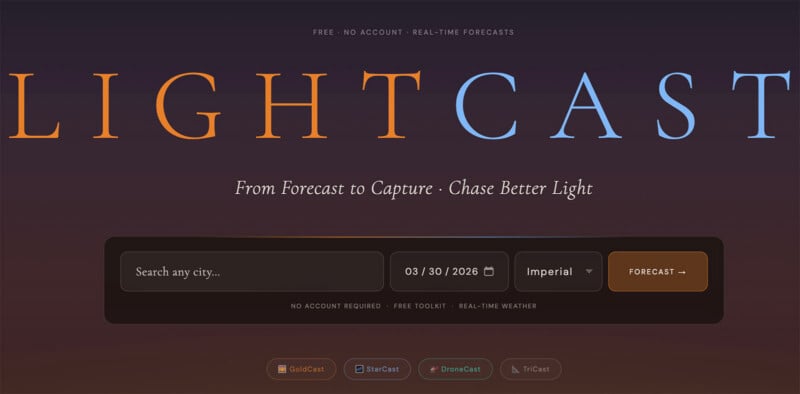
“I think it fills a real gap that has personally bugged me as a photographer for years: regular weather apps don’t tell photographers what they actually need to know before driving to a location,” Tucker tells PetaPixel.
LightCast Suite considers numerous factors when calculating its score for sunrise and sunset conditions, including cloud cover, the proportion of high-level cloud cover, humidity, visibility, low cloud percentage, and precipitation. There are four tiers of scores: flat light (0 to 34), worth shooting (35 to 54), great conditions (55 to 74), and finally, “Epic Light” (75 to 100).
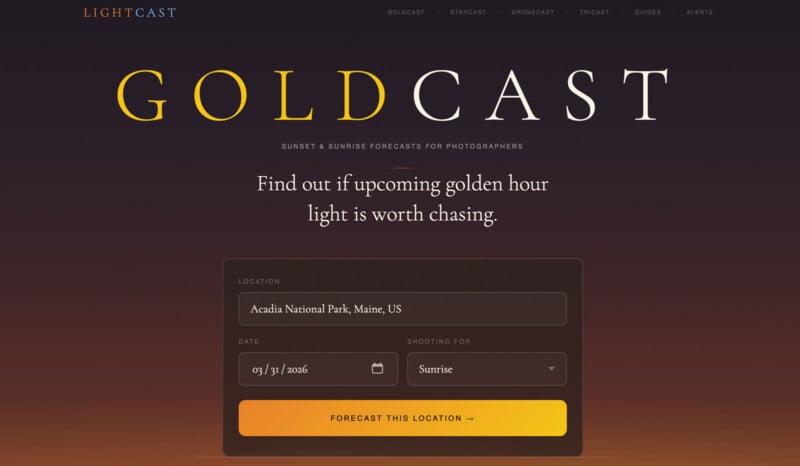 GoldCast predicts golden hour conditions around sunrise and sunset.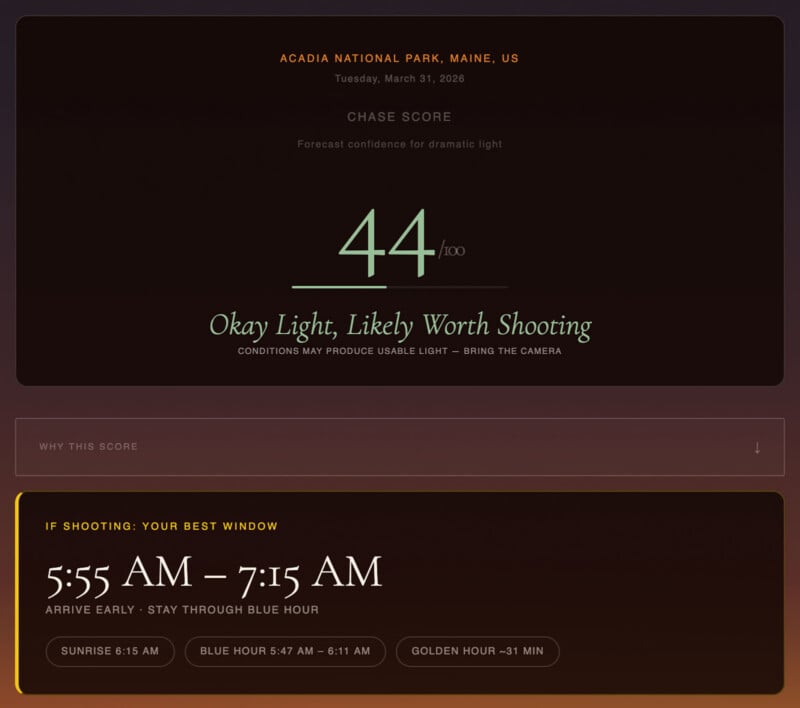
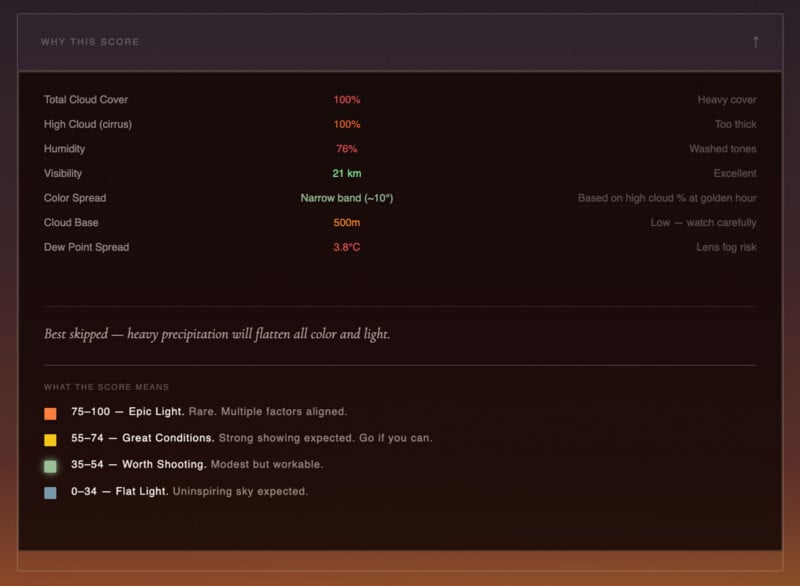
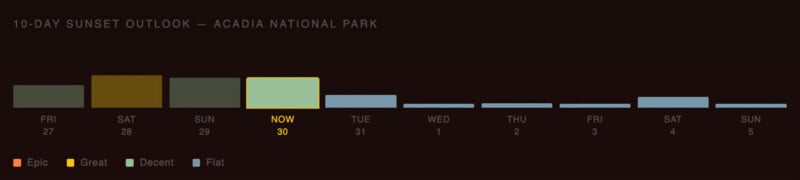
Users can select a date up to a week in advance, though, of course, weather forecasts can change dramatically over that period. The closer to the present time, the better, at least for sunrise, sunset, and aerial photography conditions.
On the other hand, some aspects of night sky photography conditions are a bit easier to predict. Important factors, such as the Moon’s phase and the light pollution level at a selected location, are predictable. However, cloud cover, visibility, atmospheric seeing, and dew-point spread vary from day to day. Like with sunrise and sunset, the StarCast has four grades. In this case, they are: stay in, worth shooting, great seeing, and pristine sky.
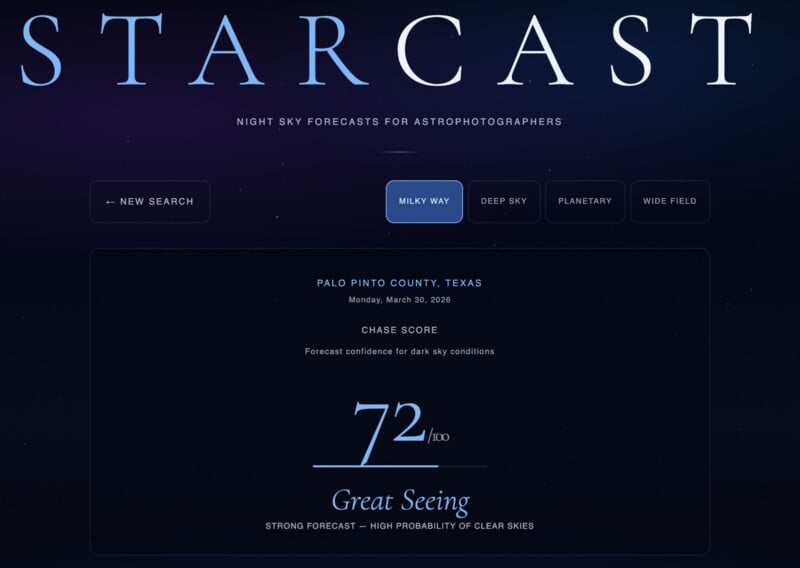 StarCast is for night sky photography, and includes scores for Milky Way, deep sky, planetary, and wide field astrophotography.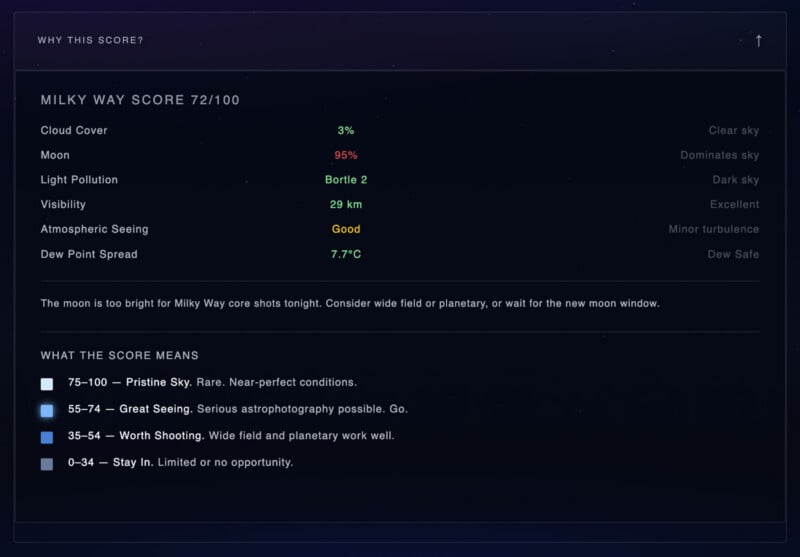
The StarCast provides detailed information, including moonrise and moonset times, visible planets, and notable constellations in the sky and their locations.
As with any forecasting system, there is always a chance that predictions will be wrong. A great forecast doesn’t prevent bad conditions, or vice versa. However, time is precious, and it is always disappointing to go out and come home empty-handed. LightCast Suite is built to help prevent these disappointments, while also providing photographers insight into when photographic conditions might be phenomenal. Photographers can even sign up for email alerts to be notified when conditions at a selected location exceed a specified threshold.
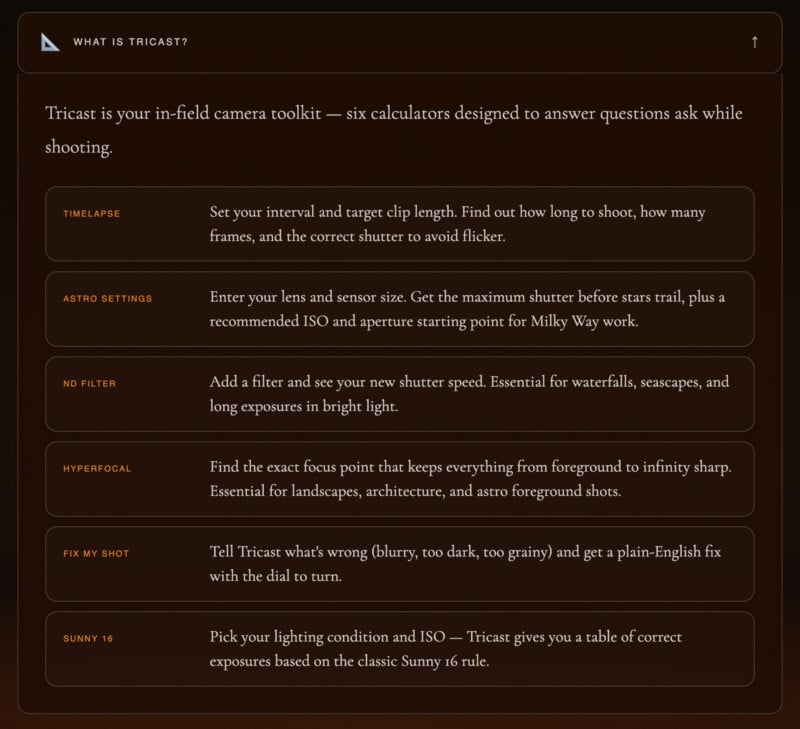
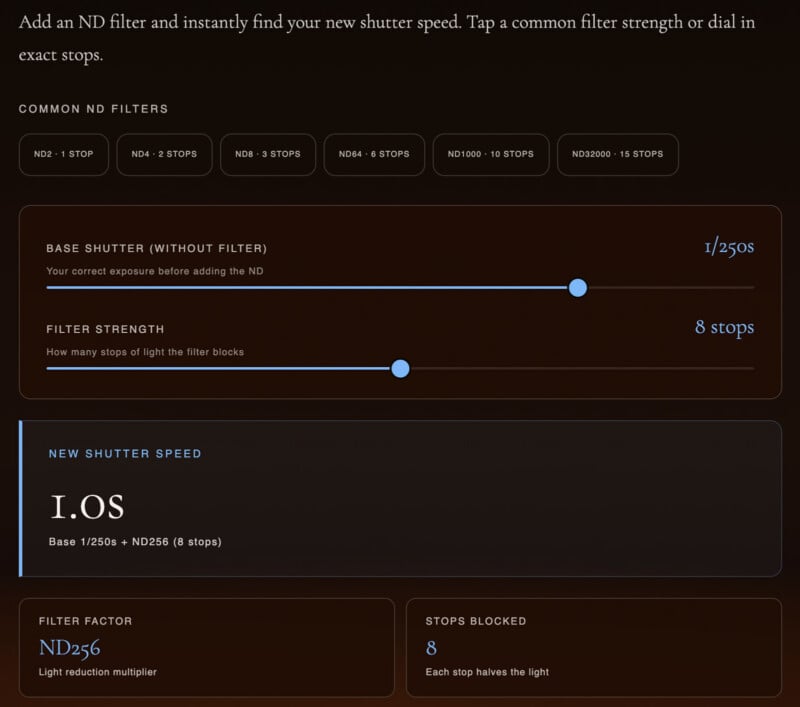
In addition to the conditions forecasting tools, LightCast Suite has a fourth tool: Tricast. This is an “in-field camera toolkit” with six calculators that photographers may need when in the field. There are calculators for timelapse and astrophotography camera settings, ND filter and hyperfocal distance calculators, a feedback tool photographers can use to fix common photo issues, and a Sunny 16 calculator to get a good exposure starting point.
LightCast Suite is entirely free to use, has no ads, and doesn’t require an account.
Image credits: LightCast Suite. Header photo by Jeremy Gray.






 English (US) ·