Forget 'Reacher,' This '90s Movie Officially Reinvented the Spy Thriller Formula
2 hours ago
7
Image via Paramount Pictures
Published Sep 13, 2026, 7:57 AM EDT
Lloyd 'Happy Trails' Farley: the man, the myth, the legend. What can be said about this amazing - and humble - man that hasn't been said before? Or, more accurately, what can be said in public? Born in Calgary, Alberta, Canada, Lloyd is a master of puns and a humorist, who has authored one pun book to date - Pun and Grimeish Mint - and is working on a second. His time with Collider has allowed Lloyd's passion for writing to explode, with nearly 1,000 articles to his name that have been published on the site, with his favorite articles being the ones that allow for his sense of humor to shine. Lloyd also holds fast to the belief that all of life's problems can be answered by The Simpsons, Star Wars, and/or The Lion King. You can read more about Lloyd on his website, or follow his Facebook page and join the Llama Llegion. Happy trails!
Few genres are as thrilling as the spy film, whether it's the kind with a cat-and-mouse game played across exotic locations; suave, debonair secret agents uncovering evil plots to destroy the world; or more cerebral fare, where the protagonist stumbles across a conspiracy that is rooted deep within global institutions. But let's say there's a spy movie that largely bucks those conventions, one that pits the Americans against the Russians during the Cold War. There's no exotic locales, just water as far as the eye can see, with the bulk of the film spent aboard cold, gray submarines, with a protagonist who isn't a suave secret agent in the vein of James Bond, but instead a desk jockey with a fear of flying. Would you believe that such a film isn't just good, but is a bona-fide masterpiece thriller? If you don't, you should: the film is The Hunt for Red October, and 36 years after its release, it's found new life as one of the most popular rentals on Apple TV.
Jack Ryan Has Three Days to Uncover a Rogue Soviet Submarine Captain's Intentions in 'The Hunt for Red October'
Image via Paramount Pictures
It's November 1984, and the Soviets have given command of Red October, a state-of-the-art Typhoon-class ballistic missile submarine with a "caterpillar drive," to the esteemed Captain Marko Ramius (Sean Connery). It's a decision they'll soon regret, after Ramius kills the political officer on board and tells his crew that they have been instructed to conduct missile drills off the American East coast. With that, they engage the caterpillar drive and, now undetectable, make their way to their destination.
Government officials in Washington call on CIA analyst Jack Ryan (Alec Baldwin) to brief them on the threat that Red October—and its commander—poses. It's certainly not good news, and after hearing that the bulk of the Soviet Navy has been mobilized to locate and sink the sub, the military staff surmises that Ramius has gone rogue and plans a renegade nuclear strike. Only Ryan, who has done extensive research on Ramius, has a different hypothesis, suggesting that Ramius actually plans to defect to the United States with the sub, a major coup for the Americans if he's right. It's his monkey, so now it's his zoo, and Ryan's given three days to confirm his theory before the U.S. Navy joins the hunt to find, and scuttle, Red October.
So Ryan is sent to the mid-Atlantic, where he boards the American submarine USS Dallas at the risk of his own life. There, he tries to convince Commander Mancuso (Scott Glenn) to contact Ramius to determine his real intentions. His timing is perfect, given "Jonesy" (Courtney B. Vance), the sonar technician aboard, has discovered a means of tracking Red October using underwater acoustics software. They catch up to the Soviet sub, where Mancuso, swayed by Ryan's arguments, contacts Ramius and offers assistance. Sure enough, Ryan was right, and Ramius, stunned but relieved that the Americans figured it out, accepts. After staging a nuclear reactor "emergency" that forces the crew to abandon ship, Ramius welcomes Ryan, Mancuso, and Jonesy aboard, turning over Red October and requesting asylum for himself and his officers. Only the arrival of Alfa-class submarine V.K. Konovalov puts a damper on the proceedings, setting up a deep-sea battle to the death.
A Wealth of Talent Both On and Off the Screen Makes 'The Hunt for Red October' Work
By rights, The Hunt for Red October shouldn't work as well as it does, but a wealth of riches both on and off the screen creates a memorable film that stands as a masterpiece of the genre. The cast, including heavyweights like Tim Curry, Sam Neill and James Earl Jones, is perfect (Glenn's performance, in particular, is one of his best). But the film lives and dies with its two leads, and they rise to the challenge. Baldwin is perfectly suited for Jack Ryan's first appearance on film, taking a character unprepared (and largely unwilling) to be involved directly in the proceedings through a journey that sees him grow in confidence and assertiveness, taking control of the situation and claiming his role as an action hero.
Baldwin's good, but he's not Sean Connery good, with the seasoned vet commanding the screen in one of the best performances of his post-James Bond career. His Marko Ramius cuts an imposing, authoritative figure, one that keeps up appearances and (largely) deflects suspicion in order to facilitate the defection of himself and his crew. He balances that with the vulnerability that comes with seeing his plan, his freedom, come to fruition. It's good enough that even his maligned non-attempt at a Russian accent (Marko McRamius?) isn't enough to distract from it.
Director John McTiernan is no stranger to generating high tension in confined areas, as he did in Die Hard. He keeps the tension on high throughout the film, dropping dangers at key intervals and generating real concern from the viewer. His vision is perfectly complemented by cinematographer Jan de Bont, his partner on Die Hard. It's a chemistry so in sync that it creates magic, and the tricks de Bont picked up from McTiernan can be seen in de Bont's first directorial affair, 1994's Speed, another thriller that spends the bulk of its time in confined quarters.
Surprisingly, one of the film's best scenes has no action whatsoever, but simply captures Ryan and Ramius conversing on the deck of Red October at the end of the film. McTiernan and de Bont immortalize the moment in a gentle blue hue, with the two talking heads on the left side of the screen, and the river behind adding an unimpeded calmness to their discourse. In a high-stakes thriller like The Hunt for Red October, it's a savvy move that grounds the film with humanity, a perfect end to a masterpiece.

 Image via Paramount Pictures
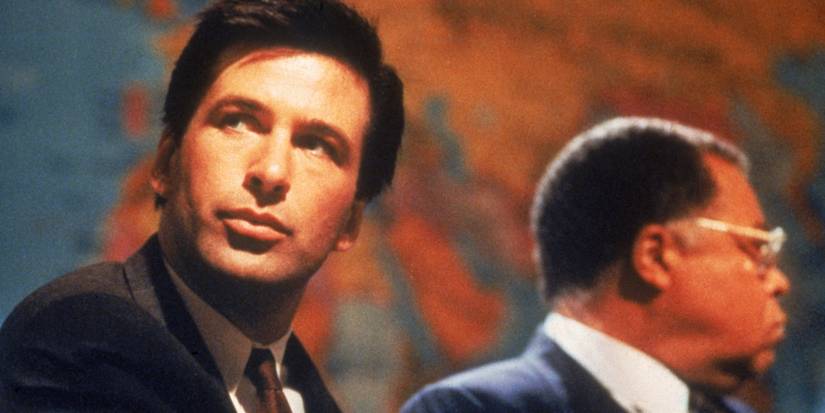 Image via Paramount Pictures







 English (US) ·