
 3 hours ago
4
3 hours ago
4
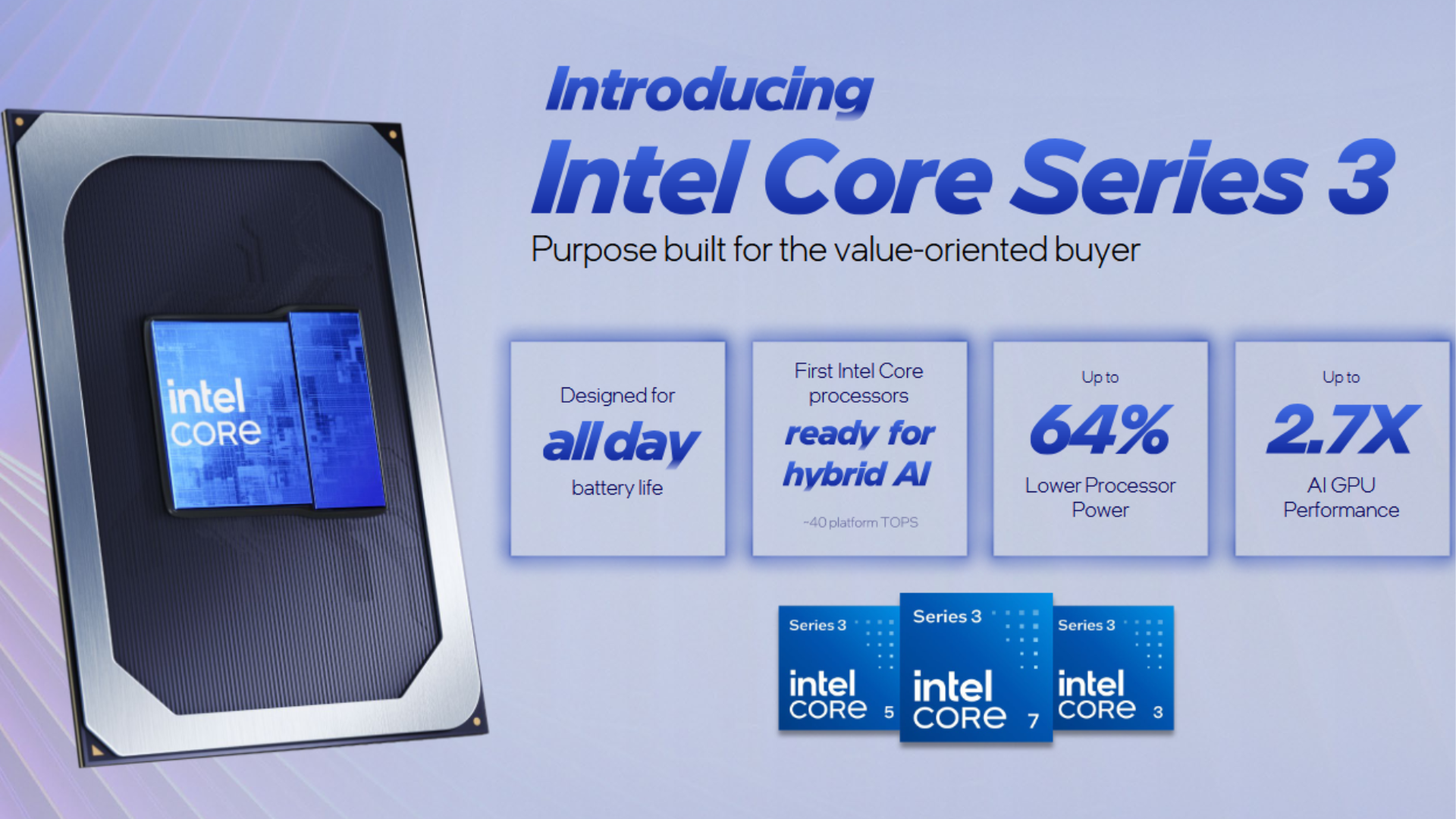
Intel launched its Wildcat Lake series of CPUs last week, called "Core Series 3," with but we haven't seen any laptop with these chips.. That is, until today. NotebookCheck's Vaidyanathan Subramaniam just took to X to show off the first machine equipped with Wildcat Lake silicon. It's a reference design, as denoted by the Intel branding on the laptop, but it's still our best look at a potential MacBook Neo competitor on the Windows side.
First look at an Intel Wild Cat Lake laptop in the wild. 2 Cougar Cove P + 4 Darkmont E cores 17 W PL1 and 35 W PL2 / 22 W PL1 Max / 11 W fanless17 TOPS NPU2 Xe coresThin and light designLooks like a perfect laptop for the beach, innit 🌊🏖️ pic.twitter.com/MCsCVbpM4AApril 23, 2026
The laptop in question has four power modes: 17W PL1, 22W PL1 Max, 35W PL2, and an 11W 'fanless' mode. That's a decent bit of grunt for entry-level silicon, and the device also features an aluminum chassis, according to a reply on the original X post. That positions it as a clear MacBook Neo rival, but one with a much higher power envelope. The Neo rarely ever touches 10W and usually operates between 3-5W with normal workloads.
Article continues below
The cooling system just isn't sufficient to tame the A18 Pro inside, but you can add something as simple as a thermal pad to reduce thermal throttling and improve performance. Since this Intel reference laptop has a comparatively-ludicrous 35W PL2, it seems like some Wildcat Lake devices can benefit from fans and perhaps even vapor chambers to extract more juice out of that silicon.
We can see that this laptop has 16 GB of RAM, as reported in Task Manager, with 8.9 GB shared with the GPU. That's already more than the 8 GB the Neo offers, which is a real bottleneck as soon as you start to go beyond web browsing or media consumption. Of course, we're in a RAM shortage right now so this machine seems like an even more solid package overall, but keep in mind that it's not a real laptop with a price tag.
Subramaniam said he wasn't allowed to run tests on the machine, but was told that PL1 Max (22W) can be sustained for up to 2 minutes versus PL2 (33W) which will only be hit for about 56 ms before throttling. We're most likely looking at the "Core 7 360/350" here, which are two of the highest-end SKUs in the Wildcat Lake lineup. That's about all the info we have — at least, the teal gradient design looks really cool.

Follow Tom's Hardware on Google News, or add us as a preferred source, to get our latest news, analysis, & reviews in your feeds.








 English (US) ·