
 3 weeks ago
73
3 weeks ago
73
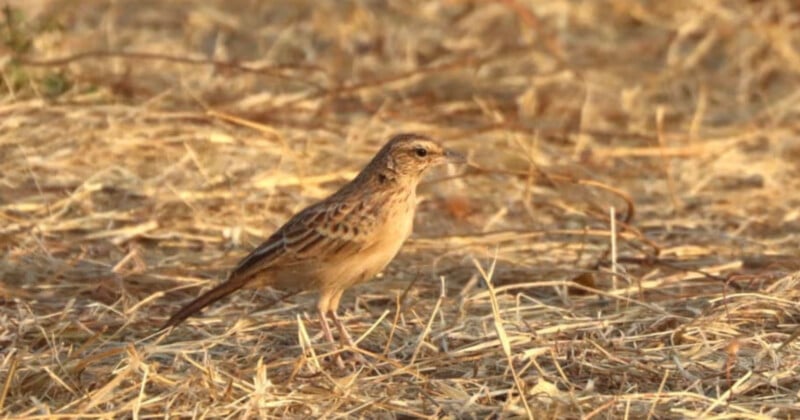 First-ever photograph of the Rusty Lark taken on February 2 by Pierre Defos du Rau and Julien Birard | Image credit: © J.Birard, I. Dapsia & P. Defos du Rau
The Rusty Lark, a small bird thought to be extinct for nearly a century, has been photographed for the first time.
The Rusty Lark, a little-known bird native to Africa’s Sahel region, has now been definitively recorded for the first time in 94 years, with researchers also capturing the first-ever photographs of the species.
French researchers Pierre Defos du Rau and Julien Birard, who work for the Office Français de la Biodiversité and Tour du Valat respectively, regularly travel to Chad and other African countries to study waterbirds. While on field trips, the pair also watch for other species they may encounter.
According to a news release from Search for Lost Birds, the discovery of the Rusty Lark happened on the morning of February 2 in the Guéra region of south-central Chad. Birard had spotted a pair of Kordofan Sparrows — the team’s main target species for the day — at close range. After retrieving a camera and microphone from their vehicle, the sparrows disappeared, but continued searching led the team to an unfamiliar rust-colored bird — which would turn out to be the elusive Rusty Lark — less than 50 feet from where the sparrows had been seen.
The pair ended up taking some pictures of the mysterious bird that day. These images — together with field observations and notes — were later reviewed by expert ornithologists, who confirmed the bird was the Rusty Lark. The sighting marks the first documented record of the species since 1931 and provides the world’s first photographs of a living Rusty Lark.
According to a report by Earth.com, the Rusty Lark measures around five to six inches in length and has rust-colored upper feathers, a faintly scaly back, and an unusually long tail for a bird of its size, without the white tail edges seen in some other lark species.
Despite the rediscovery, much about the Rusty Lark remains unknown. Its nest has never been described, its eggs have never been documented, and no recording of its song currently exists.
British ornithologist Hubert Lynes first described the species in 1920 after collecting six specimens in Sudan’s Darfur region. Eleven years later, naturalist George Latimer Bates collected what were believed to be the last known specimens in present-day Niger. After that, there were no confirmed sightings, photographs, or recordings of the bird for nearly a century.
A possible image of the Rusty Lark surfaced in 2017, but was later reassessed and determined not to show the species. As a result, the bird met the criteria to be classified as a “Lost Bird,” a designation used for species that have gone undocumented for more than a decade.
Image credits: Header photo © J.Birard, I. Dapsia & P. Defos du Rau.







 English (US) ·