
 3 hours ago
5
3 hours ago
5
Latency, bandwidth, and fidelity all matter when you’re chasing milliseconds.
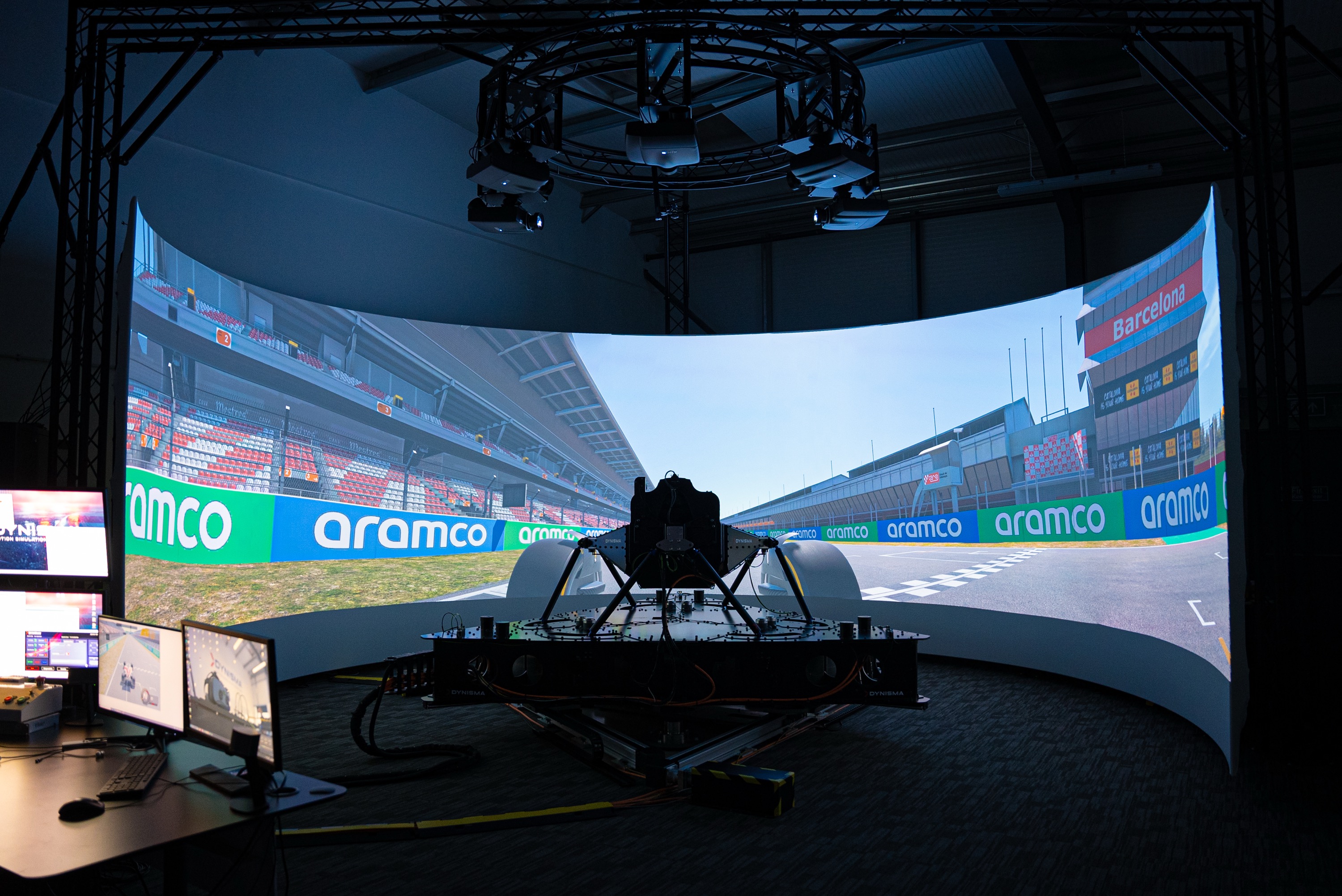
F1 teams can spend between $3 million and $10 million on driver-in-the-loop simulators. Credit: Dynisma
F1 teams can spend between $3 million and $10 million on driver-in-the-loop simulators. Credit: Dynisma
Among the ways Formula 1 has changed in the 21st century has been its adoption of driver-in-the-loop simulators. It all started in the early 2000s, probably at McLaren, maybe at Toyota or Ferrari; F1 teams are notoriously secretive about their performance advantages. Along the years, they’ve gotten more and more capable, but so too have high-end consumer sims like the multi-axis setups that cost tens of thousands of dollars. What is it that makes the multimillion-dollar simulators used in F1 that much more expensive, and that much better for the job?
For one thing, latency.
“There’s this intimate link between the inputs that [a driver] provides to the car, the way the car responds, and then the driver immediately feels that and reacts to it. So this is a very dynamic closed loop involving the driver and the car,” explained Ash Warne, founder and CTO of Dynisma Motion Generators, a UK-based simulator company that supplies Ferrari, Alpine, and soon Cadillac with DiL simulators that can cost as much as $10 million.
“And what we do in a driving simulator is obviously to take away the car entirely and to bring in our system, and we need it to replicate the real car as accurately as possible, because otherwise your World Champion racing driver, who has this innate and instinctive understanding of what the car should be, will immediately pick up on it as different,” Warne said.
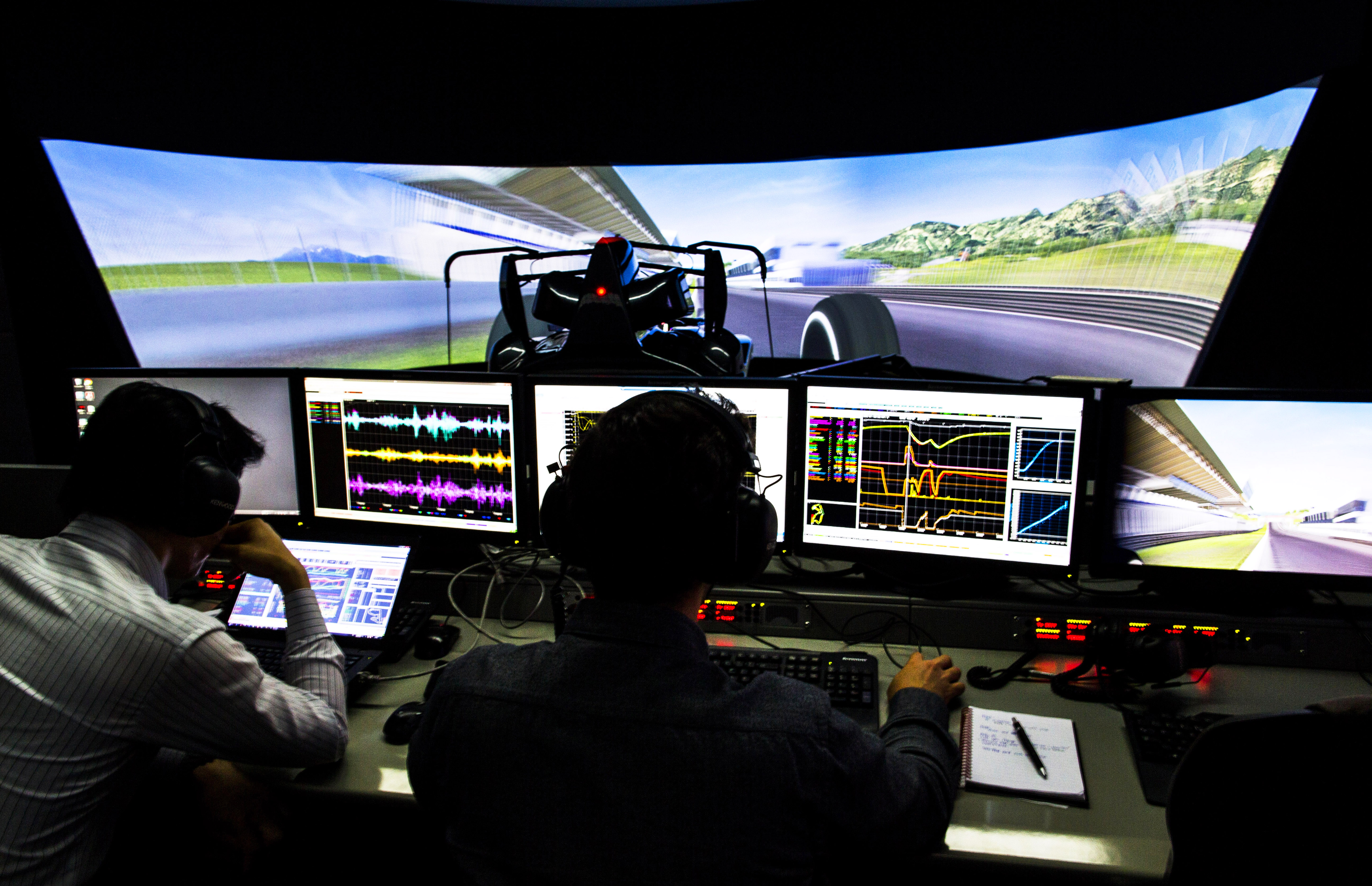
A rare look inside an F1 team’s simulator, in this case, McLaren in 2016.
Credit: Darren Heath/Getty Images
A rare look inside an F1 team’s simulator, in this case, McLaren in 2016. Credit: Darren Heath/Getty Images
And he really does mean low latency. “Between 3 and 5 milliseconds. So this is from the moment that the car physics model says, for example, the back end of this car is stepping out and starts to accelerate the car in yaw to when we can actually measure, on an accelerometer on the chassis of the simulator, that movement happening,” Warne said. For context, that’s about an order of magnitude quicker than the best commercial flight simulators, or the National Advanced Driving Simulator that we drove in Iowa a few years back.
3 ms
Warne started Dynisma after working for both McLaren and then Ferrari, after realizing that an ultra-low-latency simulator was possible. “I was able to prove, just with pen and paper, and then with simulation, that we ought to be able to get this kind of delay down, around 3 milliseconds,” Warne said. The first prototype, built when Dynisma was still a one-person operation, used hobbyist-grade electronics and motors to prove the concept. “Rather than using the industrial computers and [programmable logic controllers] and control systems we use today, the first system was developed using an Arduino and Raspberry Pi and a whole bunch of other consumer electronics,” Warne said.
High bandwidth is another must, and it’s an area where we see a big difference from flight simulators. “They move very, very slowly, and they’re interested in doing sustained bank angles, whereas we’re doing a very different problem,” Warne explained. “It’s all about being in a vehicle that’s stuck to the roads, and all of the vibrations that come from every bump that you get in the road, also from engines, etc, tires vibrating, all of these sorts of higher-frequency vibrations get transmitted in a car up through into the driver’s seat,” he said.
This is a Dynisma DMG360XY, the most advanced driving simulator currently in use in motorsport. The driver pod can rotate through 360 degrees and has 5 m of travel along the X and Y axes. Dynisma
“The biggest thing with simulators has always been the fight to make the tires feel like a tire, even though you don’t have tires. And that’s a very critical thing for the driver to feel the displacement of the suspension, the tire moving under the rim. That’s such a very distinctive feeling for the driver. So right now a lot of work is put into that,” said Simon Pagenaud, sim driver for the Cadillac F1 team.
Pagenaud has seen racing simulators evolve alongside his career, which includes an Indy 500 win as well as championships in both IndyCar and the American Le Mans Series. “My first experience on the simulator I think was probably 2008 with Wirth Research… when we had the De Ferran Motorsport program and it was already pretty good, but it definitely is not at the level it’s at now,” Pagenaud said. “The evolution since my first time on the simulator is tremendous. The visuals, of course; the movement of the platform is another thing. I would say the hardware has massively improved, and the latency is something we fight for with computer power every day, but the latency is really everything to give the driver the right feedback,” Pagenaud said.
Time to work
But what is it that a sim driver actually does for their team? “The biggest thing right now, especially in F1, is trying to understand the energy spent into the tire and not overheating the tires. So it is a big part of our job right now, trying to figure out what can we do to make the tires last longer, work better with the race car, give us more grip,” he said.
“The goal is to make the car better and help the race drivers perform better on race weekend, which is the job for every sim driver,” Pagenaud said. “The younger ones, obviously they’re also trying to prove themselves. So their job’s a bit different to mine. They need to perform. They need to always be super fast. I need to be consistent. I need to give the engineers a very subjective feedback on, ‘was this better or was this worse for real life?’ So I’m always trying to project myself into real life.”
As the two Cadillac race cars of Sergio Perez and Valtteri Bottas got ready for the first practice session of last weekend’s Monaco Grand Prix, Pagenaud was also getting to work in the sim at GM’s motorsports HQ outside Charlotte, North Carolina, plugged in to the same comms network as the engineers at the track and the Charlotte control center. (The Cadillac F1 team’s new Dynisma sim will be installed at the team’s new base in Indianapolis.)
In 2019, Simon Pagenaud won the Indianapolis 500. Clive Rose/Getty Images
“I’m trying to understand what the drivers are talking about, about the race car, their problems, their strength. And then as soon as free practice one is finished, we get on and we correlate what we have on data. Then after that’s correlated and we’re happy with minimum speed to the corner, maximum speed on the straightaway and everything lines up on the computer, then we can move on to performance items,” Pagenaud said.
Those performance items are the various changes the engineers want to test, and running through as many as 50 of them can mean a very long day, particularly when you consider the time changes involved with some races. Good thing Pagenaud has some experience with endurance racing…
The work is methodical. “So, say a run has to be five laps; we have to do five laps—in a row. If you crash, you restart five laps. So it can be a nightmare very quick if you start crashing. And then you want to be consistent; you want to be within two tenths [of a second] per lap deviation, so then it’s quality data that the engineers can look at. So it is a stressful job in that sense because you want to give the best data possible. And I personally also want to be respected for the job, so I got to give my best,” Pagenaud said.

Jonathan is the Automotive Editor at Ars Technica. He has a BSc and PhD in Pharmacology. In 2014 he decided to indulge his lifelong passion for the car by leaving the National Human Genome Research Institute and launching Ars Technica's automotive coverage. He lives in Washington, DC.







 English (US) ·