
 1 hour ago
11

Follow us
Add us as a preferred source on Google
Subscribe to our newsletter
Indium phosphide (InP) is a compound material used in specialized chip-making. Unlike silicon, which is the fundamental building block for mainstream logic and memory chips, InP — made from indium and phosphorus — is mainly used to manufacture highly specialized photonic and high-frequency electronic chips, largely due to its outstanding optical properties. Its immensely expensive and complex manufacturing process also makes it impractical for the large volumes and die sizes needed for logic and memory chips. With the industry predicting a shortfall of this crucial material right as the shift to optical interconnects in data centers begins, we explore the current state of the supply chain.
InP chips have powered high-speed lasers, modulators, photodetectors, and various other optical components used across the telecommunications industry and defense for decades. While the InP supply chain was relatively small and highly specialized, it was generally stable and sufficient to meet global demands.
Then came the AI boom. As AI clusters hit the physical limits of moving enormous amounts of data over copper, the industry began the switch to optical interconnects. First came ever-faster optical transceivers. Now the industry is transitioning to silicon photonics, near-packaged optics, and co-packaged optics, bringing optical links progressively closer to the processors themselves. InP is central to much of this transition, building the critical active optical components needed to turn electrical data into light and back again.
Individual AI data centers are already being built around hundreds of thousands of accelerators, with upcoming gigawatt-scale buildouts expected to house millions. Connecting those processors translates into demand for millions upon millions of indispensable optical components, all relying on the same relatively tiny InP supply chain.
Japan's Sumitomo Electric and U.S.-headquartered AXT together account for almost 80% of global InP substrate manufacturing, with JX Advanced Metals adding roughly another 10%. AXT, however, manufactures most of its InP substrates in China, where exports now require government licenses, further exacerbating the situation. It gets worse: China accounts for around 70% of global refined indium output, which is recovered as a byproduct of processing zinc. Export controls mean that restrictions apply to both the material itself and the finished wafer.
The resulting squeeze is already sending ripples across the industry, with several companies predicting shortfalls. Michael Hurlston, CEO of optical-component manufacturer Lumentum, said in July that the company's InP fabs were shipping more than 30% below customer demand, despite rapid capacity expansion. Coherent also described InP capacity as the “primary constraint” on its transceiver business.
A simple solution would be to expand the supply chain. However, growing large, low-defect InP crystals is difficult, while qualifying new suppliers requires time that doesn't align with the industry's demand. Furthermore, expanding substrate and laser-fabrication capacity can take years. Meanwhile, to secure optical components capacity for its accelerators, Nvidia has invested $2 billion each in Lumentum and Coherent, attaching multibillion-dollar purchase commitments and future capacity rights to both deals. Both companies, along with several others in the supply chain, are frantically pursuing solutions.
What is indium phosphide?
Indium phosphide belongs to the III-V family of compound semiconductors, named after the periodic-table groups of their constituent elements; in InP’s case, indium and phosphorus. Its better-known relatives include gallium arsenide and gallium nitride.
Indium phosphide’s distinguishing property, which separates it from silicon, is its direct bandgap, measured at about 1.34 eV at room temperature. In a direct-bandgap material, electrons dropping across the gap release their energy efficiently as photons, making the material particularly useful for lasers and other active optical devices.
Silicon, on the other hand, has an indirect bandgap, meaning that the same transition requires an additional interaction with a crystal lattice and mostly sheds its energy as heat instead. Therefore, while the material can — in silicon photonics — guide, split, and modulate light using structures fabricated with mature CMOS processes, it does not produce the light beam. As a result, Modern silicon-photonics systems commonly rely on a III-V laser source, most commonly based on the InP material system, to provide the light that the silicon circuitry manipulates.

The fiber-optic wavelength window’s alignment with InP's properties is another reason for the material's ubiquity. Modern telecom and data-center links commonly operate around 1,310 nm and 1,550 nm, where optical fiber exhibits favorable transmission characteristics. Pure InP itself does not emit at those exact wavelengths. However, InGaAsP and InAlGaAs alloys, which are grown on lattice-matched InP substrates, can have their bandgaps engineered for those bands. InGaAs layers on InP are also highly effective photodetectors at telecom wavelengths.
These characteristics and functionalities make the InP platform critical to many active functions in optical communications, including distributed-feedback (DFB) lasers, electro-absorption modulated lasers (EMLs), continuous-wave (CW) lasers, semiconductor optical amplifiers, photodetectors, and complete photonic integrated circuits. Silicon photonics and InP consequently complement each other. Silicon provides scalable optical circuitry, while InP provides efficient light generation and several high-performance active optical devices.
Beyond photonics, InP is also commonly used in high-frequency electronic chips. Electrons move through the material far faster than through silicon, giving it strong high-frequency performance that makes it suitable for millimeter-wave and terahertz electronics, radar receivers, and high-speed data converters. This market is much smaller than photonics, but it has few substitutes at the top of the frequency range.
Indium phosphide’s roles across telecommunications and AI data centers
InP lasers and transceivers have been converting electrical signals into light for long-haul fiber networks, metro links, submarine cables, and eventually shorter-reach data-center connections for decades. Despite 5G rollouts driving demand higher, the indium phosphide supply chain remained a stable, moderately sized business with predictable growth. The AI boom has now driven demand up by several orders of magnitude.
Modern AI clusters can contain hundreds of thousands of interconnected accelerators that continuously exchange data. Copper remains a cheap, effective connector over short distances, but electrical losses, signal integrity, and power requirements progressively worsen as bandwidth and distance increase. This has led to the rapid adoption of optical interconnects.
In this setup, a modulator encodes electrical data from the switch or accelerator onto light from a laser. Fiber cables then carry it across the link to a photodetector that converts the received photons back into an electrical signal. In pluggable transceivers, many of these functions are integrated into a compact module plugged into the front of a network switch, with InP-based components executing several steps in the process.
Lumentum's 200G EML, for example, monolithically combines a wavelength-locked DFB laser and an electro-absorption modulator on its InP platform, and is designed for 200-Gbps-per-lane links used in 1.6T transceivers. Coherent is producing InP EMLs, high-power CW lasers, and high-speed photodiodes for the same generation of hardware. As aggregate link speeds move from 400G and 800G to 1.6T and beyond, the number and performance of these InP-based optical components become increasingly important.
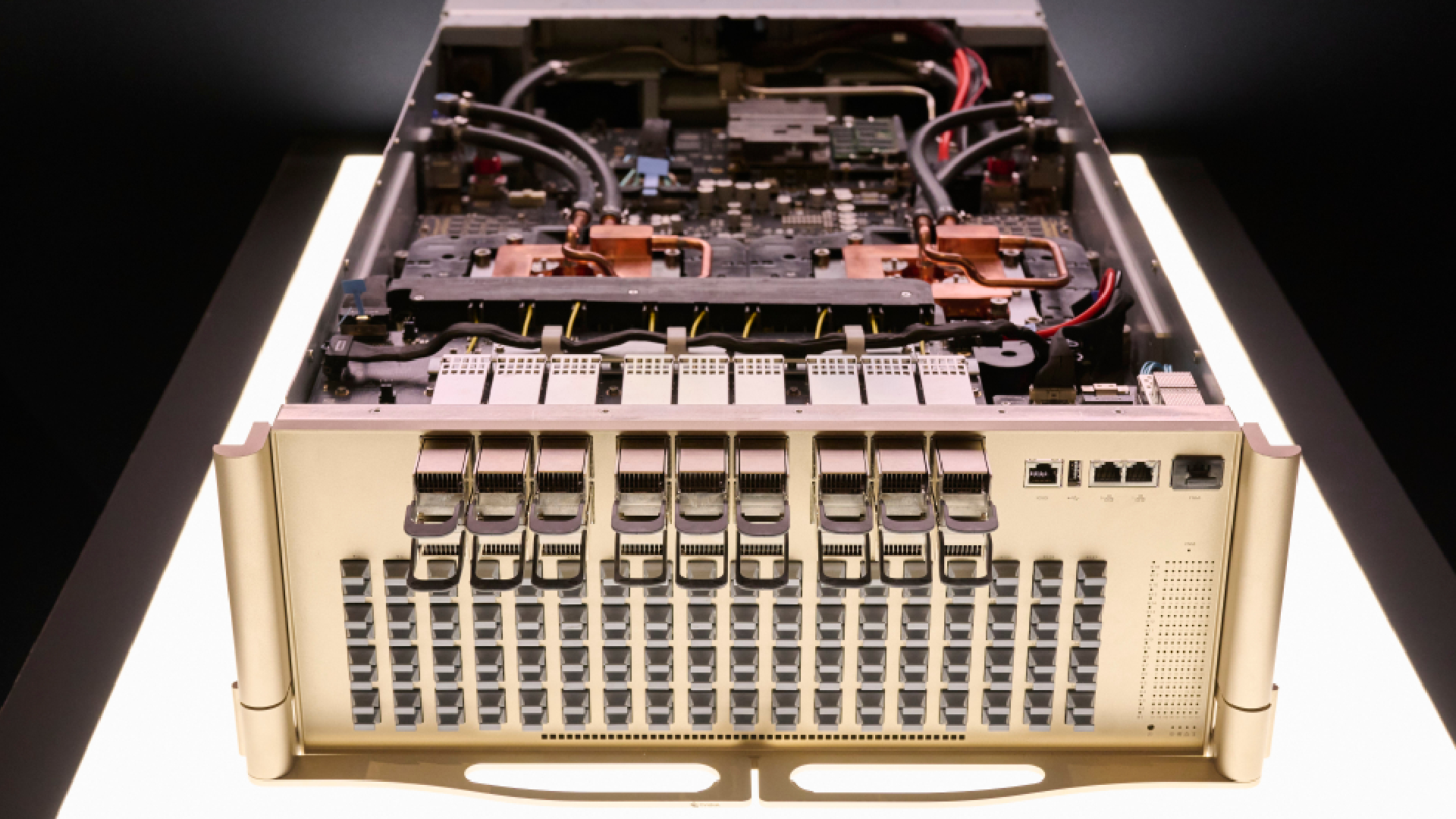
At the same time, the industry is bringing optics right to the board with co-packaged optics (CPO) to further shorten the distance data travels. Conventional pluggable optics leave around 15 to 30 centimeters (5.90 to 11.81 inches) of high-speed copper trace between the switch ASIC and the optical module. CPO brings the optical engine onto the accelerator package as a photonic integrated circuit (PIC) chip, shrinking that electrical path and reducing power consumption. Nvidia's Quantum-X and Spectrum-X photonics switches are among the first major AI platforms built around that approach.
While they integrate several optical functions onto the boards, PIC chips do not generate the laser. CPO and silicon-photonics designs still mostly use external InP CW lasers to supply light to the silicon photonic circuits, further consolidating the demand for indium phosphide in AI data centers and the industry as a whole.
The state of the supply chain
As a result of the enormous, rapidly expanding market for the material, indium phosphide’s supply chain is constrained at several points, starting with the raw material itself. Unlike many metals which are mined from dedicated deposits, indium is typically recovered as a trace byproduct of processing zinc sulfide ore. Manufacturers then combine high-purity indium and phosphorus and grow them into a single-crystal InP ingot, or boule, which they process into substrate wafers with tightly controlled properties. Next, manufacturers grow extremely thin epitaxial layers of InP-related compounds over it, commonly using metal-organic chemical vapor deposition. The epiwafer then goes through several chip-making processes and module assembly to become optical chips and devices.
Indium production's dependence on Zinc processing creates bottlenecks in InP's supply chain, right at the beginning of the stream. The USGS put global primary refined indium production at roughly 1,100 tonnes in 2025, with China accounting for 760 tonnes. For context, the BBC estimates that 30,000 tonnes of electronic-grade silicon used exclusively to make microchips are mined yearly. The United States imports all of the InP it consumes, producing nothing. Meanwhile, indium substrate manufacturers Japan's Sumitomo and JX Metals source more than 90% of their high-purity indium feedstock from China, meaning even non-Chinese substrate makers begin their process with Chinese material.
Further downstream, at the substrate manufacturing level, Sumitomo Electric holds roughly 40% of the global InP substrate market, U.S.-based AXT around 35%, and JX Advanced Metals about 10%. Together, the three control more than 90% of capacity. Although AXT is headquartered in California, most of its InP substrate production runs through its Beijing Tongmei subsidiary, which puts it directly under China's export licensing regime. Other fringe substrate manufacturers include Freiberger Compound Materials in Germany and a growing set of Chinese entrants, including Yunnan Germanium.
The supply chain is also highly concentrated at the device and component level, with Coherent and Lumentum dominating Western laser and component production. IQE supplies epitaxial wafers, and Japanese firms, including Mitsubishi Electric, supply laser components. Chinese module makers such as Innolight and Eoptolink assemble a large share of the world's finished 800G modules, pairing Western lasers with Broadcom and Marvell DSPs. We recently explored how this entanglement complicates any attempt to decouple the two ecosystems, even as the FCC is considering a ban on Chinese optical hardware. Coherent primarily sources substrates from AXT, while Lumentum relies heavily on Sumitomo and JX.
On the technical side, wafer-size limitations in InP semiconductors add another constraint. While silicon logic and memory moved to 300-mm wafers in the early 2000s, the InP industry is only now transitioning from 3-inch to 6-inch (150-mm) production; primarily because the material is brittle, expensive, and grown in small boules, factors that limit wafer size. Doubling the wafer diameter gives four times the area. Coherent's six-inch line, for example, yields more than four times as many devices as its three-inch line at a lower cost per die. On the other hand, moving a fab to six-inch requires new crystal-growth recipes, new handling equipment, new process qualification, and extensive customer requalification.
The supply chain was already struggling under these constraints when, in February 2025, Beijing placed InP, trimethylindium, triethylindium, and the technology used to produce them under export controls, requiring licenses for overseas shipments. AXT called the export controls its most significant current challenge, noting that even with sufficient capacity and strong demand, its ability to ship outside China depends on Chinese licensing decisions.
The shortfall and the race to expand
The widening gap between demand and InP industry output points to a fast-approaching shortfall. Coherent first warned of an InP shortage on its May earnings call. At the close of its fiscal year in August, CEO Jim Anderson described indium phosphide availability as the company's primary constraint, confirming that transceiver assembly and test capacity were available.
Lumentum CEO Hurlston said in July that telecom customers historically ordered lasers in the hundreds, while Nvidia and the hyperscalers were asking for hundreds of millions. Despite operating multiple InP fabs, Lumentum was shipping more than 30% below customer requirements. Earlier in the year, Hurlston said the company's capacity was sold out through 2027 and probably into 2028, even with the expanded output. In both cases, capacity was mostly bought out via Nvidia’s $4 billion investment.
To ease the multifaceted bottleneck, the industry is pursuing several solutions simultaneously, primarily expansions. Coherent is expanding its Sherman, Texas campus, reportedly described as the first and largest high-volume 6-inch InP semiconductor manufacturing facility. Washington signed a letter of intent in June for up to $50 million in CHIPS Act funding for the expansion. Coherent is now on track to double internal InP output in 2026, one quarter ahead of its original plan, and more than double it again by the end of 2027, while also adding 6-inch production in Sweden and Zurich.
Lumentum, meanwhile, is converting a 240,000-square-foot former Qorvo gallium-arsenide facility in North Carolina, which it bought for about $18 million, into another InP fab. The relevance of these expansions largely depends on the downstream InP substrate supply. Lumentum signed an agreement in July to reserve AXT InP substrate capacity through 2031, with an initial $43.5 million deposit and another $43.5 million payment contemplated for 2028. Coherent signed its own three-year 6-inch supply agreement with AXT a month earlier and prepaid $22.3 million against committed capacity.
The substrate suppliers are also expanding in kind. AXT is channeling fresh funds into Beijing Tongmei to double capacity by the end of 2026 and double it again in 2027. Similarly, JX Advanced Metals plans to invest roughly ¥120 billion ($746 million) through FY2030 to lift capacity seven to ten times above FY2025 levels, its largest-ever commitment in semiconductor materials.
Indium production — the uppermost stage of the stream — is far less active, with the biggest hurdle being the reliance on Zinc production. Global zinc mine production hasn't grown materially since 2011, sitting at or below 13 million tonnes a year, according to analysts. Wood Mackenzie expects just 0.1% growth in 2026. On the other hand, not everyone expects the crunch to last. LightCounting estimated in April that optical component demand exceeded supply by about 30% but projected that shortages would largely clear by the end of 2026 as new capacity comes online.
There are also viable, albeit slow, technical workarounds to ease the crunch. Heterogeneous integration bonds InP onto silicon to combine the strengths of both, while quantum dot lasers offer better temperature stability for uncooled operation. Furthermore, researchers continue to push InP quantum dot structures grown directly on silicon substrates. While these do not remove indium from the equation, they change how much each device needs and how it attaches, reducing consumption. Photonics is widely viewed as one of AI's major bottlenecks. However, the indium phosphide supply chain is itself tightening that bottleneck.





 English (US) ·