
 3 weeks ago
25
3 weeks ago
25
Key Highlights
- ETH recovered from $1,830 lows to approach $2,200 before consolidating around the $2,000 zone
- Whale wallets and veteran holders continue accumulating at the current $2,000 support threshold
- Spot Ethereum ETFs in the United States experienced $90 million in net outflows over the past week
- The validator entry queue has exploded to 3.4 million ETH, a dramatic increase from 904,000 in early January
- Ethereum co-founder Vitalik Buterin unveiled the Minimmit proposal to streamline finality from two rounds to one
Ethereum’s recent price action has been marked by significant volatility. After dropping to approximately $1,830 in late February, the asset staged an impressive recovery, climbing to nearly $2,200. Following this rally, ETH has retraced and is currently consolidating around the psychologically important $2,000 threshold.
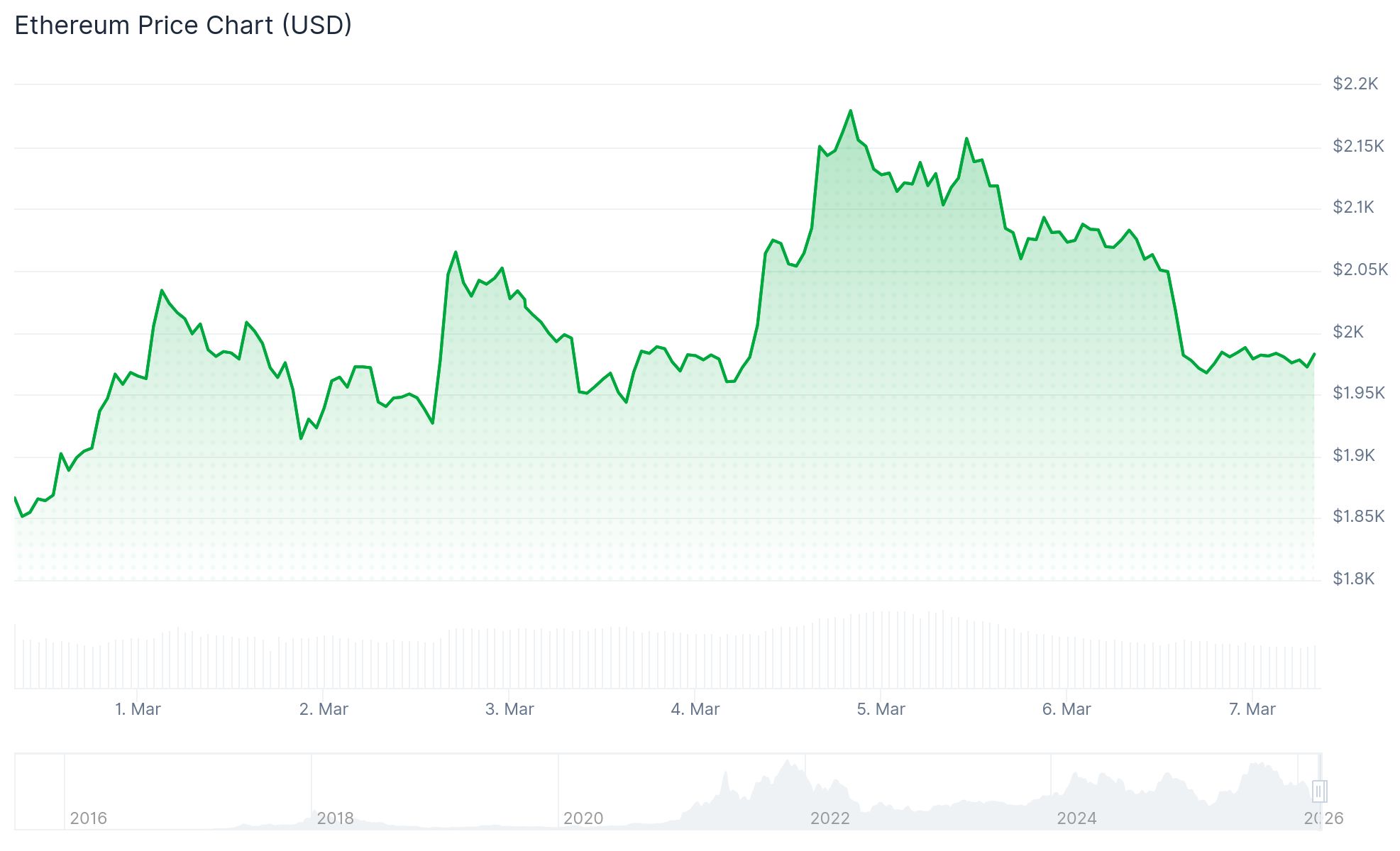 Ethereum (ETH) Price
The $2,000 price point has emerged as a critical battleground. Blockchain analytics reveal that major wallet addresses have been accumulating during recent price weakness. Instead of distributing holdings, long-term market participants are increasing their positions. Futures market data indicates that derivatives traders maintain predominantly bullish positioning.
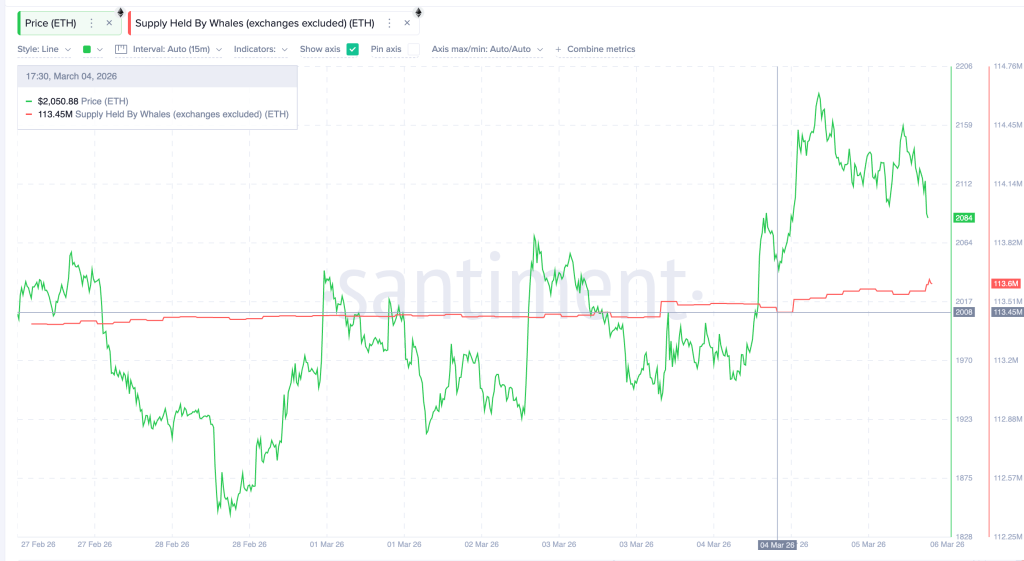 Source: Santiment
Analysis of cost-basis metrics reveals substantial ETH volume last changed hands near the $2,000 mark. This concentration suggests numerous investors have breakeven positions at current levels, creating a natural incentive to defend this price floor.
From a technical perspective, Ethereum is developing a converging wedge pattern. The asset attempted to breach $2,200 resistance but was rejected, establishing a lower peak. Meanwhile, an ascending support trendline continues to provide upside momentum. This compression pattern indicates an imminent breakout.
Should ETH successfully clear $2,200, technical analysts identify $2,400 and $2,750 as subsequent resistance targets. Conversely, a breakdown below $2,000 would likely expose support areas near $1,850 and $1,750.
Institutional ETF Withdrawals Create Headwinds
Spot Ethereum exchange-traded funds in the United States recorded $90 million in net withdrawals over the recent trading week. This outflow pattern suggests certain institutional participants are reducing their exposure. The capital exit has contributed to diminished near-term buying momentum.
On March 6 (ET), Bitcoin spot ETFs recorded a total net outflow of $349 million yesterday. The Bitcoin spot ETF with the largest single-day net outflow was Fidelity’s FBTC, with $159 million in net outflows. FBTC's cumulative historical net outflow has now reached $153 million.… pic.twitter.com/fF1MEEf3Xg
— Wu Blockchain (@WuBlockchain) March 7, 2026
The overall market sentiment remains measured. Macroeconomic uncertainties continue to influence investor behavior, with some large-scale market participants apparently trimming positions in anticipation of potential economic shifts.
Despite these challenges, Ethereum’s price has maintained its position above crucial long-term support levels. Bearish forces have been unable to trigger a more substantial downturn.
Technical indicators present a mixed picture. The Relative Strength Index currently sits at 49, indicating neutral momentum. The MACD remains in negative territory at -55.8. However, both the Commodity Channel Index and Stochastic Oscillator readings suggest building upward pressure.
Staking Demand Reaches Unprecedented Levels
Demand for Ethereum staking has accelerated dramatically. The validator activation queue has ballooned to 3.4 million ETH, representing a substantial increase from approximately 904,000 ETH recorded in early January. Current estimates place the waiting period at roughly 60 days.
Corporate entities and cryptocurrency exchanges are increasingly choosing to stake their ETH holdings rather than liquidate them. Market observers note that institutional players are prioritizing yield generation over keeping assets dormant.
One important technical item that I forgot to mention is the proposed switch from Casper FFG to Minimmit as the finality gadget.
To summarize, Casper FFG provides two-round finality: it requires each attester to sign once to "justify" the block, and then again to "finalize" it.… https://t.co/94nK7VXmp5
— vitalik.eth (@VitalikButerin) March 6, 2026
In parallel developments, Vitalik Buterin introduced a significant proposal to enhance Ethereum’s consensus mechanism. The Minimmit proposal aims to replace the existing two-round Casper FFG finality protocol with a more efficient single-round alternative.
This architectural change involves important compromises. While fault tolerance would decrease from 33% to 17%, Buterin contends that censorship resistance would improve, and the threshold required to finalize invalid chain history would increase from 67% to 83% of staked ETH.
This modification represents one component of Ethereum’s comprehensive development strategy to reduce slot times from the current 12 seconds to potentially 2 seconds, while achieving single-digit second finality.
Ethereum is presently trading around $2,000, representing a significant decline from its previous cycle peak near $4,900.









 English (US) ·