
 3 weeks ago
51
3 weeks ago
51
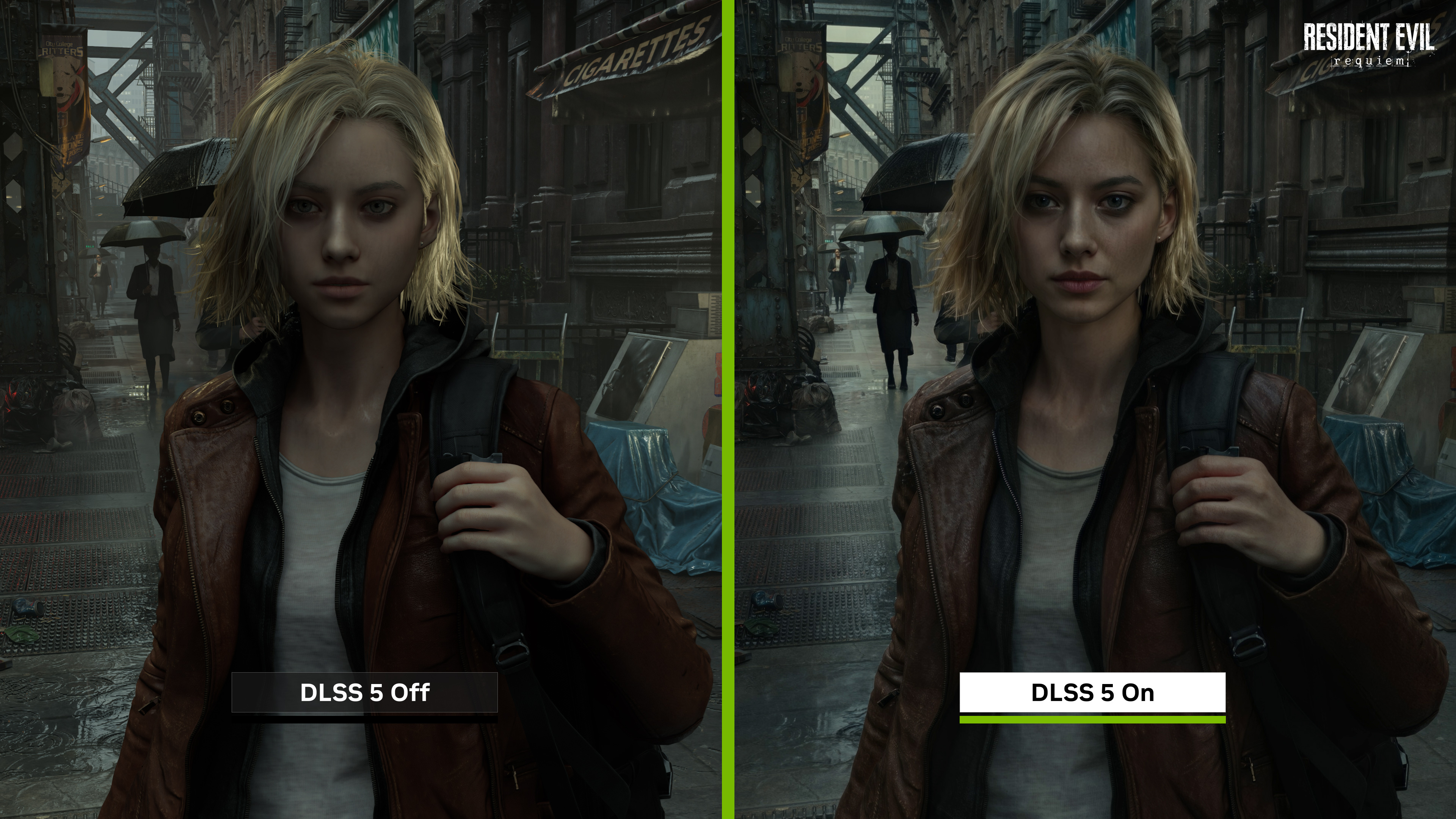
Nvidia's upcoming DLSS 5 neural rendering tech leaked earlier this week through a pre-release version of the DLL inside NBA 2K27 (which is in early access). The community quickly got it working on RTX 50-series GPUs, some of the best graphics cards, but modders later patched the DLL to work on RTX 40-series GPUs, too. Now, thanks to rapid development in the RenoDX Discord server, the DLL has once again been patched to work on RTX 30-series GPUs.
Go deeper with TH Premium: GPUs
Scouring through the server, the general sentiment is mixed. DLSS 5 works on Ampere cards, but performance tanks in almost every case. Any time a user shows decent framerates, it comes at the cost of base visual fidelity. To use DLSS 5 to make the game look more realistic, you need to turn the in-game settings all the way down. It's a balancing act to avoid the point of diminishing returns.
The net result is a more photorealistic image that looks noticeably different (better?) than native rendering. However, it introduces an insane latency penalty where most of the frame pacing is now formed exclusively by neural rendering. In worst-case scenarios, your frametimes can multiply by ten compared to before. If all of this still sounds enticing, then let's talk about the results.
Image 1 of 4
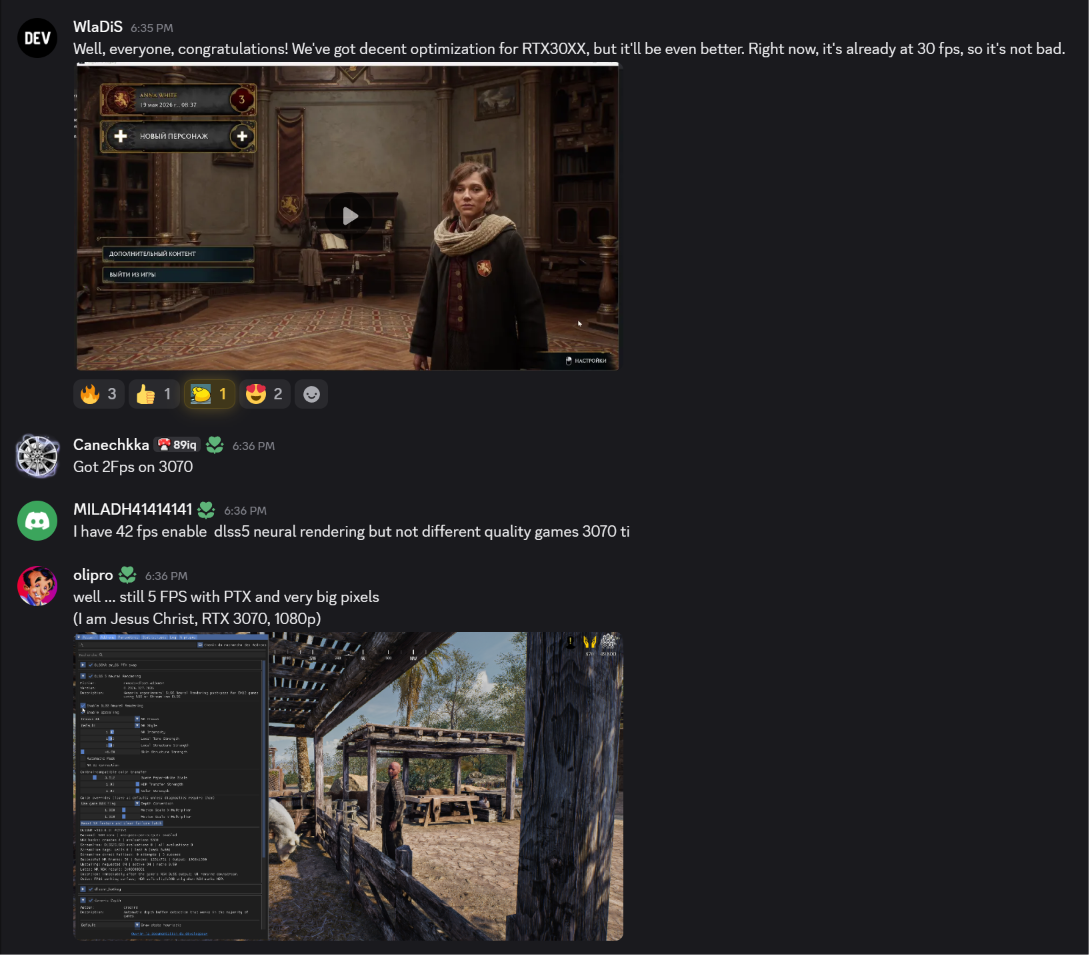
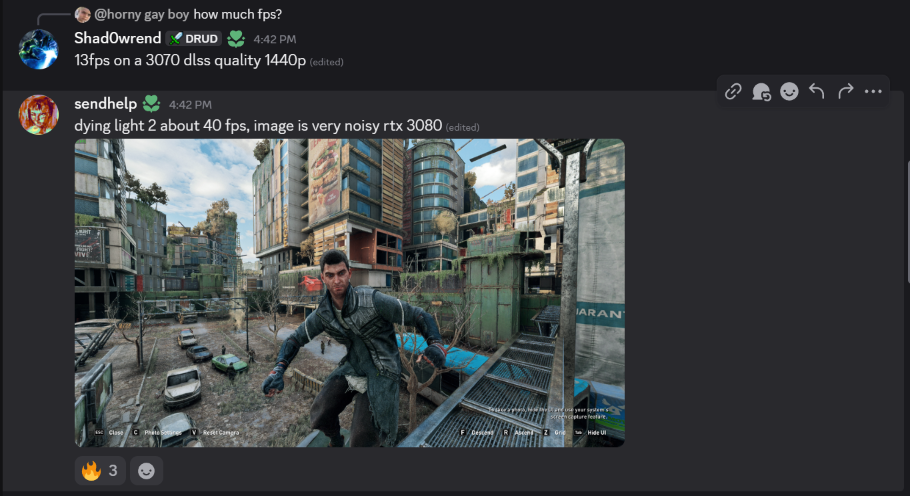
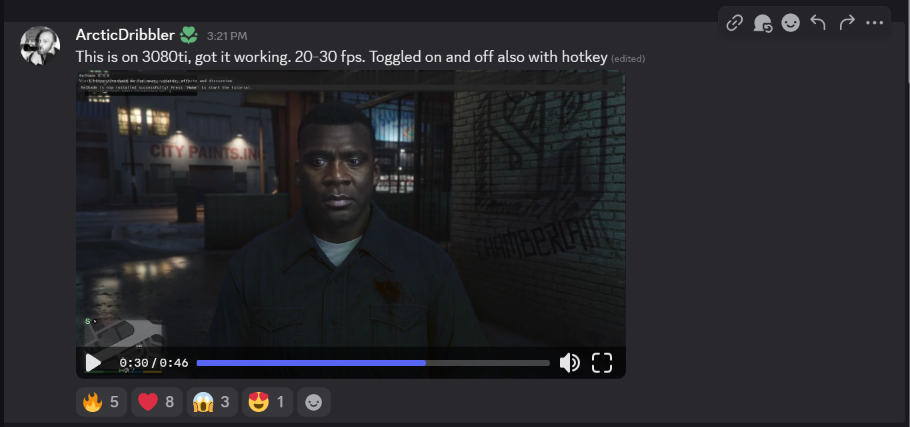
One user got Grand Theft Auto V running at around 20-30 FPS on an RTX 3080 Ti at 1440p. Another user played Dying Light 2 at roughly 40 FPS on an RTX 3080 but noted that the image was very noisy. Hogwarts Legacy was running at 30 FPS on an RTX 3090; Mortal Shell 2 at 34 FPS on RTX 3080 Ti, but with shimmering; Ready or Not at 30 FPS on RTX 3080; Neverness to Everness at 29-30 FPS on RTX 3080; and even NBA 2K27 on a mobile RTX 3070 at 25 FPS with DLAA at 1080.
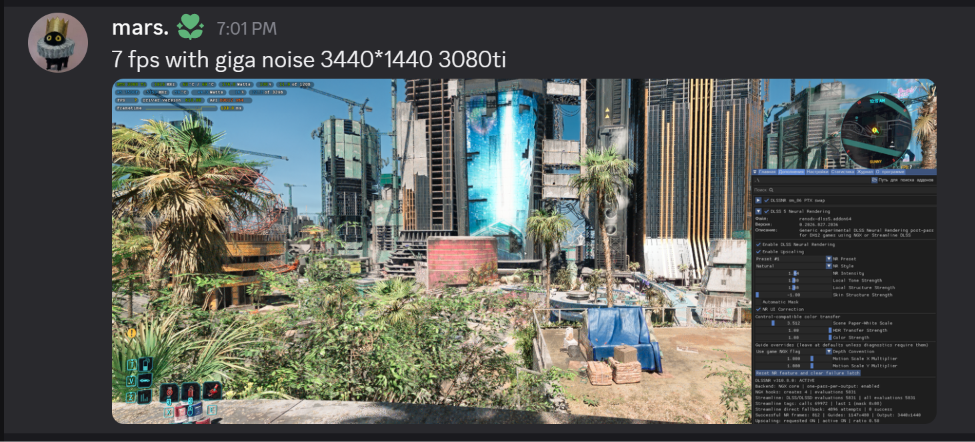
On the other hand, many users reported being stuck in single-digit FPS territory across a variety of games. You'd expect bad performance from RTX 3050 and RTX 3060 users, but the worst we saw was 2 FPS for Hogwarts Legacy on RTX 3070. One person on X enjoyed Deep Rock Galactic with DLSS 5 at 4 FPS on their RTX 3080, down from 130+ FPS without it. Back on Discord, one user ran Cyberpunk 2077 at 7 FPS on an RTX 3080 Ti.
I GOT DLSS 5 RUNNING ON MY RTX 3080!! pic.twitter.com/fiSnGKtwPWAugust 29, 2026
The most interesting result we saw was beautifully emblematic of this entire predicament. A user reached up to 41 FPS in Cyberpunk 2077 with DLSS 5. But to get there, they had to drop the resolution to 720p and use the ultra performance preset for upscaling. As mentioned earlier, you sacrifice base fidelity in order to gain the neural fidelity, if that's your cup of tea.

People seemed so impressed by DLSS 5 that several were ready to sell their Ampere cards for Blackwell GPUs for their servers. The jump from RTX 30-series to RTX 50-series is substantial, but the biggest improvements were made in the AI department. It's a fascinating case study to see people vehemently reject AI at first, then pivot to make purchasing decisions explicitly based on the most AI features possible afterward.
Nvidia still hasn't officially announced when DLSS 5 is dropping or what GPUs it will support. DLSS 4.5, the latest iteration of the tech, supports RTX GPUs all the way back to the RTX 20-series. However, it's not rocket science to deduce that the RTX 50-series will be the first to receive DLSS 5, because it's the only family that can natively read certain FP8 libraries that DLSS 5 depends on.

Follow Tom's Hardware on Google News, or add us as a preferred source, to get our latest news, analysis, & reviews in your feeds.






 English (US) ·