
 4 hours ago
4
4 hours ago
4

Published Feb 2, 2026, 12:01 AM EST
How one intrepid TCG player rediscovered his love for Darkwing Duck
 Image: Ravensburger
Having an extensive background in Magic: The Gathering does not prepare you whatsoever for Disney Lorcana. That’s the first lesson I learned after I started ripping preview packs from the upcoming Winterspell set, which is slated for prerelease on Feb. 13 and global release on Feb. 20. My goal: Figure out how to build a deck from the 384 cards.
At first, I wasn’t even sure how to tell cards apart. Magic makes this easy. Most of a card’s surface is white, blue, black, red, or green, with each color signaling a strategy at a glance. Lorcana takes a bit longer to grasp: it’s the narrow strip of color in the middle that matters, and instead of mana, those colors represent six different ink types.
I kept trying to map those ink types (each named after a gem) onto Magic’s archetypes, but there’s no neat way to do that. Instead of mechanics being tied to thematic vibes, ink types seem to function more like a loose deckbuilding blueprint: Amber is about putting lots of characters on the board and helping them work together, Amethyst focuses on drawing cards with bonus tricks, Emerald leans into control and messing with your opponent’s hand, Ruby is all about direct removal of threats, Sapphire focuses on ramp so you can play bigger cards sooner, and Steel excels at direct damage and combat. Sapphire Steel feels like Lorcana’s answer to Magic’s green. Amethyst Emerald will appeal to fans of blue. But even those touchpoints can get a bit messy when some named mechanics in Lorcana appear across all ink types.
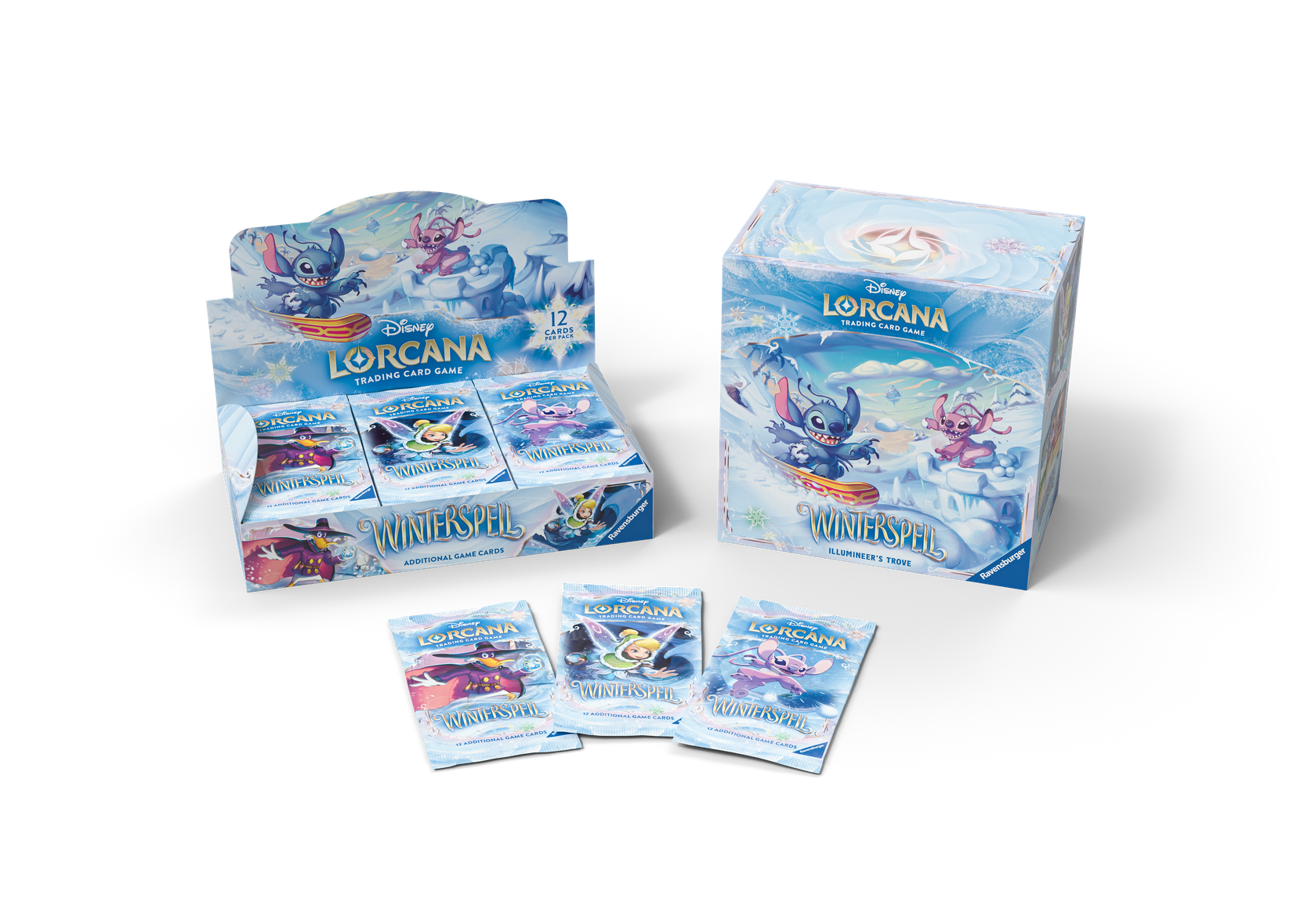 Lorcana's Winterspell set display booster box and Illumineer's Trove.Image: Ravensburger
My first breakthrough was realizing that deckbuilding in Lorcana is about leaning into aspects of two different colors that function well together. As I sorted through cards, I started noticing certain interesting combinations I wanted to tinker with. When I build a Magic deck, I start with one or more elite legendaries or mechanics and build around that. Lorcana felt frustrating when trying to take the same approach.
Then it all clicked when I started having fun with it. This is, after all, a trading card game designed by Ravensburger to, first and foremost, showcase Disney characters in their various appearances. I couldn’t help but gravitate towards certain characters I like — or at least those have fond memories of.
That’s the main reason why my first-ever Lorcana deck wound up being a Sapphire Steel Darkwing Duck deck, all because of a silly cartoon I loved watching 30-something years ago. (That’s the real magic of Lorcana, isn’t it? That sweet, delicious nostalgia.) The main card that pulled me in this direction is one of the few legendary-rarity characters I pulled: Darkwing Duck – Cool Under Pressure. He’s a 6/8 that costs seven ink who generates two lore when he quests. With shift 5, you can play this card at a cheaper cost of five ink if you do so on top of another Darkwing Duck. As it turns out, I pulled two other versions of Darkwing in Steel and another in Sapphire. So I could play Darkwing Duck – Crime Fighter for one ink early in the match, then play Cool Under Pressure on top of it by round five.
I also pulled the delightful Honker Muddlefoot – Timid Genius. As much as I loved Darkwing Duck as an avian Batman analogue back in the day, I always identified more with Honker. I, too, was a shy little duckling kid genius with big glasses… at the time. With this Honker on the board, all Darkwing Ducks get +1 Resist (defense). I also got several copies of Launchpad – Trusty Sidekick who can exert himself to let you draw a card. Normally, you’d have to discard a card when you do this, but with a Darkwing Duck in play, you don’t. The dreamlike vision of a swarm of ducks crowding up my playmat crystallized.
I found another quacktastic combo with The Thunderquack item (Darkwing’s ship), the Darkwing Tower – Icy Headquartes location, the Darkwing’s Chair Set item, and an action card called The Terror That Flaps in the Night. The Thunderquack classifies all opposing characters as villains. Darkwing Tower lets you ready a character in there whenever an opposing villain is banished. Darkwing’s Chair Set is an item you can banish to deal two damage to a character, but with a Darkwing on the board, that increases to four. The Terror That Flaps in the Night functions just like the Chair Set, boosting base two damage to three with a Darkwing in play. Discovering these combos was the moment when the deck stopped feeling like nostalgia and started feeling clever.
I stuck as many copies as I had of each of these cards in my deck and filled out the rest of the 60 cards with as many other ducks as I could find: Daisy Duck – Isabel, Scrooge McDuck – Miserly Ebenezer, and Gosalyn Mallard – Curious Child just to name a few.
I call it Mallard Mayhem.





 English (US) ·