
 2 hours ago
4
2 hours ago
4
Steven Spielberg has now made five movies about aliens (six if you count the 20-minute “Firelight” that he shot on Super 8mm when he was 17, and seven if you roll with my alternate reading of “The BFG”), and all of them are very straightforward about their shared belief that we are not by ourselves in the cosmos. Mystery abounds, but the basic existence of extraterrestrial life is unambiguously confirmed by the end of the first reel.
From “Close Encounters of the Third Kind” to “War of the Worlds” and even “Indiana Jones and the Kingdom of the Crystal Skull,” these films waste no time in confronting their characters with the answer to a question that has tugged at the human imagination since at least the second century AD (when ancient Greek satirist Lucian of Samosata wrote about a conflict on the moon), and they do so for the simple reason that Spielberg is less interested in wondering if we’re alone in the universe than he is in leveraging the universe to wonder how we can feel so alone in our own lives.


While his aliens haven’t always come in peace (often, but not always), their arrivals and/or sudden revelations have always motivated very earthbound stories about the intimate fractures that form within families, communities, and ourselves. In “Close Encounters,” little gray men come all the way from deep space to fulfill Spielberg’s fantasy of reuniting his parents; in “War of the Worlds,” buried tripods from some far-off star are closer to the surface of New Jersey than a divorced longshoreman is to his teenage son. Spielberg’s aliens illustrate how the distance between two people on the same planet can be as vast as the span from one galaxy to another.
But Spielberg, who’s dedicated his mortal existence to mining universal spectacle from the specific traumas of his own childhood, also understands better than anyone else that it doesn’t have to be. And as modern cinema’s most unbounded storyteller has observed the siloification of life in the 21st century, it makes sense that he’s turned inward to understand why people are only growing further apart. A man-on-the-run thriller about a whistleblower who’s determined to reveal that the U.S. government has been lying to the public about aliens since Roswell, “Disclosure Day” might be pitched as a spiritual sequel to “Close Encounters,” but the movie itself — typically earnest and fantastic entertainment, as fluid in its direction as it can be clumsy with its ideas — is in far more immediate conversation with Spielberg’s recent films, which have reflected upon his legend with a candor and curiosity that’s as alien to the billionaire class as E.T. was from Earth.
Similar to how “Ready Player One” allowed Spielberg to interrogate the merits of the modern blockbuster, and “The Fabelmans” saw him unpack how a single divorce shaped a half-century of American imagination, “Disclosure Day” finds him revisiting the singularly iconographic stuff of his own story to insist that we aren’t as far apart from each other as we might think. Even more rewardingly, it finds him wrestling with the burden of maintaining our collective faith in that idea, the full weight of which he’s only been able to understand, or to bear, by continuing to process it through the prism of his own experience.
“I will not be anyone’s religion,” a character scoffs at a key moment in Spielberg’s latest movie, but someone has to uphold the world’s self-belief at a time when the people in power are so determined to snuff it out. If only proving that people aren’t alone in the universe was as easy as showing them an old surveillance video of [redacted historical figure] meeting an alien.
“Disclosure Day” is naive or out of touch enough to pretend that it might be, but you don’t have to be convinced by its extremely offline logic to appreciate the crux of its emotional argument: We don’t have to be so fucking afraid of what we don’t know, be it creatures from another planet, people on the other side of an invisible border, or even the parts of ourselves that we’ve repressed too deeply to distinguish between memory and imagination. Nor do you have to buy into its big swing of an ending — as much of a moonshot as the climax of “Close Encounters,” and similarly telegraphed in advance — to enjoy the rollicking adventure required to get there. Because for all of the allusions I’ve already made to Spielberg’s other movies, the scrambly and relentless “Minority Report” is the one that “Disclosure Day” most plainly resembles on its face.
Another desaturated 140(ish)-minute chase that hinges on the ethics of disseminating privileged information that has the power to upend the bedrock of society (a subject that Spielberg also recently explored in “The Post”), “Disclosure Day” begins at a sprint and waits for its story to catch up. Yesterday morning, eight workers at the shadowy extragovernmental agency WARDEX — Waived Reporting, Development, and Extraction — failed to show up for work. Maybe that’s because the planet is on the brink of World War III (North Korea is up to no good) and people have already started hoarding supplies in anticipation of nuclear winter, or maybe it’s because they’ve unionized in a concerted effort to betray the agency’s secret purpose: safeguarding hard evidence that aliens have been visiting Earth since at least 1947.
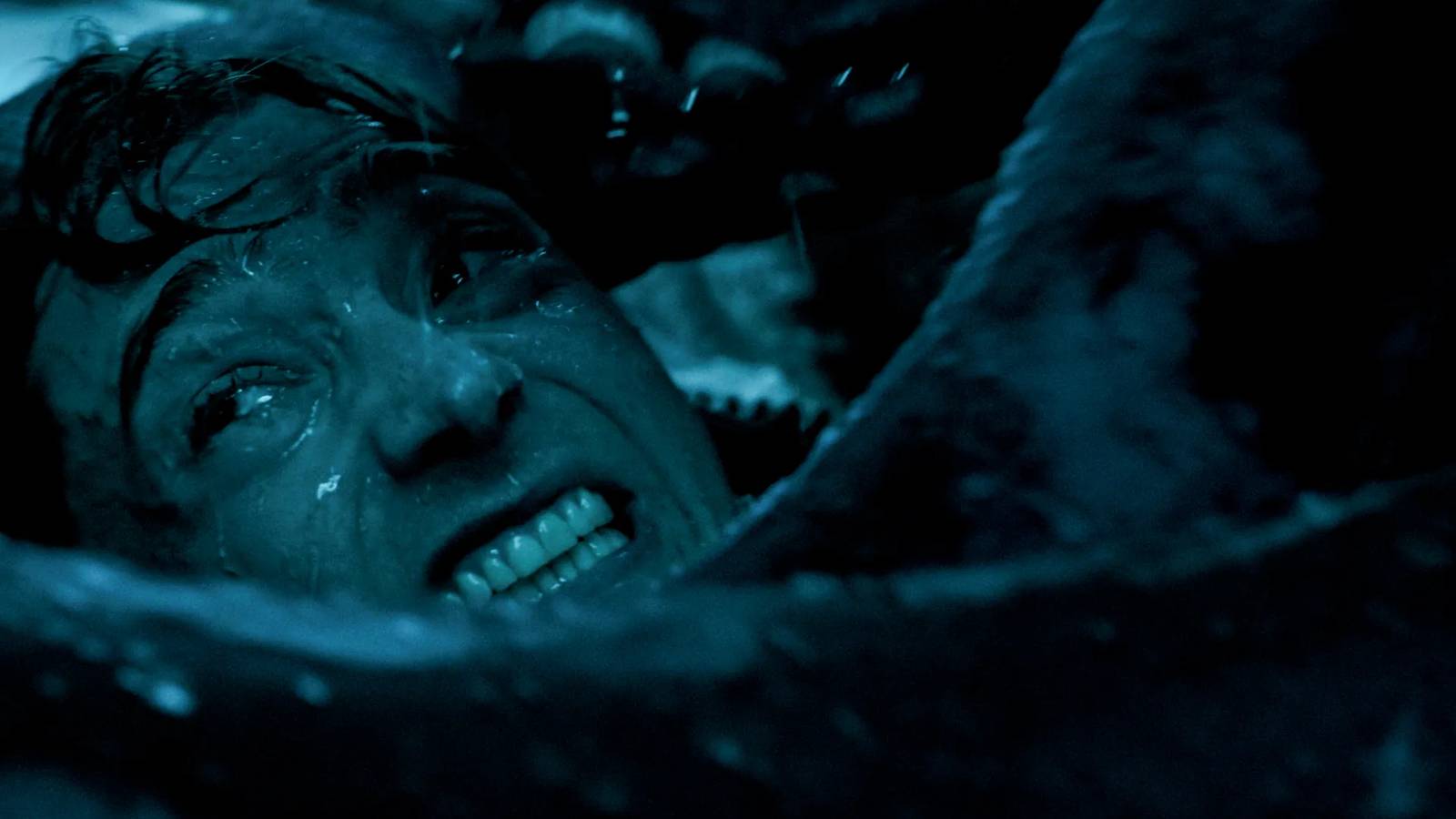
 ‘Disclosure Day’Niko Tavernise/Universal Picture
WARDEX leader Noah Scanlon is inclined to believe the latter (he’s played by a square-headed Colin Firth, costumed to resemble a sinister college professor), especially once he discovers that cybersecurity whiz Daniel Kellner (Josh O’Connor) has made off with a treasure trove of top-secret data drives and a mysterious alien device — known only as “The Device” — that everyone treats like an unstable bomb. Daniel is determined to get the goods to his former WARDEX colleague Hugo Wakefield (a winningly manic Colman Domingo), but Hugo is too paranoid to offer his exact location, and spends most of the movie saying things like “lie low,” “get off the road,” and “we’ll contact you when the time comes.” He also spends most of the movie building a mid-century home inside of a giant warehouse, the explanation for which is as easy to figure out as it is satisfying in the context of Spielberg’s auto-fiction.
Meanwhile, in the “Show Me State” (ha!), relentlessly chipper meteorologist Margaret Fairchild (Emily Blunt) dreams of landing a job behind the anchor desk and graduating from Kansas City to a bigger market, even though her musician boyfriend Jackson (a scruffy and hapless Wyatt Russell) seems to enjoy their giant loft. Is Margaret a die-hard careerist, or has she just spent her entire life in search of an errant truth that always seems to be one step ahead of her? Oh, and some quick follow-up questions: Why can she suddenly read people’s most intimate thoughts just by looking at them and speak every language on Earth, and is her unbridled passion for Gwen Stefani’s “The Sweet Escape” a symptom of extraterrestrial interference? (No spoilers, but the answer to that last matter remains tantalizingly unresolved).
 ‘Disclosure Day’Niko Tavernise/Universal Picture
Whatever the case, Margaret suffers a strange and extremely public episode while doing her weather report on live TV (she makes a series of unnatural but mathematically precise clicking sounds before collapsing to the floor), which adversaries Noah and Hugo both interpret as the starting gun in a race to reach her first. If WARDEX gets hold of Margaret, the secrets of alien life will remain top-secret. If Hugo wins out and successfully introduces her to Daniel, the meteorologist and the number-cruncher will somehow form a magical dyad capable of translating E.T.’s message to the masses.
“Disclosure Day” stops a long alien finger short of a “Signs”-level fait accompli, but David Koepp’s screenplay — cobbled together from an outline that Spielberg tapped out on his Notes app — is nevertheless guided by a distinctly Shyamalanesque logic, its loose and goofy story beats clashing against the ecstatic precision of Spielberg’s visual genius. The writing is a bit clunky even before Firth starts using unstable alien technology to hack Eve Hewson’s brain like Cerebro (the “Bridge of Spies” acquits herself well in the thankless role of Daniel’s girlfriend Jane, a former novitiate and current liability whose most important function is to question the movie’s faith in people), but Spielberg is so excited about the stakes at hand that his enthusiasm for the material smoothes over its wrinkles.
A lifelong fantasist who’s matured into a master without ever growing up, Spielberg — now a half-century removed from “Close Encounters” — continues to delight in telling stories about regular people being subsumed into larger-than-life spectacle, and he’s as giddy as ever about replicating that experience for his audience. He’s tickled about the prospect of flipping post-QAnon conspiracy brain into a reason for us to believe in each other (a humanist reading that still allows for the possibility that Spielberg is convinced of an actual cover-up), and “Disclosure Day” is rocket-fueled by the decades of institutional distrust that have accumulated in his work over the last 50 years; needless to say, there would be no Daniel Kellner without Edward Snowden.
 ‘Disclosure Day’Niko Tavernise/Universal Picture
The hope that Spielberg once aimed at the skies is now focused squarely here on Earth, and the final battle for the future of human trust and transparency is palpably contained within every virtuosic pan and piece of blocking, of which there are dozens. I’ve been on Twitter too long to be swayed by the movie’s conviction that proof of alien life would do more to end wars than inflame them, and Koepp’s script never puts in the work required to earn its optimism on the subject, but the childlike joy and wonder in seeing Janusz Kamiński’s camera trace impossible circles around a wooden fence, or pivot from one side mirror of Margaret’s car to the other, is contagious enough that even the film’s most credulous ideas feel too sincere to reject outright. (For his part, Kaminski exalts in revisiting the muted palette that colored the millennial chapter of his Spielberg collaborations, his well-documented fetish for halation re-energized by a movie that sees every iPhone as a potential source of lens flare.)
While Spielberg has never lost his sense of fun, “Disclosure Day” is uniquely fortified by the sense that he’s still searching for new ways to enrapture a jaded audience with his spectacle, and the movie’s ethos becomes that much harder to deny every time its director manages to suspend our disbelief all over again. There might not be anything here quite as inventive as the spider robot sequence from “Minority Report,” but a certain setpiece — the one that starts with a car getting shoved into an oncoming freight train — is as gripping as Hollywood action gets. (John Williams’ score, classical but subdued, drops out to great effect when the action spikes.) Spielberg claims the scenario first came to him on the set of “The Sugarland Express,” but the opening minutes of “The Fabelmans” would suggest that he might have been incepted by the idea almost two decades before that. Was it a dream or a memory? Even he doesn’t seem to know for sure.
 ‘Disclosure Day’Universal Pictures and Amblin En
As might be expected, Spielberg’s cast is eager to share in his enthusiasm. O’Connor is boxed in by a role that’s long on urgency and short on nuance, but he does an excellent job of scaling from “I’m just a math nerd!” to “I could stare down Jason Bourne,” which is what this movie needs from him. Blunt, on the other hand, has a lot more room to maneuver, and she absolutely makes the most of it (heroic stuff in the context of a story whose characters are too frequently overshadowed by whatever ethos they’re meant to embody).
Tasked with playing clueless and omniscient all at once, Blunt conjures the magic of “Liar Liar”-era Jim Carrey every time Margaret is made to speak without thinking; Margaret is confused by her newfound ability to connect with everyone she meets, but Blunt’s performance is rooted in a profound and unwavering belief that leaving every stranger on Earth with a Spielberg Face might be enough to save the world. That shared understanding between the actor and her part tees up an incredible riff on the Hawthorne Plaza Mall scene from “Minority Report,” with Blunt going full Pre-Cog mode as she uses her unfettered psychic abilities to disarm the various people in her path.
Most striking about her performance in that sequence — and others — is how Blunt always makes it seem as though everything she learns about another character teaches her something about her own, so that Margaret comes off less as a seer than a translator of sorts. “People have the right to know the truth,” Daniel insists about the existence of alien life, but “Disclosure Day” contends that each of us is an infinite universe unto ourselves, teeming with unexplored secrets.
Far-fetched as this popcorn movie gets, it crucially never loses sight of the notion that to look outward is to look within (and vice versa), a theory that only grows clearer over the span of a blockbuster whose 79-year-old director still peers back at his childhood for a better view of the stars. “We are not alone,” the saying goes. To watch “Disclosure Day” in a room full of other people gasping at the same things, all of us putty in the hands of a filmmaker whose dreams and/or memories have long become our own, is to recognize that we never were.
Grade: B+
Universal Pictures will release “Disclosure Day” in theaters on Friday, June 12.
Want to stay up to date on IndieWire’s film reviews and critical thoughts? Subscribe here to our newsletter In Review by David Ehrlich, in which our Chief Film Critic and Head Reviews Editor rounds up the best new reviews and streaming picks along with some exclusive musings — all only available to subscribers.






 English (US) ·