
 Image via Matt Infante/Paramount+

Published Oct 28, 2026, 10:00 AM EDT
Tania Hussain is an Executive Editor at Collider responsible for creative, editorial, and managerial duties. In addition to leading content ideation and development, she works to generate innovative and compelling ideas for feature articles and reviews with her editorial team across Features, Lists, Reviews, and Interviews. She also serves as the primary editor overseeing Collider’s Signature Series profiles, spotlighting some of the most influential voices in film and television. Tania has helped cover and ideate content for major events for Collider, including the Toronto International Film Festival. She has also conducted more than 100 interviews since her start in the business more than 15 years ago. Some favorites include Joel McHale, Charlie Cox, Jennifer Garner, Tina Fey, Kate Winslet, Bob Odenkirk, Andy Richter, Jordan Schlansky, Jamie Dornan, Yeardley Smith, Rafe Spall, Esther Smith, and a reasonable toss-up between Cookie Monster and Kermit the Frog. She has covered set visits, in-person junkets, and red carpets for several films and TV shows, including most recently, The Sheep Detectives, Masterchef, and Star Trek: Starfleet Academy.
Sign in to your Collider account
There’s something truly amusing about watching Michael C. Hall’s Dexter Morgan tackle the indignities of old age in Dexter: Resurrection Season 2. In the highly anticipated return of the original series’ opening credits, the serial killer’s once familiar morning routine now comes with a little more wear and tear. From slicing a New York bagel to throwing out the trash, the rituals are recognizable, but the man behind the Dark Passenger isn’t quite the same, and his aching shoulder is a nice reminder that even America’s favorite antihero isn’t immune to aging (and that murder is easier on his body than getting out of bed).
While it’s a funny acknowledgment of the passage of time, for someone convinced he’s different from others, that cruel joke becomes the foundation of a surprisingly thoughtful second season. Dexter is back in New York, hunting monsters and negotiating his next moves with his conscience and father, Harry (James Remar), but also trying to show up for his son, Harrison (Jack Alcott). As he leans harder into being there for his kid (or at least, tries to), Dexter remains haunted by the consequences of his choices and begins to wonder whether his work means anything anymore.
With the first two episodes available for review, the premiere isn’t exactly flawless, rushing through some setup to pick up where last season left off. Thankfully, by the second episode, the series finds a much better rhythm, particularly in how confidently it embraces the humor and suspense that made the original series so fun to begin with. The new killers are genuinely creepy, and Dexter’s internal commentary is as entertaining as ever, largely because he’s also a little sassier than usual. It’s an exciting start to a season that feels like it’s having a bit more fun with itself.
What Is ‘Dexter: Resurrection’ Season 2 About?
Picking up after the deadly events of the first season, Dexter: Resurrection finds Hall’s Dexter Morgan continuing life in New York City, still hunting down killers while building a strong relationship with his son, Harrison. Now a graduate of the police academy, Harrison is beginning his career with the NYPD’s homicide division, working alongside Lieutenant Claudette Wallace (Kadia Saraf), who is still tracking the notorious New York Ripper. Her investigation this season leads her to Don Framt (Brian Cox), an elderly man suspected of being the elusive killer who has evaded authorities for decades. As all the players establish themselves on Season 2’s chessboard, a new threat emerges in the form of the Five Borough Killer, played by Dan Stevens, whose seemingly ordinary appearance disguises a particularly disturbing appetite for murder.
Collider Exclusive · Horror Survival Quiz Which Horror Villain Do You Have the Best Chance of Surviving? Jason Voorhees · Michael Myers · Freddy Krueger · Pennywise · Chucky
Five killers. Five completely different ways to die — if you're not smart enough, fast enough, or self-aware enough to avoid it. Only one of them is the villain your particular set of instincts gives you a fighting chance against. Eight questions will figure out which one.
🏕️Jason
🔪Michael
💤Freddy
🎈Pennywise
🪆Chucky
TEST YOUR SURVIVAL →
01
Something feels wrong. You can't explain it — you just know. What do you do? First instincts are the difference between the survivor and the first act casualty.
ALeave immediately. I don't need to understand a threat to respect it. BStay quiet and observe. If I can see it, I can understand it. If I can understand it, I can avoid it. CStay awake. Whatever this is, I am not going to sleep until I feel safe again. DConfront it directly. Fear grows in the dark — I'd rather know what I'm dealing with. ECheck everything, trust nothing. The threat might be closer than I think — and smaller.
NEXT QUESTION →
02
Where are you most likely to find yourself when things go wrong? Setting is everything in horror. Where you are determines which rules apply.
ASomewhere remote — a cabin, a campsite, off the grid and away from people. BA quiet suburban neighbourhood where nothing ever happens. Except tonight. CIn my own head — the most dangerous place of all, depending on what's already in there. DWherever children are — because something about this place attracts the worst things. ESomewhere ordinary — a house, a toy store, a place where the last thing you'd expect is a threat.
NEXT QUESTION →
03
What is your most reliable survival asset? Every survivor has a quality the villain didn't account for. What's yours?
APhysical fitness — I can run, I can swim, I can outlast something that relies on brute persistence. BSpatial awareness — I always know the exits, the hiding spots, the fastest route out. CPsychological resilience — I've faced my worst fears before. They don't have the same power over me. DEmotional steadiness — I don't panic. Panic is what gets you caught. EScepticism — I don't underestimate threats because of how they look. Size is irrelevant.
NEXT QUESTION →
04
What kind of fear is hardest for you to fight through? Knowing your weakness is the first step to not dying because of it.
AThe unstoppable — something that will not stop, cannot be reasoned with, and is always getting closer. BThe invisible — a threat I can feel but can't locate, watching from somewhere I can't see. CThe psychological — something that uses my own mind and memories against me. DThe unknowable — something ancient, shapeless, that feeds on the fear itself. EThe mundane — a threat so ordinary-looking that no one will believe me until it's too late.
NEXT QUESTION →
05
You're with a group when things start going wrong. What's your role? Horror movies are brutally clear about who survives group situations and who doesn't.
AThe one who says "we need to leave" first — and means it, even when no one listens. BThe one who stays quiet, watches the others, and figures out the pattern before anyone else does. CThe one who holds the group together when panic sets in — because someone has to. DThe one who asks the questions nobody wants to ask — because ignoring them gets people killed. EThe one who takes the threat seriously when everyone else is laughing it off.
NEXT QUESTION →
06
What's the horror movie mistake you're most likely to make? Honest self-assessment is a survival skill. Denial is not.
AGoing back for someone — I know I shouldn't, but I can't leave them behind. BAssuming I'm safe once I've found a hiding spot. That's when it finds me. CFalling asleep when I absolutely cannot afford to. Exhaustion is its own enemy. DLetting my curiosity override my instincts — I always need to understand what I'm dealing with. EDismissing the threat because of how it looks. That's exactly what it wants.
NEXT QUESTION →
07
What's your best weapon against something that can't be stopped by conventional means? Every horror villain has a weakness. The survivors are always the ones who find it.
AThe environment itself — I use the terrain, the water, the geography against it. BPatience — I wait, I watch, and I strike at the one moment it doesn't expect. CLucidity — if I can stay in control of my own mind, it loses its primary weapon. DCourage — facing it directly, refusing to run, taking away the fear it feeds on. EImprovisation — I use whatever's at hand, however unconventional. Creativity over brute force.
NEXT QUESTION →
08
It's the final scene. You're the last one standing. How did you make it? The final survivor always has a reason. What's yours?
AI kept moving. I never stopped, never hid for too long, never let it corner me. BI figured out the pattern before anyone else did — and I used it against the thing following it. CI stayed awake, stayed lucid, and refused to give it the one thing it needed most. DI stopped being afraid of it. And the moment I did, everything changed. EI took it seriously from the start — and I never once made the mistake of underestimating it.
REVEAL MY VILLAIN →
Your Survival Odds Have Been Calculated Your Best Chance Is Against…
Your instincts, your strengths, and your particular way of thinking under pressure point to one villain you actually have a fighting chance against. Everyone else — good luck.
Jason Voorhees
Jason is relentless, but he is also predictable — and that is the gap you would exploit.
- He moves in straight lines toward his target. He doesn't strategise, doesn't adapt, doesn't outsmart. He simply pursues.
- Your ability to keep moving, use the environment, and resist the panic that freezes most victims gives you a genuine edge.
- The Crystal Lake survivors were always the ones who stopped running in circles and started thinking about terrain, water, and distance.
- You think like that. Which means Jason, for all his indestructibility, would face someone who simply refused to be where he expected.
Michael Myers
Michael watches before he moves. He is patient, methodical, and almost impossible to detect — until it's too late for anyone who isn't paying close enough attention.
- But you are paying attention. You notice the shape in the window, the car parked slightly wrong, the silence where there should be sound.
- Michael's power lies in the invisibility of ordinary suburbia — the fact that nothing ever looks wrong until it already is.
- Your spatial awareness and instinct to map every room, every exit, and every shadow before you need them is precisely the quality Laurie Strode had.
- You are not a victim waiting to happen. You are someone who already suspects something is wrong — and acts on it.
Freddy Krueger
Freddy wins by getting inside your head — using your own fears, your own memories, your own subconscious as weapons against you. That strategy requires a target who can be destabilised.
- You are harder to destabilise than most. You've faced uncomfortable truths about yourself and you haven't looked away.
- The survivors on Elm Street were always the ones who understood what was happening and chose to face it rather than flee from it.
- Freddy's greatest weakness is that his power evaporates in the presence of someone who refuses to give him the fear he feeds on.
- Your psychological resilience — the ability to stay grounded when reality itself becomes unreliable — is exactly the quality that keeps you alive here.
Pennywise
Pennywise is ancient, shapeshifting, and feeds on terror — but it has one critical vulnerability: it cannot function against someone who genuinely stops being afraid of it.
- The Losers Club didn't survive because they were braver than everyone else. They survived because they faced their fears together, and faced them honestly.
- You ask the questions others avoid. You look directly at what frightens you rather than turning away.
- That directness — the refusal to let fear fester in the dark — is Pennywise's worst nightmare.
- It chose the wrong target when it chose you. You are exactly the kind of person whose fear tastes like nothing at all.
Chucky
Chucky's greatest advantage is that nobody takes him seriously until it's already too late. He exploits the gap between how something looks and what it actually is.
- You don't have that gap. You take threats seriously regardless of how they present — and you never make the mistake of underestimating something because of its size or appearance.
- Chucky relies on surprise, on the delay between recognition and response. You close that delay faster than almost anyone.
- Your instinct to treat every unfamiliar thing with appropriate scepticism — rather than dismissing it because it seems absurd — is the exact quality that keeps you breathing.
- Against Chucky, not laughing is already winning. You are very good at not laughing.
↻ RETAKE THE QUIZ
With Uma Thurman returning as Charley and Desmond Harrington reprising his role as Joey Quinn from the original Dexter series, the titular character soon finds himself dealing with familiar faces while also working through several new dangers. As Harrison settles into his responsibilities as a cop, Dexter continues taking justice into his own hands, even if it means sidestepping dad duty a bit. But his increasingly impulsive behavior this season has Harry (of all people) questioning his judgment. Combined with the prospect of aging weighing heavily on his mind, Dexter begins experiencing something he probably never anticipated: a midlife crisis. Suddenly, it feels like someone who has spent most of his life satisfying his Dark Passenger is worried about what comes next.
Michael C. Hall Leads an Impressive Ensemble in ‘Dexter: Resurrection’ Season 2
After nearly 20 years, it’s hard to imagine anyone else playing Dexter Morgan quite like Hall, who slips back into the role with ease. He’s especially entertaining this season, leaning into Dexter’s biggest frustrations of getting older while keeping that wonderfully awkward sense of humor. Hall has always been brilliant at conveying Dexter’s thoughts with the smallest facial expressions, but this time around his delivery is also rather biting, which makes for some very funny moments. While his chemistry with Remar is equally enjoyable, that patriarchal voice of reason starts to sound more fatherly than anything.
Dexter’s relationship with Harrison ultimately gives Hall his most tender moments. Alcott continues to impress as a young man trying to follow his own path while dealing with a father whose serial killer habits have complicated his life. While their scenes together are more natural this season, Alcott also shares excellent moments with Saraf, whose determined detective remains a compelling presence as her investigation into the New York Ripper intensifies. Also joining the cast in Season 2 is Bokeem Woodbine as Captain Mixon, who brings a striking authoritative presence to the department with his pragmatic demeanor.
Among the newcomers, Cox is wonderfully exciting as Don Framt, bringing a sinister charm to the aging suspect that makes his interactions with Hall particularly enjoyable. Stevens is equally commanding as the Five Borough Killer, shifting effortlessly between an ordinary New Yorker and a deeply disturbed murderer. After last season kind of did her dirty and left her without much to do, Thurman makes a welcome return as Charley, whose uneasy arrangement with Dexter creates some entertaining tension. Meanwhile, Harrington brings back Joey Quinn’s energy and charm, while Ntare Guma Mbaho Mwine returns as Dexter’s neighbor Blessing, continually grounding our serial killer in humanity. Nona Parker Johnson also joins Season 2's ensemble as Fiona, adding another interesting dynamic to Harrison’s new life in law enforcement.
‘Dexter: Resurrection’ Season 2 Knows How To Stay Fresh
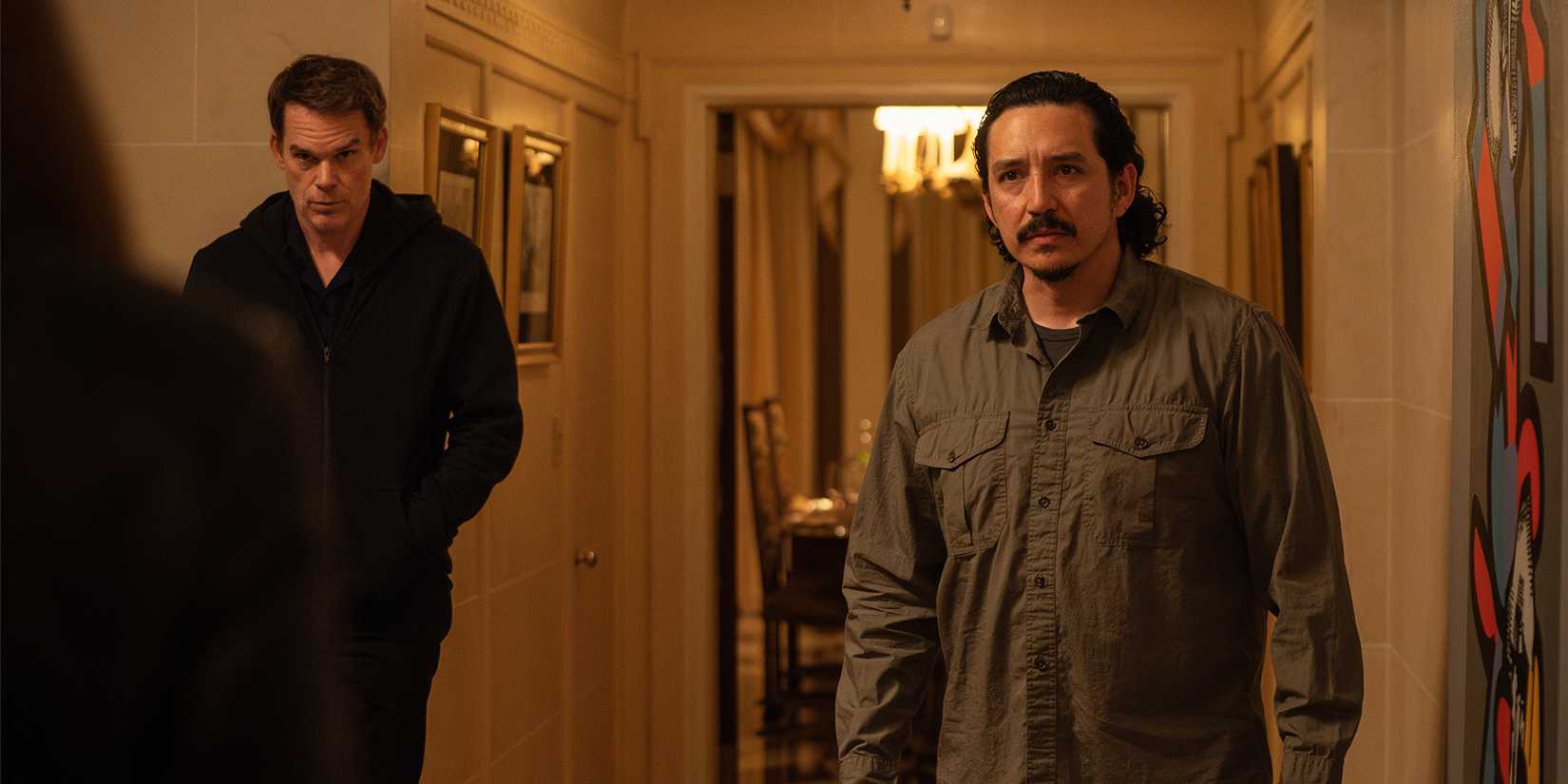 Image via Matt Infante/Paramount+
One of Season 2’s greatest joys is how the writers have very naturally incorporated Dexter’s midlife crisis into his already complicated existence. He’s listening to self-help podcasts any chance he can get while questioning whether his kills have actually made a difference. His pursuit of the Rapunzel Killer, Al Walker (Eric Stonestreet), only adds to that frustration, particularly when Dexter realizes taking another murderer off the streets doesn’t automatically mean recognition. Following the death of his former friend Batista (David Zayas), Dexter is facing the uncomfortable reality of growing older and losing people who have been part of his life for decades. Sure, he’s spent his time keeping others at arm’s length (like “Lumberjack Dexter”), but his growing isolation feels different this time around, especially as he builds a meaningful relationship with Harrison without giving up the very thing that cost him so much.
That concern over legacy becomes particularly interesting with Cox’s Don Framt, an aging suspected serial killer who seems to relish the notoriety surrounding his crimes. For Dexter, Don is a sharp reflection of what his own future might look like, particularly as he gets older. What will Dexter have to show for his life’s work? It’s an interesting question for a character so adamant about living his life through this “righteous code” to “protect others.” Meanwhile, Stevens’ Five Borough Killer brings a more contemporary perspective to the discussion, deliberately provoking authorities and seeking public attention through his crimes. It’s a smartly written character who feels especially relevant in this modern social media age, where society’s fascination with true crime and influencer culture has created celebrities out of criminals.
The writing also takes a noticeably creepier turn this season, particularly with Gabriel Luna’s Sleepy-Eyed Stranger, whose bone-chilling habit of sneaking into people’s homes is genuinely terrifying. Sharing anything more about his methods would be a spoiler, as the real horror sits uncomfortably in the slow burn of it all. His introduction in Episode 2 is enough to leave you feeling uneasy and rather paranoid. It’s the sort of psychological horror the original Dexter did so well, and it’s very exciting to see the writers finding fresh ways to bring that type of fear back.
Though it’s still early in the season, Dexter: Resurrection is off to a promising start, with intriguing storylines that have already made the first two episodes an enjoyable watch. There are some growing pains, but the series finds its footing fast, and though Dexter might be getting older, there’s still plenty of life left in his Dark Passenger.
Dexter: Resurrection Season 2 premieres October 30 on Paramount+.
Release Date July 13, 2025
Network Paramount+ with Showtime
Directors Marcos Siega
Pros & Cons
- Michael C. Hall is terrific as an older, wearier Dexter, with his signature dark humor as sharp as ever.
- Brian Cox and Dan Stevens are compelling additions, bringing fresh menace to an already impressive ensemble.
- The writing cleverly explores Dexter's midlife crisis while delivering some genuinely disturbing psychological horror.
- The premiere feels rushed as it works through lingering storylines and introduces new threats.






 English (US) ·