
 3 weeks ago
24
3 weeks ago
24

Published May 31, 2026, 8:00 AM EDT
This very French werewolf is no longer one of the scariest monsters in Ravenloft
 Graphic by Polygon I Source images: Wizards of the Coast/Dungeon Masters
Scary season starts early this year, at least as far as Dungeons & Dragons is concerned. The upcoming release of Ravenloft: The Horrors Within on June 16 will mark the peak of “Season of Horror” for the world’s most famous role-playing game; we have some interesting teases of the contents of the book already, thanks to D&D’s new official actual play show, Dungeon Masters, and the Ravenloft Play-Along pack available on D&D Beyond.
These weekly drops consist of encounters and monsters seen in the show, giving players an early taste of what they will find inside Ravenloft: The Horrors Within. This week’s drop is a returning monster from Van Richten’s Guide to Ravenloft, the loup garou. This lycanthrope is inspired by French folklore (“loup garou” literally means werewolf in French), later exported to Canada, where it merged with Native American legends.
First appearing in the second edition of the game, D&D’s loup garou is a stronger, scarier werewolf, with a challenge rating of 13 and the potential to wipe out an entire party. Or at least, that’s what the 5th edition version could do.
I’m curious to see how the party led by DM Jasmine Bhullar will deal with a loup garou in the next episode of Dungeon Masters. The characters are all level 6, so in theory, they shouldn’t have any problem. You’ve read that right: The encounter presented in the Play-Along Pack is for level 6 characters, and it includes a loup garou and three werewolves. Unless there is a glaring mistake, this means that the game acknowledges that a level 6 party can take on challenges of much higher level than before.
 Image: Wizards of the Coast
The encounter has the party accompanied by two banshees, but I doubt they would tip the scales much. The loup garou is immune to the frightened condition, making the banshee’s horrify attack useless, and once they expend their once-per-day deathly wail (which also affects the party, by the way), the screaming ladies are left with their unimpressive corruptive touch attack. On top of that, the loup garou and its pack have a chance to ambush the party during the encounter.
Do challenge ratings not mean anything anymore in D&D 5.5e? After running 5e for a while, a DM learns that those numbers are just loose references, and building a challenging encounter for a party requires a lot more work. However, 5.5e sometimes gives the impression of having thrown away what little balance the game had. I appreciate many of the rules updates that the new edition has brought, but when it comes to monsters, the new approach is something I struggle to get behind.
The new loup garou unfortunately went through many of the same changes that affected monsters in D&D’s 2024 rules update. The stat block was ‘roided up, with almost every number getting a boost. However, the loup garou lost the traits and special abilities that ultimately made it a challenging foe for players and an interesting monster to run for DMs.
In an encounter, the loup garou from Van Richten’s Guide could play several roles: 120 feet of darkvision along with proficiency in perception and stealth made for a great ambusher; high movement speed and a sweeping attack legendary action were perfect for a skirmisher; finally, high damage output and hit points, and a special regeneration that made it unkillable by non-silvered weapons meant that the loup garou was an excellent brute too. On top of all that, the ability to change shape with a bonus action could set up devastating surprise rounds or allow a loup garou on the run to blend into a crowd.
 Image: Anna Podedworna/Wizards of the Coast
The new loup garou has more hit points, a higher attack bonus and overall damage output, and a more devastating curse (more on that later), but that’s about it. It lost the Mauling Pounce legendary action and, more importantly, the regeneration trait, which made it recover 10 hit points at the start of every round, unless it was struck with a silvered weapon. The 5e loup garou died only if it started its turn with zero hit points and didn’t regenerate. The new version gets 17 more hit points and an extra point of armor class to compensate.
These changes align with the new monster design philosophy in 5.5e. The current version of the rules got rid of most immunities or unique defensive traits like the loup garou’s regeneration, replacing them with stat boosts. All were-monsters lost their immunity to non-magical, non-silvered weapons. Likely motivated by a desire to simplify gameplay, this decision proves that simpler does not always mean better. Not only did it result in a loss of flavor and role-playing potential, but it also made combat more one-dimensionalfrom
I can imagine the odd situation where players were faced with an unkillable monster in 5e, but no decent DM would put their players in such a scenario without good reason. The need for silvered weapons or similar implements could serve as a reward for cautious, prepared players or as a prompt for a quest. Facing an “unkillable” monster could be a great way to humble the characters and make them feel that, despite being “heroes,” the world is still a scary, dangerous place. This is even more true for a setting like Ravenloft, which is meant to terrorize your players, and the old loup garou was a great way to achieve that.
The new stat block still poses a decent challenge. If you are planning to use a loup garou, remember that the mobility and free movement legendary action are still there, along with the bonus action shape change, so there is no need to treat this as a sack of HPs. Surprise attacks and hit-and-run tactics are still viable, even if the removal of the blood frenzy trait, which granted the creature advantage on attacks against wounded creatures, will make these ambushes less devastating. But the bite attack can wreck the party or even derail the entire campaign.
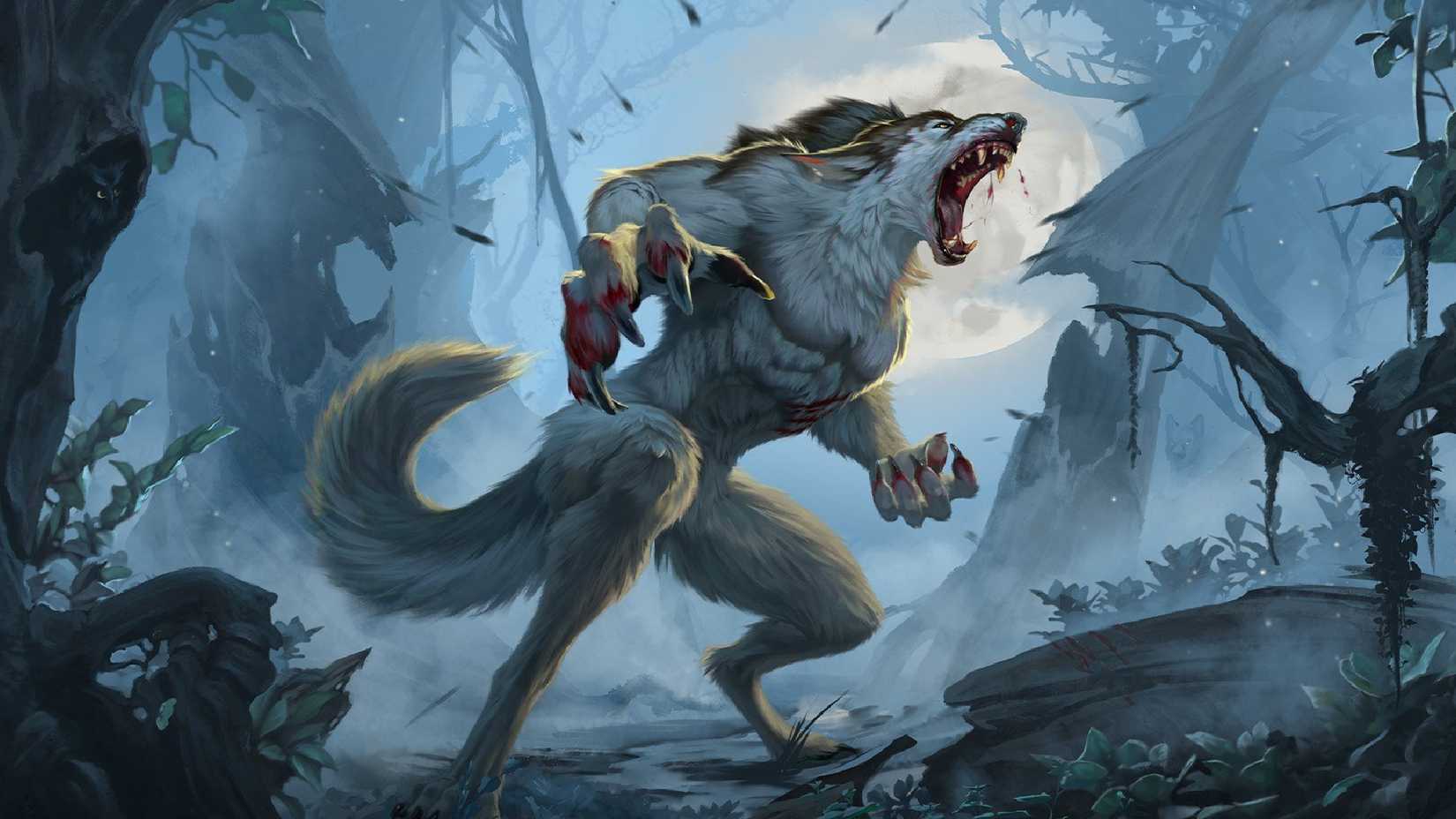 Image: Darrington Press/Ilya Royz
The loup garou’s bite attack can still transmit its lycanthropy curse, but now the DC to resist has increased from 17 to 18. Moreover, the curse is now in line with how it’s presented in the 5.5e Monster Manual: A cursed character that drops to 0 hit points immediately becomes a werewolf with 10 HP under the DM’s control. The designers finally decided to add specifics on how to end the curse too (unlike in the Monster Manual), which requires killing the loup garou.
Compared to 5e, the curse now has a more immediate impact: a loup garou can target characters with low constitution to instantly “kill” them and turn them into allies before fleeing to safety. However, in Van Richten’s Guide, slaying the beast wasn’t enough: a player affected by the loup garou’s curse also needed to receive a Remove Curse spell and pass a DC 17 constitution save. On a fail, the curse continued for another month. So, the new rules are taking away another chance for roleplaying by reducing the complexity.
What happens when you take complexity away from monsters? Players get the edge, of course. With optimized builds and gear, I don’t think it’s too absurd for a level 6 party to take on a loup garou and its pack: the monster got objectively weaker. Of course, there’s nothing wrong with letting players have their fun, but this just makes it harder for DMs to design balanced encounters.
Ravenloft is a great setting filled with scary, cool monsters to throw at players. It’s a shame that the 5.5e changes are taking away some of the features that made these creatures memorable.






 English (US) ·