
 4 weeks ago
35
4 weeks ago
35
TLDR
- President Trump terminated the U.S.-Iran peace memorandum during a NATO gathering in Turkey, triggering a sharp rally in crude oil markets.
- Brent crude futures surged 5.5% to reach $78.24 per barrel; U.S. WTI crude climbed approximately 3%.
- The IRGC reported strikes on 85 American military installations across Kuwait and Bahrain, plus the downing of a U.S. reconnaissance drone.
- Equity markets worldwide declined, with European indices falling 1.6% and American index futures dropping 0.8–1.2%.
- Washington canceled a sanctions exemption that permitted Tehran to export crude internationally, intensifying supply concerns.
Crude oil markets experienced a dramatic surge exceeding 5% on Wednesday following President Donald Trump’s announcement that the memorandum of understanding with Iran aimed at ending Gulf hostilities was “over.”
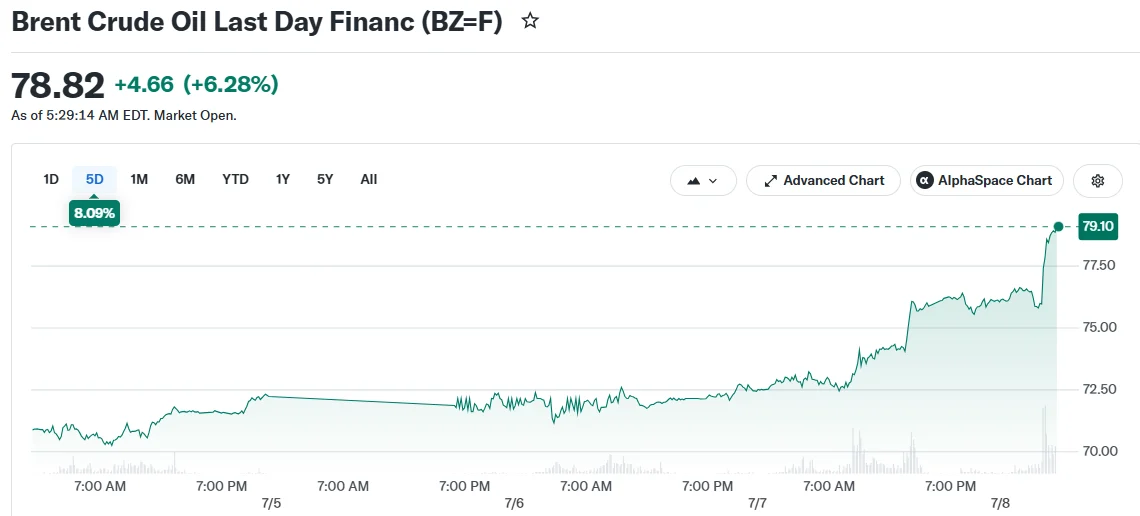 Brent Crude Oil Last Day Financ (BZ=F)
During remarks at a NATO conference in Turkey, Trump criticized Tehran for acting in bad faith. “As far as I’m concerned, it’s over,” the president stated, characterizing negotiations with Iran as “just a waste of time.”
The president’s statements sent shockwaves through financial markets already experiencing heightened anxiety following reciprocal military operations between American and Iranian armed forces.
.@POTUS on the status of the ceasefire with Iran: "To me, I think it's over. I don't want to deal with them anymore. They're scum… They're led by sick people… I'll speak to our negotiators. They want to negotiate—they're good people… but they have to come back to me. As far… pic.twitter.com/6eYfwMxSdn
— Rapid Response 47 (@RapidResponse47) July 8, 2026
Brent crude contracts climbed 5.5% to settle at $78.24 per barrel. U.S. West Texas Intermediate advanced roughly 3% to $72.49 per barrel. This represents Brent’s largest single-session increase since the final days of May.
Gulf Region Sees Escalation of Military Operations
The Islamic Revolutionary Guards Corps of Iran announced it conducted operations against 85 American military facilities across Kuwait and Bahrain, while also destroying an American MQ-9 reconnaissance aircraft.
The Defense Department characterized its military response as retaliation for Iranian aggression toward commercial shipping in the Strait of Hormuz. U.S. Central Command confirmed striking more than 80 Iranian targets and destroying approximately 60 Iranian patrol boats operating in or near the strategic waterway.
Tehran has denied involvement in Tuesday’s assaults on merchant vessels near Oman’s coastline, which targeted a Saudi crude carrier and a Qatari liquefied natural gas tanker.
Diplomatic efforts toward a lasting peace agreement have reportedly been suspended to accommodate memorial services for former Iranian Supreme Leader Ayatollah Ali Khamenei, who died during a joint U.S.-Israeli military operation in Iran during late February.
The Strait of Hormuz serves as a critical transit point for approximately 20% of global oil and LNG shipments. OCBC analysts suggest that complete resumption of hostilities seems improbable considering domestic political pressures facing the U.S. administration before November’s midterm elections, though they emphasized “no clear path to fully securing the Strait of Hormuz” currently exists.
Washington additionally revoked a sanctions exemption that had permitted Iran to export petroleum on international markets, a decision likely to constrict global crude availability in upcoming weeks.
Equities Decline as Bond Yields Climb
The oil surge delivered a significant blow to worldwide financial markets. European equities tumbled 1.6%, tracking toward the STOXX 600’s steepest single-day decline since mid-March. American equity index futures retreated between 0.8% and 1.2%.
The VIX volatility gauge spiked nearly 13%, marking its most substantial single-session advance in more than thirty days.
U.S. 10-year Treasury note yields climbed to a one-month peak of 4.56%. German and Italian government bond yields similarly reached one-month highs.
Recent data revealed U.S. Strategic Petroleum Reserve inventories declining to their lowest point since 1983, leaving markets increasingly vulnerable to supply interruptions.
Semiconductor and artificial intelligence equities were already experiencing selling pressure prior to Trump’s remarks, as market participants scrutinized elevated valuations. Samsung declined for a consecutive session despite announcing a nineteen-fold profit increase. Concerns are mounting that memory chip demand may decelerate during the year’s second half.
The dollar strengthened throughout the session, lifting the euro slightly above $1.14. The Federal Reserve’s June policy meeting minutes are scheduled for release later Wednesday.
✨ Limited Time Offer
Get 3 Free Stock Ebooks
Discover top-performing stocks in AI, Crypto, and Technology with expert analysis.
- Top 10 AI Stocks - Leading AI companies
- Top 10 Crypto Stocks - Blockchain leaders
- Top 10 Tech Stocks - Tech giants






 English (US) ·