
 3 hours ago
10
3 hours ago
10
TLDR:
- The Cronos token burn removes 228 million CRO from the community pool. Community approval lifts this program to 428 million tokens.
- All Ult and Cronos Launch revenue will fund CRO buybacks and monthly burns. Published transaction hashes allow public verification.
- Staking rewards keep their current terms, with Strategic Reserve support maintaining payouts as emissions decline under existing policy.
- CRO trades near $0.0669 after a roughly 1.56% daily gain. Future purchase amounts depend on product revenue and execution costs.
The Cronos token burn removed 228 million CRO from the community pool after voters approved two governance proposals. Cronos Network announced the decision on October 3, bringing burns under the community program to 428 million tokens.
CRO traded near $0.0669, gaining approximately 1.56% over 24 hours, according to Coingecko market data. The destroyed tokens carried an estimated market value of about $15 million.
The approved framework directs all revenue from Ult and Cronos Launch toward open market purchases and monthly burns. Cronos will publish transaction hashes, while staking rewards retain their existing terms and funding support through the Strategic Reserve.
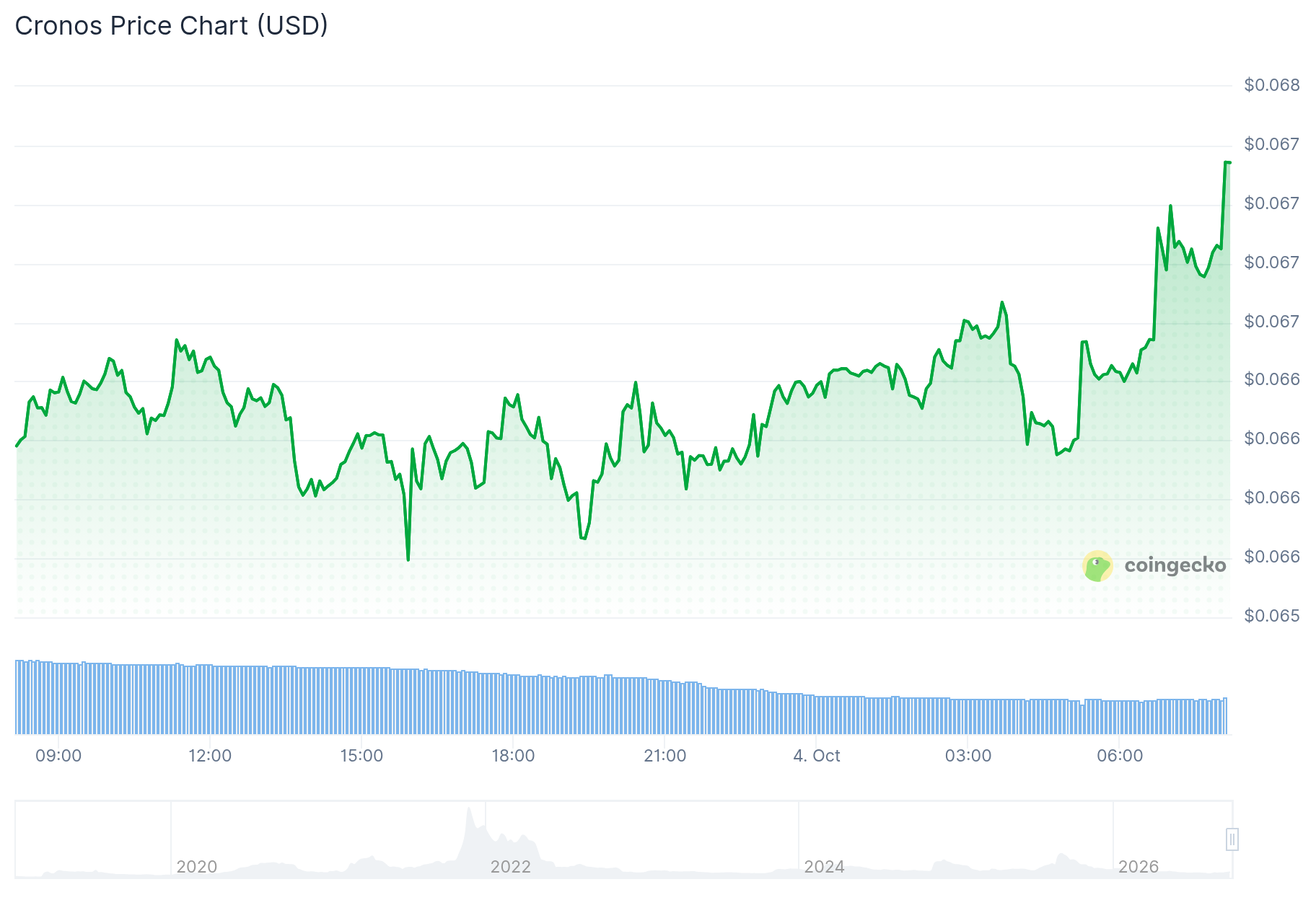 Cronos (CRO) Price
Cronos token burn lifts community total to 428 million
Proposal 36 authorized the latest community pool transfer to a burn address on Cronos POS. Four previous rounds each removed 50 million CRO, making this fifth round considerably larger.
The Cronos token burn therefore exceeded the combined size of those earlier rounds by 28 million tokens. The 428 million total describes this community initiative, rather than every historical destruction of CRO.
The immediate operation used tokens already held by the community pool. It did not require purchasing the entire 228 million CRO from exchanges, an important distinction when assessing market demand.
Future CRO buybacks introduce a separate source of purchases because they use product revenue to acquire tokens. Their size will vary with platform earnings and the market price when transactions execute.
Although the Cronos token burn reduces available supply, it does not establish a guaranteed price increase. Liquidity, demand, reserve distributions, and broader market conditions still influence how CRO trades.
Coingecko listed daily trading volume near $5.82 million and market capitalization around $3.31 billion. These figures show that the burn announcement arrived alongside relatively limited turnover compared with the token valuation.
That leaves a practical distinction between governance approval and sustained trading interest. A smaller token supply alone cannot reveal whether demand will grow enough to support a lasting advance.
CRO Buybacks Tie Monthly Burns to Revenue From Trading
Proposal 37 commits 100% of Ult and Cronos Launch revenue to token purchases and destruction. Cronos Labs says existing capital will cover operations, infrastructure, and growth spending instead of those product receipts.
The Cronos token burn framework links supply reduction directly to activity on both products. Ult generates trading revenue, while Cronos Launch collects fees associated with tokens created and traded through its launchpad.
Monthly burns provide a schedule for removing purchased tokens, and published transaction hashes allow independent verification. Community members can check execution amounts rather than relying solely on announcements about future commitments.
Under the Cronos token burn plan, published records can help compare revenue commitments with the tokens actually purchased and destroyed. A transaction record verifies execution, while separate revenue reporting would explain whether purchases reflect all earnings from the two platforms.
The revenue percentage is fixed, but the purchase budget is not. As an illustration, $100,000 would acquire about 1.5 million CRO near $0.0669 before fees and execution costs.
That calculation highlights why product revenue remains a central measure for future CRO buybacks. More usage can generate larger purchases, although lower revenue would reduce the number of tokens acquired.
Staking rewards retain their current parameters, including existing lock periods and bonus structures. The Strategic Reserve will support payouts as emissions decline, keeping reward funding separate from revenue committed to monthly burns.
The Cronos token burn does not change the review process for potential Crypto.com listings. The published strategy says qualifying tokens enter an ongoing assessment, with Crypto.com controlling criteria and final decisions.
Cronos Launch opened on September 15, followed by Ult on September 17. The September governance document listed the purchasing contract as being developed. Subsequent execution hashes will show the amounts bought and burned.
The post Cronos Token Burn Removes 228 Million CRO as Voters Back Buybacks appeared first on Blockonomi.





 English (US) ·