
 13 minutes ago
16

Published Nov 22, 2026, 12:00 PM EST
A change in filming location forced the effects team to rethink everything, leading to an unexpectedly ingenious solution
 Universal Pictures
Getting a 36-foot-tall Cyclops into a cave halfway up a mountain in Greece sounds like the kind of impossible task Odysseus himself might have encountered. But that's exactly what Christopher Nolan’s effects team had to accomplish for The Odyssey. And to make matters worse, it wasn't even the original plan. What started as a sequence intended for a Los Angeles soundstage became a logistical challenge that forced the filmmakers to rethink nearly everything about bringing the mythical creature to life.
The Odyssey’s special effects supervisor Scott Fisher and visual effects supervisor Andrew Jackson spoke with Polygon about creating Polyphemus, the one-eyed giant who traps Odysseus and his men inside his cave before the Greek hero devises a plan to escape. As it turns out, the production's biggest obstacle ultimately led to one of its most effective creative decisions.
A giant change of plans
The biggest problem wasn't simply building a massive puppet. It was finding the time to do it. Fisher explained that the Cyclops sequence had originally been scheduled toward the end of production, allowing his team to focus on more immediate challenges while experimenting with ideas for the creature.
"We had a full-size kind of stick puppet we were moving around, and there were all kinds of animatronic builds," Fisher tells Polygon.
When the filming location changed, the Cyclops suddenly became a much higher priority, leaving the team scrambling to develop a workable design. They now had to figure out how to build a giant creature that could be transported overseas and operated in an environment that wasn't exactly designed to accommodate a film crew, much less a massive puppet.
You move one arm and the rest of its body would kind of react.
"We were limited to what we could do in that time frame," Fisher explains. "So we kind of worked backwards into making it the simplest kind of form and movement that we could."
As it turned out, that limitation became an advantage. Rather than creating an elaborate animatronic creature capable of independently moving every part of its body, the team developed a puppet that responded naturally when individual sections were manipulated.
"You wouldn't have to move the entire body," Fisher says. "You move one arm and the rest of its body would kind of react and move a bit and had this natural kind of feeling to it."
Sometimes, apparently, less really is more. Even when the thing you're building stands 36-feet tall.
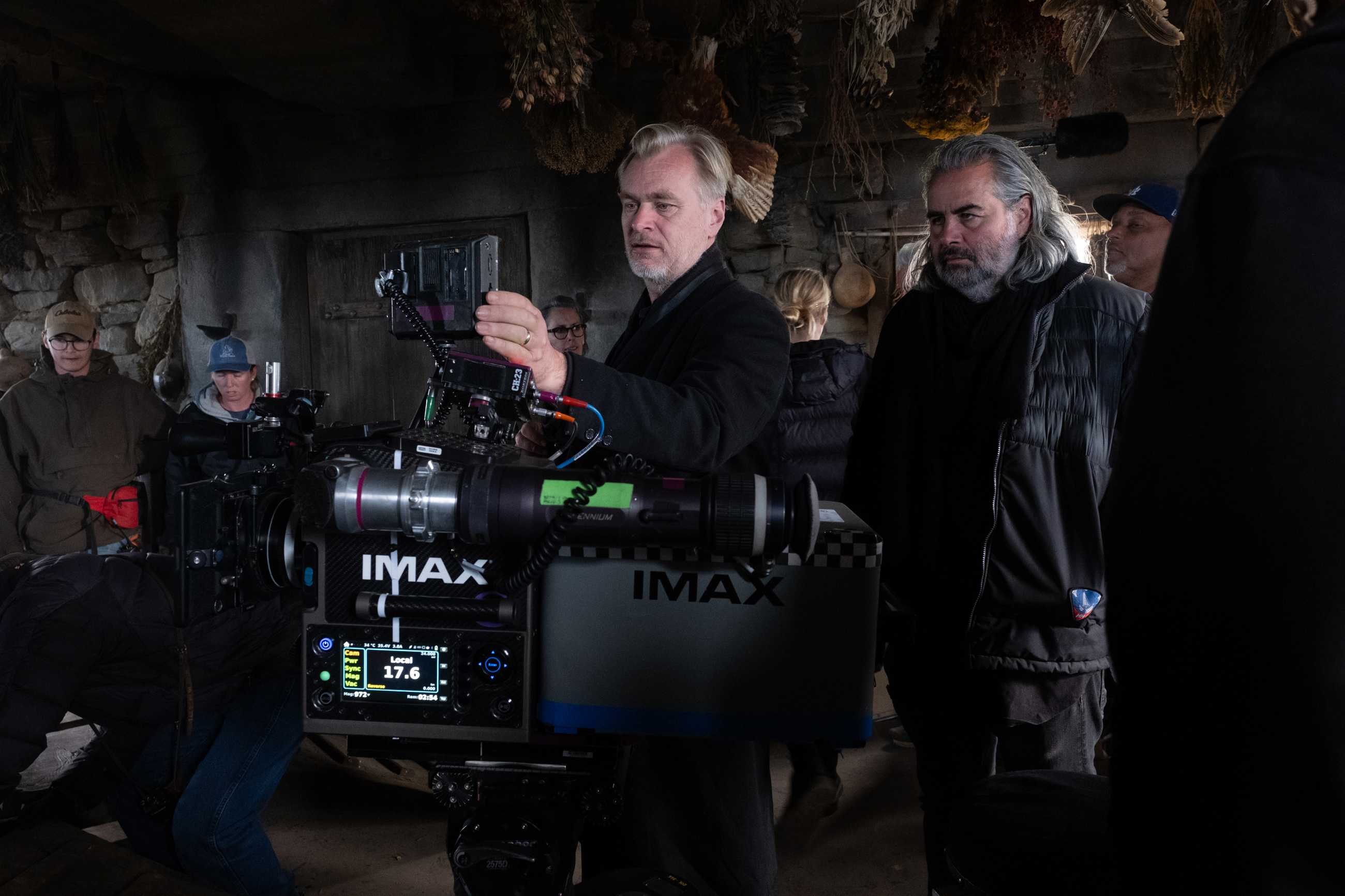 Image: Universal Pictures
Of course, designing the Cyclops was only part of the challenge. The team still had to get the enormous creation to its filming location. Jackson recalled that Fisher's team constructed the puppet quickly before suspending it inside a cave in Greece.
"They made that thing, the 36-foot-high puppet that we strung up from a cave in Greece, and operated it, all in a very short time," Jackson says. Fisher described the logistical challenges of getting everything built, packed, shipped overseas, and transported halfway up a mountain. Once inside the cave, the crew had to create an entirely new support structure to operate the creature.
"In the cave itself, we had to build an overhead, like, rock-and-roll truss grid to support all of our puppeteering lines," Fisher explains. The practical puppet also wasn't intended to accomplish everything on its own.
"We knew there was going to be a visual effects component to it because of the way it was built," Fisher says. "It wasn't a complete puppet, so we were definitely going to need some help for some of the more elaborate movements and things."
Despite Nolan's reputation for practical effects, the goal wasn't to eliminate digital technology. Instead, the production used a physical creature wherever possible, with visual effects helping accomplish movements the puppet couldn't perform on its own.
The actor behind the Cyclops took his cues from the puppet
 Image: Sony Pictures Classics/Everett Collection
The collaboration didn't end with the special effects and visual effects teams. Actor Bill Irwin, who portrays Polyphemus, also had to adapt his performance to the creature's unusual construction. Himesh Patel, who plays Odysseus's second-in-command, Eurylochus, told Polygon that seeing Irwin on set was one of the biggest surprises of the production.
"I was pretty amazed the first time I saw Bill Irwin as Polyphemus, because I didn't know exactly how we were gonna be doing it," Patel says.
Patel knew a puppet would be involved but wasn't sure how much of Irwin's performance would be physically present during filming. Then Irwin arrived wearing full prosthetics.
"He was there for us actors, he was doing the sounds and everything that would be concurrent with what we were doing with the marionette," Patel explains. What impressed Patel most, however, was how Irwin approached the physical performance. Rather than expecting the puppet to mimic his movements, Irwin studied how the puppet moved and adjusted his own performance accordingly.
"He was observing how the marionette moved, because that would actually inform how he moved," Patel says. "And so they would marry up."
The Odyssey arrives on digital, 4K Ultra HD and Blu-ray on Nov. 17





 English (US) ·