
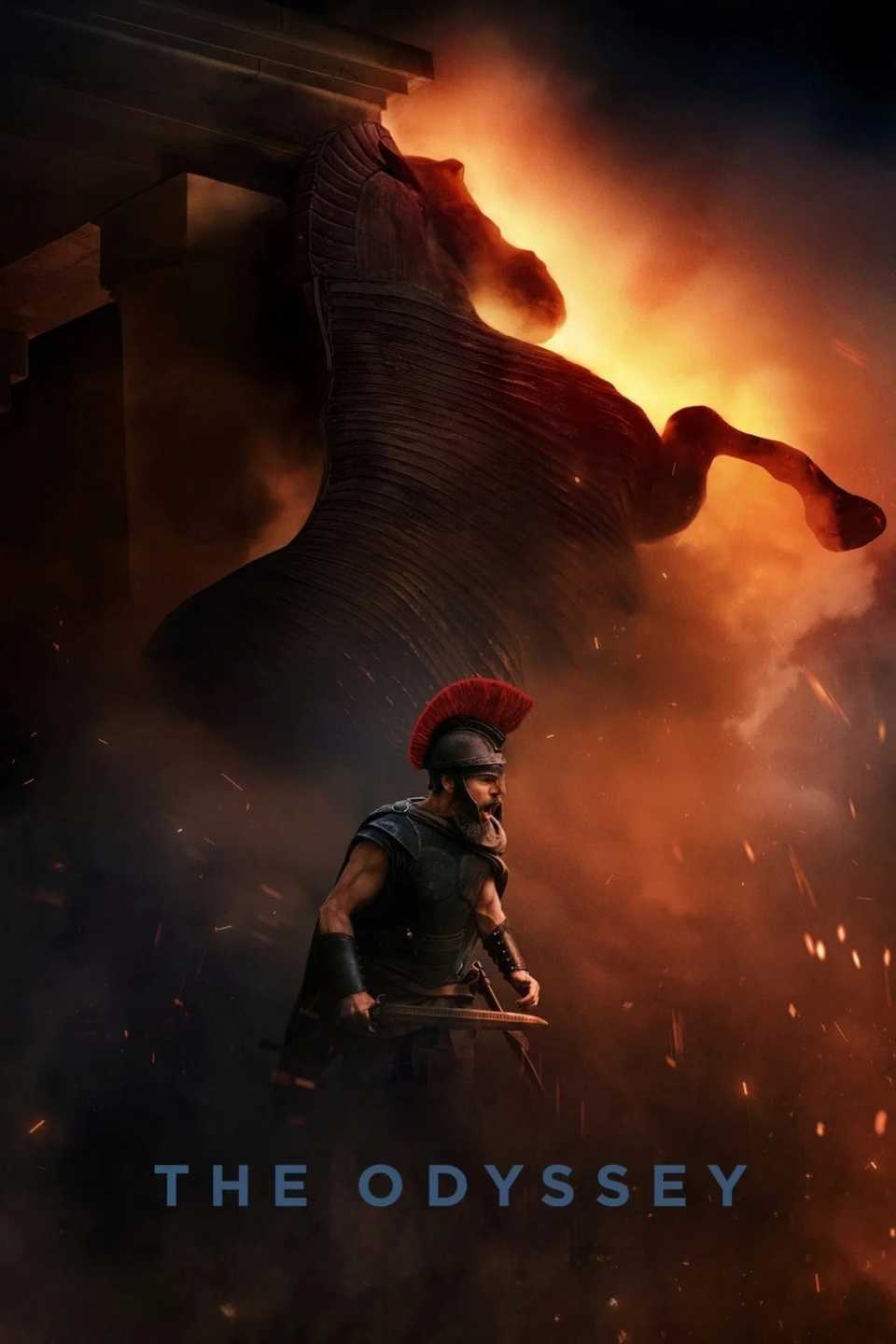
Very soon, Oscar-winning filmmaker Christopher Nolan’s action epic, The Odyssey, will be journeying across theaters and IMAX. Fans are counting down the days to the star-powered film in anticipation of Nolan’s rendition of Odysseus’s (Matt Damon) decade-long voyage home. Particularly, fans are anxious to see this saga told in the director’s signature boundary-pushing large format. Nolan is consistently redefining what IMAX is capable of, and in the lead-up to release, Collider’s Steven Weintraub had the pleasure of sitting down with him to discuss how The Odyssey continues to reexamine what the premier format can do.
The Odyssey, starring Damon as the King of Ithaca, as well as Anne Hathaway as Queen Penelope, Tom Holland as their son Telemachus, Zendaya as Athena, Lupita Nyong’o as Helen of Troy and Clytemnestra, Robert Pattinson as Antinous, and a whole host of talented actors, tells Homer’s Greek epic entirely in IMAX 70mm, and comes in at a whopping 2 hours and 52 minutes.
In this conversation about The Odyssey’s groundbreaking use of IMAX technology, Nolan discusses the innovative ways he and cinematographer Hoyte van Hoytema applied their shared expertise to fully immerse audiences in the film, whether that be in high-intensity action sequences or more intimate close-ups, and how IMAX influenced the edit of The Odyssey. He also reflects on the custom lens he modified for The Dark Knight that became a high-demand tool for filmmakers like J.J. Abrams and Zack Snyder, as well as the late David Keighley, “the longest-serving IMAX employee,” who collaborated with Nolan to change the future of filmmaking forever.
Choosing Which Lenses To Use for 'The Odyssey' Was a Meticulous Process for Christopher Nolan
"You’re really trying to just move the camera in such a way that the audience feels the proximity to the action."
COLLIDER: I knew David Keighley. I spoke to him many, many times. I do a lot of events at IMAX and a lot of screenings, and he was always so gracious. He was the best. One of the things that he told me about was the importance of lenses, large screen lenses, on the IMAX camera. I think he told me, and I could be wrong, that you bought some on the second-hand market and converted them into film lenses.
CHRISTOPHER NOLAN: No, you're right. On The Dark Knight, we had to modify an old Hasselblad lens, stills camera, medium format lens, for the movie camera, for the IMAX camera. It was a T2 lens, which means you could shoot in relatively low light, so for aerials of cities and things where you can't light it, it was a key lens. It was the only one in the world at the time, and I used to have filmmakers, from J.J. Abrams and Zack Snyder, fighting over it and wanting to borrow it for different films. Yeah, we still use it to this day. But, as of now, IMAX and Panavision have made a lot more lenses along those lines and really expanded the toolset for filmmakers.
How did you decide which lens or lenses you wanted to use on this film?
NOLAN: Well, the interesting thing with IMAX is it prompts a kind of filmmaking where you're not looking at the proscenium. You're not looking at the frame so much as the proximity of the camera to the action. And what that means is you actually don't change lenses that often. You're doing a lot with a 50 or 80 because those lenses take on very different characteristics depending on how close you are to the subject, whether you're shooting a face or whether you're shooting a landscape. So, we have a broad set of lenses, just in case, but for the most part, we're tending to shoot things on the 50 or the 80.
A lot of that, as I say, is because we're really just trying not to think in two-dimensional terms. We’re trying to think in three-dimensional terms. So Hoyte [van Hoytema] and myself, we're really trying to move the camera to where it needs to be to feel you’re close to the action, because on a giant IMAX screen, the proscenium kind of disappears. It's really designed, as is the 5-perf 70 mil version, as your peripheral vision that's being filled in by those areas. So, you’re really trying to just move the camera in such a way that the audience feels the proximity to the action. They feel that they're on the deck of a ship or close to the actors.
The Surprising Role 'The Dark Knight' Played in the Creation of 'The Odyssey'
“Are we going to need to shoot alternate takes or different formats?”
 Image via Warner Bros. Pictures
I'm so curious about the editing, because you know that a lot of people are going to be watching this full-frame IMAX in IMAX. How did that possibly change the editing structure? Because you don't want to cut a tremendous amount when you're watching something in IMAX, as far as I'm aware, but maybe I'm wrong.
NOLAN: Well, it's not that you're wrong, as such. It’s been an evolution. When we first started shooting IMAX, we were the first filmmakers to do it for a dramatic theatrical feature. We did it on The Dark Knight. It’s something I'd wanted to do since I was a kid, and we were given a rule book this thick of all the things you can and can't do. What we learned, really, over time is that actually you can. It's more versatile in that you can use the IMAX frame in a way that's more analogous to regular filmmaking.
But the essential thing, and we looked at The Dark Knight, very particularly — “Are we going to need to shoot alternate takes or different formats?” — but over time, as we use the format more and more, what we realize is that the way I like to block the action, the way I was working with first, Wally Pfister, who really pioneered this, and then Hoyte van Hoytema, who took it to the next level in terms of using this format for telling Hollywood stories, is really, it's about protecting the action for 240 frame. We always started off mixing the 240 with the IMAX originally, so we had to protect for that frame area, and keep the action relatively centered, using the greater frame area more for the peripheral vision, more for the idea of being immersed in the action, and moving the camera closer and further away, rather than, for example, zooming in or looking at things in two-dimensional terms, really trying to orient the viewer where you need in terms of the action.
That becomes very adaptable for different aspect ratios, so we're then able to take our IMAX image, show it on 70 millimeter full frame, but also adapt it to their 1:9 digital screens very effectively, and other film formats, like the 2.20:1 5-perf, 1:8:5 presentations, the DCPs and laser projectors, and everything. It's a robust image. It's a very, very strong negative, and so you can adapt it to any different format and really get the most out of it. So what we're doing with The Odyssey is we're making sure that in every theater that it goes to, it's playing on the largest screen possible.
Christopher Nolan Pays Tribute to IMAX's David Keighley
"We engaged in a 20-year, very joyful conversation about how to incorporate IMAX technology into Hollywood filmmaking."
I really want to ask about David Keighley. Everyone knows you and what you've done for IMAX, but David was such a huge part of this. For people who don't know him and his contributions, because he was so important to this, could you tell people about him and what he helped put together?
NOLAN: David and Patricia Keighley were married and worked together. David was the longest-serving IMAX employee. He knew the format almost from its inception. He introduced me to how to use the cameras. We engaged in a 20-year, very joyful conversation about how to incorporate IMAX technology into Hollywood filmmaking. He had an incredible eye for quality and quality control, and all things IMAX. He knew more about this stuff than anybody, and he and Patricia have been absolutely a driving force behind all of it.
He also had a commitment to film that was very, very important, to the point at which Kodak, some years ago, when it was selling less and less film for use in TV shows and things like that, they were actually very close to stopping making it at one point, and it was David who insisted that him or I sit down with the then head of Kodak and talk about why filmmakers really wanted and needed to continue. Kodak did so, and they're doing incredibly well with it today and producing wonderful film stocks of all different types, bespoke film silks for filmmakers, production is way back up from where it was, and really, a younger generation of filmmakers learned to love it. None of that would be possible without David. Without David, there wouldn't be any film to shoot on. It's a huge debt that, as filmmakers and as filmgoers, we owe him.
The Odyssey opens in theaters and IMAX on July 17.
Release Date July 17, 2026
Runtime 172 Minutes



 English (US) ·