
 6 hours ago
19
6 hours ago
19
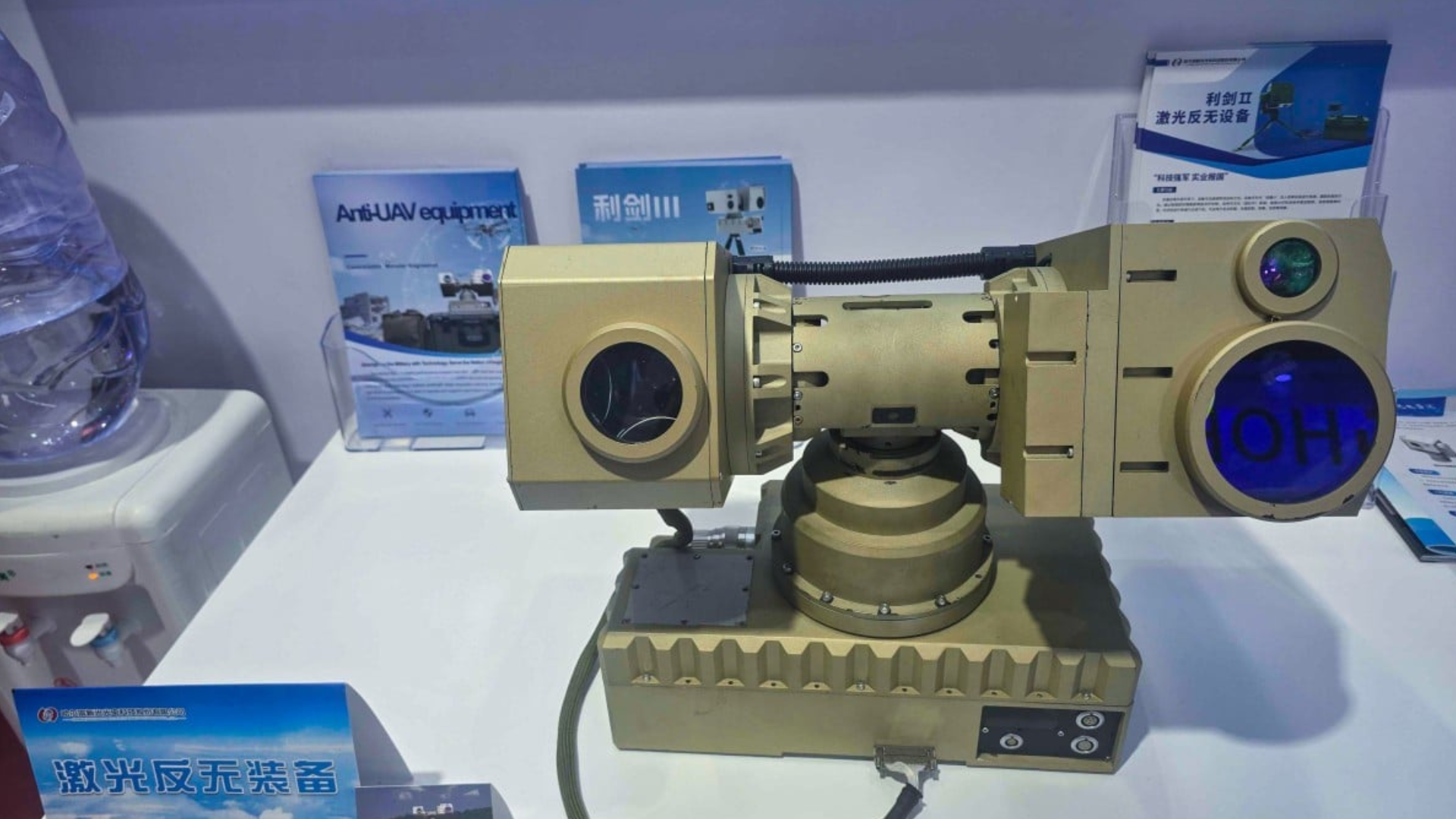
Chinese defense supplier Harbin Xinguang Optic-Electronics Technology demo’d two man-portable anti-drone lasers at a Beijing arms expo this week, putting backpack-scale directed-energy hardware alongside the mounted platforms that have so far dominated the space. The Lijian II and Lijian III, shown at the Defence Information Equipment & Technology Exhibition 2026 that opened Tuesday, weigh 30kg (66 pounds) and 25kg (55 pounds), draw around 2 kW, and cost about 2 million yuan (US$295,000) each, according to the South China Morning Post. It also uses AI for targeting.
Each portable unit splits into a laser emitter, an air cooler, and a handheld control terminal, light enough for one or two soldiers to carry. The emitter accounts for about 15kg, and the cooling system for roughly 10kg. Both models have a pitch angle above 90 degrees and reach about 500 meters (1,640 feet). The Lijian III burns through a drone in 4 seconds and needs under 5 seconds to cool before firing again, the company said.
The same line includes a fixed-position model, the Lijian-10G, that draws around 10 kW and reaches 1,200 meters (3,900 feet), but requires a large liquid-cooled box rather than a backpack. Harbin Xinguang said the portable units are "easier to operate and can be quickly deployed and recovered," in comments from a product promoter as reported by SCMP.
Those weight savings, of course, come out of the overall power budget of the laser. At roughly 2 kW, the portable Lijian models sit below the 3 kW-class NI-L3K counter-drone lasers that China showed at DSA 21026 in Malaysia, and far below the heavier directed-energy systems built elsewhere. The U.S. Army is currently testing a vehicle-mounted 20kW LOCUST system on the Oshkosh JLTV platform, and Israel's 100kW Iron Beam became the first high-power laser to enter service late last year. Obviously, those trade portability for the wattage needed to engage longer-range targets.
A 2 kW suits small, low, and slow targets at close range, with a much more favorable cost per shot. Burning down a quadcopter or FPV drone using a laser consumes energy rather than shoulder-fired munitions, which can cost tens of thousands of dollars per round. Zhao said the core technology reached maturity in 2023, as the war in Ukraine reshaped thinking around drone warfare.
Rather troubling is the fact that the Lijian series uses AI to identify targets and engage drones that enter its range, cued by external sensors such as radar. Harbin Xinguang said the weapons have already been placed at some Chinese facilities, including military airfields, and that it’s seeking further orders through the exhibition.
All the specifications come from the manufacturer's exhibition materials and a company representative and haven’t been independently tested.

Follow Tom's Hardware on Google News, or add us as a preferred source, to get our latest news, analysis, & reviews in your feeds.







 English (US) ·