
 3 weeks ago
29
3 weeks ago
29
“Clearly, they admire the work that’s being done by SpaceX and are trying to replicate it.”
China's Long March 10B booster, 16 feet (5 meters) in diameter, descends toward its recovery vessel in the South China Sea. Credit: Chinese Foreign Ministry via X
China’s sprawling state-owned rocket developer, maker of the country’s Long March rocket family, announced it recovered a reusable orbital-class booster for the first time Friday in the South China Sea.
The milestone mission began with the liftoff of a Long March 10B rocket from the Wenchang Commercial Space Launch Site on Hainan Island, China’s southernmost province. Powered by seven kerosene-fueled engines, the approximately 209-foot-tall (63.6-meter) rocket took off at 12:15 am EDT (04:15 UTC), or 12:15 pm local time at the seaside spaceport at Wenchang.
About 10 minutes later, the Long March 10B booster descended from space and guided itself into a four-legged frame affixed to an offshore vessel. Tensioned cables stretched over the ship in a grid pattern captured the rocket as it shut down its landing engines, leaving the smoldering booster hanging in midair. The rocket’s upper stage continued into orbit and deployed a payload known only as CX-26. Chinese officials hailed the flight as a “complete success.”
A growing number
“A historic day in China’s space program!” wrote Mao Ning, a spokesperson for the Chinese Foreign Ministry, on X. “China’s Long March 10B has successfully completed its maiden flight—and recovered its first stage via a sea-based net. This marks the country’s first-ever controlled rocket recovery. A major leap toward reusable launch capabilities.”
The landing on Friday makes the China Aerospace Science and Technology Corporation (CASC) and its subsidiary, the China Academy of Launch Vehicle Technology (CALT), the third enterprise to accomplish this feat. SpaceX did it with its Falcon 9 rocket in 2015 and with its Starship/Super Heavy booster in 2024. Blue Origin landed its New Glenn booster on an offshore platform for the first time last November.
SpaceX and Blue Origin use propulsive landings to return their Falcon 9 and New Glenn boosters to offshore platforms or onshore landing pads. With Starship, SpaceX pioneered a new method of catching the rocket’s reusable booster back at its launch pad using mechanical arms mounted to the launch tower.
The Long March 10B employs a different approach for recovery, combining an offshore vessel floating downrange with the catch technique somewhat like what SpaceX uses for Starship. Catching the rocket in this way reduces the effect of reuse on payload capacity. The Long March 10B doesn’t have to carry the extra mass of landing legs, and recovering it downrange reduces how much fuel the rocket must consume during its descent.
In a statement, CASC said the Long March 10B test flight “validated key core technologies” for a reusable launch architecture, such as multiple engine restarts with high-altitude ignition, high-precision navigation and control, and the first capture and recovery using a net system on a sea-based platform.
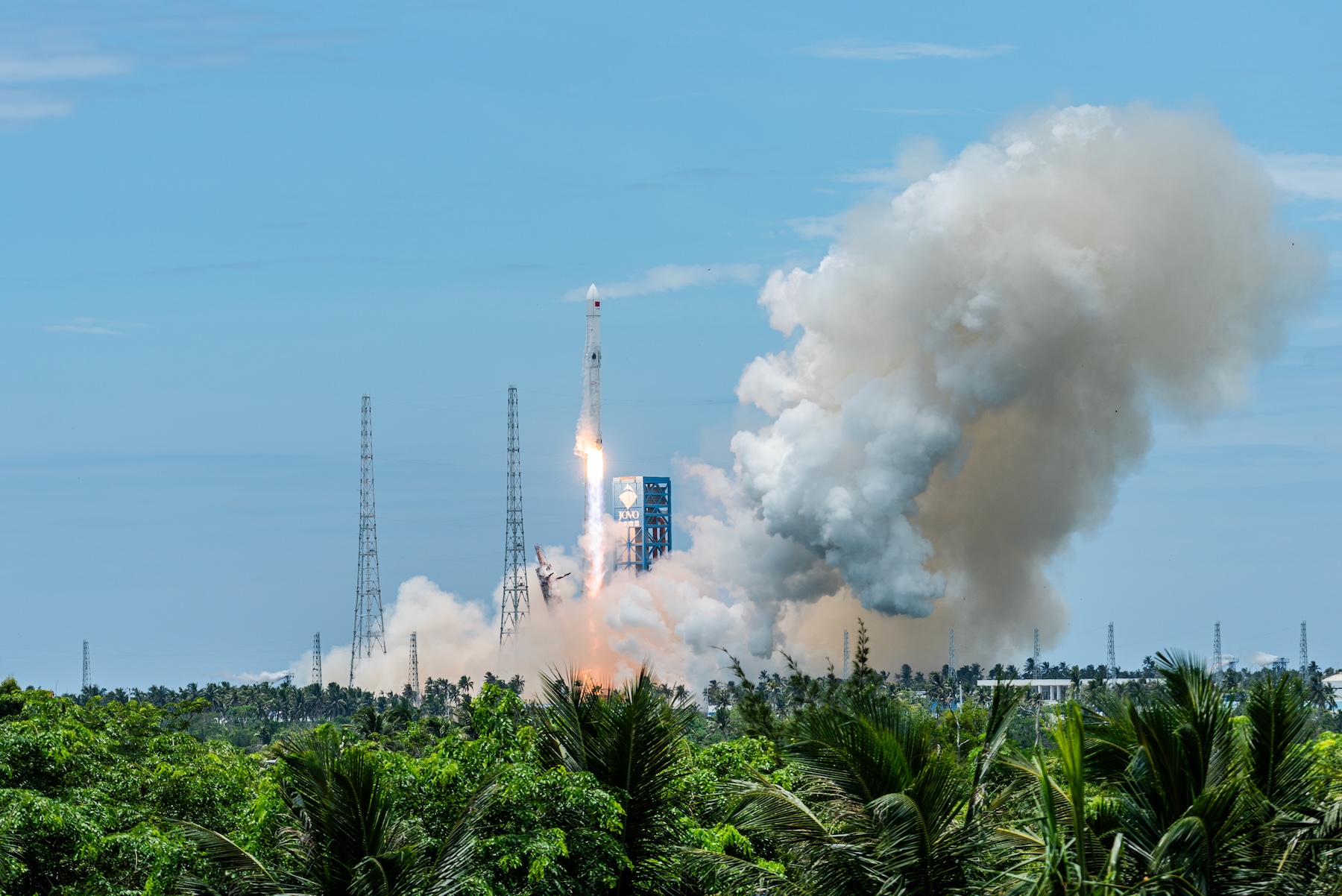
A Long March 10B rocket lifts off from Wenchang Spacecraft Launch Site on July 10, 2026, in Wenchang, Hainan Province of China.
Credit: Ding Yi/VCG via Getty Images
A Long March 10B rocket lifts off from Wenchang Spacecraft Launch Site on July 10, 2026, in Wenchang, Hainan Province of China. Credit: Ding Yi/VCG via Getty Images
Friday’s launch was the first flight of the Long March 10B, a medium-lift rocket with a payload capacity of approximately 16 metric tons (35,000 pounds) to low-Earth orbit. This is slightly less than the lift capacity of SpaceX’s Falcon 9. The Long March 10B has two stages, with seven YF-100K engines on the booster consuming kerosene and liquid oxygen, and a single methane-fueled YF-219 engine on the second stage.
“Moving forward, the Long March 10B development team will continue to optimize the vehicle’s performance and accelerate the iterative upgrading of reusable rocket technologies,” CASC said. “The first stage reuse flight test is expected to be completed by the end of this year.”
The Long March 10B is similar to China’s Long March 10A rocket, which is still awaiting its first full-scale test flight. The Long March 10A has the same first stage booster as the Long March 10B, but a different upper stage and a payload fairing to accommodate cargo and satellites. The Long March 10A, on the other hand, is designed for future crew launches to China’s Tiangong space station using the country’s new human-rated spaceship, the Mengzhou, replacing China’s Shenzhou crew capsule and the Long March 2F rocket used to power it into orbit.
Chasing the Moon
A heavier configuration, known simply as the Long March 10, is a key part of China’s Moon program. This more powerful rocket will combine three Long March 10 first stage boosters—each reusable—together to generate more thrust at liftoff. A second stage and third stage will propel Chinese astronauts and their lunar landers toward the Moon. The Chinese government says it aims to land its citizens on the Moon by 2030. Friday’s launch was a small step toward that goal.
China launched a scaled-down version of the Long March 10A rocket in February with a prototype of the Mengzhou capsule to test the spacecraft’s launch abort system, which would trigger to whisk crew members away from a failing rocket. The Mengzhou test went well, and remarkably, the Long March 10A continued flying after the capsule fired away from the booster, eventually coming back to Earth for a controlled splashdown at sea. The Long March 10B took this achievement a step further with a midair catch.
Multiple commercial and government-backed Chinese rocket companies are trying to level the playing field with the United States. China is the world’s second-largest spacefaring nation, but US companies, dominated by SpaceX, are launching payloads into orbit about twice as often as Chinese rockets. SpaceX’s blistering launch cadence is made possible by the partially reusable Falcon 9, something Blue Origin and Chinese companies are seeking to emulate.
US military officials have identified China’s advancements in reusable rocketry as a key to unlocking the country’s ability to potentially threaten US assets in space. “I’m concerned about when the Chinese figure out how to do reusable lift that allows them to put more capability on orbit at a quicker cadence than currently exists,” said Maj. Gen. Brian Sidari, the Space Force’s deputy chief of space operations for intelligence, at a conference last year.
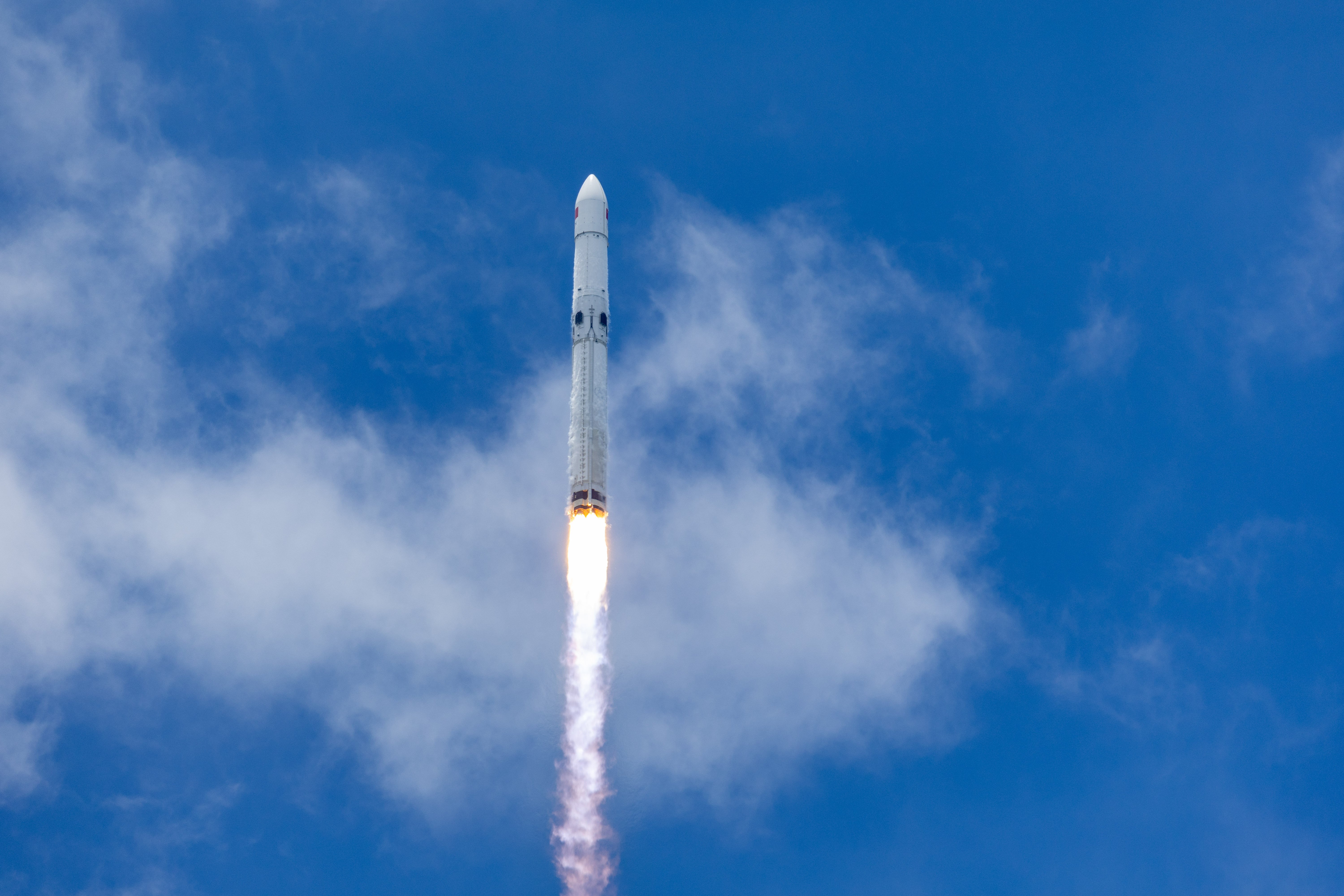
Seven kerosene-fueled engines power the Long March 10B rocket into the sky with nearly 2 million pounds of thrust.
Credit: Liu Yang/VCG via Getty Images
Seven kerosene-fueled engines power the Long March 10B rocket into the sky with nearly 2 million pounds of thrust. Credit: Liu Yang/VCG via Getty Images
SpaceX has used the Falcon 9’s rapid-fire launch cadence to deploy more than 12,000 satellites for its commercial Starlink Internet network. Starlink has spawned several spinoffs for the US military, including a secure communications network called Starshield, a constellation of spy satellites based on the Starlink design. More recently, SpaceX has won contracts to provide the Space Force with a new Space Data Network and support an emerging capability using satellites to identify moving targets on the ground and in the air.
All of this would give US forces an advantage in any future conflict with China, which is still in the early stages of launching its own versions of Starlink. China’s mastery of rocket reuse would significantly expand the country’s launch capacity, accelerating its ability to close the gap.
“Clearly, they admire the work that’s being done by SpaceX and are trying to replicate it, and at the same time take it away from the United States if it ever came to it,” said Charles Galbreath, a retired US Space Force colonel and director and senior resident fellow for space studies at the Mitchell Institute think tank’s Spacepower Advantage Center of Excellence.
“We’ll see what happens next,” Galbreath told Ars. “Are they able to rapidly turn and increase their launch rate as a result of this potential reuse? What impact will that have on their ability to field an operational architecture of satellites?”
More to come
Two Chinese rocket companies have already tried to recover their rockets after launching from one of China’s inland spaceports. The first was LandSpace, a privately funded firm that debuted its medium-class Zhuque-3 rocket in December. The rocket reached orbit, but the booster crashed near the landing zone in the Gobi Desert at high speed. A few weeks later, another one of China’s state-owned rocket builders successfully launched the first Long March 12A rocket, but the booster again lost control on descent and could not be recovered.
The next flight of the Zhuque-3 rocket could happen later this month or in August, with LandSpace again expected to attempt to land the booster downrange. Other Chinese rockets that could soon achieve reusability include Space Pioneer’s Tianlong-3, China Commercial Rocket Co.’s Long March 12B, CAS Space’s Kinetica-2, i-Space’s Hyperbola-3, and Galactic Energy’s Pallas-1. Further into the future, China aims to debut a huge new reusable rocket on the scale of Starship named the Long March 9.
In the United States, there are SpaceX’s Falcon 9, Falcon Heavy, and Starship, along with Blue Origin’s New Glenn rocket. Rocket Lab is aiming to launch its first medium-lift Neutron rocket with a reusable booster by the end of the year. Relativity Space is developing a partially reusable heavy-lifter named Terran R, and Firefly Aerospace is partnering with Northrop Grumman on the Eclipse rocket, which officials say will eventually have a recoverable and reusable first stage. Stoke Space has the bolder ambition of a fully reusable rocket called Nova.
Several European companies also plan to test reusable rocket technology, but their vehicles are not as mature as many of the US and Chinese rockets. Rocket builders in India, Japan, and Russia have reuse in their roadmaps, with varying degrees of realism.
The proliferation of Chinese rocket companies, scattered across four land-based spaceports and multiple ocean-going launch platforms, should set up China to quickly ramp up its launch cadence.
“It probably won’t be but a few years before they’re able to achieve a much higher launch cadence,” Galbreath said. “They also have more launch sites than the United States currently, so if you couple their number of sites with reusability, they could surpass us in terms of launch rate, which in and of itself is more of a pride thing. But it’s the capability that’s being launched as a result of that that could actually have a significant impact on our competition, and if we got to it, a conflict.
“There’s nothing wrong with competition as long as it’s peaceful,” Galbreath said. “That can drive innovation, but I’m concerned that the historic example of Chinese behavior has not always remained peaceful. So, we have to look at everything they do carefully. On the one hand, they’re competing with SpaceX, but we know that because of the way China has organized its military, its space capabilities, all under military control, that there is significant utility that their armed forces will receive from this race.”

Stephen Clark is a space reporter at Ars Technica, covering private space companies and the world’s space agencies. Stephen writes about the nexus of technology, science, policy, and business on and off the planet.





 English (US) ·