
 2 hours ago
6

Published Nov 14, 2026, 7:00 PM EST
Send this article to your favorite space crustacean
Send this article to your favorite space crustacean
 Source: Bill Watterson / Andrews & McMeel
Calvin and Hobbes wasn't Bill Watterson's first pitch for a comic strip. C&H's protagonists began as side characters in Watterson's comic The Doghouse before his original syndicate suggested that they ought to be the focus. "Marvin" became "Calvin," the rest of The Doghouse's cast was dropped, and while United Feature Syndicate still didn't take the resulting comic, Universal Press Syndicate did.
Before then, Watterson had drawn cartoons about a spacefaring character as early as college. Watterson went on to make that character the focus of one of his rejected comics: a mustachioed, cigar-smoking parody of adventurers like Flash Gordon. Shortly after Calvin and Hobbes began, Watterson reworked "Mort" into Calvin's fantasy alter ego Spaceman Spiff.
 Spaceman Spiff's first appearance in Calvin and Hobbes, from Nov. 29, 1985Source: Bill Watterson/Andrews & McMeel
Over the course of Calvin and Hobbes' run, Spiff was one of Calvin's most frequent escapist characters. Whenever Calvin was caught in a boring or unpleasant situation, he frequently retreated into his Spiff persona to pass time or even make a hasty retreat. In practice, that gave Watterson a handy excuse to take Calvin and Hobbes' art well outside its usual mundane setting, with tons of gross aliens, impossible landscapes, and great phrases like "eat hot electric death" that don't usually come up in everyday conversation.
Much like the rest of Calvin and Hobbes, Spaceman Spiff really hit his stride in the comic's last three years, when Watterson began doing his trademark "unbreakable" Sunday strips. Some of the most colorful and evocative C&H comics are Spaceman Spiff adventures from the mid-'90s, but Spiff made a few solid appearances before that point. Here are some of our picks for the best Spaceman Spiff comics in Calvin and Hobbes.
July 30, 1987
 Calvin and Hobbes for July 30, 1987Source: Bill Watterson/Andrews & McMeel
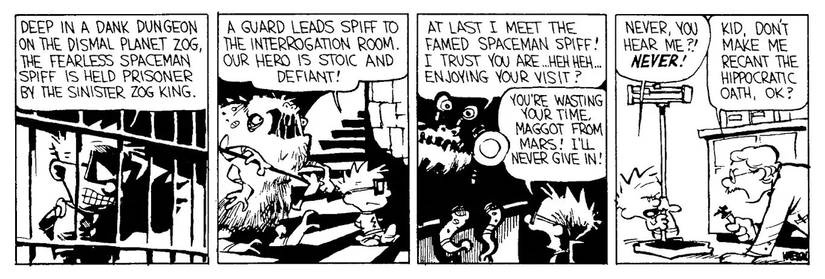
When Calvin gets sick during his summer vacation, his first reaction is to get annoyed. Sick days are for the school year. I think we all can relate.
Unfortunately for all involved, Calvin's mom takes him to the doctor. That includes a checkup, an injection, and a retreat into Calvin's Spiff mode, as he imagines himself as a prisoner of aliens rather than a little kid trapped in an examination room.
Oct. 18, 1987
 Calvin and Hobbes for Oct. 18, 1987Source: Bill Watterson/Andrews & McMeel
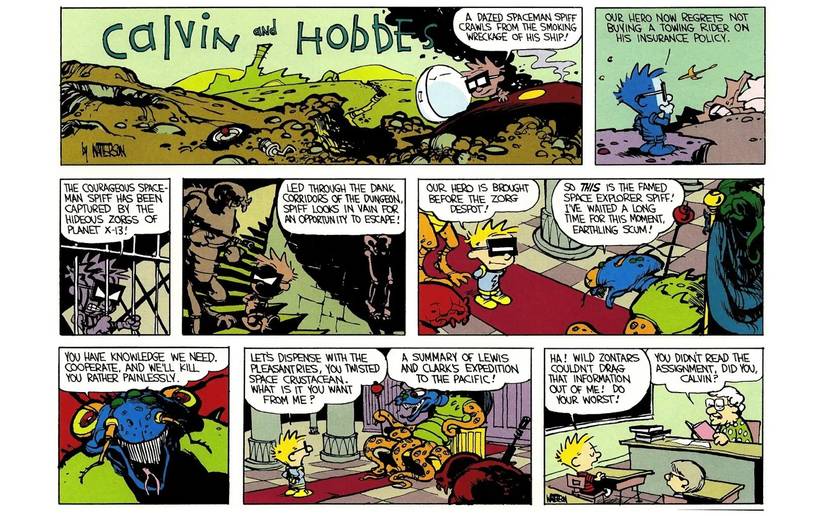
Calvin's teacher Mrs. Wormwood catches a lot of strays in Spaceman Spiff cartoons. Sometimes I want to see a version of C&H from her perspective. Most of her class are apparently boring normal kids who do the reading and don't get in unusual amounts of trouble. Then there's Calvin, who's as much of a chaos agent as a six-year-old can be. Mrs. Wormwood and Mr. Wilson from Dennis the Menace would have a lot to talk about.
In this early installation, Calvin gets called on in class and seamlessly incorporates Mrs. Wormwood's history question into his daydream. It's not being called on in class; it's being interrogated by the Hideous Zorgs of Planet X-13. (Look at those bug-men. Those are aliens that deserve the word "Hideous" being part of their proper noun.)
May 23, 1990
 Calvin and Hobbes for May 23, 1990Source: Bill Watterson/Andrews & McMeel
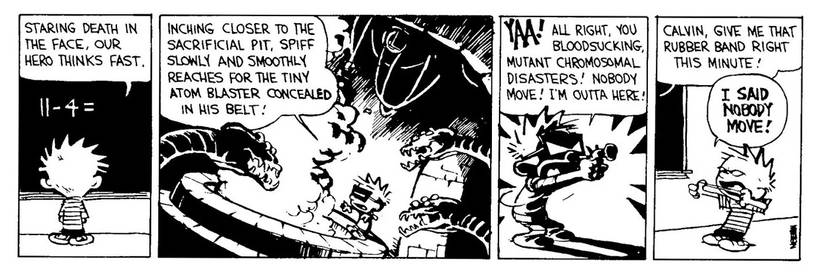
The most extreme (in the '90s sense) Spaceman Spiff adventure was a week-long story where Calvin got deeply enough into character that he staged a breakout from elementary school. Called to the board to answer a math problem, Calvin instead decides to shoot his way out (with a rubber band), then run for the door.
Through what one assumes is the relative indifference of school staff, Calvin manages to make it all the way home before his mom catches him. Unfortunately, Spiff can't get Calvin out of the ensuing consequences.
Sept. 26, 1993
 Calvin and Hobbes for Sept. 26, 1993Source: Bill Watterson/Andrews & McMeel
Right from the start, Bill Watterson has said that one of his primary influences on Calvin & Hobbes is George Herriman's Golden Age newspaper comic Krazy Kat, which ran from 1913 to 1944. That was already some inside baseball in the 1980s when Calvin and Hobbes was new, as Krazy Kat’s modern following is almost exclusively made up of historians, fanatics, and other cartoonists. It’s not dead media yet, though, as historians and preservationists have made a point of keeping collections of Krazy Kat in print. Curious readers can check out Fantagraphics' George Herriman Library hardcover collections, which are still in print at time of writing.
If you check out Krazy Kat, its influence on Calvin and Hobbes is obvious immediately, particularly in its colored Sunday comics. Herriman's characters inhabited a cartoonish version of the Arizona desert, and many of Watterson's Spaceman Spiff strips feature him visiting alien planets with similar arid backgrounds. This largely-wordless strip from 1993 is a perfect example, with so much of it devoted to Calvin's imagined spaceship journey from an alien valley to home.
April 30, 1995
 Calvin and Hobbes for April 30, 1995Source: Bill Watterson/Andrews & McMeel
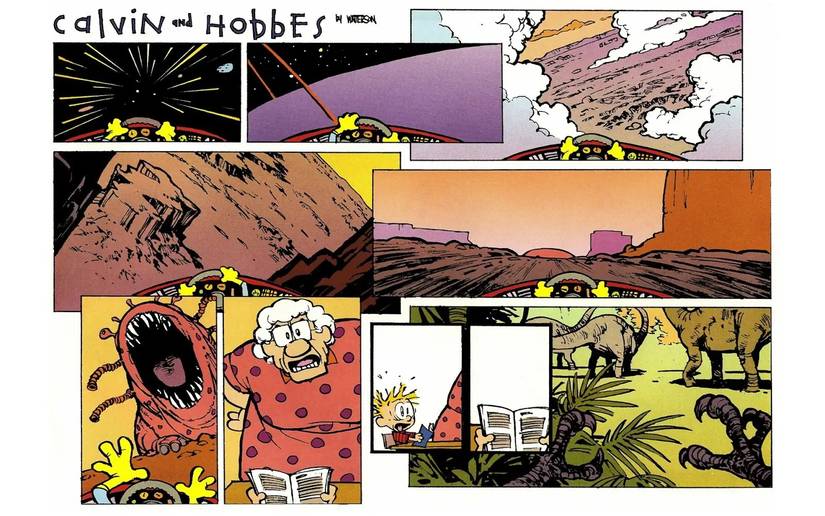
One of the best Spaceman Spiff strips comes in the last year of Calvin and Hobbes. Without dialogue, we see the entire comic from Calvin's perspective, as he's entertaining himself during yet another boring class by imagining himself behind the stick of Spiff's flying saucer.
Suddenly, Mrs. Wormwood interrupts his daydream and breaks his train of thought. As soon as she isn't paying attention anymore, Calvin switches to a new scenario: this time, he's a dinosaur stalking prey.







 English (US) ·