
 4 weeks ago
26
4 weeks ago
26
Key Highlights
- Bitwise Asset Management has joined forces with Lombard to enable institutions to generate yield and access credit using Bitcoin without relinquishing custody
- The solution leverages “Bitcoin Smart Accounts” technology to bridge institutional custody systems with decentralized finance platforms
- Morpho, a leading decentralized lending platform, will supply the underlying borrowing technology
- Approximately $500 billion in institutional Bitcoin remains disconnected from DeFi opportunities, according to Lombard’s estimates
- The service launch is scheduled for the second quarter of 2026, with additional custody partners planned for future integration
Lombard, a company specializing in Bitcoin lending infrastructure, has unveiled a collaboration with Bitwise Asset Management designed to enable institutional investors to generate returns on their Bitcoin holdings while maintaining their existing custody arrangements.
.@Bitwise Asset Management joins Lombard's Bitcoin Smart Accounts as a strategic yield partner.
The global crypto asset manager with $15B+ AUM and 40+ investment products is developing scalable Bitcoin yield strategies for the estimated $500B in institutionally custodied BTC. pic.twitter.com/6HUAJP9YIZ
— Lombard (@Lombard_Finance) March 24, 2026
The announcement came during the Digital Asset Summit held in New York. The initiative is aimed at asset management firms, corporate treasuries, and wealthy individuals holding substantial Bitcoin positions who have historically lacked viable options for earning returns on these assets.
According to Jacob Phillips, CEO of Lombard, the breakthrough lies in a technology called “Bitcoin Smart Accounts.” This innovation bridges the gap between institutional custody frameworks and blockchain-based finance—two ecosystems that have remained largely disconnected.
Bitwise will construct the yield-generation strategies, which will blend decentralized finance lending opportunities with tokenized traditional assets. Morpho, a decentralized lending platform, will provide the technical framework for collateralized borrowing against Bitcoin.
The technology employs Bitcoin-native mechanisms, including partially signed Bitcoin transactions and timelock features, to authenticate collateral. This approach enables onchain representation of lending positions without requiring actual transfer of the underlying Bitcoin assets.
Phillips emphasized that the architecture eliminates three major risk categories simultaneously: custody risk, bridge risk, and counterparty risk. These concerns have traditionally prevented institutions from participating in Bitcoin lending markets or made such participation unappealing.
Lombard’s research indicates that approximately $500 billion in Bitcoin currently resides in institutional custody arrangements. The vast majority of these holdings remain disconnected from blockchain-based financial markets and generate zero returns.
Bitcoin’s Presence in Decentralized Finance Remains Limited but Expanding
According to DefiLlama data, Bitcoin’s total value locked within DeFi protocols stands at approximately $2.93 billion. While this represents only a fraction of Bitcoin’s roughly $1.4 trillion market capitalization, the figure has shown consistent growth.
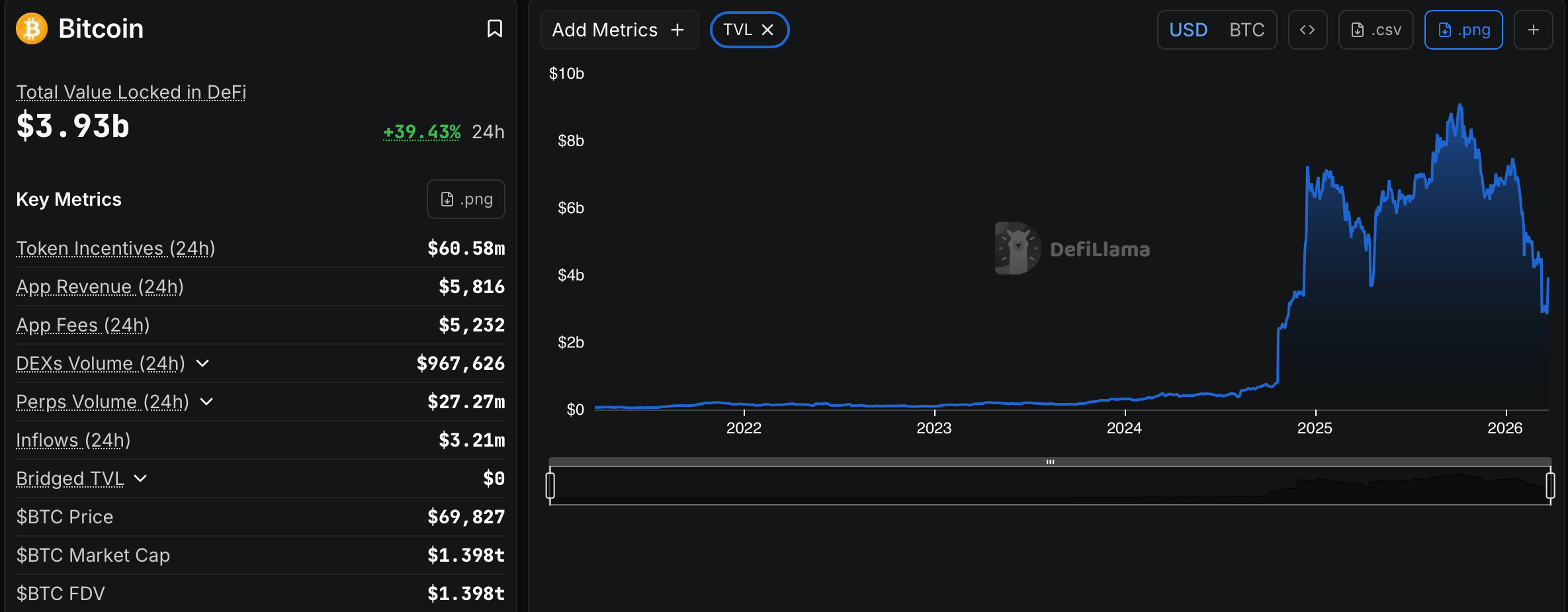 Source: DefiLlama
Babylon Protocol currently dominates Bitcoin-focused DeFi with approximately $2.8 billion in total value locked. Lombard holds the second position with around $744 million.
Additional indicators of growing adoption include Telegram’s integration of yield-generating vaults into its cryptocurrency wallet in February, supporting Bitcoin, Ether, and USDT. March saw Babylon, a Bitcoin staking protocol, partner with hardware wallet manufacturer Ledger, enabling users to earn returns while maintaining self-custody through hardware-secured transaction signing.
Earlier in January, Bitwise had already collaborated with Morpho to introduce non-custodial vault products that generate yield through overcollateralized lending mechanisms.
Impact on Institutional Market Participants
For institutional market participants, available alternatives have been constrained. Generating yield or obtaining liquidity from Bitcoin positions has traditionally required removing assets from custody, accepting counterparty exposure, or creating taxable events.
The Lombard-Bitwise framework is structured to circumvent all three obstacles. By preserving Bitcoin within its existing custody infrastructure, institutions can maintain their current asset holding procedures unchanged.
Phillips characterized the development as transforming Bitcoin from a static value store into productive capital. The platform launch is targeted for the second quarter of 2026, with Lombard indicating plans to onboard additional custodians and protocol integrations following the initial release.
✨ Limited Time Offer
Get 3 Free Stock Ebooks
Discover top-performing stocks in AI, Crypto, and Technology with expert analysis.
- Top 10 AI Stocks - Leading AI companies
- Top 10 Crypto Stocks - Blockchain leaders
- Top 10 Tech Stocks - Tech giants










 English (US) ·