
 3 hours ago
14

Follow us
Add us as a preferred source on Google
Subscribe to our newsletter
AI spending is generating revenue for technology providers, but most other S&P 500 companies have yet to show comparable gains in productivity or profit margins, a report by Apollo’s Daily Spark analysis has shown.
Go deeper with TH Premium: AI and data centers
Artificial intelligence has helped fuel a boom in technology spending, but the financial benefits remain difficult to spot across much of corporate America. Apollo Global Management chief economist Torsten Slok said on October 24 that revenue per worker and profit margins were rising for the Magnificent Seven technology stocks while remaining flat across the other 493 companies in the S&P 500.
Notably, Slok’s analysis found no clear evidence that AI is boosting productivity growth, despite heavy investment in the technology. Revenue per worker and profit margins have risen among the Magnificent Seven but remain flat across the other 493 companies in the S&P 500, according to the report. “Despite massive investments and widespread hype around artificial intelligence, the technology has delivered zero financial payoff to corporate America outside of tech,” Slok wrote.
Running AI models at scale can quickly drive up costs since many providers charge by token usage, so bills climb as employees make more requests or AI agents process data and handle increasingly complex tasks. Slok said mainstream companies were beginning to view token spending as a cost center rather than a source of growth. Venture capital-backed businesses are spending more on tokens, he noted, while established companies have less incentive to pay for the newest models if cheaper alternatives can do the job.
That creates a problem for AI providers hoping to turn growing adoption into a lasting revenue stream. Selling more computing power and model access can boost suppliers’ sales, but customers need to see corresponding gains in productivity, revenue or operating costs to keep spending at the same pace. Moreover, if AI expenses rise without a measurable improvement in business performance, the additional spending could weigh on margins.
“AI does not understand accountability, trust, culture, unwritten rules, ethical trade-offs or fairness, all of which shape reputational risk and ultimately drive revenue growth and profit margins.” Slok added. “The bottom line is that the AI story will be decided in the S&P 493, not the Mag 7, and so far, there is no evidence that revenue growth or margins are improving outside the tech sector.”
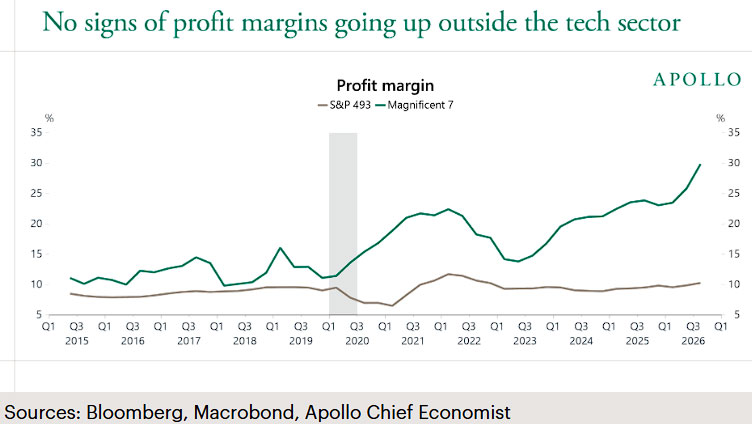
Slok’s analysis also points to a broader limitation: AI adoption remains concentrated among a relatively small group of companies. Unless usage spreads across more industries and produces measurable results, the technology’s effect on the wider economy could remain limited.
Get Tom's Hardware's best news and in-depth reviews, straight to your inbox.
The same tension is emerging in India’s financial technology sector. A PwC India survey reported by Business Standard on September 11 found that 84% of surveyed fintech respondents had yet to see measurable financial results from their AI investments.
That has not stopped companies from pressing ahead. The survey also found that 48% of respondents identified proprietary intelligence as a leading strategic priority. Meanwhile, 30% expected customer experience to drive AI agent adoption over the next three to five years, followed by cost reduction and productivity gains at 22%.
Trust is another hurdle for businesses looking to deploy AI agents in financial services. As per the survey, 41% of respondents identified customer trust and adoption as the biggest barriers to scaling agentic payments, while 33% pointed to fraud, security and risk management as major concerns.
AI agents could expand the technology’s role in business by handling multistep tasks rather than simply responding to prompts, although their ability to access tools, process information and act across company systems also brings additional usage costs and security concerns.
Nvidia has been developing tools to address some of those risks, previously, introducing its Open Agent Safety Platform, a hardware-and-software security stack designed to help businesses control AI agents and restrict potentially harmful actions. Rising token consumption has also prompted companies including Microsoft, Meta and Amazon to rein in AI usage as employees adopt the tools and agentic workloads drive up bills. The trend highlights a growing challenge for businesses: encouraging wider AI adoption without allowing operating costs to spiral.
OpenAI CEO Sam Altman has also acknowledged the problem, describing AI token costs as a “huge issue” for customers seeking better value from their spending. The infrastructure behind the AI boom carries its own price tag with Amazon, Google, Meta and Microsoft having committed enormous sums to data centers, chips and the power needed to run AI workloads.

Follow Tom's Hardware on Google News, or add us as a preferred source, to get our latest news, analysis, & reviews in your feeds.







 English (US) ·