
In the waning hours before GTA VI becomes available on my living room console, I am (for now) posted up at my PC, blasting bright, neon pink directly into my retinas. Just like when I was a kid.
I’ve been playing Barbie Rewind in bits and odd pieces. Released last week, it’s another retro game collection from Digital Eclipse that thankfully makes 16 classics playable again for normal people who don’t have giant retro console collections, decades after their original releases. One of those games—Barbie: Vacation Adventure—never even got a full release until now, and was previously only known via a handful of magazine previews. Now, you can play it.
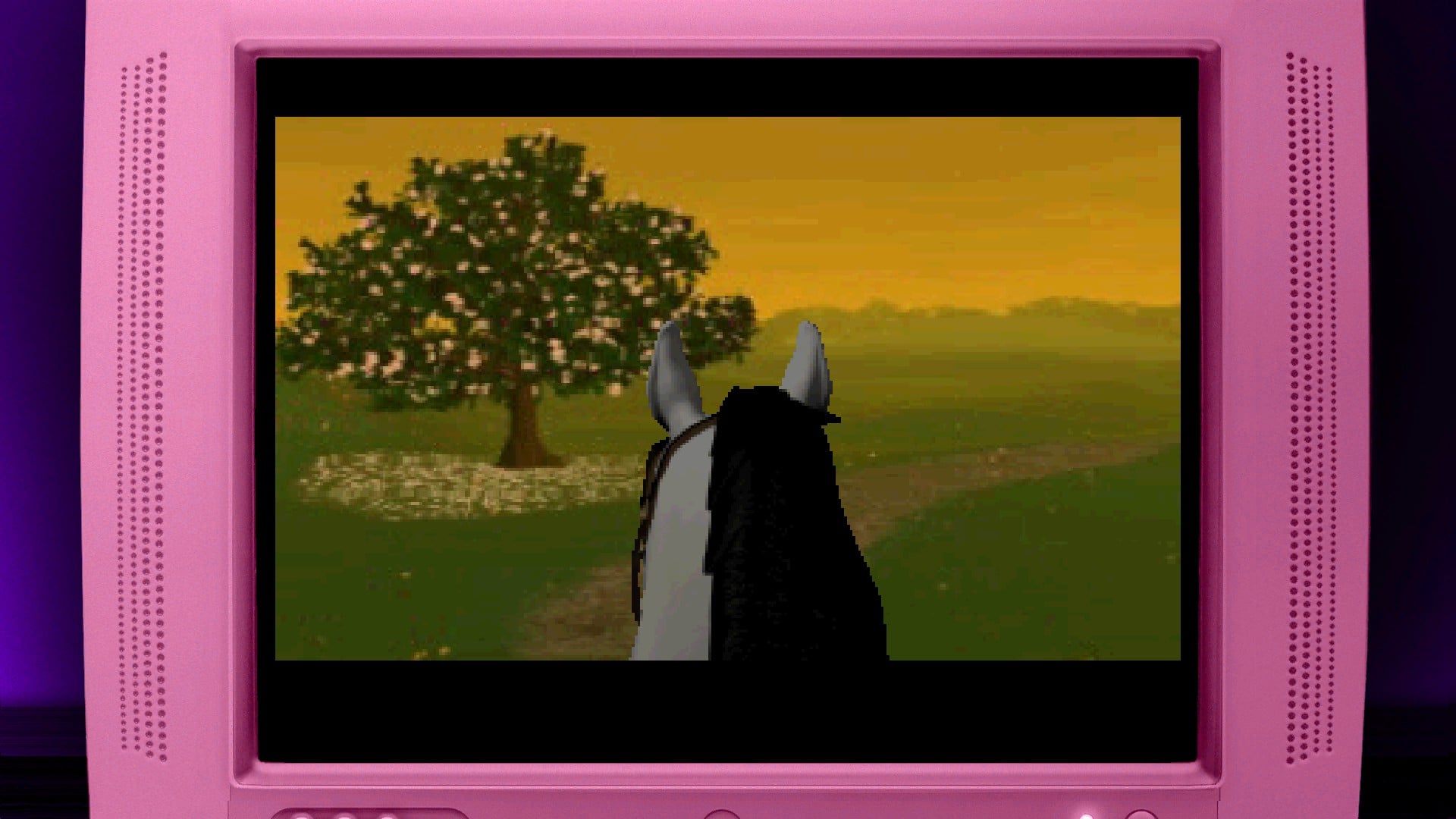
I like the idea of Barbie Rewind, and I’m glad these games are available again. But the presentation of this collection leaves a lot wanting. It’s buggy, for one—I had weird audio blips in both the Dreamhouse segments (more on those in a moment) and in several of the games, with sound and music cutting out randomly or going fuzzy like a radio. Barbie Super Sports was, I hate to use the phrase but, literally unplayable—once I got to the skiing section, I couldn’t move my character at all in any direction no matter how many times I tried or what buttons I pushed. At one point, I spent so long navigating back and forth in and out of menus trying to check the controls that my menu got stuck on the controls page, leaving me unable to exit the game without hard shutting it down. Unfortunately, doing so erased all of my progress in both Super Sports and two other games I had tried prior, which in turn set me back on my objectives in the Dreamhouse. I also just found most of the games difficult to parse visually in their original resolution on a modern 1080p monitor; surely something should have been done about that?
 © Digital Eclipse
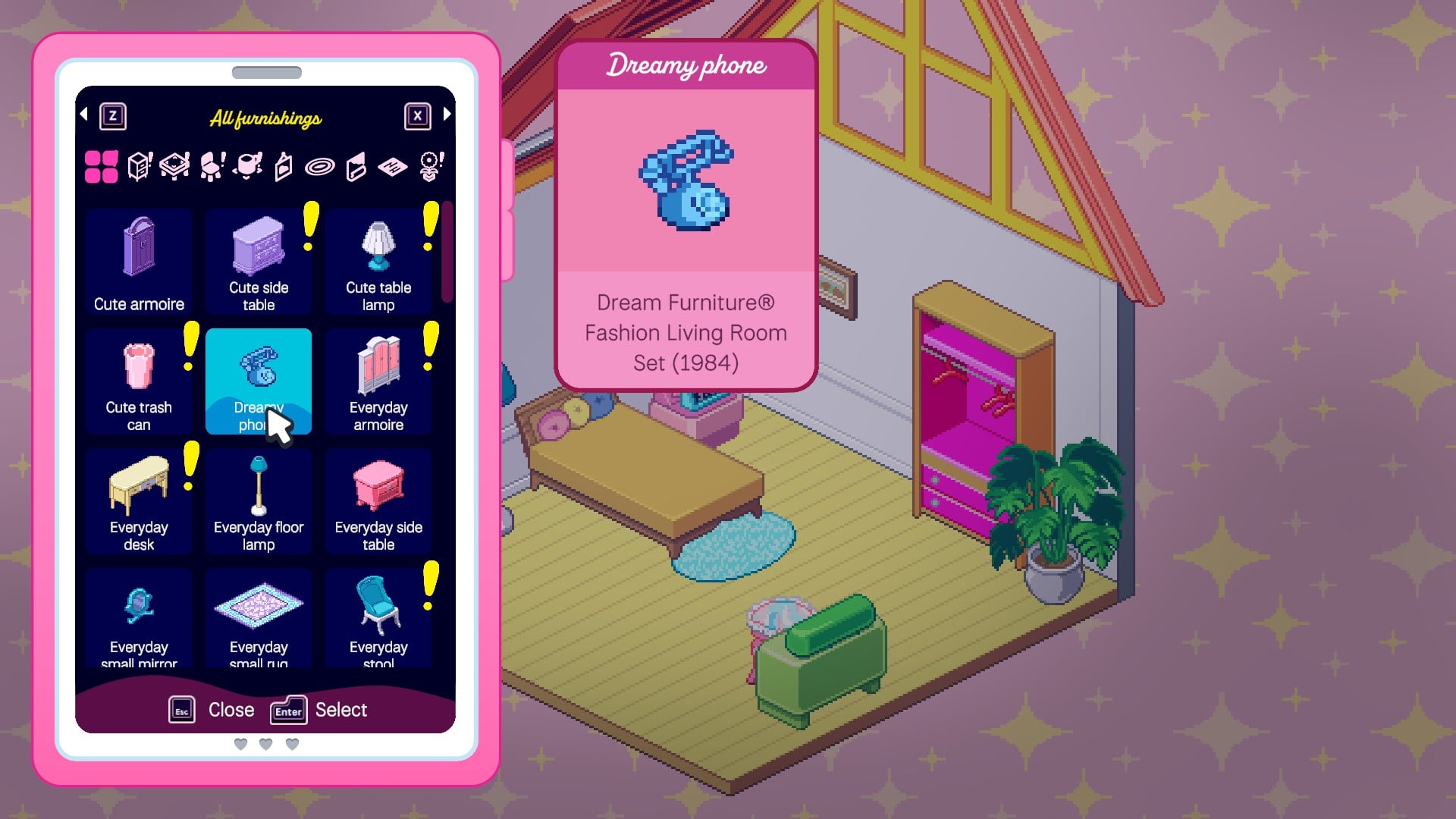
For that reason, I find the Dreamhouse bit of Barbie Rewind far more compelling than the games that are the actual purpose of the collection. As you play the retro games, you unlock new rooms in a Dreamhouse and new furniture to fill them with. The decor is all taken from Barbie playsets over the years: couches, tables, lamps, phones, beds, and so forth. While the decorating mechanics are pretty simple, the decorations themselves are bright and colorful neons and pastels in funky and often retro shapes and styles, daring you to try to make them fit an orderly theme. Just as I would want a pile of mixed-up playsets to be.
I imagine that those who played with such things growing up will recognize them, but it’s reminded me that despite being a Barbie fiend, I never had any Barbie playsets growing up. Just dolls and clothes. I would build houses for them out of a couple of empty K’NEX boxes, or use the couch and pillows to make small Barbie forts. I’m a little jealous of whoever got to mess around with all this plastic, though I’m sure that, had I had any of this, it would have gotten lost like all the little Barbie shoes that disappeared over the years. It’s not the same, decorating a virtual Dreamhouse. But it’s a nice enough approximation, given that I’m not about to go out and buy any of this in reality.
Rachel Simone Weil, a girls video game and toy historian, played a major role in getting the Dreamhouse aspects together. She served as a historical consultant on Barbie Rewind, and especially focused on making sure the Dreamhouse elements were an accurate and celebratory portrayal of Barbie history. Obviously, Barbie Rewind could not include every single playset ever made, so Weil had to be selective as she tapped into different aspects of Barbie history. What were the most important relics of Barbie history?
“Obviously, the iconic playsets, the ones that fans remember, those really tactile memories of just the feeling of the plastic or the way the box smelled,” she said. “There are certain playsets, I think, that are really emblematic of the brand. I think of the Beach Blast pool. That’s pretty iconic. Obviously, the original Barbie Dreamhouse. We also included some deep cuts. There’s Cafe Today, which is pretty rare and hard to come by, especially in good condition, but a beautiful, psychedelic-designed cafe.”
In addition to the mix of iconic sets and deep cuts, Weil also wanted to emphasize technology, given the video game-ness of Barbie Rewind. And Barbie has quite the technological history. Weil tells me about playsets from before I was born making a point to include computers, phones, record players, CD players, and so forth. Barbie was always hip, always on top of the latest trends both in fashion and in tech.
 © Digital Eclipse
“The Barbie Dreamhouse from 1979 has this nightstand with this little tiny computer in it,” Weil says. I’ve seen it, I have it in my Barbie Rewind Dreamhouse currently, and it looks wonderfully retro and ridiculous. “And in ‘79, personal computers were just starting to come out. So, you’re starting to see people imagining what computers might be, right? And then you see Day to Night Barbie in the ‘80s, you start to see the IBM PC style playset computers.
“Oh, another one I really like is the travel agent playset from, I think, 1986. The travel industry was famously one of the first industries to adopt computer technology. And right as it’s happening, Barbie is there with that travel agent playset and she’s got a computer. And the home office playsets from the ‘80s and ‘90s. Barbie’s got a home computer. She goes to work and she does computers.”
Barbie was a massive, massive part of my childhood. For a solid eight, nine, ten years, Barbie was one of my predominant interests. Dressing up those dolls, taking them to friends’ houses, and playing make-believe was formative for me, and two of the video games in this collection (Barbie Super Sports and Barbie Race and Ride) represent my earliest memories of playing video games at all. I was playing Barbie long before I had my hands on Mario or Zelda.
And yet, Barbie is rarely if ever considered to be on equal footing with those classics. In some ways, I get it—mainstream gaming is bent far more toward the kinds of games that Mario and Zelda evolved to become. And yet, Infinity Nikki is massive. So is The Sims. The Style Savvy series on Nintendo handhelds was super popular, as were animal-focused games like Nintendogs. Heck, we just heard everyone praising Dressmaker. These games have always been with us, and Barbie pioneered a lot of what they would become. It’s unfortunately not too hard to work out why Barbie doesn’t get the respect she deserves.
“Barbie Rewind is the first retro game compilation that centers predominantly girl-led experiences in console gaming, right, of the 20th century,” Weil says. “These games were a big deal when they came out in terms of popularity, sales, and it’s not just about the market impact. These games had a big, like, left a big impression on the people that played them, right?
 © Digital Eclipse
“Girls who played these games in the ‘80s, ‘90s, ‘00s are adults now, and they’re looking back on these games with fondness and nostalgia and stories about, you know, negotiating with their siblings about who got the controller and the hours poured into them. There’s really not been—I’d say there’s been a lack of an outlet for that fondness or way to revisit these games or even an acknowledgement from the world that these Barbie games, they weren’t just a fever dream, not only were they real, but we can play them again on modern platforms. So, I think for Digital Eclipse and Atari to put out this collection in collaboration with Mattel, I think it’s really gratifying, a gratifying acknowledgement that women’s retro gaming experiences are valid, important, and they’re part of the broader retro gaming culture at large, and they deserve to be included.”
It’s not just girls, either. David Lowey, director of marketing at Atari, is here to champion girl games for everyone. “It’s amazing how many people I’ve spoken to, particularly guys I’ve spoken to, who have played a significant amount of these games. And the answer is always the same. It was like, ‘Yeah, it was on the PC in the kitchen. It was my sister’s game, but I played the hell out of it.’ I heard that so much.”
Recently, an interview with the developers of Dressmaker sparked some social media discussion around women as gamers, and whether they are being adequately served by games that reflect their interests. It’s a tricky discussion. On one hand, it’s obviously narrow-minded to assume that women are only going to be interested in games about fashion and vacation and pet rescue and horses. But on the other, it is true that many women do find those things interesting, and that because those things are typically associated with women, games like the ones in Barbie Rewind are less common and often not as well-funded or supported as more “masculine” games.
Weil had not seen the Dressmaker discourse when I spoke to her and thus didn’t want to comment on the interview specifically, but I asked her to tell me more broadly: what are we talking about when we talk about Girl Games? What does it mean for a game to be a Girl Game?
“First of all, it’s changed a lot in the last 15 years,” she says. “I think 15 years ago it was very difficult to have that conversation. I remember being in grad school and having professors say, ‘you can’t study Barbie video games.’ I remember having an exhibit vandalized. People were upset about the idea that we would talk about girls’ video games, or that acknowledging that they existed and celebrating those memories was the same as saying, ‘girls must do this, and girls must love pink and whatever.’ And so it’s a difficult conversation.”
Weil goes on to say that she intentionally uses the phrase “girl game” to provoke that difficult conversation: to get people talking about the dichotomy between what girls must be, what they can be, and what they’re allowed to be.
“One thing that I think about as a historian is that this scrutiny of girl games, [where people ask], ‘Is this set modeling the right behaviors for girls? Is this setting up the right expectations for what femininity means and all this stuff?’ We’re not asking those same questions about boy games. We’re not asking, is Mega Man a good role model for boys? Is Mega Man going to teach boys to, you know, be this or that? Or, if we’re asking those questions, it’s not preventing Mega Man from being part of retro gaming canon, right?
“For me as a historian, I’m not saying we shouldn’t ask those questions, or we shouldn’t talk about those social issues. But I think we have a tendency to let the pendulum swing too far and say, ‘there are social issues around this. And so let’s put all the Barbie games in the trash.’ We can’t do that. I think the history of girls’ video games has been forgotten and rediscovered like three or four times because this behavior of saying, ‘This is a delicate subject, this touches on social topics or discrimination or stereotypes or things like that. And I feel nervous about that. And so I’m just going to pretend that these games didn’t exist.’ We can’t do that.”



 English (US) ·