
 2 hours ago
10
2 hours ago
10

Published Jun 1, 2026, 3:00 PM EDT
The Backrooms is just the modern internet manifested in a physical nightmare realm
 Image: A24/Everett Collection
A photograph of a bland yellow office space somehow evolved into one of the defining horror myths of the digital age, and it’s now a feature film overtaking the likes of Star Wars. That's strange on its face, considering the original image of the Backrooms doesn’t offer any tangible monster, violence, or jump scare. It’s just an unsettling photo, one that millions immediately understood the uncanny nature of the moment they saw it.
The reason may be that the Backrooms was never really about an unending physical space, but about the internet itself. One of the earliest internet fantasies was discovery. You could stumble onto bizarre personal websites, niche forums, fan pages, abandoned blogs, strange communities, and weird art projects with a few thoughtful clicks. The web of the late '90s and early 2000s felt infinite, yet still strangely human. Today's internet is technically larger than ever, even though it feels oddly smaller. That’s primarily by design. Major platforms dominate attention, algorithms funnel users toward the same content, and search results become increasingly polluted with sponsored content and AI-generated misinformation.
Much of what we encounter online is optimized rather than created — a contradiction the Backrooms captures quite beautifully. The space appears infinite, yet every room inside that expanse lacks distinct meaning and looks nearly identical to every other room before it. Those lost within its suffocatingly liminal space, often called “wanderers,” can search forever without finding anything genuinely new. The horror of the Backrooms isn't necessarily being trapped, but being caught in this very loop of endless wandering without meaningful discovery.
While the feature film portrays its characters doing a little more than simply wandering, for the most part those trapped inside the Backrooms are relegated to moving from room to room. The space has no purpose, no exit, no clear map, and no true explanation. (Unlike 2026's other liminal space thriller, Exit 8, in which the protagonist had to follow a clear set of rules to escape his own endless loop.) This mirrors the core functionality of the modern internet: Social media feeds have no endpoint, streaming services autoplay indefinitely, and recommendation algorithms continuously generate the next piece of filler. The internet has become a space that increasingly resembles a hallway extending forever rather than a journey toward a destination.
There’s also an undercurrent of corporate liminality in the Backrooms that most viewers might miss despite it being manifested on nearly every surface. The visual language of the space is often deeply corporate, replete with fluorescent lighting, stained office carpets, industrial corridors, and storage rooms. It’s a space rooted in nostalgia, filled with environments designed for efficiency rather than humanity.
Nowhere is that corporate liminality more fully realized than in Kane Parsons’ interpretation of the horror phenomenon. Both his YouTube videos and new feature film highlight the Backrooms as a literal corporate project gone wrong — an experiment conducted by scientists and executives attempting to exploit dimensions beyond human understanding. One video from his YouTube series in particular, called "Backrooms - Presentation," makes this case even more evident and holistically terrifying through a fictional advertisement noting all the ways Async’s “A-Space” can be used to enhance profits. (Storage and warehousing, commercial space, residential, corporate offices, etc.) Parsons’s Backrooms story isn’t about the monsters within the space so much as it is about becoming lost inside systems built by organizations pursuing goals that ordinary people barely understand.
The strangest thing about the Backrooms is that it emerged from the exact version of the internet many people now mourn. No single creator built the mythology. It spread through imageboards, wikis, forums, YouTube videos, and roleplay communities, with thousands of contributors collectively adding new rooms, entities, and stories simply because they found the idea compelling. The Backrooms could only have existed on a participatory internet, one driven by curiosity rather than optimization. Yet the horror it depicts feels inseparable from the internet that followed.
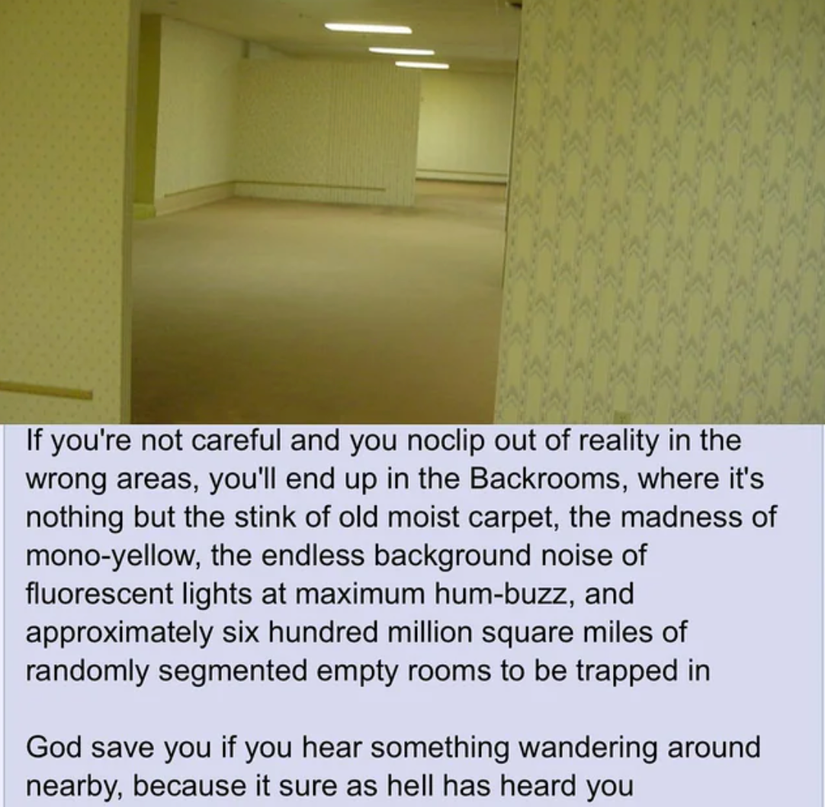 Image: 4chan
As platforms became increasingly centralized, algorithms replaced exploration, and endless feeds transformed browsing into passive consumption, the web began to feel less like a frontier and more like a labyrinth. The Backrooms captures that shift perfectly. It is the internet imagining its own future and recoiling from what it sees. A collaborative myth born from an era of digital discovery became one of the defining symbols of alienation and isolation. In this way, the Backrooms feels like a misremembered form of what the internet once was.
Parsons’s Backrooms even seems aware of this contradiction. The main character of the film, Clark (Chiwetel Ejiofor), at one point remarks, "The more times it remembers something, the less it does." The line refers to the Backrooms itself, but it also feels like a description of the modern web. The internet remembers everything, yet each layer of reposting, archiving, algorithmic sorting, and content recycling pushes us further from the original. What remains are fragments of screenshots without context, abandoned forums, dead links, and half-forgotten communities. The Backrooms feels like the internet trying to remember what it once was and finding only distorted echoes. The more it remembers, the less it does.
That original yellow-hued room is frightening because it feels familiar, not because we've been there physically, but because we've been there digitally. We've clicked through endless tabs, wandered through recommendation chains, forgotten what we were originally looking for, and found ourselves somewhere strange and empty. The Backrooms became one of the defining horror stories of the internet age because it understood that the scariest labyrinth wasn't hiding beneath reality. We built it ourselves.
Backrooms is playing in theaters now.







 English (US) ·