
 3 weeks ago
38
3 weeks ago
38
When new display technologies and standards appear, they’re usually first available to professionals. Pro monitors are often engineered and built with price as a secondary consideration, and as such, they can be costly. But when you consider that the measuring equipment used to test and maintain them is even more expensive, the math makes more sense.
What makes a monitor professional? Color accuracy is certainly a top priority, but I’ve tested many inexpensive gaming screens that deliver reference-level numbers. The big thing you get for that extra money is flexibility and options. Asus ProArt displays are perfect examples of this modus operandi. Many of them have auto-calibration from a built-in meter, along with OSD options, control software, and even connections to third-party apps like Portrait Displays’ Calman and Light Illusion ColourSpace.
Asus ProArt PA32KCX Specs
Swipe to scroll horizontally
Panel Type / Backlight | IPS / Mini LED |
| Row 1 - Cell 0 | 4,032 dimming zones |
Screen Size / Aspect Ratio | 32 inches / 16:9 |
Max Resolution and Refresh Rate | 7680x4320 @ 60 Hz |
| Row 4 - Cell 0 | FreeSync and G-Sync Compatible |
Native Color Depth and Gamut | 10-bit / DCI-P3+ |
| Row 6 - Cell 0 | VESA DisplayHDR 1000 |
| Row 7 - Cell 0 | HDR10, HLG, Dolby Vision |
Response Time (GTG) | 5ms |
Brightness (mfr) | 1,000 nits full field |
| Row 10 - Cell 0 | 1,200 nits peak |
Contrast (mfr) | 1,000:1 |
Speakers | 2x 3w |
Video Inputs | 1x DisplayPort 2.1 |
| Row 14 - Cell 0 | 2x HDMI 2.1, 2x Thunderbolt 4 |
Audio | 3.5mm headphone output |
USB 3.2 | 3x type A, 2x type C |
| Row 17 - Cell 0 | Power output: 96w |
Power Consumption | 89.3w, brightness @ 200 nits |
Panel Dimensions WxHxD w/base | 28.6 x 19.5-23.5 x 9.7 inches (726 x 495-597 x 229mm) |
Panel Thickness | 3.5 inches (89mm) |
Bezel Width | Top/sides: 0.3 inch (8mm) |
| Row 22 - Cell 0 | Bottom: 0.75 inch (19mm) |
Weight | 31.1 pounds (14.1kg) |
Warranty | 3 years |
The PA32KCX is an everything-and-the-kitchen-sink display aimed squarely at creative professionals. Its image modes are based on color standards, and you get them all here – P3 cinema and display, sRGB, Adobe RGB, BT.709, BT.2020, DICOM, and every flavor of HDR – HDR10, Hybrid Log Gamma, and Dolby Vision. Ok, there’s one omission, HDR10+. All modes can be calibrated independently, and you can create up to three custom configurations.
Calibration options are many. You can do it the old-school way in the OSD with a meter and software. Or you can let Calman do it automatically using a special workflow included with Calman Ultimate. It also interfaces with Light Illusion ColourSpace software. And there’s Asus’ Display Widget center, which lets you control the OSD from the Windows desktop. And there’s built-in auto-calibration using a little robotic color meter that flips up from beneath the screen. Flexibility? The PA32KCX has it in spades.
The big star is resolution. 7680x4320 means over 33 million pixels and a density of 275ppi. Pixel pitch is an incredibly fine 0.092mm. You cannot see the pixel matrix, no matter how closely you look. The maximum refresh rate is 60 Hz, with overdrive and Adaptive-Sync available.
Physically, the PA32KCX is a tank with rugged construction and all-business styling. It includes a light hood to prevent reflections from clouding the image. Asus uses a technology called Lux Pixel to further reduce the effects of ambient light. The 4,032-zone Mini-LED backlight can reach 1,000 nits of sustained brightness across the full field, with 1,200-nit peaks when local dimming is active. A Quantum Dot layer ensures the largest possible color gamut, which in my tests covered almost 110% of DCI-P3.
The PA32KCX also includes many connectivity options, including HDMI 2.1, DisplayPort 2.1, Thunderbolt 4, and USB types A and C. A KVM feature lets you work with multiple systems controlled by a single set of input devices. And there are internal speakers with a 3.5mm headphone jack.
All this tech and professional goodness will set you back $8,799 at this writing. It’s a lot to be sure, but the PA32KCX has a lot. A lot of features, a lot of performance, a lot of technology, and a lot of precision.
Assembly and Accessories
The PA32KCX ships in a large box with its contents protected by flexible foam that doesn’t crumble. The base is six pounds alone, with another three pounds in the upright. Once you assemble it and snap the panel on, the package tops 32 pounds. A light hood is included along with cables for IEC power, USB, HDMI, and DisplayPort.
Product 360
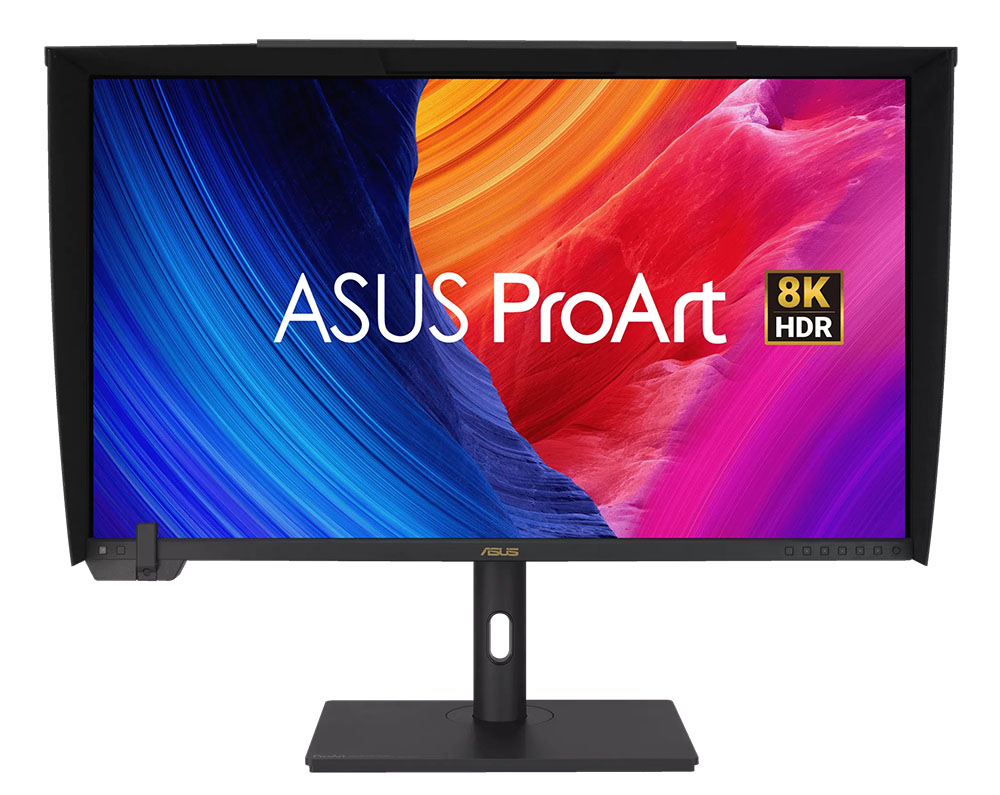
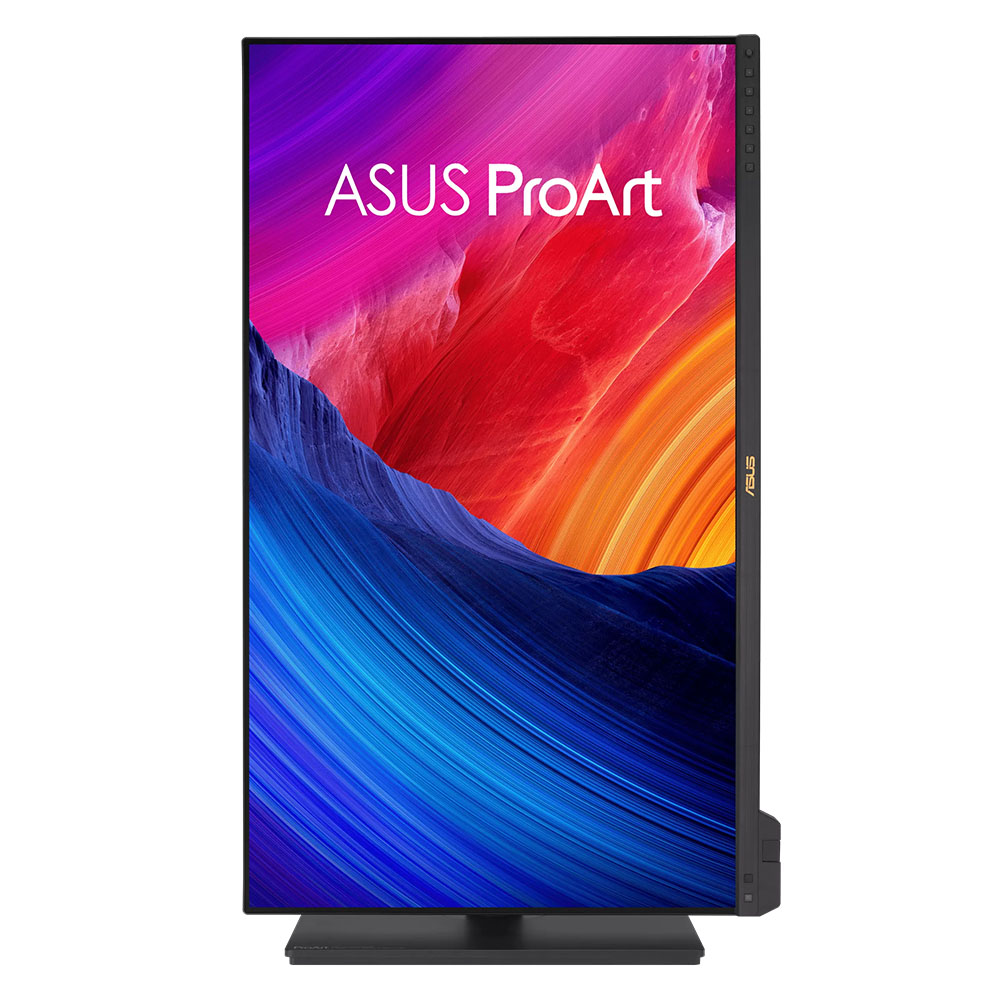
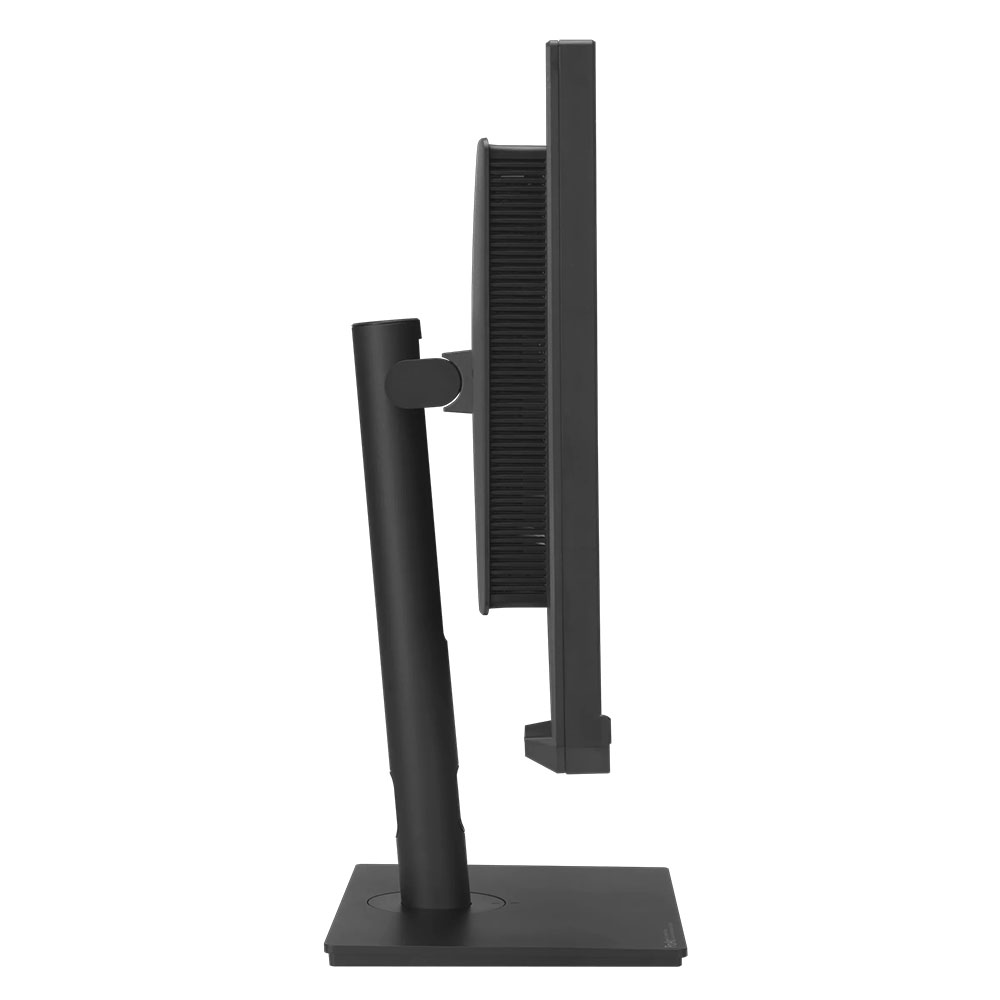
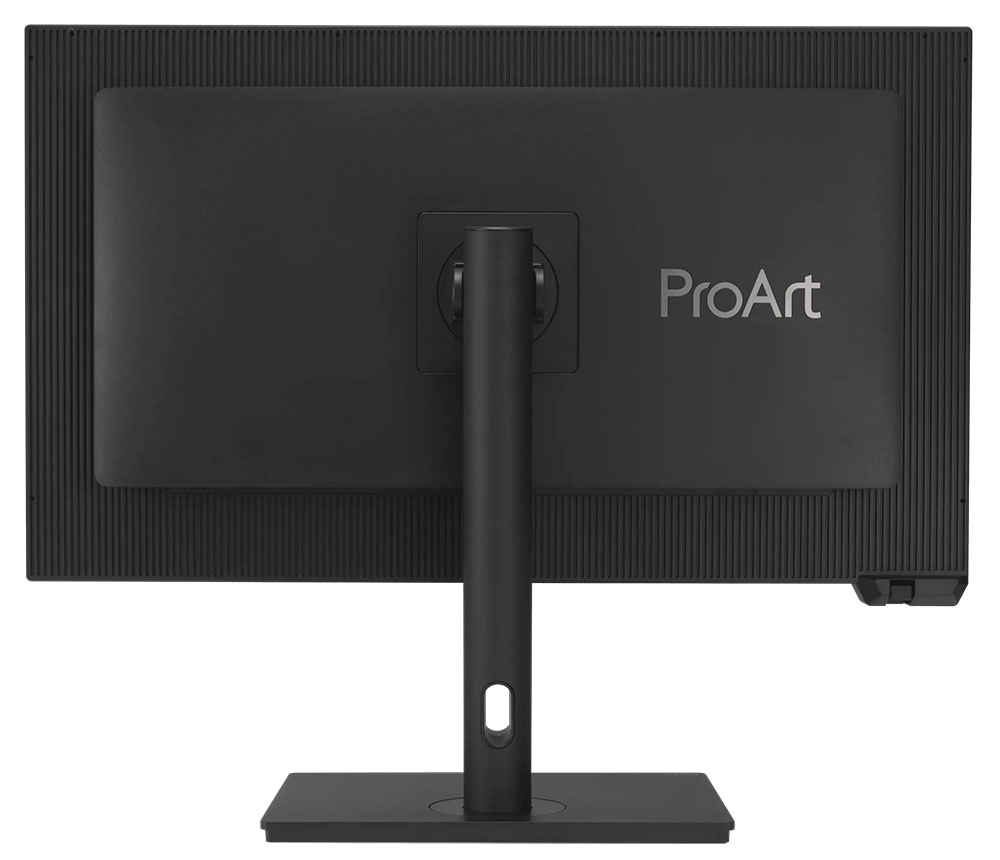
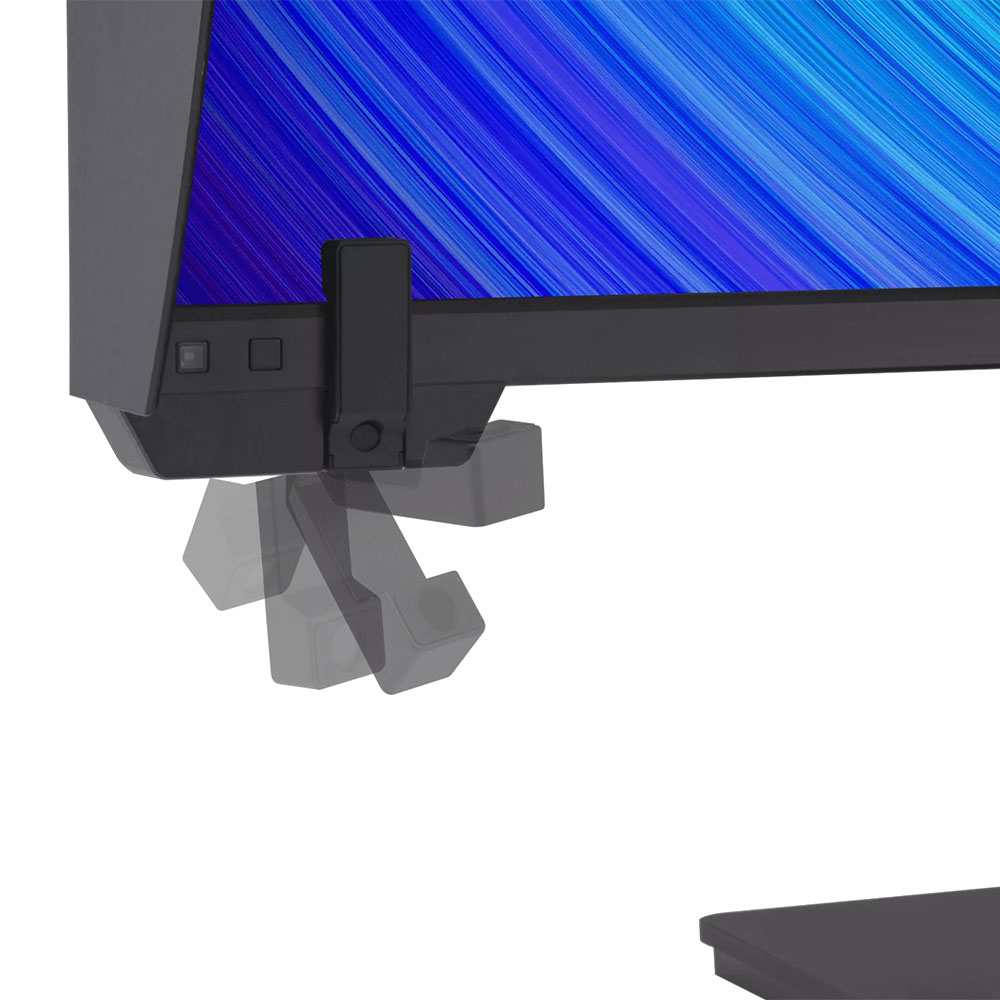
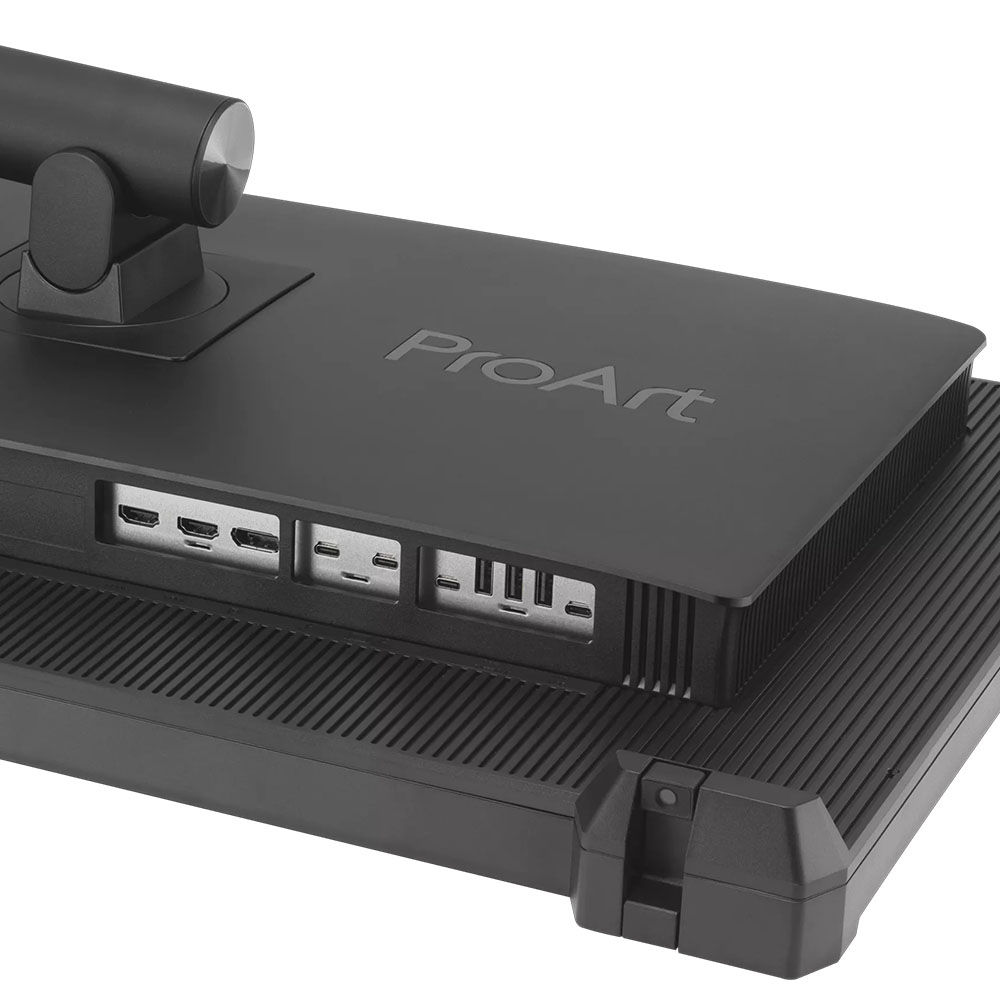
The PA32KCX’s styling is simple and to the point, with functionality as the priority. The included light hood attaches with four screws and is lined with a fuzzy light-absorbing material. It keeps ambient reflections at bay, as does the screen’s front layer, which has a matte finish. At the lower left, you can see the integrated colorimeter that flips up when autocal is engaged. At the lower right is a row of control keys and a tiny joystick that accesses the comprehensive menu system.
In the back is a thick component bulge with plenty of ventilation around its sides. There are internal fans that run quietly in the background. I noted that my sample ran them periodically in standby mode. The stand is very substantial and weighs almost 10 pounds, comparable to some entire monitors. It has full ergonomics with four inches of height, 5/23 degrees tilt, 30 degrees swivel, and a 90-degree portrait mode. Movements are firm and solid with no play or wobble. If you prefer an arm, there’s a 100mm VESA mount in the back.
The input panel is large and includes a wide variety of interfaces. There are two HDMI 2.1, a DisplayPort 2.1 and two Thunderbolt 4 for video. Peripheral support comes from three USB-A ports and two USB-C ports, one of which supports 96W charging. A KVM manager in the OSD can bind video and USB ports to enable many different control configurations for multiple source components.
The integrated color meter lives in a little protrusion at the lower left and flips up onto the screen when activated. The auto calibration routine is in the OSD and can be used at any time to dial in the PA32KCX. Next to it are two sensors that can adjust image parameters based on ambient light and backlight intensity.
OSD Features
The PA32KCX’s OSD is large and comprehensive, yet easy to navigate thanks to a logical layout designed for creative pros. It appears when you press the joystick.
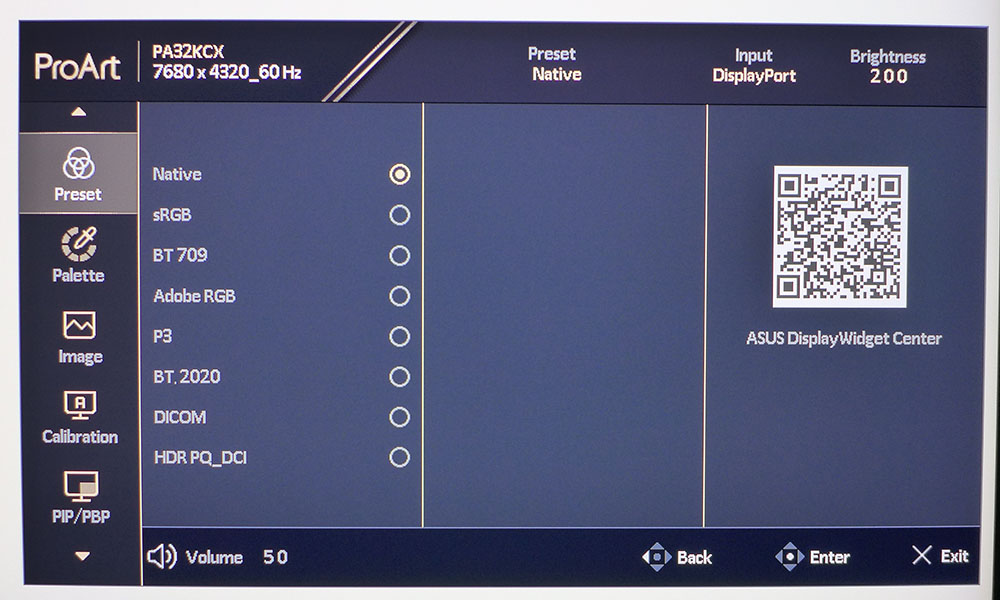
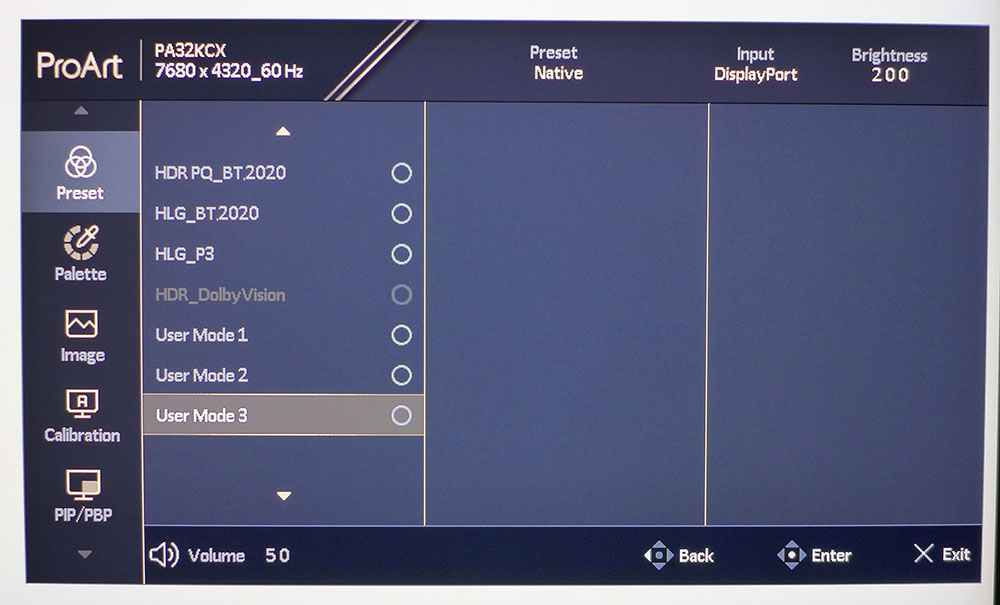
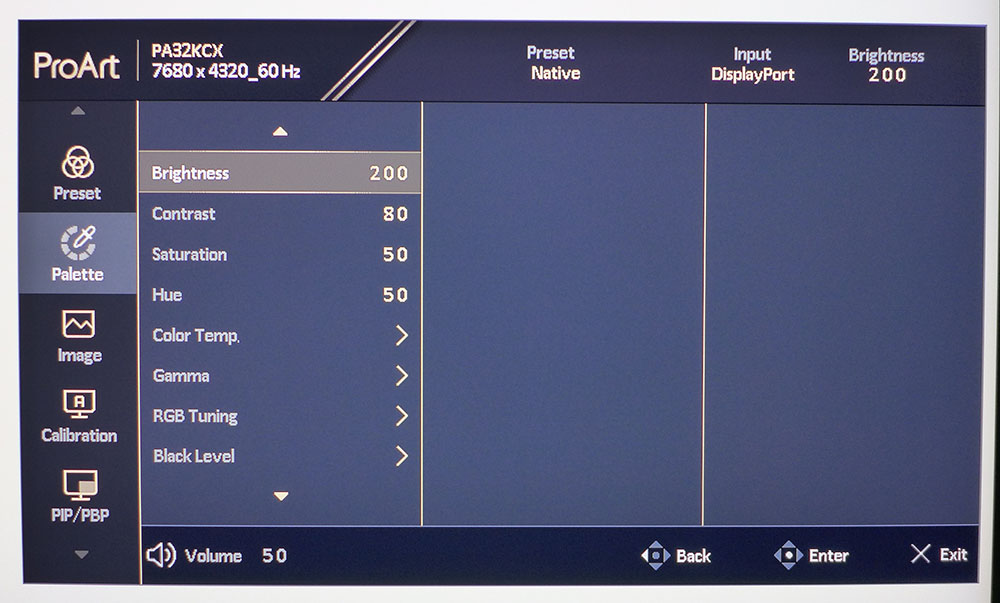
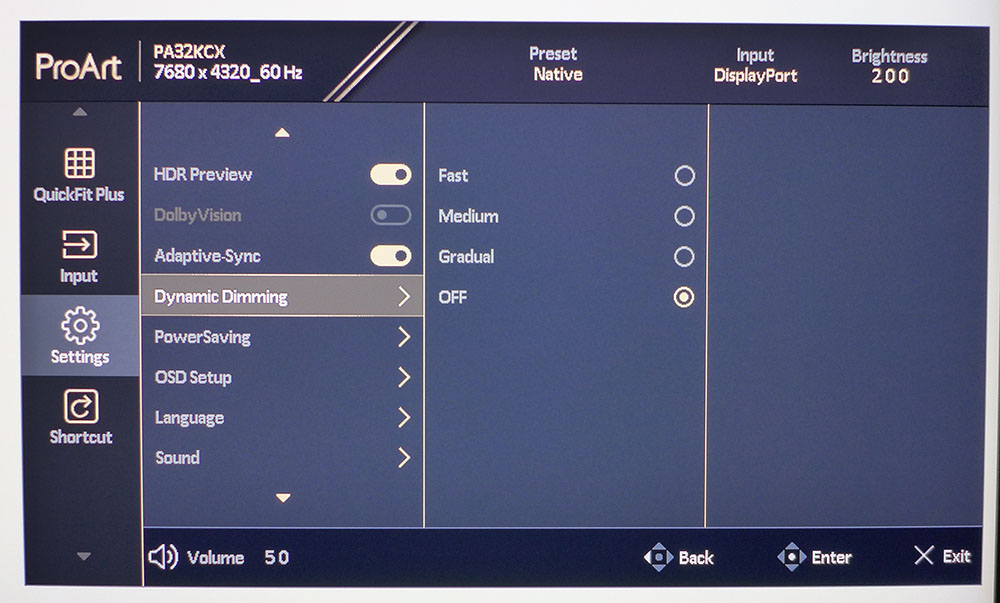
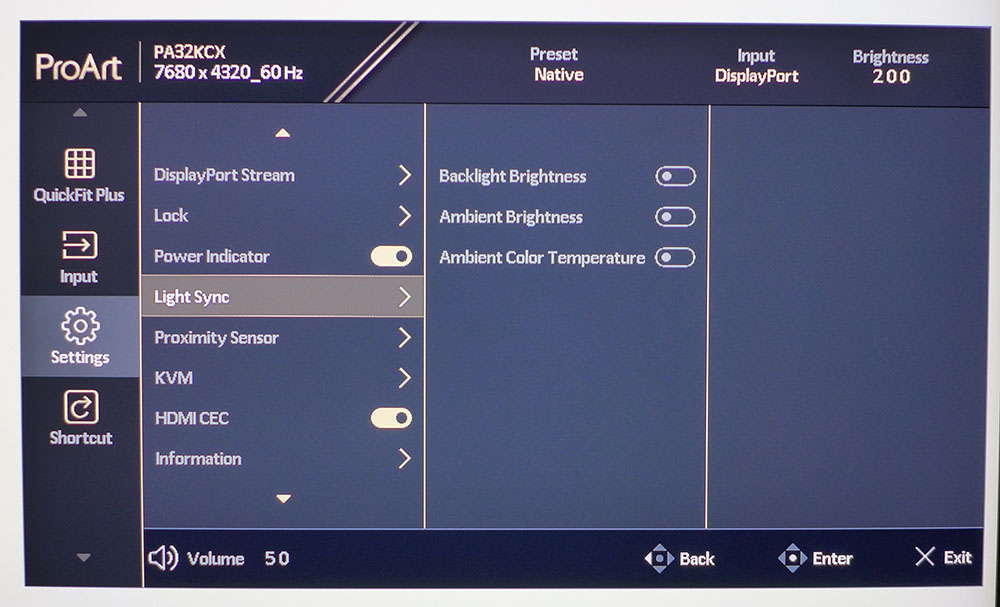
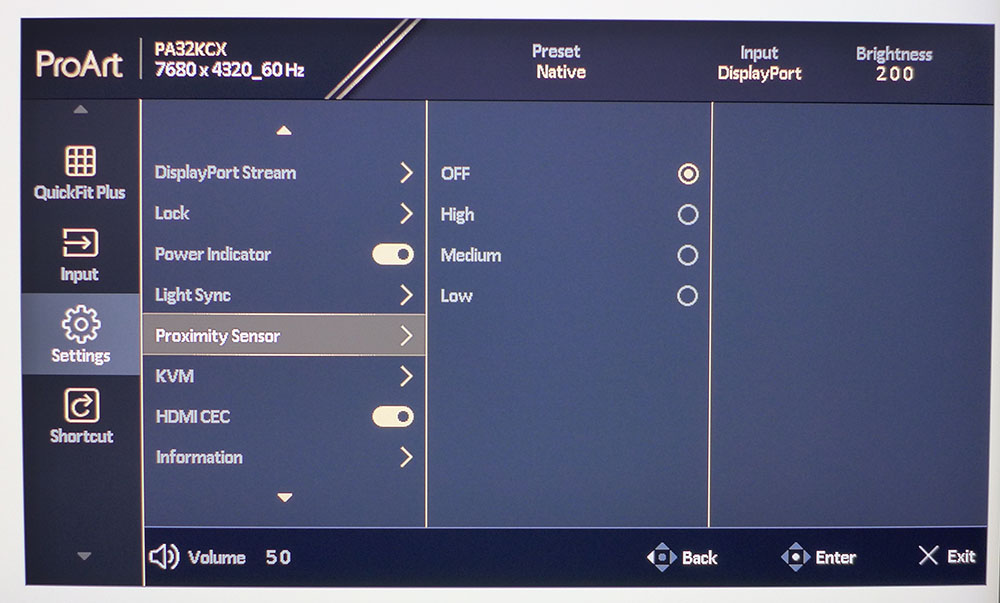
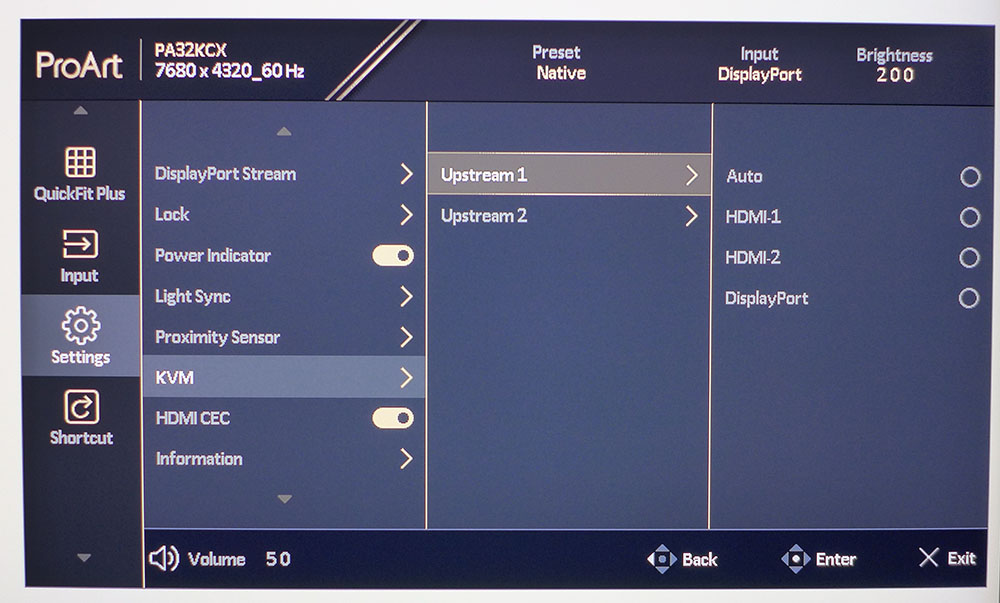
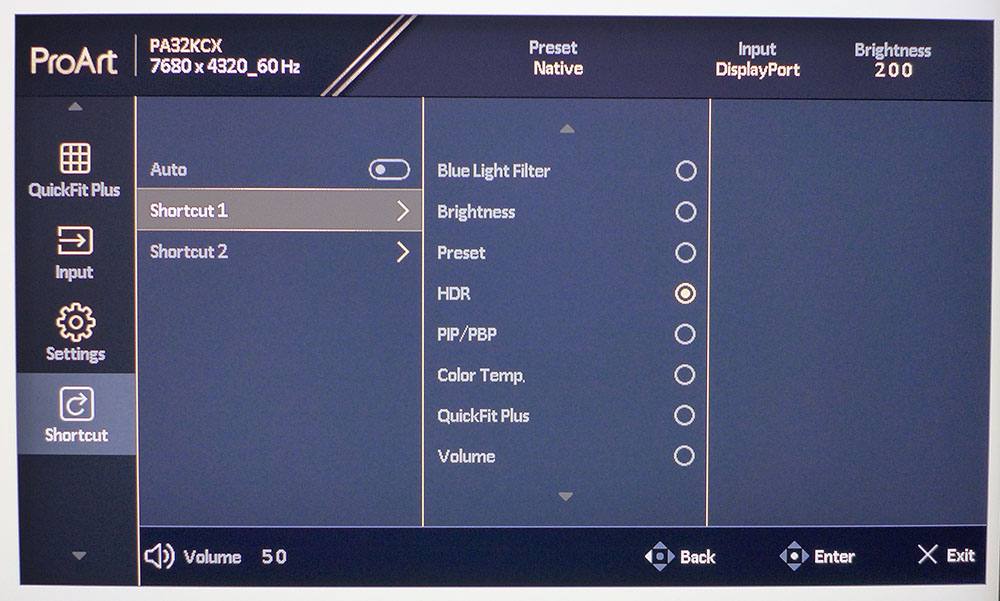
First up are the color modes, with 15 in total. Native is the default, and it uses the PA32KCX’s full color gamut, which covers around 110% of DCI-P3. The modes are the gateway to the monitor’s functions and all you need to do is pick the standard you need to work in for a task. Each has been factory-calibrated and they are close to the mark. You can adjust any of them with OSD controls or with the various automatic calibration routines. HDR support includes three PQ curves for HDR10+, P3, or BT.2020 color options. Dolby Vision support will be enabled in a firmware update made available by the time you read this. Additionally, there are three user memories that can store any combination of settings you wish.
The Palette menu has all the traditional OSD calibration controls, including color temp presets, labeled by Kelvin value, gamma factors, RGB gain/offset, and a black level threshold control. Where’s the local dimming control? I’m getting to that.
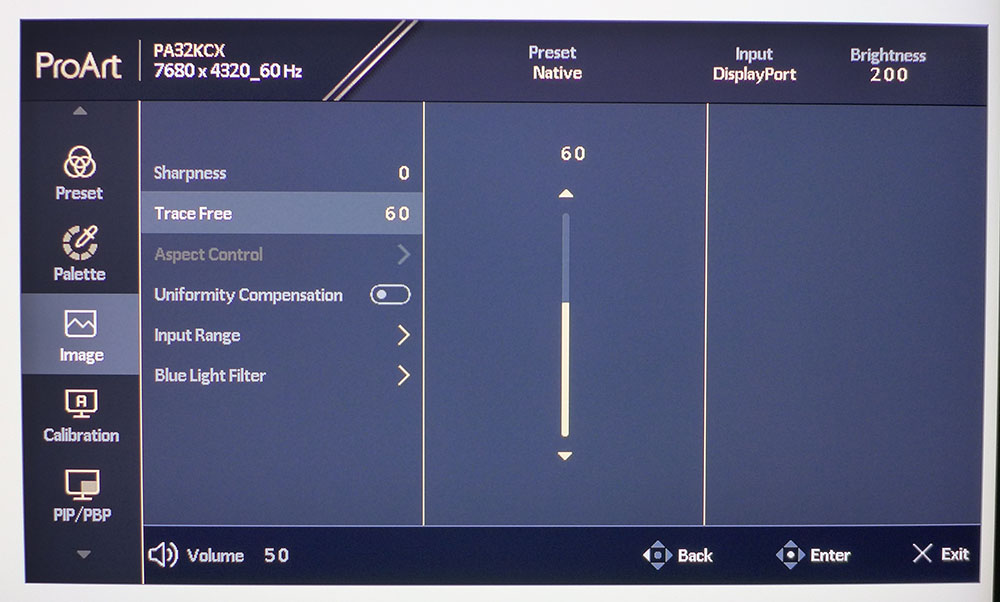
The Image menu includes overdrive and uniformity compensation. My sample was visually perfect, so I didn’t need to use it. You also get a blue light filter to help reduce eye fatigue when reading.
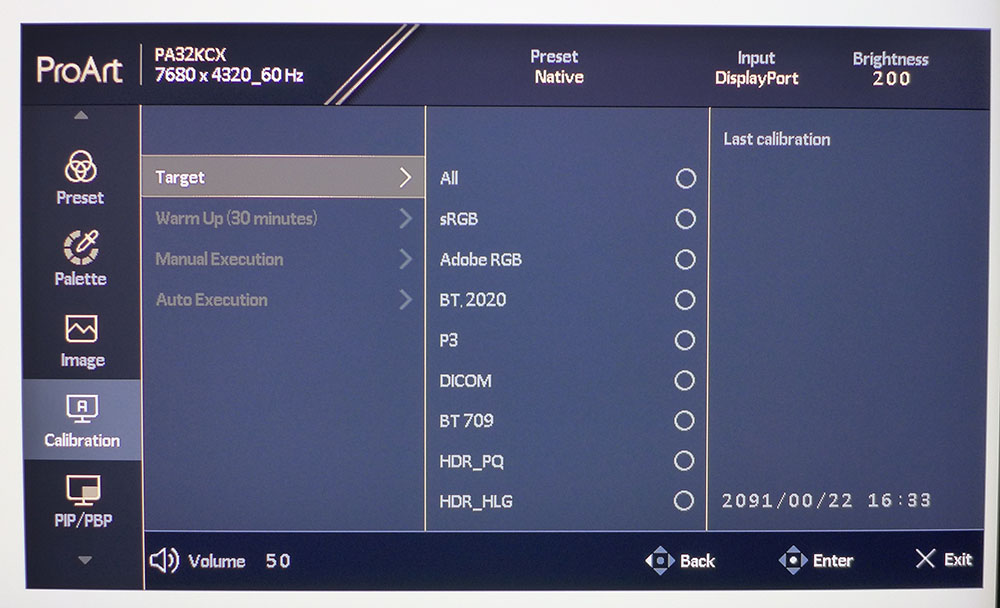
The Calibration menu accesses the PA32KCX’s integrated colorimeter for hands-off adjustments. Just choose the target spec, you can do them all in one go if you like, then select manual or auto execution. The latter lets you delay the start time. It stores the date and time, so you know how long it’s been since the last calibration. Adjusting one color standard takes around 20 minutes.
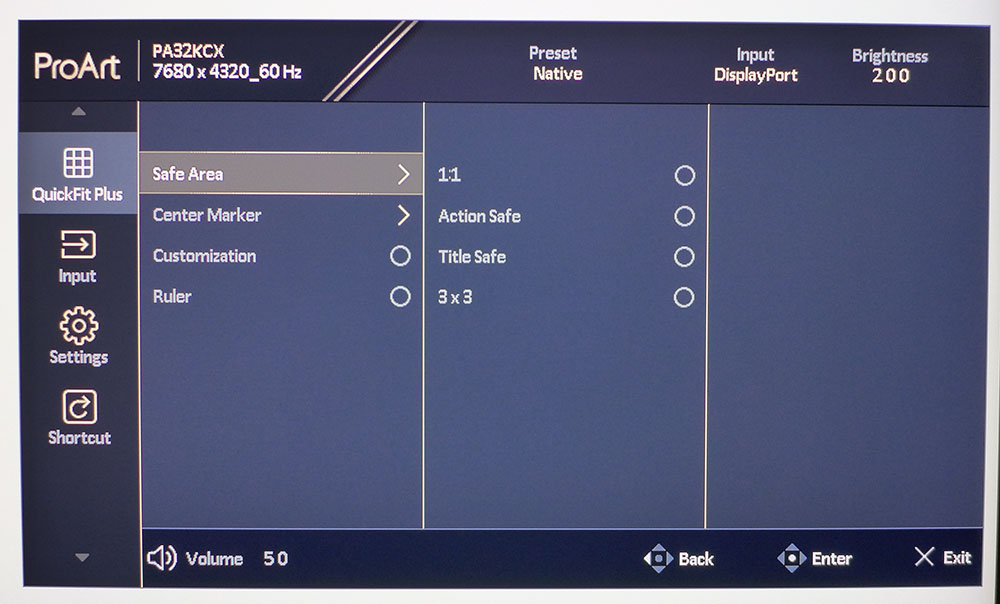
If you use the PA32KCX for postproduction or on location, Asus provides screen markers for filming. There are safe areas, center marks, rulers, and custom options. This is super handy when shooting in different aspect ratios.
Ah, here’s the local dimming control, in the Settings menu. Personally, I’d put it back in the Palette menu. And Adaptive-Sync is here too; I think that belongs in the Image menu. But that’s just me. Dynamic Dimming has three speeds, or you can turn it off. It’s very effective thanks to the huge number of zones, and it even worked for my ANSI contrast test, which is a first. More on that later. Here too is the Light Sync control, which uses a front bezel sensor to change the picture based on ambient light and backlight brightness. The second sensor is user proximity, and it can turn the screen off when you leave your desk.
For convenience, Asus includes a powerful KVM feature that binds video inputs to the two USB-C ports. They are easy to set up to your preference. Finally, two of the front control keys can be programmed for different quick access functions.
Asus ProArt PA32KCX Setup And Hands-on
Setting up a monitor like the PA32KCX depends on the intended usage. It’s pretty close out of the box in any of its color modes, but for the greatest precision, calibration is recommended. You can configure any of the modes in the OSD using traditional gamma presets and color temps. The RGB sliders include gain and offset controls.
If you use the built-in meter, it runs hands-free and takes around 20 minutes for each mode. It can be scheduled for a delayed start if you wish. It’s good for quick touch-ups. For more detailed adjustment, the OSD is precise enough, but doesn’t include a gamma editor or color management. The best way is to use Calman and its Asus-specific workflow, or Light Illusion ColourSpace. You’ll need a USB connection for the control portion of the workflow, but it is very powerful. You can create 3D color lookup tables and custom gamma curves created with as many points as you want. It’s also the best way to calibrate for HDR10 and Dolby Vision.
For my purposes, I tested all the color modes as they shipped and found them close to standard. I’ll get into more detail on page four with a complete set of measurement charts and a summary of the dE values, gamma results, and gamut volumes for every mode.
Each mode has specific gamma and grayscale values that are in line with their individual specification. sRGB has a fixed D65 temp and sRGB gamma which is close to 2.2 power. BT.709 is the same, but lets you choose from four gammas. P3 color includes cinema and display standards. Cinema conforms to DCI 1.2 with 2.6 gamma and a D63 temperature. BT.2020 (SDR) has a 2.4 gamma and D65. You also get Adobe RGB with a 2.2 gamma and D65 temp.
For HDR, there are modes for HDR10, HLG, and Dolby Vision. HDR10 and HLG let you choose between P3 and BT.2020 color spaces. HDR10 includes three different luminance curves, of which Optimized came closest to spec in my tests. This was with local dimming turned on.
In a professional setting, the PA32KCX is a premium-quality reference tool. The picture is stunning with no visible trace of the pixel structure. It’s hard to describe, but if you can check out one of these monitors in person, you’ll see what I mean. The image quality is simply on another level from any other fixed pixel technology.
Contrast is impressive as well, especially when the local dimming is engaged. There are 4,032 dimming zones, so halo artifacts are nowhere to be found. It doesn’t quite have that OLED glow, but it is sharper than a 4K screen. Local dimming can be used for SDR and HDR, with three response speeds. Color rendering is state-of-the-art thanks to the Quantum Dot layer. The PA32KCX covers around 110% of DCI-P3, which is slightly more than some other QD screens I’ve tested.
The only thing the PA32KCX cannot do well is game. The refresh rate tops out at 60 Hz, which is nowhere near fast enough to avoid significant motion blur. The inclusion of Adaptive-Sync is nice, though, if you play titles that aren’t too twitchy. Asus Trace Free overdrive is as effective as it can be. A setting of 60 avoided ghosting artifacts. If you’re playing more static games, the picture is simply gorgeous.
Viewing HDR content was an impressive experience. Though I’d still reach for an OLED for ultimate HDR image quality, the PA32KCX came closer than any other LCD to replicating that look. With local dimming engaged, HDR contrast and black levels cannot be measured since the backlight is turned off. The dimming improves intra-image contrast immensely, though. I’ll talk about that on page three.
Takeaway: I spend every day looking at a 4K OLED monitor. The PA32KCX takes pixel density and sharpness to a level beyond that. An 8K picture is something that needs to be seen to be understood. Color and contrast are incredible here, with perception and numbers that compete with the best OLED screens. I can’t imagine any video or photography professional finding any complaints here. I’ve reviewed a number of pro screens in the past, and the PA32KCX is one of the very best and most flexible, with no faults of consequence.
MORE: Best Gaming Monitors
MORE: How We Test PC Monitors
MORE: How to Buy a PC Monitor








 English (US) ·